
Our Daily Bread
Sermon
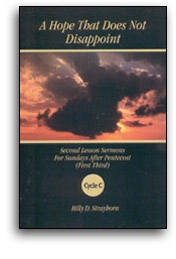
A Hope That Does Not Disappoint
Second Lesson Sermons For Sundays After Pentecost (First Third) Cycle C
After hearing in Sunday school about Jesus feeding the 5,000 from five loaves and two fish, a little boy was watching his mother make sandwiches and said, "Boy, Jesus sure must have sliced that bread awfully thin!"
Throughout time, grain and bread have been powerful symbols of life, vitality, sharing, nurture, the family, and even wealth. To produce or gather grain was the first requirement of life. To store it and hoard it was the first sign of wealth. To share it was the first sign of hospitality. We call it breaking bread together, even today.
Bread And Life
Bread embodies the very substance of life. We see it, touch it, smell it, and taste it every day. We take it for granted because we have it. We forget how important it is to our daily life until we don't have enough. And yet every time we pray the Lord's Prayer we pray for our daily bread. In our abundance we have it in many varieties. It comes in many shapes, colors, sizes, and flavors. There are certain things that wouldn't be right without a particular kind of bread being served with it.
Sausage gravy wouldn't be any good without biscuits to pour it over.
Chipped beef wouldn't be right without toast.
Neither would a bacon, lettuce, and tomato sandwich.
Bread is an important element of daily life. What's Italian food without a thick slab of garlic bread, bread so heavy in butter and garlic that you make sure your spouse has a piece, too? Otherwise you won't be able to kiss for a week.
And what's a big pot of beans or black-eyed peas without a hunk of hot cornbread?
What's a gyro without pita bread?
Or imagine a Big Mac without the sesame seed bun.
We eat all kinds of bread on a daily basis. We eat tortillas with Mexican food, crackers with chili, Texas toast with chicken fried steak, hot pastrami on rye, bagels with cream cheese or lox, toasted English muffins with jelly. Who could have a big family dinner without a basket of hot dinner rolls?
Bread is important. There's nothing in the world that excites the senses and brings back more memories than the smell of bread baking. It permeates every corner of the house. It lingers invitingly, tempting the taste buds. The anticipation tastes almost as good as that first thick slab, still steaming and hot from the oven, slathered with butter or honey and melting in your mouth.
Now that your mouth is watering thinking about bread and what you're going to have for lunch or why you didn't eat breakfast, think about this question. "Have you ever been really hungry? Have you ever gone without food for any significant length of time?"
There was a young man and his friend, both eighteen years old, who decided to hitchhike from Springfield, Missouri, to Washington, D.C., and then on up to New York City. They weren't the smartest of the bunch because they took off in November. It was cold and snowing. The further East they went, the colder it got and the more it snowed. They weren't having a whole lot of luck getting a ride -- partly because of the weather and partly because of the way they looked. It was the 1960s. They both had long hair and bell-bottom jeans. Nobody was stopping.
It wasn't long before they ran out of money. They went for three days without food. Neither of them had ever been so hungry in all their lives. They eventually collected enough soda bottles to buy a loaf of day-old bread and a small jar of peanut butter. They were so hungry that turned out to be one of the finest meals either one of them had ever eaten.
Most of us never really experience that kind of hunger. All we ever have is that "stand in front of the fridge with the door open, I don't know what I want, but I want something 'cause I've got the munchies" kind of hunger. That describes our lives, too. There is a hunger like that munchie kind of hunger within us. We know we want something to satisfy that hunger, but we don't know what. And we don't know where to turn.
Bread is a powerful symbol in the Bible. All this talk about bread isn't meant to drive you crazy or make you so hungry you can't listen. But that hunger you're feeling right now can't begin to compare to the hunger the Israelites felt as they wandered in the wilderness after leaving Egypt. They hungered and prayed for bread to fill their aching, empty stomachs. And then there was Jesus' hunger. Imagine how hungry he must have been after spending forty days fasting in the wilderness. The temptation to turn stones to bread was very real.
There are other Biblical symbols of bread, as well. There is unleavened bread, prepared and eaten hurriedly on the night of the Passover, a night that families still celebrate today. There are the loaves and fishes that fed both 5,000 and 4,000. There is the bread of the last breakfast, the meal of bread and grilled fish Jesus served the disciples on the beach shortly before his Ascension. And there is the loaf of revelation at Emmaus, where Jesus revealed his risen self through the breaking of bread with two of the disciples who had given up hope.
The Last Supper
Who could forget the bread of the Last Supper where bread and wine on the table are transformed in significance, and Jesus becomes the loaf of life? Throughout his ministry Jesus said things like: "I am the bread of life ... I am the living bread that came down from heaven ... whoever feeds on this bread will never hunger and will live forever ... this bread I give for the life of the world."
At the Last Supper, Jesus broke bread with the disciples and prepared himself to be broken for our sakes. As we look at the elements -- the common everyday types of bread -- we are reminded of Christ's sacrifice for our lives, and it breaks our hearts to think that God loves us this much. We come broken by sin and broken by others. In that brokenness we come to the brokenness of Christ and we find wholeness.
In our hungering and thirsting we come to Christ who is hungering and thirsting for our salvation. In Christ we find satisfaction and fullness. In our brokenness, our hearts and spirits are healed and raised to new life in Christ. As we eat the bread of the Lord's Supper it ceases to be bread and becomes part of us. In the receiving we are consumed in the giving of ourselves to Christ. We rise in newness of life through him and in him. We look the same but somehow we are different. We are new from the inside out. We are fed and satisfied. We are clean and shiny. We glow from the grace of the one who invites us to this special table, our Lord and Savior.
And as we look out at those around us, we are reminded of the multiplicity of our responses and experiences. On every occasion that the Lord's Supper is celebrated we realize that as members of the church, we really are one Body, one Loaf in Christ, made of many grains. We are multinational, multiracial, multilingual, multicultural, and multigenerational. But we are made one in the Body of Christ. Out of our diversity comes unity through Christ. Today we affirm one Lord, one Savior, one Spirit, one Baptism, one God and Creator of us all. Today we affirm one loaf, the body of Christ.
Today we kneel before the Lord's table with men, women, and children around the world of every station and occupation. Today saints and sinners, royalty and commoners, priests and laity, righteous and unrighteous all kneel before Christ. The one thing that binds us together is that we all hunger and thirst and there is only one person who can satisfy that aching hunger. That person is Christ Jesus who gave his life for us.
When we eat the bread and wine, we remember Jesus' words found in Paul's letter: "This is my body that is for you. Do this in remembrance of me." In the same way he took the cup also, after supper, saying, "This cup is the new covenant in my blood. Do this, as often as you drink it, in remembrance of me."
We do this in remembrance and in amazement. Amazement because we marvel that the love of God could encompass and forgive the sins of the whole world. We marvel that the little morsel of everyday bread which we receive can satisfy a hunger such as ours. And yet it does, because it is a gift from God. It's just bread, but it's so much more. And it means so much more. It is the bread of life.
Come and join us in our celebration. Celebrate this simple yet elegant meal prepared just for you. Come. Be fed by the hand of the Savior, the Bread from Heaven. Don't go away hungry.
Throughout time, grain and bread have been powerful symbols of life, vitality, sharing, nurture, the family, and even wealth. To produce or gather grain was the first requirement of life. To store it and hoard it was the first sign of wealth. To share it was the first sign of hospitality. We call it breaking bread together, even today.
Bread And Life
Bread embodies the very substance of life. We see it, touch it, smell it, and taste it every day. We take it for granted because we have it. We forget how important it is to our daily life until we don't have enough. And yet every time we pray the Lord's Prayer we pray for our daily bread. In our abundance we have it in many varieties. It comes in many shapes, colors, sizes, and flavors. There are certain things that wouldn't be right without a particular kind of bread being served with it.
Sausage gravy wouldn't be any good without biscuits to pour it over.
Chipped beef wouldn't be right without toast.
Neither would a bacon, lettuce, and tomato sandwich.
Bread is an important element of daily life. What's Italian food without a thick slab of garlic bread, bread so heavy in butter and garlic that you make sure your spouse has a piece, too? Otherwise you won't be able to kiss for a week.
And what's a big pot of beans or black-eyed peas without a hunk of hot cornbread?
What's a gyro without pita bread?
Or imagine a Big Mac without the sesame seed bun.
We eat all kinds of bread on a daily basis. We eat tortillas with Mexican food, crackers with chili, Texas toast with chicken fried steak, hot pastrami on rye, bagels with cream cheese or lox, toasted English muffins with jelly. Who could have a big family dinner without a basket of hot dinner rolls?
Bread is important. There's nothing in the world that excites the senses and brings back more memories than the smell of bread baking. It permeates every corner of the house. It lingers invitingly, tempting the taste buds. The anticipation tastes almost as good as that first thick slab, still steaming and hot from the oven, slathered with butter or honey and melting in your mouth.
Now that your mouth is watering thinking about bread and what you're going to have for lunch or why you didn't eat breakfast, think about this question. "Have you ever been really hungry? Have you ever gone without food for any significant length of time?"
There was a young man and his friend, both eighteen years old, who decided to hitchhike from Springfield, Missouri, to Washington, D.C., and then on up to New York City. They weren't the smartest of the bunch because they took off in November. It was cold and snowing. The further East they went, the colder it got and the more it snowed. They weren't having a whole lot of luck getting a ride -- partly because of the weather and partly because of the way they looked. It was the 1960s. They both had long hair and bell-bottom jeans. Nobody was stopping.
It wasn't long before they ran out of money. They went for three days without food. Neither of them had ever been so hungry in all their lives. They eventually collected enough soda bottles to buy a loaf of day-old bread and a small jar of peanut butter. They were so hungry that turned out to be one of the finest meals either one of them had ever eaten.
Most of us never really experience that kind of hunger. All we ever have is that "stand in front of the fridge with the door open, I don't know what I want, but I want something 'cause I've got the munchies" kind of hunger. That describes our lives, too. There is a hunger like that munchie kind of hunger within us. We know we want something to satisfy that hunger, but we don't know what. And we don't know where to turn.
Bread is a powerful symbol in the Bible. All this talk about bread isn't meant to drive you crazy or make you so hungry you can't listen. But that hunger you're feeling right now can't begin to compare to the hunger the Israelites felt as they wandered in the wilderness after leaving Egypt. They hungered and prayed for bread to fill their aching, empty stomachs. And then there was Jesus' hunger. Imagine how hungry he must have been after spending forty days fasting in the wilderness. The temptation to turn stones to bread was very real.
There are other Biblical symbols of bread, as well. There is unleavened bread, prepared and eaten hurriedly on the night of the Passover, a night that families still celebrate today. There are the loaves and fishes that fed both 5,000 and 4,000. There is the bread of the last breakfast, the meal of bread and grilled fish Jesus served the disciples on the beach shortly before his Ascension. And there is the loaf of revelation at Emmaus, where Jesus revealed his risen self through the breaking of bread with two of the disciples who had given up hope.
The Last Supper
Who could forget the bread of the Last Supper where bread and wine on the table are transformed in significance, and Jesus becomes the loaf of life? Throughout his ministry Jesus said things like: "I am the bread of life ... I am the living bread that came down from heaven ... whoever feeds on this bread will never hunger and will live forever ... this bread I give for the life of the world."
At the Last Supper, Jesus broke bread with the disciples and prepared himself to be broken for our sakes. As we look at the elements -- the common everyday types of bread -- we are reminded of Christ's sacrifice for our lives, and it breaks our hearts to think that God loves us this much. We come broken by sin and broken by others. In that brokenness we come to the brokenness of Christ and we find wholeness.
In our hungering and thirsting we come to Christ who is hungering and thirsting for our salvation. In Christ we find satisfaction and fullness. In our brokenness, our hearts and spirits are healed and raised to new life in Christ. As we eat the bread of the Lord's Supper it ceases to be bread and becomes part of us. In the receiving we are consumed in the giving of ourselves to Christ. We rise in newness of life through him and in him. We look the same but somehow we are different. We are new from the inside out. We are fed and satisfied. We are clean and shiny. We glow from the grace of the one who invites us to this special table, our Lord and Savior.
And as we look out at those around us, we are reminded of the multiplicity of our responses and experiences. On every occasion that the Lord's Supper is celebrated we realize that as members of the church, we really are one Body, one Loaf in Christ, made of many grains. We are multinational, multiracial, multilingual, multicultural, and multigenerational. But we are made one in the Body of Christ. Out of our diversity comes unity through Christ. Today we affirm one Lord, one Savior, one Spirit, one Baptism, one God and Creator of us all. Today we affirm one loaf, the body of Christ.
Today we kneel before the Lord's table with men, women, and children around the world of every station and occupation. Today saints and sinners, royalty and commoners, priests and laity, righteous and unrighteous all kneel before Christ. The one thing that binds us together is that we all hunger and thirst and there is only one person who can satisfy that aching hunger. That person is Christ Jesus who gave his life for us.
When we eat the bread and wine, we remember Jesus' words found in Paul's letter: "This is my body that is for you. Do this in remembrance of me." In the same way he took the cup also, after supper, saying, "This cup is the new covenant in my blood. Do this, as often as you drink it, in remembrance of me."
We do this in remembrance and in amazement. Amazement because we marvel that the love of God could encompass and forgive the sins of the whole world. We marvel that the little morsel of everyday bread which we receive can satisfy a hunger such as ours. And yet it does, because it is a gift from God. It's just bread, but it's so much more. And it means so much more. It is the bread of life.
Come and join us in our celebration. Celebrate this simple yet elegant meal prepared just for you. Come. Be fed by the hand of the Savior, the Bread from Heaven. Don't go away hungry.
