
Overcoming Evil
Sermon
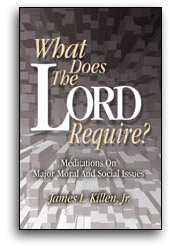
WHAT DOES THE LORD REQUIRE?
Meditations On Major Moral And Social Issues
Evil is a reality. We have to cope with it. The Bible tells us what to do about evil. "Do not be overcome by evil but overcome evil with good" (Romans 12:21). That is the right answer. But, when we are faced with the reality of evil, it is awfully hard to do the right thing. The process that can bring us to the ability to do it is nothing less than a part of the saving work of God.
On September 11, 2001, the United States of America and the rest of the world came face to face with the reality of evil in a new and horrifying way. Millions of people watched on live television as the second of two hijacked airliners was crashed into the second tower of The World Trade Center in New York City, sending plumes of flame and smoke belching out from all sides of the building. We all knew without being told that we were witnessing a well planned and very deliberate act of terrorism. We all wondered how anyone could hate so deeply that they would be willing to do a thing like that. We were all aghast at what we saw.
After that, one emotion followed another for most of us. We knew at the time of impact that thousands of innocent people were dying. We could imagine what it would have been like to have someone in one of the planes or the towers or in the Pentagon. Our hearts hurt. We were caught up in grief. There was also admiration. The news commentators spoke of the chaos around the crash site but, miraculously, most of the mostly unprepared people who were there did exactly the right things. And a new group of heroes emerged, firemen, police officers, and others who risked their lives to snatch the lives of others out of the hands of death.
Soon we all began to experience anger, a real and righteous anger. We were angry at what happened, and at the people who made it happen and at the whole configuration of human history that contributed to its happening. And, we were right to be angry. It should not have happened.
Soon we began to realize that we have an enemy who hates us and wants to destroy us. We realized that we are up against something really evil.
A second shock wave struck us when television newscasts showed pictures of people, even little children, in what we thought were friendly countries, celebrating the catastrophe and when we heard that many in other parts of the world were saying, "It's too bad that it happened, but the Americans brought it on themselves." We are accustomed to thinking of our country as heroic and good. It is hard to discover that not everyone sees us in that way. When we heard those things, we were even more angry.
How should we respond to all of these things? There is certainly that within each of us that wants to strike back in anger, to take all of the military and economic power that our country can muster and return hurt for hurt. But there is that within many of us that really doesn't want a war. Thousands have already died. We don't want any more to die if that can be avoided. No doubt, some military response will be necessary. The enemy cannot be allowed to keep on committing atrocities. But military response alone will not solve our world's problems. One of the news commentators who reflected on the disaster quoted theologian Reinhold Niebuhr, who said, "Anger is the right response to evil. But it is important not to let anger turn into hatred or revenge." If we do, we ourselves will have been overcome by the evil we have suffered. Fear and hate and terrorism will have won.
In the months following the September 11 tragedy, the world has watched the escalation of hatred and hostilities between Israelis and Palestinians. We have seen two peoples, whose futures are tied to each other, returning hurt for hurt in a terrible spiral, until now the world wonders if they will ever be able to live in peace. We could imagine ourselves being caught up in a similar escalation of more catastrophic proportions. We know that is not what God wants to happen and we don't want it to happen either.
Then what can we do? What should be our response to the September 11 tragedy? What does our Christian heritage offer to us?
First, we should seek healing. We were right to return to our spiritual heritage and to turn to God in our anguish and pray, "O Lord, save." We need desperately to recover our wholeness. No, things can never be as they were before. In fact, the security that we once thought we had was never real. We need to find our way to a wholeness as persons and as a nation that will work in the real world. Our faith assures us that God is always at work in human history to heal and to save. We remember the promise that was given to the people of Israel in their time of brokenness. "Comfort, O comfort my people says your God. Speak tenderly to Jerusalem and cry to her that she has served her term, that her penalty is paid, that she has received from the Lord's hand double for all her sins" (Isaiah 40:1--2).
When the Soviet Union collapsed and left the United States standing alone as the most powerful nation in the world, this country entered one of the most dangerous times in its history. Everyone expects the superpower to make everything come out all right for everybody. And everyone blames the superpower when things don't come out all right for anyone. There is bound to be jealousy because some enjoy prosperity while others endure poverty and some enjoy freedom while others endure oppression. And there are real grievances because the powerful are always tempted to forget to do justice, love mercy, and walk humbly with God. Real grievances combine with jealousy to generate hatred. The danger goes with the power. It is very important to recover our religious heritage.
Once while the British Empire held the position of the world's superpower, a grand celebration was held to commemorate the diamond jubilee of Queen Victoria. It was an awesome display of the worldwide power of the British Empire. Rudyard Kipling was asked to write a poem for the occasion. He wrote "Recessional." It was a long poem that put the nation's pride into perspective and warned the people not to forget the God beneath whom they held power. The poem repeated the refrain, "Lest we forget, lest we forget."1 We have sometimes been in danger of forgetting, haven't we?
It is important for us to renew our relationship with God who is always here to forgive our sins, to heal our hurting hearts, to enable us to reclaim our highest national commitments, and to give us the strength and the courage to go on. We will need that renewal if we are to move into today's world and act with wisdom and decisiveness.
But, does our Christian heritage not tell us that repentance must be a part of our preparation for salvation? How can we deal with the need for repentance in this situation? Must repentance come before forgiveness and healing or is it the promise of forgiveness and healing that sets us free to reckon with our need to repent? In fact, the two need to come together in the working out of God's salvation. Repentance is a gift of God's love. It is the assurance of God's promise to save that sets us free to make needed changes - and change is a part of God's saving work.
Many of us have not been able to deal with the need for repentance in the time of our anguish. We have reacted with justifiable anger when our self--righteous enemies - and our self--righteous friends - have said the September 11 tragedy was God's punishment for something we have done. The deaths of thousands of innocent people was not something God wanted to happen. We have wanted to cry out in defense of our nation.
But as the Lord makes us able, we need to ask ourselves uncomfortable questions. Have we really lived up to the commitment to liberty and justice for all that is a part of our nation's heritage, or have we just claimed liberty and justice for ourselves? Have we allowed the seduction of prosperity and pleasure to make us compromise our integrity and our commitment to human values? Have we ever, in fact, either intentionally or unintentionally, prospered at the expense of the disadvantaged peoples of the world? Have we ever been oblivious or indifferent to the oppression of others - or have we ever in any way participated in it? Have we ever been too arrogant in our exercise of our power and have we been too ready to send in the bombers, as if they could solve the problems of the world? We need to deal with those questions seriously.
It can be a good thing, even though it is often a hard thing, to see ourselves as others see us. A few months before September 11, the editor of Zion's Herald magazine interviewed Arund Gandhi, the grandson of Mohandas Gandhi, who is living in this country as a missionary of his grandfather's philosophy of non--violence. He said he has been watching our society being destroyed by violence. He spoke of the spread of violence as a way of life in our country. He reflected that we feel we must spend so much money on weapons of mass destruction so we can remain safe from the rest of the world, but we have accomplished exactly the opposite result. These things are only confusing us and destroying our humanity. He said, "The way we are going at the moment, I wouldn't be surprised if, in another few years, Americans will not be able to travel anywhere in the world because they are despised by everybody and because of terrorism and threats to kill them everywhere."2 His words were frighteningly prophetic. We will be wise to ask searching questions about ourselves as a nation. Is any part of the evil we must overcome to be found within us?
But now we have to come to the question that we announced for this sermon. How can we overcome evil? We have been forced to realize that we are up against something really evil in the world and we want to know how to overcome it. It was necessary for us to wait until now to deal with that question because we need to claim God's saving grace to enable us to overcome evil - otherwise we might have been overcome by the same evil working within us and we might not have been ready to hear what Jesus and Paul have to say about how to overcome evil.
Jesus said, "Love your enemies, do good to those who hate you, bless those who curse you, pray for those who abuse you. If anyone strikes you on the cheek, offer the other also; and from anyone who takes away your coat do not withhold even your shirt. Give to everyone who begs from you; and if anyone takes away your goods, do not ask for them again. Do to others as you would have them do to you" (Luke 6:27--31).
Paul said, "Do not repay anyone evil for evil but take thought for what is noble in the sight of all. Beloved, never avenge yourselves, but leave room for the wrath of God; for it is written 'Vengeance is mine, I will repay says the Lord.' No, 'if your enemies are hungry, feed them; if they are thirsty, give them something to drink; for by doing this, you will heap burning coals on their heads.' Do not be overcome by evil, but overcome evil with good" (Romans 12:17--21).
That is not exactly the first solution we would have thought of, is it? Yes, it is sometimes necessary to contain violence with violence. Military action against terrorism is probably necessary. But it will never solve the problem. And the longer we depend upon military action for our solution, the harder the problem will be to solve.
The real evil, the real enemy that we are up against, is hate. Hate is what makes a person fly an airplane full of people into a building full of people in an attempt to destroy as much as he can. Osama bin Laden is a real problem. But he is not the real enemy. The real enemy is the hate that burns within him and others like him. In a sense, he, too, is the victim of hate. Yes, he is responsible for what he did under the compulsion of hate, just as we will be responsible for anything we do under the compulsion of hate if we allow hate to grow within us. But, if we allow hate to grow within us, we will have been overcome by evil and hate will have won.
The only way to overcome hate is with love. At first, that sounds like an irresponsible platitude. If it is ever to be more than that, we are going to have to learn a lot more about the dynamics of love and about how to put love to work in our world than we know now - but it is long past time for us to start learning. It is clear that we will have to be made able to love through some miraculous saving work of God. But that miracle can and does happen. Love will require us to learn respect and understanding in situations in which those attitudes are very hard to maintain. And love will require us to take action to change those conditions that generate hate. A part of our nation's first announced strategy in dealing with terrorism had to do with the rehabilitation of a nation so impoverished and devastated by its succession of wars that it was reduced to desperation that gave birth to hate. We need to remember that an effective strategy for overcoming hate may indeed involve feeding our enemies.
What else must we learn about love? What else will love teach us about how to overcome evil? We will learn as we go. But it really is the only way to go. Love really is the only hope for our world. Friends, let us not be overcome by evil. Let us learn how to overcome evil with good.
____________
1. Rudyard Kipling, "Recessional" from The Five Nations (Doubleday, Doran & Company Inc., 1903) or see The Methodist Hymnal, 1932, p. 497.
2. Arund Gandhi, from an interview published in Zion's Herald, July--August, 2001, (New Berwick, Minnesota: Boston Wesleyan Association), pp. 16--18, 30--31.
On September 11, 2001, the United States of America and the rest of the world came face to face with the reality of evil in a new and horrifying way. Millions of people watched on live television as the second of two hijacked airliners was crashed into the second tower of The World Trade Center in New York City, sending plumes of flame and smoke belching out from all sides of the building. We all knew without being told that we were witnessing a well planned and very deliberate act of terrorism. We all wondered how anyone could hate so deeply that they would be willing to do a thing like that. We were all aghast at what we saw.
After that, one emotion followed another for most of us. We knew at the time of impact that thousands of innocent people were dying. We could imagine what it would have been like to have someone in one of the planes or the towers or in the Pentagon. Our hearts hurt. We were caught up in grief. There was also admiration. The news commentators spoke of the chaos around the crash site but, miraculously, most of the mostly unprepared people who were there did exactly the right things. And a new group of heroes emerged, firemen, police officers, and others who risked their lives to snatch the lives of others out of the hands of death.
Soon we all began to experience anger, a real and righteous anger. We were angry at what happened, and at the people who made it happen and at the whole configuration of human history that contributed to its happening. And, we were right to be angry. It should not have happened.
Soon we began to realize that we have an enemy who hates us and wants to destroy us. We realized that we are up against something really evil.
A second shock wave struck us when television newscasts showed pictures of people, even little children, in what we thought were friendly countries, celebrating the catastrophe and when we heard that many in other parts of the world were saying, "It's too bad that it happened, but the Americans brought it on themselves." We are accustomed to thinking of our country as heroic and good. It is hard to discover that not everyone sees us in that way. When we heard those things, we were even more angry.
How should we respond to all of these things? There is certainly that within each of us that wants to strike back in anger, to take all of the military and economic power that our country can muster and return hurt for hurt. But there is that within many of us that really doesn't want a war. Thousands have already died. We don't want any more to die if that can be avoided. No doubt, some military response will be necessary. The enemy cannot be allowed to keep on committing atrocities. But military response alone will not solve our world's problems. One of the news commentators who reflected on the disaster quoted theologian Reinhold Niebuhr, who said, "Anger is the right response to evil. But it is important not to let anger turn into hatred or revenge." If we do, we ourselves will have been overcome by the evil we have suffered. Fear and hate and terrorism will have won.
In the months following the September 11 tragedy, the world has watched the escalation of hatred and hostilities between Israelis and Palestinians. We have seen two peoples, whose futures are tied to each other, returning hurt for hurt in a terrible spiral, until now the world wonders if they will ever be able to live in peace. We could imagine ourselves being caught up in a similar escalation of more catastrophic proportions. We know that is not what God wants to happen and we don't want it to happen either.
Then what can we do? What should be our response to the September 11 tragedy? What does our Christian heritage offer to us?
First, we should seek healing. We were right to return to our spiritual heritage and to turn to God in our anguish and pray, "O Lord, save." We need desperately to recover our wholeness. No, things can never be as they were before. In fact, the security that we once thought we had was never real. We need to find our way to a wholeness as persons and as a nation that will work in the real world. Our faith assures us that God is always at work in human history to heal and to save. We remember the promise that was given to the people of Israel in their time of brokenness. "Comfort, O comfort my people says your God. Speak tenderly to Jerusalem and cry to her that she has served her term, that her penalty is paid, that she has received from the Lord's hand double for all her sins" (Isaiah 40:1--2).
When the Soviet Union collapsed and left the United States standing alone as the most powerful nation in the world, this country entered one of the most dangerous times in its history. Everyone expects the superpower to make everything come out all right for everybody. And everyone blames the superpower when things don't come out all right for anyone. There is bound to be jealousy because some enjoy prosperity while others endure poverty and some enjoy freedom while others endure oppression. And there are real grievances because the powerful are always tempted to forget to do justice, love mercy, and walk humbly with God. Real grievances combine with jealousy to generate hatred. The danger goes with the power. It is very important to recover our religious heritage.
Once while the British Empire held the position of the world's superpower, a grand celebration was held to commemorate the diamond jubilee of Queen Victoria. It was an awesome display of the worldwide power of the British Empire. Rudyard Kipling was asked to write a poem for the occasion. He wrote "Recessional." It was a long poem that put the nation's pride into perspective and warned the people not to forget the God beneath whom they held power. The poem repeated the refrain, "Lest we forget, lest we forget."1 We have sometimes been in danger of forgetting, haven't we?
It is important for us to renew our relationship with God who is always here to forgive our sins, to heal our hurting hearts, to enable us to reclaim our highest national commitments, and to give us the strength and the courage to go on. We will need that renewal if we are to move into today's world and act with wisdom and decisiveness.
But, does our Christian heritage not tell us that repentance must be a part of our preparation for salvation? How can we deal with the need for repentance in this situation? Must repentance come before forgiveness and healing or is it the promise of forgiveness and healing that sets us free to reckon with our need to repent? In fact, the two need to come together in the working out of God's salvation. Repentance is a gift of God's love. It is the assurance of God's promise to save that sets us free to make needed changes - and change is a part of God's saving work.
Many of us have not been able to deal with the need for repentance in the time of our anguish. We have reacted with justifiable anger when our self--righteous enemies - and our self--righteous friends - have said the September 11 tragedy was God's punishment for something we have done. The deaths of thousands of innocent people was not something God wanted to happen. We have wanted to cry out in defense of our nation.
But as the Lord makes us able, we need to ask ourselves uncomfortable questions. Have we really lived up to the commitment to liberty and justice for all that is a part of our nation's heritage, or have we just claimed liberty and justice for ourselves? Have we allowed the seduction of prosperity and pleasure to make us compromise our integrity and our commitment to human values? Have we ever, in fact, either intentionally or unintentionally, prospered at the expense of the disadvantaged peoples of the world? Have we ever been oblivious or indifferent to the oppression of others - or have we ever in any way participated in it? Have we ever been too arrogant in our exercise of our power and have we been too ready to send in the bombers, as if they could solve the problems of the world? We need to deal with those questions seriously.
It can be a good thing, even though it is often a hard thing, to see ourselves as others see us. A few months before September 11, the editor of Zion's Herald magazine interviewed Arund Gandhi, the grandson of Mohandas Gandhi, who is living in this country as a missionary of his grandfather's philosophy of non--violence. He said he has been watching our society being destroyed by violence. He spoke of the spread of violence as a way of life in our country. He reflected that we feel we must spend so much money on weapons of mass destruction so we can remain safe from the rest of the world, but we have accomplished exactly the opposite result. These things are only confusing us and destroying our humanity. He said, "The way we are going at the moment, I wouldn't be surprised if, in another few years, Americans will not be able to travel anywhere in the world because they are despised by everybody and because of terrorism and threats to kill them everywhere."2 His words were frighteningly prophetic. We will be wise to ask searching questions about ourselves as a nation. Is any part of the evil we must overcome to be found within us?
But now we have to come to the question that we announced for this sermon. How can we overcome evil? We have been forced to realize that we are up against something really evil in the world and we want to know how to overcome it. It was necessary for us to wait until now to deal with that question because we need to claim God's saving grace to enable us to overcome evil - otherwise we might have been overcome by the same evil working within us and we might not have been ready to hear what Jesus and Paul have to say about how to overcome evil.
Jesus said, "Love your enemies, do good to those who hate you, bless those who curse you, pray for those who abuse you. If anyone strikes you on the cheek, offer the other also; and from anyone who takes away your coat do not withhold even your shirt. Give to everyone who begs from you; and if anyone takes away your goods, do not ask for them again. Do to others as you would have them do to you" (Luke 6:27--31).
Paul said, "Do not repay anyone evil for evil but take thought for what is noble in the sight of all. Beloved, never avenge yourselves, but leave room for the wrath of God; for it is written 'Vengeance is mine, I will repay says the Lord.' No, 'if your enemies are hungry, feed them; if they are thirsty, give them something to drink; for by doing this, you will heap burning coals on their heads.' Do not be overcome by evil, but overcome evil with good" (Romans 12:17--21).
That is not exactly the first solution we would have thought of, is it? Yes, it is sometimes necessary to contain violence with violence. Military action against terrorism is probably necessary. But it will never solve the problem. And the longer we depend upon military action for our solution, the harder the problem will be to solve.
The real evil, the real enemy that we are up against, is hate. Hate is what makes a person fly an airplane full of people into a building full of people in an attempt to destroy as much as he can. Osama bin Laden is a real problem. But he is not the real enemy. The real enemy is the hate that burns within him and others like him. In a sense, he, too, is the victim of hate. Yes, he is responsible for what he did under the compulsion of hate, just as we will be responsible for anything we do under the compulsion of hate if we allow hate to grow within us. But, if we allow hate to grow within us, we will have been overcome by evil and hate will have won.
The only way to overcome hate is with love. At first, that sounds like an irresponsible platitude. If it is ever to be more than that, we are going to have to learn a lot more about the dynamics of love and about how to put love to work in our world than we know now - but it is long past time for us to start learning. It is clear that we will have to be made able to love through some miraculous saving work of God. But that miracle can and does happen. Love will require us to learn respect and understanding in situations in which those attitudes are very hard to maintain. And love will require us to take action to change those conditions that generate hate. A part of our nation's first announced strategy in dealing with terrorism had to do with the rehabilitation of a nation so impoverished and devastated by its succession of wars that it was reduced to desperation that gave birth to hate. We need to remember that an effective strategy for overcoming hate may indeed involve feeding our enemies.
What else must we learn about love? What else will love teach us about how to overcome evil? We will learn as we go. But it really is the only way to go. Love really is the only hope for our world. Friends, let us not be overcome by evil. Let us learn how to overcome evil with good.
____________
1. Rudyard Kipling, "Recessional" from The Five Nations (Doubleday, Doran & Company Inc., 1903) or see The Methodist Hymnal, 1932, p. 497.
2. Arund Gandhi, from an interview published in Zion's Herald, July--August, 2001, (New Berwick, Minnesota: Boston Wesleyan Association), pp. 16--18, 30--31.
