
People Die!
Sermon
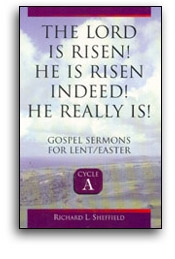
The Lord Is Risen! He Is Risen Indeed! He Really Is!
Gospel Sermons For Lent/Easter
"People die. Don't ya know." That's what Cleopas and his friend said to Jesus on Easter afternoon on their way home. People die!
Don't believe it? Don't want to believe it? Read about it in The Lima News. And not just in the obits. This is my copy of The Lima News from Good Friday, the day we remember that Jesus died.
Page 1: Cult Died in Shifts
Page 2: A headline so gruesome, let's just say, "Wife kills husband."
Page 3: A list of the dead from page 1, by age, sex, and the state where they got their driver's license.
Page 4: A story about the continuing and never-ending O J murder case.
Page 5: A story about serial killer Charles Manson.
Page 6: An editorial about air-bags, designed to save lives, now known possibly to cause deaths.
Page 7: More on the mass suicide in California:
QUOTE: "For them, death was not tragic. For people who called themselves monks and lived in a virtual computer cloister, tied to each other and to astrological portents, death was apparently not an end as much as a transition. 'I'm sure they were convinced of their immortality,' said Dr.James Breckenridge, professor of religion at Baylor University in Waco, Texas."1
To believe that you're immortal is to believe that you are not mortal, that you not only will not, but that you cannot die. Thirty-nine people died last week believing that. They proved only that people die, like Cleopas and his friend said that first Easter day.
By the time I got through all that it was a relief finally to get to famous-maker sunglasses at 25 percent off and Saville Row sport-coats at 35 percent off at the after-Easter sales.
A lot of people's minds (like a lot of our minds?) are closed when it comes to the meaning of Easter. People think it is a holy day that seems to mean that people do not die. But then they do. We've mixed the message. The message of Easter is that Jesus lives, not that people don't die.
And people who do die are not in a holding pattern over some heavenly heliport, and they do not find their hope in something hiding behind the Hale Bopp comet.
Death is not a boarding pass for life. And Christianity is not about denying death. It's about the defeat of death in resurrection, in restoration to life by God through Jesus Christ -- a defeat that does not deny the reality of death, but says we can live with that reality in assurance that God really raises those who do die to life forever with him.
It's not that I don't die, but that I do live, and that I can live now, life now, and a resurrected life someday like that of Jesus Christ.
More comforting, I think, than the notion that Grandma lives on somewhere, is the belief that Grandma will live forever someday, not in the worn-out body where she spent her last days, but in a resurrected body, a recreated body, where she will spend eternal days with Christ.
As the creed we will say says, "I believe in the resurrection of the body and the life everlasting." That's the meaning of Easter.
The meaning of Holy Week is that Jesus died. "(He) suffered under Pontius Pilate, was crucified, died, and was buried. He descended to the dead."
He was dead, dead as a doornail, which my dictionary defines as "undoubtedly dead."2
There are a lot of dead doornails in here. No, I don't mean you! I counted them. There are precisely 2,128 symbols of just how dead Jesus was nailed into the doors at the back of the sanctuary where most of you came in this morning. Doornails are nails in doors used to strengthen and decorate them. There are 2,128 doornails nailed in the doors to this room. And at last count, they're all dead. They didn't die. They were never alive. But we are. Jesus was. And dead as a doornail he was and we shall be.
If you find that disconcerting, you are not alone. The denial of death is something we humans have been doing as long as we've been alive. The early church had to deal with an early heresy called "gnosticism." The gnostics, much like the cult in California, thought they knew something the rest of us didn't -- that people who die, really don't.
It's amazing how much theology you get in newspapers and magazines these days. One of The Lima News articles quotes William Dinges, who teaches about new religions at Catholic University in Washington, D.C. Says Dinges, "They very well might have lived as computer age 'gnostics,' initiates of a select group, with access to special, arcane truths.
"Part of the mystique of the ancient tradition of gnosticism is that it is 'very antimaterialistic,' said Dinges. 'If you see your body as a prison and matter as bad, it's 'I'm outta here.' "3
Even on the next UFO out of town!
Such beliefs deny the goodness of what God has made. And the church since the beginning has condemned such beliefs as meaningless madness. As meaningless and as mad as the death of 39 young, bright, apparently well-to-do men and women, who in checking out of earthly life thought they were only checking in to life beyond the stars.
The church has long rejected the notion that like the cult in California we should put our hope in death as a transition to life, instead of in the God of life who defeats death in Jesus Christ.
Death is the end, says the church. But that end portends God's creating a new beginning. Christian hope is in the resurrection of the body, a new body -- not the old one -- a new life, a God-given life, for you, for me, in Jesus Christ. A life that I am to claim not by claiming that ending this life will make my life better, but by living this life as it is, and making of it all that it can be, in anticipation of life as it will be, beyond death. Death that will come to me as surely as it came to Jesus himself.
Dead as the nails in those doors, he was. Yet Jesus is now as alive as everyone in this room, and because he lives we shall live also.
I recently saw a sign outside a church that said, "The empty tomb is the foundation of our faith." I know what they're saying. But they're saying it wrongly. "The Church's one foundation is Jesus Christ her Lord." Her living Lord. Our Lord. Who is alive! And who calls you and me to live like we believe it.
There are lots of reasons not to believe it. Just read your newspaper! Cleopas and friend didn't believe it, even when they were looking right at it.
In the story I read from Luke the two followers of Jesus are heading home because what they had hoped for, and dreamed of, had died. There was no point in hanging around. On Friday he was hanging on a cross. Then they hauled him down and put him in a hole in the ground. Some silly women said they saw him alive. But the first stage of facing death is to deny it. If it's too good to be true, it is. Too bad. That's life! That's right, said Jesus, as "he interpreted to them the things about himself in all the scriptures" (Luke 24:27 NRSV). Scriptures that never deny death. But Scriptures that also always hold out hope of life.
But with life staring them right in the face, Cleopas and his companion didn't believe it. Lots of commentators have wondered why. Maybe Jesus wore a hood. Or they were blinded by their tears. Or they were in shock. You could even say, they were taking Jesus' death very well. They weren't denying it. On their way home, they were on their way to dealing with the death of their friend in a psychologically healthy way, we would say.
All of which may have been true. But the simple truth for me is simply that if someone I loved and cared about died, and then showed up two days after the funeral, I doubt I'd see it either. I know I wouldn't. And if I thought I did, I'd deny it.
We have a capacity for what psychologists call "cognitive dissonance." Jesus died. Dead people don't live. Jesus is dead. If you see him alive, "cognitive dissonance" takes care of it. We bring what we experience into line with what we know. And that's what we believe. That's how we survive, psychologically, in this confusing world. These two men, or maybe it was a man and a woman, were survivors. Jesus wasn't. He died, don't you know!?
Well, he did. But he rose again from the dead. And those two people, like people ever since, found him "... made known to them in the breaking of the bread" (Luke 24:35 NRSV).
That bread on the Table. It's there to tell us one thing.
The Lord is Risen!
He is Risen Indeed!
And as he was with Cleopas and friend, he's here breaking bread with you and me.
____________
1. The Lima News, 3/28/97.
2. The Random House Dictionary of the English Language.
3. The Lima News, 3/28/97.
Don't believe it? Don't want to believe it? Read about it in The Lima News. And not just in the obits. This is my copy of The Lima News from Good Friday, the day we remember that Jesus died.
Page 1: Cult Died in Shifts
Page 2: A headline so gruesome, let's just say, "Wife kills husband."
Page 3: A list of the dead from page 1, by age, sex, and the state where they got their driver's license.
Page 4: A story about the continuing and never-ending O J murder case.
Page 5: A story about serial killer Charles Manson.
Page 6: An editorial about air-bags, designed to save lives, now known possibly to cause deaths.
Page 7: More on the mass suicide in California:
QUOTE: "For them, death was not tragic. For people who called themselves monks and lived in a virtual computer cloister, tied to each other and to astrological portents, death was apparently not an end as much as a transition. 'I'm sure they were convinced of their immortality,' said Dr.James Breckenridge, professor of religion at Baylor University in Waco, Texas."1
To believe that you're immortal is to believe that you are not mortal, that you not only will not, but that you cannot die. Thirty-nine people died last week believing that. They proved only that people die, like Cleopas and his friend said that first Easter day.
By the time I got through all that it was a relief finally to get to famous-maker sunglasses at 25 percent off and Saville Row sport-coats at 35 percent off at the after-Easter sales.
A lot of people's minds (like a lot of our minds?) are closed when it comes to the meaning of Easter. People think it is a holy day that seems to mean that people do not die. But then they do. We've mixed the message. The message of Easter is that Jesus lives, not that people don't die.
And people who do die are not in a holding pattern over some heavenly heliport, and they do not find their hope in something hiding behind the Hale Bopp comet.
Death is not a boarding pass for life. And Christianity is not about denying death. It's about the defeat of death in resurrection, in restoration to life by God through Jesus Christ -- a defeat that does not deny the reality of death, but says we can live with that reality in assurance that God really raises those who do die to life forever with him.
It's not that I don't die, but that I do live, and that I can live now, life now, and a resurrected life someday like that of Jesus Christ.
More comforting, I think, than the notion that Grandma lives on somewhere, is the belief that Grandma will live forever someday, not in the worn-out body where she spent her last days, but in a resurrected body, a recreated body, where she will spend eternal days with Christ.
As the creed we will say says, "I believe in the resurrection of the body and the life everlasting." That's the meaning of Easter.
The meaning of Holy Week is that Jesus died. "(He) suffered under Pontius Pilate, was crucified, died, and was buried. He descended to the dead."
He was dead, dead as a doornail, which my dictionary defines as "undoubtedly dead."2
There are a lot of dead doornails in here. No, I don't mean you! I counted them. There are precisely 2,128 symbols of just how dead Jesus was nailed into the doors at the back of the sanctuary where most of you came in this morning. Doornails are nails in doors used to strengthen and decorate them. There are 2,128 doornails nailed in the doors to this room. And at last count, they're all dead. They didn't die. They were never alive. But we are. Jesus was. And dead as a doornail he was and we shall be.
If you find that disconcerting, you are not alone. The denial of death is something we humans have been doing as long as we've been alive. The early church had to deal with an early heresy called "gnosticism." The gnostics, much like the cult in California, thought they knew something the rest of us didn't -- that people who die, really don't.
It's amazing how much theology you get in newspapers and magazines these days. One of The Lima News articles quotes William Dinges, who teaches about new religions at Catholic University in Washington, D.C. Says Dinges, "They very well might have lived as computer age 'gnostics,' initiates of a select group, with access to special, arcane truths.
"Part of the mystique of the ancient tradition of gnosticism is that it is 'very antimaterialistic,' said Dinges. 'If you see your body as a prison and matter as bad, it's 'I'm outta here.' "3
Even on the next UFO out of town!
Such beliefs deny the goodness of what God has made. And the church since the beginning has condemned such beliefs as meaningless madness. As meaningless and as mad as the death of 39 young, bright, apparently well-to-do men and women, who in checking out of earthly life thought they were only checking in to life beyond the stars.
The church has long rejected the notion that like the cult in California we should put our hope in death as a transition to life, instead of in the God of life who defeats death in Jesus Christ.
Death is the end, says the church. But that end portends God's creating a new beginning. Christian hope is in the resurrection of the body, a new body -- not the old one -- a new life, a God-given life, for you, for me, in Jesus Christ. A life that I am to claim not by claiming that ending this life will make my life better, but by living this life as it is, and making of it all that it can be, in anticipation of life as it will be, beyond death. Death that will come to me as surely as it came to Jesus himself.
Dead as the nails in those doors, he was. Yet Jesus is now as alive as everyone in this room, and because he lives we shall live also.
I recently saw a sign outside a church that said, "The empty tomb is the foundation of our faith." I know what they're saying. But they're saying it wrongly. "The Church's one foundation is Jesus Christ her Lord." Her living Lord. Our Lord. Who is alive! And who calls you and me to live like we believe it.
There are lots of reasons not to believe it. Just read your newspaper! Cleopas and friend didn't believe it, even when they were looking right at it.
In the story I read from Luke the two followers of Jesus are heading home because what they had hoped for, and dreamed of, had died. There was no point in hanging around. On Friday he was hanging on a cross. Then they hauled him down and put him in a hole in the ground. Some silly women said they saw him alive. But the first stage of facing death is to deny it. If it's too good to be true, it is. Too bad. That's life! That's right, said Jesus, as "he interpreted to them the things about himself in all the scriptures" (Luke 24:27 NRSV). Scriptures that never deny death. But Scriptures that also always hold out hope of life.
But with life staring them right in the face, Cleopas and his companion didn't believe it. Lots of commentators have wondered why. Maybe Jesus wore a hood. Or they were blinded by their tears. Or they were in shock. You could even say, they were taking Jesus' death very well. They weren't denying it. On their way home, they were on their way to dealing with the death of their friend in a psychologically healthy way, we would say.
All of which may have been true. But the simple truth for me is simply that if someone I loved and cared about died, and then showed up two days after the funeral, I doubt I'd see it either. I know I wouldn't. And if I thought I did, I'd deny it.
We have a capacity for what psychologists call "cognitive dissonance." Jesus died. Dead people don't live. Jesus is dead. If you see him alive, "cognitive dissonance" takes care of it. We bring what we experience into line with what we know. And that's what we believe. That's how we survive, psychologically, in this confusing world. These two men, or maybe it was a man and a woman, were survivors. Jesus wasn't. He died, don't you know!?
Well, he did. But he rose again from the dead. And those two people, like people ever since, found him "... made known to them in the breaking of the bread" (Luke 24:35 NRSV).
That bread on the Table. It's there to tell us one thing.
The Lord is Risen!
He is Risen Indeed!
And as he was with Cleopas and friend, he's here breaking bread with you and me.
____________
1. The Lima News, 3/28/97.
2. The Random House Dictionary of the English Language.
3. The Lima News, 3/28/97.
