
The Power Of The Future
Sermon
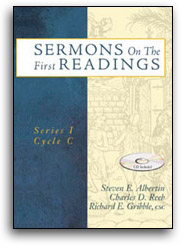
Sermons On The First Readings
Series I, Cycle C
We have all had them. We all hate them. You know what I am talking about: boring history teachers. All they can do is rattle off names, dates, and places. All they expect from their students is the rote memorization of facts. When you were in their classes, you couldn't wait for the bell to ring. But the good history teacher was someone special. He/she made history come alive. The past was vital and interesting. The past was important because it helped you to understand the present. The past was important because it taught you invaluable lessons about human nature and the nature of human life. The past was important because it helped you not to repeat the mistakes of the past.
But that is all easier said than done. The more we study the past, the more it seems that for every step forward, we take two steps backwards. In spite of our desire not to repeat the mistakes of the past, we nevertheless commit them anyway. Those pat phrases about history that once seemed to be clichés now ring more true than ever before: "The more things change, the more they stay the same." "We are condemned to repeat the sins of the past."
Despite our determination to do things differently, despite our commitment to human freedom, it seems that it is next to impossible really to overcome the sins of the past. I once heard a pastor in a marriage ceremony say to the bridal couple, "By the grace of God may you grow old together." That was an understatement if I ever heard one. Given the emotional and psychological baggage that a couple brings to their marriage, given the sins they will commit against each other, and given the grievances they will hold against each other, it is indeed only by the grace of God that their relationship will hold together.
Our health is continually shaped and haunted by the sins of the past. Especially as I age, I have become acutely aware of how I can't escape the consequences of the past. For all of us, as we age, the shortness of breath, the pains in our chest, the stiffness in our joints, the cancer in our organs, all are reminders that we reap what we sow. We can't escape the consequences of our choices. The lack of exercise, the one too many desserts, the over-indulgence with the wrong sorts of foods, all limit the choices of our future actions. No matter how hard we try, we can't escape the choices of the past. We are prisoners of our history. We are doomed finally to die.
Recently a popular song on the airwaves by Irish rock band U2 expressed just this sentiment. The song, titled "Stuck in a Moment and Can't Get Out of It," expresses musically the frustration of being unable to escape your mistake, your error, your failure, and to move on with your life.
Today's First Lesson from the prophet Jeremiah addresses a similar situation. It is the sixth century B.C.E. and Israel is stuck in the consequences of its past and has no future. The mistakes of the past that Israel was unable to keep from repeating have condemned it and destroyed its future. Time after time the prophet Jeremiah had warned Israel to repent and change its idolatrous and rebellious ways or it would be destroyed. In 586 B.C.E. his words finally came true. The Babylonian empire swept down and destroyed the city of Jerusalem and the magnificent Temple of Solomon. In order to further ridicule and humiliate the Israelites, its King Jehoiakim was removed, his eighteen-year-old son and next in line for the throne, Jehoichin, was deported and his uncle, Mattaniah, was installed as a flunky, puppet king by the Babylonians. In a further gesture of humiliation and ridicule, Mattaniah was given a new name by the Babylonians, Zedekiah, which translated meant "The Lord (Yahweh) is our righteousness." The name was actually an expression of ridicule and derision. It was intended to add insult to injury because it ridiculed the religious faith of the Israelites. Obviously, their God was anything but righteous with the way he had allowed his people to be so defeated by the Babylonians.
The final humiliation of the Israelites is recorded in 2 Kings 25. In a climactic gesture of degradation, the Babylonians murder King Zedekiah's children before his very eyes and then poke out his eyes. The death of his children would be the last thing he would be permitted to see in this world. And instead of putting him out of his misery and executing him, they allowed him to live out his life in prison with the vision of this painful execution seared into his memory. They had absolutely no respect for this puny, upstart nation, its incompetent king and, most of all, its God. "The Lord is our Righteousness"? Ha! This God and his people are nothing in comparison to the mighty and powerful Babylonian empire and its gods.
All the symbols of their nation and their religious faith had been destroyed. God had promised them and given them a land, a holy city, a temple, and a king. Their God was loving and merciful and worthy of their praise. But now in the rubble of Jerusalem and in their deportation to a strange and foreign land filled with foreign gods, the Israelites were faced with the biggest crisis in their history. Not only was their suffering great, but also their religious faith seemed to be in vain. What about their God? Was he weak and insignificant? Had be been defeated? Did their God even exist? Without their land, their city, their temple, and their king, they had no hope, no future, and no faith.
It is into this context that Jeremiah makes the shocking announcement that is today's First Lesson. From a section of the book that bears his name called the Book of Consolation, Jeremiah refuses to accept the evidence of the present moment. Contrary to appearances, in spite of evidence to the contrary, Jeremiah insists that God has not abandoned his people. Instead, God has promised them a new future. They will not be prisoners of the past. The days are coming when all those signs of God's faithfulness and their status as God's chosen people will be restored. They will have the land of Judah regained. Jerusalem and the Temple will be rebuilt. And the monarchy will be restored, which would include the return of a king from the line of David.
It is interesting to note how Jeremiah takes a jab at the legitimacy of the puppet king Zedekiah and all the less than honorable kings that reigned before him. Jeremiah promises that this new king will also be called "The Lord is our righteousness," which in Hebrew is also "Zedekiah." In contrast to the disgraceful treachery, intrigue, and corruption that were a part of the regime of the present Zedekiah, the new Zedekiah, the future Zedekiah, would rule with a sense of righteousness and honor that was truly befitting of his name.
Of course, it was promises such as this one from the prophet Jeremiah that sustained the Israelites through their time of exile and into the future. Despite centuries of occupation and humiliation by one nation after another, the Israelites still had hope. They did not give up. They still waited for the coming of a king, a righteous branch and true descendant of King David, who would restore their good fortunes and lead them to future greatness.
Why do we read this passage today on this first Sunday in Advent and at the beginning of another church year? The word advent means "coming." Of course, at this time of the year we are anticipating the "coming" of Christmas and the celebration of the "coming" of Jesus the Christ as the babe of Bethlehem. From the first days of the early Christian church, Jesus was seen as the fulfillment of this prophecy from Jeremiah. Jesus was the true Zedekiah, the one who was in every way an expression of the Lord's (God's) righteousness. In Jesus, the true Zedekiah, the righteous Branch and descendant of King David finally came. God finally kept his promises and the good fortunes of God's people were restored.
But all is not well. Just like the first Zedekiah's tarnished and fraudulent reign that was an absolute betrayal of everything right and true and just, we are still waiting for the restoration. There are times in this life when we feel as betrayed as the Israelites must have felt betrayed by their fraudulent king Zedekiah. The leaders and government officials, in whom we thought we could trust, more often than not turn out to be imposters, fakes, more interested in their own careers than serving the people who elected them. The boss we thought we could trust, the friend we thought we could count on, the spouse we thought we could believe in, the job that we thought was safe and secure, all too often turn out to be disappointments, pretenders, the betrayers of our faith, and the saboteurs of our hope.
Even worse, we seem unable to shake a past that always seems to haunt us. The Israelites were unable to escape the centuries of unfaithfulness and sin that had accumulated all around them. The sins of the fathers were finally visited upon the children. The piper finally was paid. Jerusalem, the Temple, and the monarchy were finally obliterated. Likewise, we are haunted by the past and are unable to shake its consequences. We struggle not only with our forefather's stupidity and arrogance but also with our own. America seems to be a culture gagging on its own self-indulgence. The diseases of affluence, diabetes, heart disease, hypertension, and obesity are destroying us. Our extravagance is consuming our resources and polluting our environment. Complacent with our success our children are content with a dumbed-down education, disdain hard work, and consider success to be a right. Our neglect of marriage and family finally has caught up with us, and we are plagued with divorce and broken families. And worst of all, God is the one holding our feet to the fire. As he made Israel pay for her sin, so also will he make us pay. In fact, the pain and disappointment we suffer every day are the signs that we already are reaping the fruits of our sin.
Advent is also that season of the church year when we ponder our future and the Second Coming of Christ. That means that we ponder the meaning not only of the first coming of Christ in the babe of Bethlehem but also the Second Coming of Christ, when he comes again "to judge the living and the dead." Given the predicament we have gotten ourselves into, that Second Coming seems to promise more doom than blessing, more judgment than mercy. We fear that it will be an apocalyptic holocaust and the obliteration of our Jerusalems, our temples, and our monarchies, since we have been just as inept and corrupt as the sixth-century Israelites.
But that is when we need to remember just who this "righteous Branch" is and what this second Zedekiah, the true "Lord is our righteousness," has done. It is because of the first Advent coming of this Zedekiah that we can look forward to the second Advent coming of this Zedekiah not with fear and trembling but with joy and hope. Jesus, the Zedekiah truly worthy of his name, became one of us and one with us in our sin, in the disasters we have brought upon ourselves, and in the follies we have inflicted on one another. And he carried them in his flesh to the cross where he suffered the same fate suffered by the first Zedekiah and ancient Israel and every other sinner that has walked the face of the earth. But this time there was a big difference. He suffered "for us and our salvation." As the Son of God, he suffered our fate under his Father's own wrath "for us." His death finally silenced the charges and accusations God brings against us. God so loved the world that he chose not to make the world pay but sent his own Son to pay. He suffers his own judgment on himself so that we might be free from this damnable fate. He loves the world that much.
A mother is walking down the sidewalk alongside a busy street with her toddler in hand. It is a great day. They are enjoying their stroll. Suddenly a dog barks. The mother turns and looks at the dog. Distracted she relaxes her grip on the hand of her child and he slips away and walks into the street. The mother quickly turns, realizing what has happened. She screams when she sees that her child has walked out into the street into the path of a speeding truck. The driver of the truck obviously has not seen her child. Death is certain. So the mother runs out into the street shouting at her child to run when she lunges, pushing her child out of the path of the speeding truck only to be struck dead herself. In the ultimate act of love, she has sacrificed her life for the life of her child. She is truly righteous. There is no duplicity, nothing phony or fake in this "Zedekiah." Her action has restored Jerusalem and saved Judah. She is the "righteous Branch to spring up for David." She is Jesus. She is the one who has saved the world.
Because of the first coming of Jesus, of the true Zedekiah, the authentic "The Lord is our righteousness," we can look forward to the Second Coming of Jesus. Then, when he "comes again to judge the living and the dead," he will finally set all things right in this world. Because of the Christmas we are about to celebrate, we can look forward to that future. It is a future filled with promise and hope. Because of Jesus and his death and resurrection, our sins have been forgiven. Our past need not enslave us. We no longer need be imprisoned by it. We can dare to live life differently and begin to make a new world that is not doomed to repeat the sins of the past. Our lives can be different from what we thought they had to be.
Because of what Jesus has done, you have a new future. You have a life filled with new possibilities. It is like that day when you were promoted to a new job. You now have a career and opportunities that you never had before. Your life now can be different from what it had been before. It is like that day when you received that diploma. You graduated! You now can go and do things that before were never possible. It is like that day you made those wedding vows. Those promises opened up a whole new life with new experiences, pleasures, and blessings that never existed before. You have a new future. The new future changes the way you live in the present.
The Reverend Martin Luther King, Jr., knew what it was like to have a vision of the future change the way you live in the present. In his famous "I Have a Dream" speech he spoke eloquently of having been to the mountaintop, the mountaintop of Calvary, where the cross of Jesus gave him a vision of a new future. There he saw new possibilities for the human race. There he saw a new world, where people were no longer "judged by the color of the their skin but by the content of their character."
It was 1880 in the Connecticut House of Representatives. It was a bright day in May. The legislature was doing its work by the natural light of day, when suddenly in the middle of the day a solar eclipse interrupted the light of day. Not understanding the scientific significance of this "natural" event, the people gathered in legislature panicked. There was a clamor for action. What were they going to do? The Speaker of the House took the floor and spoke.
"The Day of the Lord may be approaching and the judgment of this world may be upon us ... or it may not. I don't know. If it is not the Day of the Lord, then there is no reason to adjourn our assembly. If it is, I for one wish to be found doing my duty. I am not at all worried about what fate lies ahead for me. Therefore, let us break out the candles and continue our work."
These are the words of a man who expected Jesus to come but was unafraid. He was ready to get back to his desk and continue the legislative debate. He had a vision of the future. He was confident that the future was in Jesus' hands. That meant that there was nothing to fear. He was sure that his sins of the past could not hurt him. He knew that he could be about the work God had given to do with a sense of peace that the world could never give him. Only Jesus could give him that, only the true Zedekiah, only the one who really was "The Lord is our righteousness."
That same peace and confidence is ours. We too have a future in the hands of Jesus. Therefore, there is nothing to fear. And there are no limits to changes we can work to bring to this world.
But that is all easier said than done. The more we study the past, the more it seems that for every step forward, we take two steps backwards. In spite of our desire not to repeat the mistakes of the past, we nevertheless commit them anyway. Those pat phrases about history that once seemed to be clichés now ring more true than ever before: "The more things change, the more they stay the same." "We are condemned to repeat the sins of the past."
Despite our determination to do things differently, despite our commitment to human freedom, it seems that it is next to impossible really to overcome the sins of the past. I once heard a pastor in a marriage ceremony say to the bridal couple, "By the grace of God may you grow old together." That was an understatement if I ever heard one. Given the emotional and psychological baggage that a couple brings to their marriage, given the sins they will commit against each other, and given the grievances they will hold against each other, it is indeed only by the grace of God that their relationship will hold together.
Our health is continually shaped and haunted by the sins of the past. Especially as I age, I have become acutely aware of how I can't escape the consequences of the past. For all of us, as we age, the shortness of breath, the pains in our chest, the stiffness in our joints, the cancer in our organs, all are reminders that we reap what we sow. We can't escape the consequences of our choices. The lack of exercise, the one too many desserts, the over-indulgence with the wrong sorts of foods, all limit the choices of our future actions. No matter how hard we try, we can't escape the choices of the past. We are prisoners of our history. We are doomed finally to die.
Recently a popular song on the airwaves by Irish rock band U2 expressed just this sentiment. The song, titled "Stuck in a Moment and Can't Get Out of It," expresses musically the frustration of being unable to escape your mistake, your error, your failure, and to move on with your life.
Today's First Lesson from the prophet Jeremiah addresses a similar situation. It is the sixth century B.C.E. and Israel is stuck in the consequences of its past and has no future. The mistakes of the past that Israel was unable to keep from repeating have condemned it and destroyed its future. Time after time the prophet Jeremiah had warned Israel to repent and change its idolatrous and rebellious ways or it would be destroyed. In 586 B.C.E. his words finally came true. The Babylonian empire swept down and destroyed the city of Jerusalem and the magnificent Temple of Solomon. In order to further ridicule and humiliate the Israelites, its King Jehoiakim was removed, his eighteen-year-old son and next in line for the throne, Jehoichin, was deported and his uncle, Mattaniah, was installed as a flunky, puppet king by the Babylonians. In a further gesture of humiliation and ridicule, Mattaniah was given a new name by the Babylonians, Zedekiah, which translated meant "The Lord (Yahweh) is our righteousness." The name was actually an expression of ridicule and derision. It was intended to add insult to injury because it ridiculed the religious faith of the Israelites. Obviously, their God was anything but righteous with the way he had allowed his people to be so defeated by the Babylonians.
The final humiliation of the Israelites is recorded in 2 Kings 25. In a climactic gesture of degradation, the Babylonians murder King Zedekiah's children before his very eyes and then poke out his eyes. The death of his children would be the last thing he would be permitted to see in this world. And instead of putting him out of his misery and executing him, they allowed him to live out his life in prison with the vision of this painful execution seared into his memory. They had absolutely no respect for this puny, upstart nation, its incompetent king and, most of all, its God. "The Lord is our Righteousness"? Ha! This God and his people are nothing in comparison to the mighty and powerful Babylonian empire and its gods.
All the symbols of their nation and their religious faith had been destroyed. God had promised them and given them a land, a holy city, a temple, and a king. Their God was loving and merciful and worthy of their praise. But now in the rubble of Jerusalem and in their deportation to a strange and foreign land filled with foreign gods, the Israelites were faced with the biggest crisis in their history. Not only was their suffering great, but also their religious faith seemed to be in vain. What about their God? Was he weak and insignificant? Had be been defeated? Did their God even exist? Without their land, their city, their temple, and their king, they had no hope, no future, and no faith.
It is into this context that Jeremiah makes the shocking announcement that is today's First Lesson. From a section of the book that bears his name called the Book of Consolation, Jeremiah refuses to accept the evidence of the present moment. Contrary to appearances, in spite of evidence to the contrary, Jeremiah insists that God has not abandoned his people. Instead, God has promised them a new future. They will not be prisoners of the past. The days are coming when all those signs of God's faithfulness and their status as God's chosen people will be restored. They will have the land of Judah regained. Jerusalem and the Temple will be rebuilt. And the monarchy will be restored, which would include the return of a king from the line of David.
It is interesting to note how Jeremiah takes a jab at the legitimacy of the puppet king Zedekiah and all the less than honorable kings that reigned before him. Jeremiah promises that this new king will also be called "The Lord is our righteousness," which in Hebrew is also "Zedekiah." In contrast to the disgraceful treachery, intrigue, and corruption that were a part of the regime of the present Zedekiah, the new Zedekiah, the future Zedekiah, would rule with a sense of righteousness and honor that was truly befitting of his name.
Of course, it was promises such as this one from the prophet Jeremiah that sustained the Israelites through their time of exile and into the future. Despite centuries of occupation and humiliation by one nation after another, the Israelites still had hope. They did not give up. They still waited for the coming of a king, a righteous branch and true descendant of King David, who would restore their good fortunes and lead them to future greatness.
Why do we read this passage today on this first Sunday in Advent and at the beginning of another church year? The word advent means "coming." Of course, at this time of the year we are anticipating the "coming" of Christmas and the celebration of the "coming" of Jesus the Christ as the babe of Bethlehem. From the first days of the early Christian church, Jesus was seen as the fulfillment of this prophecy from Jeremiah. Jesus was the true Zedekiah, the one who was in every way an expression of the Lord's (God's) righteousness. In Jesus, the true Zedekiah, the righteous Branch and descendant of King David finally came. God finally kept his promises and the good fortunes of God's people were restored.
But all is not well. Just like the first Zedekiah's tarnished and fraudulent reign that was an absolute betrayal of everything right and true and just, we are still waiting for the restoration. There are times in this life when we feel as betrayed as the Israelites must have felt betrayed by their fraudulent king Zedekiah. The leaders and government officials, in whom we thought we could trust, more often than not turn out to be imposters, fakes, more interested in their own careers than serving the people who elected them. The boss we thought we could trust, the friend we thought we could count on, the spouse we thought we could believe in, the job that we thought was safe and secure, all too often turn out to be disappointments, pretenders, the betrayers of our faith, and the saboteurs of our hope.
Even worse, we seem unable to shake a past that always seems to haunt us. The Israelites were unable to escape the centuries of unfaithfulness and sin that had accumulated all around them. The sins of the fathers were finally visited upon the children. The piper finally was paid. Jerusalem, the Temple, and the monarchy were finally obliterated. Likewise, we are haunted by the past and are unable to shake its consequences. We struggle not only with our forefather's stupidity and arrogance but also with our own. America seems to be a culture gagging on its own self-indulgence. The diseases of affluence, diabetes, heart disease, hypertension, and obesity are destroying us. Our extravagance is consuming our resources and polluting our environment. Complacent with our success our children are content with a dumbed-down education, disdain hard work, and consider success to be a right. Our neglect of marriage and family finally has caught up with us, and we are plagued with divorce and broken families. And worst of all, God is the one holding our feet to the fire. As he made Israel pay for her sin, so also will he make us pay. In fact, the pain and disappointment we suffer every day are the signs that we already are reaping the fruits of our sin.
Advent is also that season of the church year when we ponder our future and the Second Coming of Christ. That means that we ponder the meaning not only of the first coming of Christ in the babe of Bethlehem but also the Second Coming of Christ, when he comes again "to judge the living and the dead." Given the predicament we have gotten ourselves into, that Second Coming seems to promise more doom than blessing, more judgment than mercy. We fear that it will be an apocalyptic holocaust and the obliteration of our Jerusalems, our temples, and our monarchies, since we have been just as inept and corrupt as the sixth-century Israelites.
But that is when we need to remember just who this "righteous Branch" is and what this second Zedekiah, the true "Lord is our righteousness," has done. It is because of the first Advent coming of this Zedekiah that we can look forward to the second Advent coming of this Zedekiah not with fear and trembling but with joy and hope. Jesus, the Zedekiah truly worthy of his name, became one of us and one with us in our sin, in the disasters we have brought upon ourselves, and in the follies we have inflicted on one another. And he carried them in his flesh to the cross where he suffered the same fate suffered by the first Zedekiah and ancient Israel and every other sinner that has walked the face of the earth. But this time there was a big difference. He suffered "for us and our salvation." As the Son of God, he suffered our fate under his Father's own wrath "for us." His death finally silenced the charges and accusations God brings against us. God so loved the world that he chose not to make the world pay but sent his own Son to pay. He suffers his own judgment on himself so that we might be free from this damnable fate. He loves the world that much.
A mother is walking down the sidewalk alongside a busy street with her toddler in hand. It is a great day. They are enjoying their stroll. Suddenly a dog barks. The mother turns and looks at the dog. Distracted she relaxes her grip on the hand of her child and he slips away and walks into the street. The mother quickly turns, realizing what has happened. She screams when she sees that her child has walked out into the street into the path of a speeding truck. The driver of the truck obviously has not seen her child. Death is certain. So the mother runs out into the street shouting at her child to run when she lunges, pushing her child out of the path of the speeding truck only to be struck dead herself. In the ultimate act of love, she has sacrificed her life for the life of her child. She is truly righteous. There is no duplicity, nothing phony or fake in this "Zedekiah." Her action has restored Jerusalem and saved Judah. She is the "righteous Branch to spring up for David." She is Jesus. She is the one who has saved the world.
Because of the first coming of Jesus, of the true Zedekiah, the authentic "The Lord is our righteousness," we can look forward to the Second Coming of Jesus. Then, when he "comes again to judge the living and the dead," he will finally set all things right in this world. Because of the Christmas we are about to celebrate, we can look forward to that future. It is a future filled with promise and hope. Because of Jesus and his death and resurrection, our sins have been forgiven. Our past need not enslave us. We no longer need be imprisoned by it. We can dare to live life differently and begin to make a new world that is not doomed to repeat the sins of the past. Our lives can be different from what we thought they had to be.
Because of what Jesus has done, you have a new future. You have a life filled with new possibilities. It is like that day when you were promoted to a new job. You now have a career and opportunities that you never had before. Your life now can be different from what it had been before. It is like that day when you received that diploma. You graduated! You now can go and do things that before were never possible. It is like that day you made those wedding vows. Those promises opened up a whole new life with new experiences, pleasures, and blessings that never existed before. You have a new future. The new future changes the way you live in the present.
The Reverend Martin Luther King, Jr., knew what it was like to have a vision of the future change the way you live in the present. In his famous "I Have a Dream" speech he spoke eloquently of having been to the mountaintop, the mountaintop of Calvary, where the cross of Jesus gave him a vision of a new future. There he saw new possibilities for the human race. There he saw a new world, where people were no longer "judged by the color of the their skin but by the content of their character."
It was 1880 in the Connecticut House of Representatives. It was a bright day in May. The legislature was doing its work by the natural light of day, when suddenly in the middle of the day a solar eclipse interrupted the light of day. Not understanding the scientific significance of this "natural" event, the people gathered in legislature panicked. There was a clamor for action. What were they going to do? The Speaker of the House took the floor and spoke.
"The Day of the Lord may be approaching and the judgment of this world may be upon us ... or it may not. I don't know. If it is not the Day of the Lord, then there is no reason to adjourn our assembly. If it is, I for one wish to be found doing my duty. I am not at all worried about what fate lies ahead for me. Therefore, let us break out the candles and continue our work."
These are the words of a man who expected Jesus to come but was unafraid. He was ready to get back to his desk and continue the legislative debate. He had a vision of the future. He was confident that the future was in Jesus' hands. That meant that there was nothing to fear. He was sure that his sins of the past could not hurt him. He knew that he could be about the work God had given to do with a sense of peace that the world could never give him. Only Jesus could give him that, only the true Zedekiah, only the one who really was "The Lord is our righteousness."
That same peace and confidence is ours. We too have a future in the hands of Jesus. Therefore, there is nothing to fear. And there are no limits to changes we can work to bring to this world.
