
Prayer 12
Worship
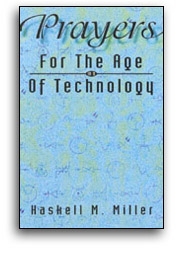
Prayers for the Age of Technology
Object:
Dear Loving, Merciful God:
We are easily convinced that we are all sinners, for we are keenly aware that we are finite, fallible human beings. We compromise, equivocate, go against our better judgment, and often fail to abide by what we have reason to believe is your will for us.
But what exactly is sin? The ambiguity in the term troubles us greatly.
We are told that sin is "rebellion against God," but few of us have consciously and deliberately rebelled against you. Breaking the Ten Commandments is frequently cited, but strict legalism seems out of keeping with your expectation of obedient love, as set forth in the New Testament. We note that sin often is thought of as failure to abide by social customs, codes, or laws, but we know that customs and codes change from time to time and place to place; and man-made laws often fail to be fair or just.
The idea of original sin has become especially troubling. Is it a literal fact that sin is something born in us as a result of what Adam and Eve did in the Garden of Eden? We can see that there could have been no sin without understanding of the difference between right and wrong, good and evil. But this ability to understand seems more a blessing than a curse. Is it not evidence of your loving providence and grace that we have been endowed with this capacity? Is not this the point at which you have blessed us with the privilege of being your children, capable of responding to your love and enjoying meaningful fellowship with you?
How shall we reconcile the idea of original sin with the notion that we are personally responsible for sinning? Is not the Adam and Eve story an allegory with which early people kept themselves reminded of universal human weakness?
The evidence we are receiving through scientific studies in sociology, psychology, and biology, evidence we see as part of your continuing revelation, indicates that there are many factors affecting behavior that are beyond the individual's control. How shall these be taken into account? In fact, is not much sin social in nature, almost totally unrelated to individual responsibility?
It appears to us that the idea of original sin is related to the fact that we are born equipped with animal appetites and drives, and we must learn to function with conscience that struggles with values. Is not this the arena in which sin is defined?
We assume that you are always on the side of right and the highest values. It seems to us, therefore, that freely to choose less than the best in a situation where values are at stake would be the greatest kind of sin. It would surely be indicative of alienation from you and disregard of your will.
Bear with us, Lord, as you note our divergence from some of the views held by our ancestors. We have no desire to deny sin or to trivialize it. We seek a clearer understanding of it, and we are comforted by assurance that we can be saved from it. Amen.
We are easily convinced that we are all sinners, for we are keenly aware that we are finite, fallible human beings. We compromise, equivocate, go against our better judgment, and often fail to abide by what we have reason to believe is your will for us.
But what exactly is sin? The ambiguity in the term troubles us greatly.
We are told that sin is "rebellion against God," but few of us have consciously and deliberately rebelled against you. Breaking the Ten Commandments is frequently cited, but strict legalism seems out of keeping with your expectation of obedient love, as set forth in the New Testament. We note that sin often is thought of as failure to abide by social customs, codes, or laws, but we know that customs and codes change from time to time and place to place; and man-made laws often fail to be fair or just.
The idea of original sin has become especially troubling. Is it a literal fact that sin is something born in us as a result of what Adam and Eve did in the Garden of Eden? We can see that there could have been no sin without understanding of the difference between right and wrong, good and evil. But this ability to understand seems more a blessing than a curse. Is it not evidence of your loving providence and grace that we have been endowed with this capacity? Is not this the point at which you have blessed us with the privilege of being your children, capable of responding to your love and enjoying meaningful fellowship with you?
How shall we reconcile the idea of original sin with the notion that we are personally responsible for sinning? Is not the Adam and Eve story an allegory with which early people kept themselves reminded of universal human weakness?
The evidence we are receiving through scientific studies in sociology, psychology, and biology, evidence we see as part of your continuing revelation, indicates that there are many factors affecting behavior that are beyond the individual's control. How shall these be taken into account? In fact, is not much sin social in nature, almost totally unrelated to individual responsibility?
It appears to us that the idea of original sin is related to the fact that we are born equipped with animal appetites and drives, and we must learn to function with conscience that struggles with values. Is not this the arena in which sin is defined?
We assume that you are always on the side of right and the highest values. It seems to us, therefore, that freely to choose less than the best in a situation where values are at stake would be the greatest kind of sin. It would surely be indicative of alienation from you and disregard of your will.
Bear with us, Lord, as you note our divergence from some of the views held by our ancestors. We have no desire to deny sin or to trivialize it. We seek a clearer understanding of it, and we are comforted by assurance that we can be saved from it. Amen.
