
The Prodigal Son
Drama
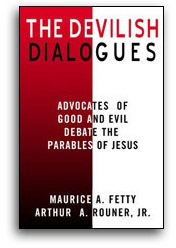
The Devilish Dialogues
Advocates Of Good And Evil Debate The Parables Of Jesus
So he returned home to his father. And while he was still a long distance away, his father saw him coming, and was filled with loving pity and ran and embraced him and kissed him.
His son said to him, "Father, I have sinned against heaven and against you, and am not worthy of being called your son...."
But his father said to the slaves, "Quick! Bring the finest robe in the house and put it on him. And a jeweled ring for his finger; and shoes! And kill the calf we have in the fattening pen. We must celebrate with a feast, for this son of mine was dead and has returned to life. He was lost and is found." So the party began. -- Luke 15:20-24
I
The Devil's Advocate:
Right at the beginning, I wish to make at least one thing clear: I am at a distinct disadvantage having to speak here in this church with all these religions trappings. Look at it: lighted candles, high altar, soft lights, and emotional music. Religious sentiment is hanging out all over.
So, I want you to know that I have to make my appeal through all the glut of sentimentalism, nostalgia, and religious wishful thinking. Furthermore, I want to point out that most people check their intelligence the minute they enter the church door. It is almost as if they had an intelligence rack alongside the coat and hat rack, so that every time they hang up their coat they hang up their intelligence as well. Once that's done, they enter the sanctuary and sit in a half-somnolent state waiting to be titillated with pious mishmash and soothed with illusory dream-spinning about how they wished everything might be, without ever letting any fact of harsh reality trouble their delicate little minds and hearts. So you see, I am usually at quite a disadvantage.
But probably not here in this church. For as I look out across the congregation, I am aware that I am in the company of intelligent men and women, dedicated to sorting out fact from fancy, reality from idealism, actuality from illusion. It is encouraging, for I am persuaded that balanced, cool-headed, reasonable people such as yourselves will see the rightness and reasonableness of my argument. Your superior intelligence and logical brilliance will be a great asset in warding off the idealistic pitch which my perennial opponent will be throwing at you. So in that respect, I feel very fortunate to be able to address you, even though we are not in neutral territory.
The Lord's Advocate:
We think you're putting us on, Devil's Advocate. After all, soft lights and flickering candles set a pretty good scene for you, too! What could be more tempting, after all, than to turn piety into patronage, sentimentality into self-interest, soft lighting into a soft sell --Êfor hell?
You're at no disadvantage! Even if these "trappings" you speak of do mean something a little more to us than you seem to think, and go a little deeper than you might imagine.
Those tapers, with their flame, friend, tell us the Holy Spirit of our Lord is here. He comes like fire, to burn in our hearts -- a fire you may have trouble drowning out. And that cross is where our Christ was crucified. He loves us -- and you, too, tempting one -- enough to give his life. That's a lot to do. Can you match that?
The lights are low, because it's evening. There's healing in evening's glow, didn't you know? And we come for help. And you'll have to work awfully hard to keep us from getting it.
But -- say on!
II
The Devil's Advocate:
This parable of the so-called Prodigal Son is one of the most unfair, sentimentalized pieces of religious mishmash that I have ever come across. Most everyone knows the story. There are all kinds of proverbial sayings about prodigal sons. But the Church has been terribly guilty of propagating half-truths and distorted points of view regarding this parable. Can you not just see the hauteur, the sneering snobbishness, with which they tell this story of the younger prodigal son? They sit on their comfortable self-righteousness like a Charles de Gaulle on Mount Olympus, viewing with contemptuous disdain the supposed excesses, follies, and failures of this wayward young man. They have terrible bias which prevents them from seeing the reality of the story. And what is the reality?
The reality is this: the younger son knew the real story of his sated old man and pompous older brother. The old man was probably a stuffy, stalemated, old-line capitalist, wedded to the old order of things. He was probably crotchety, unyielding, unbending, unwilling to see anything new or try anything different. He was fearful, rigid, unwilling to take a risk, afraid to learn anything or experience anything that might threaten his own small ideas or shake up his little fiefdom. His life was provincial, circumscribed, stale, arid, and dull.
Now, I ask you, who wouldn't want to leave a closed-in, stultifying place like that? Any young man with intelligence and drive and dreams would have to get out of a place like that. If he stayed around there he would become dull and sullen and indolent, just as his older brother had already. The younger brother saw that if he were going to make it in this world, he was going to have to get out on his own.
Besides, there are other little factors that people such as my opponent over there like to overlook as they tell the story from their biased point of view. You know, people always think the young son was crass and greedy by asking for his share of the inheritance in advance. But a closer look will tell you he was just shrewd, because the older son got twice as much inheritance as the younger. That's right, according to Jewish law, as recorded in Deuteronomy 21:17, the firstborn son gets twice as much inheritance as anyone else in the family. Now anybody, especially younger brothers, can tell you that's a lousy deal. What younger man would want to stay around under that kind of injustice? His older brother would always have the upper hand. The younger brother had no real chance for advancement, no real chance to come into his own. So, why shouldn't he get out?
Besides, there are a lot of older brothers who come off rather badly in history, especially in the Bible. Contrary to some of the superstitions of the firstborn being the best born, the one on whom the strength and therefore, the inheritance falls, the younger sons often come off better. Remember, it was Cain, the older brother, who in jealousy killed his more capable younger brother, Abel. Remember, too, how Esau hated his more clever, cunning, and younger brother, Jacob.
Older brothers have a tendency to be too much like their fathers. They are identified with the old order, the old way of thinking and doing. They always keep the old rules, color within the lines, and stay at home near Mommy and Daddy. They are unimaginative. And, because they have the financial and psychological advantage of the inheritance, they rarely try anything new, rarely take any creative initiative. Their future is in an inherited future, which is another way of saying that they will be a carbon copy of the past.
I say, "God bless ..." I mean, "Satan bless the younger brother." He saw things as they really were and he set out to do something different, to be his own man, to chart his own course. Listen, why should his whole life be one of accepting hand-me-downs from his less-than-brilliant older brother? Why should he be forever disadvantaged because of an accident of birth? Why should he not get out from under his stodgy father and his dull, bossy brother? I'm for the young man. He wanted to be free from the burdening oppressiveness of his father and brother.
The Lord's Advocate:
I'm for the young man, too! So was his father for the young man.
Funny, how that stuffy, narrow-minded, conservative, John Birch, Rotarian, dirty old capitalist-of-a-father suddenly has such a beautiful bridge across the generation gap, and listened to his swinging son without letting his hair stand on end, and understood what was really bugging the boy, and was able to hold out his arms in welcome and forgiveness, isn't it?
Would that more conservative, capitalist fathers in our congregation today had such humble hearts, and open understanding, and ears that hear toward the kids of today.
No, we pious types are not nearly so narrow-minded and condemning of the Prodigal Son as you seem to think.
Let's concede that second sons do get an unfair deal when it comes to inheritance. Maybe the boy did have good reasons for cutting out and putting up in his own pad in some city far away. I'm not sure many fathers today would give that big a chunk to any child to take off with and live it up. That forgiving father begins to look a lot like a liberal to me. Seemed to know this was the only way the lad would learn, learn that self-centeredness isn't something you can survive on.
I'm not sure that home really was such a bad place to live. But, whatever kind of home it was, nobody forced him to stay. He went with his father's blessing, a great deal of faith on his father's part, I'd say.
A good example for fathers to follow in our day. Let kids get out of the white suburban ghetto. Let them see what the world is like. Let them see the many colors people come it, the many streets other sons live on, the kinds of fathers other fellows have. It's different. And "learning by living" is still a pretty good way.
A wise and loving man, I'd say, to let number two son have his way.
III
The Devil's Advocate:
I'm for the young man, no matter what you say. He's the stuff the world is made of: spirit, intelligence, adventure, risk, ambition, and independence. Yes, sir, I'm for him. And I know many of you are, too. For the young man represents, in many ways, the American spirit: independent, free, willing to go on its own and take its own risks.
You will notice that the younger son went into a far country. He didn't hang around to mooch off the family. There were no pleading letters home, no tearful, weepy scenes for his mommy. When he left, he left. If he was going to be a man, he was going to be a man. He didn't even hang around to make it off his relatives or his dad's business acquaintances. Instead, he left the country, went to a place where the culture and customs were different, the business world unfamiliar, and the people strangers.
Now, of course, like many young men, he ran into a little bad luck. You must remember that he had lived a rather drab and dull life up to now. He had been isolated, provincialized, and totally unacquainted with other people and other ways of life. He had lived in an ideal, homogeneous, upper middle-class ghetto. Life had been pleasant, but it was pleasantly bland, with no spice or challenge.
So, the first thing to remember is the excitement which must have been his when he got to the big city in that other country. He most likely went to the Paris or New York of his day. And it was a most expanding, eye-opening experience. He wondered how he could have waited so long to make the break with the old home for this new way of life.
One of the first things he wanted to try was the reputedly good vintage wine and gourmet cuisine of that city. So, he made the rounds. Italian, French, Chinese, Jewish, Russian, Japanese, Hungarian, and German restaurants became a regular part of his experience. And in the course of it, he picked up a few friends. After all, who wants to eat alone? They had some great times and he came to be regarded as a leading connoisseur of wines and foods. Some restaurants began to give him discounts because of his kindly recommendations in their behalf. He was, in the very best sense of the word, a cultured man. He had finesse, poise, class, style, and ... money.
But foods and wines are only part of the delightful experiences of a man of the world. There is also the world of women, and his adopted city was full of them: beautiful, clever, sexy, luscious, and willing.
The young man's own attitudes about women and sex were somewhat clouded and unsure, but he was confident he did not want to repeat either his father's or his brother's attitudes and experiences. In fact, he had come to believe that their pent-up sexual feelings and inhibitions were what made them so dull and lifeless.
He guessed that his father's wife was rather languid and pallid when it came to man-woman relationships, because the only time he ever noticed a change in her was when he slipped some rum into her cake. His older brother's wife was neurotic and frigid and was undoubtedly the reason he was so devoted to his work. He suspected that both his father and brother were probably quite desperate, and that was undoubtedly the explanation for their pinching of the cleaning lady and flirting with the maid. And if you could have seen the maid and cleaning lady you would realize even more how desperate they were.
Well, the younger brother rightly felt all that kind of conduct to be fake, phony, and futile. If a man is going to commit psychological adultery, he might as well do the real thing. Besides, he saw that the sexual mores of his father and brother were mostly bound up with the economic system. They needed a stable family unit to support the economic system and to provide legitimate heirs by which they would retain control.
But the young man was enlightened. He wanted to be free to experience the delights of the body. He wanted to divorce sex from the economic system. He wanted to be done with the hypocrisy of his brother and father. He wanted to be open, uninhibited, unhypocritical.
So, he subscribed to a magazine called Bunny and went to the right clubs and night spots, and made his way in this new world of experience. It was a grand life, full of pleasure, uninhibited, free: a journey of pure delight. It was the kind of life described by your magazines -- you know, the ones your men have under their mattresses. He took the wraps off the old taboos. And, though not as promiscuous as your American groupies, who follow the rock bands and athletes around to keep their beds warm, he was not, on the other hand, as idealistic as your college kids who say they make love only when in love.
Rather, he saw sex as a gift to be enjoyed and satisfied, quite apart from empty moralisms and tight-knit economic systems. So it was that, contrary to the opinions of the puritanical moralists, our young man became a truly enlightened, liberated person, truly a man of the world.
The Lord's Advocate:
It does seem uncharitable to disagree. I'm sure the Prodigal Son was a nice boy, and perhaps he did become something of a culture buff in that far country, sampling the wines of the world and the dishes of the different countries, not to mention the female dishes that were evidently served up to him in response to the well-known fact that he had money to pay for his pleasures!
But it doesn't really say he was a symphony season ticket holder, or one of the theater group of first-nighters. If he was a sophisticate or a swinger, he evidently did his swinging at a pretty low level.
The scripture says that the young man "wasted all his money on parties and prostitutes." "Prodigal" means to waste, to throw away. I think your young man of the world was very young indeed, and rather immature, not a little selfish, and not very smart.
In fact, if he messed with prostitutes he was in an awfully big hurry for sex, wasn't he? Looks to me as though he couldn't wait to build a relationship with a woman, that he wasn't really interested in love, and that he certainly didn't find anyone to care about or care for.
Indeed, he was duped! The kind of so-called "friends" he collected were quite evidently people who were only interested in his money. As long as he had it, they were around. But, when he ran out, they dropped him like the proverbial hot potato.
When the famine came, he suddenly didn't have a friend anywhere! All of a sudden, nobody knew him. He, who had been a welcome guest as long as he had money, was now everyone's excess baggage. Nobody wanted him. He starved. He finally had to hire on with a farmer, until he found himself eating the pods that the pigs left.
He was used, manipulated, "taken." And the kind of blindness that allows that to happen is usually the blindness of selfishness. He had been so centered on himself that he never saw that these "friends" were only moochers, that these women were only predators who cared nothing for him as a person.
It's when selfishness rules the roost, and egotism dominates the heart, that sin sickens the soul, that a person's life gets out of tune, out of touch with the best that he knows, the best principles, the best people, the best hopes and dreams and ideals and goals.
And it was when he was good and hungry, tired and dirty, and without friends or funds, that he began to look back over his life and think about his family and look into his own heart, and, as the scripture says, "finally came to his senses."
He may have thought his fling was fine while it lasted. But he changed his mind. And, when he finally went home, he said, "Father, I have sinned...."
IV
The Devil's Advocate:
Now, my friends, I must confess that I am reluctant to discuss this last section of the parable with you. I know that you have been very sympathetic and understanding to our young man. You have seen the sheer folly and absurdity of our misguided moralist. His arguments have been vain and windy, unrealistic and pompous.
Therefore, I want you to understand that we are not conceding a thing to our defender of the status quo. But we shall have to admit that our young man failed us. He was our hero, the hope of our future generations, but alas, he was much more immature than we thought. Just when he was becoming a leading man of the world, a connoisseur of women and wine, he chickened out on us and ran for Daddy and home. I must admit that it is disgusting.
It is disgusting on at least two counts. The first is that, like an idiot, he spent all his money, rather than wisely investing it so it would be a constant source of independence for him. So when his money was gone, he didn't stand up and work like a man. Nor, did he exercise enough intelligence to con a good job out of his friends. Now, hardly anybody can tolerate that kind of stupidity. So, what does he do? He goes whining back to Daddy. He knows that at least his stodgy old dad will take him back as a slave.
So off he goes back home like a sobbing adolescent. And, what is worse, he even falls for his father's forgiveness line. We all know why the father was so happy to see him, don't we? It just supported the unimaginative, self-righteousness of the father and his system. The father was vindicated. He was proven right. The son didn't have the guts to be independent. He had to go sniffling back to good, old, stable Dad. Couldn't stand on his own two feet when the going got tough.
We also know why the brother was so angry and indignant, don't we? He was just more stupid than the father. If he had had a bit more information and intelligence he could have seen that he was being proven right. He was the better of the sons. Furthermore, the younger son would be right back where he wanted him, but even more so than before. Without any money, Daddy's little boy would forever be beholden to his father and older brother, a condition entirely revolting to us free spirits.
Finally, it's easy to see why these religious types like this story. I supports their childish, adolescent ideas of dependence on God: a God which is really a projected father-image. Religious people are really childish people who go scurrying back to their Heavenly Daddy when they get into trouble. They are afraid to stand on their own feet. They tremble before the harsh realities of the world like an adolescent with acne on his first date.
My friends, let us be done with this crutch of religion, this nursery bottle of prayer, this wet nurse of confession, this endless search of a cosmic substitute Father who will take us and cuddle us in his arms like children.
We need men and women who will stand up firmly and bravely in the self-realization of their freedom. The world does not need sobbing, whining adolescents. It needs courageous men and women willing to take the consequences of their actions. It needs men and women who have "come of age."
The Lord's Advocate:
Poor Prodigal Son! Man mountain gone wrong. Hero with an Achilles' heel! If he'd just played it a little differently, he'd have brought it off, wouldn't he?
You made a good try, Devil's Advocate, and you've proved the wrong case. You have defended my case and eloquently. I thank you! Let the congregation be judge and jury.
If your young man had "made it" out there, we might have had to concede. But he didn't make it. He went home to his father, just as you said, even though he had had all the qualifications for being an independent, self-starting, free-spirited, unbound, unconventional cosmopolitan. He had everyone, except.... He had it made, but.... He would have made the grade, if....
Always a condition, always an exception, always a flaw. Yes, he could have done and been all those things if he had been God. If he'd had the power, insight, perseverance, wisdom, strength -- you name it -- of God.
But he did not. He was not God. He was a man. And in his heart was an eternal flaw, a fatal flaw, a crack, a cleft in his human will. And that was sin. The willful desire to have everything for himself, to put self at the center of his soul, to let ego reign on the throne of his life.
And every person who has ever lived has always ultimately lost in the battle of life as long as that human flaw was allowed to fester, as long as that crack could remain and widen and deepen into a crevasse, and then a gaping gap: between self and one's humanity, and that one Person and Power who could heal that hole and bridge the breech.
Let's face it: no one makes it on his own. There are no self-made people. We all need someone. And that boy needed his father, and the wonder of that story is that he finally had eyes to see it, and knew it! Jesus' story is to say that that waiting Father, who had let his son go out into the world, was God -- the God whom every person who has ever lived needs, and who waits for every one of us to come to our senses, and finally come home to him.
Our national hymn sings: "God mend thine every flaw." And it is faith that finds the flaw in every one of us, and overcomes it.
We all have feet of clay. We all have Samson's hair. We all have Achilles' heels. We all have sin in our souls. That's why we turn tail in life, that's why we crump, why we clam in the clutch, why we boot great opportunities; that's why we so often make a mess of life.
We need God. And that boy knew it. And every person, someday, somehow, ultimately knows it. All of us here know it.
Only God can bridge that gap in our hearts. Only God can throw out that bridge from heaven to earth that provides a safe way across the depths of human sin and failure and evil. And, God has done that for all of us, and for all of history, in the life and death of Jesus Christ. He alone can help us overcome our sin. He alone can give us the hand we need to hold "in making it" on the journey through life. He alone is my hope, and your hope, and the Prodigal Son's hope.
That's the message of the forgiving Father. That's the love that waits for us when we come to our senses. That's the key that alone can make us the strong men and women of the world that your Prodigal was not man enough to be, until he returned to his Father: our Father!
His son said to him, "Father, I have sinned against heaven and against you, and am not worthy of being called your son...."
But his father said to the slaves, "Quick! Bring the finest robe in the house and put it on him. And a jeweled ring for his finger; and shoes! And kill the calf we have in the fattening pen. We must celebrate with a feast, for this son of mine was dead and has returned to life. He was lost and is found." So the party began. -- Luke 15:20-24
I
The Devil's Advocate:
Right at the beginning, I wish to make at least one thing clear: I am at a distinct disadvantage having to speak here in this church with all these religions trappings. Look at it: lighted candles, high altar, soft lights, and emotional music. Religious sentiment is hanging out all over.
So, I want you to know that I have to make my appeal through all the glut of sentimentalism, nostalgia, and religious wishful thinking. Furthermore, I want to point out that most people check their intelligence the minute they enter the church door. It is almost as if they had an intelligence rack alongside the coat and hat rack, so that every time they hang up their coat they hang up their intelligence as well. Once that's done, they enter the sanctuary and sit in a half-somnolent state waiting to be titillated with pious mishmash and soothed with illusory dream-spinning about how they wished everything might be, without ever letting any fact of harsh reality trouble their delicate little minds and hearts. So you see, I am usually at quite a disadvantage.
But probably not here in this church. For as I look out across the congregation, I am aware that I am in the company of intelligent men and women, dedicated to sorting out fact from fancy, reality from idealism, actuality from illusion. It is encouraging, for I am persuaded that balanced, cool-headed, reasonable people such as yourselves will see the rightness and reasonableness of my argument. Your superior intelligence and logical brilliance will be a great asset in warding off the idealistic pitch which my perennial opponent will be throwing at you. So in that respect, I feel very fortunate to be able to address you, even though we are not in neutral territory.
The Lord's Advocate:
We think you're putting us on, Devil's Advocate. After all, soft lights and flickering candles set a pretty good scene for you, too! What could be more tempting, after all, than to turn piety into patronage, sentimentality into self-interest, soft lighting into a soft sell --Êfor hell?
You're at no disadvantage! Even if these "trappings" you speak of do mean something a little more to us than you seem to think, and go a little deeper than you might imagine.
Those tapers, with their flame, friend, tell us the Holy Spirit of our Lord is here. He comes like fire, to burn in our hearts -- a fire you may have trouble drowning out. And that cross is where our Christ was crucified. He loves us -- and you, too, tempting one -- enough to give his life. That's a lot to do. Can you match that?
The lights are low, because it's evening. There's healing in evening's glow, didn't you know? And we come for help. And you'll have to work awfully hard to keep us from getting it.
But -- say on!
II
The Devil's Advocate:
This parable of the so-called Prodigal Son is one of the most unfair, sentimentalized pieces of religious mishmash that I have ever come across. Most everyone knows the story. There are all kinds of proverbial sayings about prodigal sons. But the Church has been terribly guilty of propagating half-truths and distorted points of view regarding this parable. Can you not just see the hauteur, the sneering snobbishness, with which they tell this story of the younger prodigal son? They sit on their comfortable self-righteousness like a Charles de Gaulle on Mount Olympus, viewing with contemptuous disdain the supposed excesses, follies, and failures of this wayward young man. They have terrible bias which prevents them from seeing the reality of the story. And what is the reality?
The reality is this: the younger son knew the real story of his sated old man and pompous older brother. The old man was probably a stuffy, stalemated, old-line capitalist, wedded to the old order of things. He was probably crotchety, unyielding, unbending, unwilling to see anything new or try anything different. He was fearful, rigid, unwilling to take a risk, afraid to learn anything or experience anything that might threaten his own small ideas or shake up his little fiefdom. His life was provincial, circumscribed, stale, arid, and dull.
Now, I ask you, who wouldn't want to leave a closed-in, stultifying place like that? Any young man with intelligence and drive and dreams would have to get out of a place like that. If he stayed around there he would become dull and sullen and indolent, just as his older brother had already. The younger brother saw that if he were going to make it in this world, he was going to have to get out on his own.
Besides, there are other little factors that people such as my opponent over there like to overlook as they tell the story from their biased point of view. You know, people always think the young son was crass and greedy by asking for his share of the inheritance in advance. But a closer look will tell you he was just shrewd, because the older son got twice as much inheritance as the younger. That's right, according to Jewish law, as recorded in Deuteronomy 21:17, the firstborn son gets twice as much inheritance as anyone else in the family. Now anybody, especially younger brothers, can tell you that's a lousy deal. What younger man would want to stay around under that kind of injustice? His older brother would always have the upper hand. The younger brother had no real chance for advancement, no real chance to come into his own. So, why shouldn't he get out?
Besides, there are a lot of older brothers who come off rather badly in history, especially in the Bible. Contrary to some of the superstitions of the firstborn being the best born, the one on whom the strength and therefore, the inheritance falls, the younger sons often come off better. Remember, it was Cain, the older brother, who in jealousy killed his more capable younger brother, Abel. Remember, too, how Esau hated his more clever, cunning, and younger brother, Jacob.
Older brothers have a tendency to be too much like their fathers. They are identified with the old order, the old way of thinking and doing. They always keep the old rules, color within the lines, and stay at home near Mommy and Daddy. They are unimaginative. And, because they have the financial and psychological advantage of the inheritance, they rarely try anything new, rarely take any creative initiative. Their future is in an inherited future, which is another way of saying that they will be a carbon copy of the past.
I say, "God bless ..." I mean, "Satan bless the younger brother." He saw things as they really were and he set out to do something different, to be his own man, to chart his own course. Listen, why should his whole life be one of accepting hand-me-downs from his less-than-brilliant older brother? Why should he be forever disadvantaged because of an accident of birth? Why should he not get out from under his stodgy father and his dull, bossy brother? I'm for the young man. He wanted to be free from the burdening oppressiveness of his father and brother.
The Lord's Advocate:
I'm for the young man, too! So was his father for the young man.
Funny, how that stuffy, narrow-minded, conservative, John Birch, Rotarian, dirty old capitalist-of-a-father suddenly has such a beautiful bridge across the generation gap, and listened to his swinging son without letting his hair stand on end, and understood what was really bugging the boy, and was able to hold out his arms in welcome and forgiveness, isn't it?
Would that more conservative, capitalist fathers in our congregation today had such humble hearts, and open understanding, and ears that hear toward the kids of today.
No, we pious types are not nearly so narrow-minded and condemning of the Prodigal Son as you seem to think.
Let's concede that second sons do get an unfair deal when it comes to inheritance. Maybe the boy did have good reasons for cutting out and putting up in his own pad in some city far away. I'm not sure many fathers today would give that big a chunk to any child to take off with and live it up. That forgiving father begins to look a lot like a liberal to me. Seemed to know this was the only way the lad would learn, learn that self-centeredness isn't something you can survive on.
I'm not sure that home really was such a bad place to live. But, whatever kind of home it was, nobody forced him to stay. He went with his father's blessing, a great deal of faith on his father's part, I'd say.
A good example for fathers to follow in our day. Let kids get out of the white suburban ghetto. Let them see what the world is like. Let them see the many colors people come it, the many streets other sons live on, the kinds of fathers other fellows have. It's different. And "learning by living" is still a pretty good way.
A wise and loving man, I'd say, to let number two son have his way.
III
The Devil's Advocate:
I'm for the young man, no matter what you say. He's the stuff the world is made of: spirit, intelligence, adventure, risk, ambition, and independence. Yes, sir, I'm for him. And I know many of you are, too. For the young man represents, in many ways, the American spirit: independent, free, willing to go on its own and take its own risks.
You will notice that the younger son went into a far country. He didn't hang around to mooch off the family. There were no pleading letters home, no tearful, weepy scenes for his mommy. When he left, he left. If he was going to be a man, he was going to be a man. He didn't even hang around to make it off his relatives or his dad's business acquaintances. Instead, he left the country, went to a place where the culture and customs were different, the business world unfamiliar, and the people strangers.
Now, of course, like many young men, he ran into a little bad luck. You must remember that he had lived a rather drab and dull life up to now. He had been isolated, provincialized, and totally unacquainted with other people and other ways of life. He had lived in an ideal, homogeneous, upper middle-class ghetto. Life had been pleasant, but it was pleasantly bland, with no spice or challenge.
So, the first thing to remember is the excitement which must have been his when he got to the big city in that other country. He most likely went to the Paris or New York of his day. And it was a most expanding, eye-opening experience. He wondered how he could have waited so long to make the break with the old home for this new way of life.
One of the first things he wanted to try was the reputedly good vintage wine and gourmet cuisine of that city. So, he made the rounds. Italian, French, Chinese, Jewish, Russian, Japanese, Hungarian, and German restaurants became a regular part of his experience. And in the course of it, he picked up a few friends. After all, who wants to eat alone? They had some great times and he came to be regarded as a leading connoisseur of wines and foods. Some restaurants began to give him discounts because of his kindly recommendations in their behalf. He was, in the very best sense of the word, a cultured man. He had finesse, poise, class, style, and ... money.
But foods and wines are only part of the delightful experiences of a man of the world. There is also the world of women, and his adopted city was full of them: beautiful, clever, sexy, luscious, and willing.
The young man's own attitudes about women and sex were somewhat clouded and unsure, but he was confident he did not want to repeat either his father's or his brother's attitudes and experiences. In fact, he had come to believe that their pent-up sexual feelings and inhibitions were what made them so dull and lifeless.
He guessed that his father's wife was rather languid and pallid when it came to man-woman relationships, because the only time he ever noticed a change in her was when he slipped some rum into her cake. His older brother's wife was neurotic and frigid and was undoubtedly the reason he was so devoted to his work. He suspected that both his father and brother were probably quite desperate, and that was undoubtedly the explanation for their pinching of the cleaning lady and flirting with the maid. And if you could have seen the maid and cleaning lady you would realize even more how desperate they were.
Well, the younger brother rightly felt all that kind of conduct to be fake, phony, and futile. If a man is going to commit psychological adultery, he might as well do the real thing. Besides, he saw that the sexual mores of his father and brother were mostly bound up with the economic system. They needed a stable family unit to support the economic system and to provide legitimate heirs by which they would retain control.
But the young man was enlightened. He wanted to be free to experience the delights of the body. He wanted to divorce sex from the economic system. He wanted to be done with the hypocrisy of his brother and father. He wanted to be open, uninhibited, unhypocritical.
So, he subscribed to a magazine called Bunny and went to the right clubs and night spots, and made his way in this new world of experience. It was a grand life, full of pleasure, uninhibited, free: a journey of pure delight. It was the kind of life described by your magazines -- you know, the ones your men have under their mattresses. He took the wraps off the old taboos. And, though not as promiscuous as your American groupies, who follow the rock bands and athletes around to keep their beds warm, he was not, on the other hand, as idealistic as your college kids who say they make love only when in love.
Rather, he saw sex as a gift to be enjoyed and satisfied, quite apart from empty moralisms and tight-knit economic systems. So it was that, contrary to the opinions of the puritanical moralists, our young man became a truly enlightened, liberated person, truly a man of the world.
The Lord's Advocate:
It does seem uncharitable to disagree. I'm sure the Prodigal Son was a nice boy, and perhaps he did become something of a culture buff in that far country, sampling the wines of the world and the dishes of the different countries, not to mention the female dishes that were evidently served up to him in response to the well-known fact that he had money to pay for his pleasures!
But it doesn't really say he was a symphony season ticket holder, or one of the theater group of first-nighters. If he was a sophisticate or a swinger, he evidently did his swinging at a pretty low level.
The scripture says that the young man "wasted all his money on parties and prostitutes." "Prodigal" means to waste, to throw away. I think your young man of the world was very young indeed, and rather immature, not a little selfish, and not very smart.
In fact, if he messed with prostitutes he was in an awfully big hurry for sex, wasn't he? Looks to me as though he couldn't wait to build a relationship with a woman, that he wasn't really interested in love, and that he certainly didn't find anyone to care about or care for.
Indeed, he was duped! The kind of so-called "friends" he collected were quite evidently people who were only interested in his money. As long as he had it, they were around. But, when he ran out, they dropped him like the proverbial hot potato.
When the famine came, he suddenly didn't have a friend anywhere! All of a sudden, nobody knew him. He, who had been a welcome guest as long as he had money, was now everyone's excess baggage. Nobody wanted him. He starved. He finally had to hire on with a farmer, until he found himself eating the pods that the pigs left.
He was used, manipulated, "taken." And the kind of blindness that allows that to happen is usually the blindness of selfishness. He had been so centered on himself that he never saw that these "friends" were only moochers, that these women were only predators who cared nothing for him as a person.
It's when selfishness rules the roost, and egotism dominates the heart, that sin sickens the soul, that a person's life gets out of tune, out of touch with the best that he knows, the best principles, the best people, the best hopes and dreams and ideals and goals.
And it was when he was good and hungry, tired and dirty, and without friends or funds, that he began to look back over his life and think about his family and look into his own heart, and, as the scripture says, "finally came to his senses."
He may have thought his fling was fine while it lasted. But he changed his mind. And, when he finally went home, he said, "Father, I have sinned...."
IV
The Devil's Advocate:
Now, my friends, I must confess that I am reluctant to discuss this last section of the parable with you. I know that you have been very sympathetic and understanding to our young man. You have seen the sheer folly and absurdity of our misguided moralist. His arguments have been vain and windy, unrealistic and pompous.
Therefore, I want you to understand that we are not conceding a thing to our defender of the status quo. But we shall have to admit that our young man failed us. He was our hero, the hope of our future generations, but alas, he was much more immature than we thought. Just when he was becoming a leading man of the world, a connoisseur of women and wine, he chickened out on us and ran for Daddy and home. I must admit that it is disgusting.
It is disgusting on at least two counts. The first is that, like an idiot, he spent all his money, rather than wisely investing it so it would be a constant source of independence for him. So when his money was gone, he didn't stand up and work like a man. Nor, did he exercise enough intelligence to con a good job out of his friends. Now, hardly anybody can tolerate that kind of stupidity. So, what does he do? He goes whining back to Daddy. He knows that at least his stodgy old dad will take him back as a slave.
So off he goes back home like a sobbing adolescent. And, what is worse, he even falls for his father's forgiveness line. We all know why the father was so happy to see him, don't we? It just supported the unimaginative, self-righteousness of the father and his system. The father was vindicated. He was proven right. The son didn't have the guts to be independent. He had to go sniffling back to good, old, stable Dad. Couldn't stand on his own two feet when the going got tough.
We also know why the brother was so angry and indignant, don't we? He was just more stupid than the father. If he had had a bit more information and intelligence he could have seen that he was being proven right. He was the better of the sons. Furthermore, the younger son would be right back where he wanted him, but even more so than before. Without any money, Daddy's little boy would forever be beholden to his father and older brother, a condition entirely revolting to us free spirits.
Finally, it's easy to see why these religious types like this story. I supports their childish, adolescent ideas of dependence on God: a God which is really a projected father-image. Religious people are really childish people who go scurrying back to their Heavenly Daddy when they get into trouble. They are afraid to stand on their own feet. They tremble before the harsh realities of the world like an adolescent with acne on his first date.
My friends, let us be done with this crutch of religion, this nursery bottle of prayer, this wet nurse of confession, this endless search of a cosmic substitute Father who will take us and cuddle us in his arms like children.
We need men and women who will stand up firmly and bravely in the self-realization of their freedom. The world does not need sobbing, whining adolescents. It needs courageous men and women willing to take the consequences of their actions. It needs men and women who have "come of age."
The Lord's Advocate:
Poor Prodigal Son! Man mountain gone wrong. Hero with an Achilles' heel! If he'd just played it a little differently, he'd have brought it off, wouldn't he?
You made a good try, Devil's Advocate, and you've proved the wrong case. You have defended my case and eloquently. I thank you! Let the congregation be judge and jury.
If your young man had "made it" out there, we might have had to concede. But he didn't make it. He went home to his father, just as you said, even though he had had all the qualifications for being an independent, self-starting, free-spirited, unbound, unconventional cosmopolitan. He had everyone, except.... He had it made, but.... He would have made the grade, if....
Always a condition, always an exception, always a flaw. Yes, he could have done and been all those things if he had been God. If he'd had the power, insight, perseverance, wisdom, strength -- you name it -- of God.
But he did not. He was not God. He was a man. And in his heart was an eternal flaw, a fatal flaw, a crack, a cleft in his human will. And that was sin. The willful desire to have everything for himself, to put self at the center of his soul, to let ego reign on the throne of his life.
And every person who has ever lived has always ultimately lost in the battle of life as long as that human flaw was allowed to fester, as long as that crack could remain and widen and deepen into a crevasse, and then a gaping gap: between self and one's humanity, and that one Person and Power who could heal that hole and bridge the breech.
Let's face it: no one makes it on his own. There are no self-made people. We all need someone. And that boy needed his father, and the wonder of that story is that he finally had eyes to see it, and knew it! Jesus' story is to say that that waiting Father, who had let his son go out into the world, was God -- the God whom every person who has ever lived needs, and who waits for every one of us to come to our senses, and finally come home to him.
Our national hymn sings: "God mend thine every flaw." And it is faith that finds the flaw in every one of us, and overcomes it.
We all have feet of clay. We all have Samson's hair. We all have Achilles' heels. We all have sin in our souls. That's why we turn tail in life, that's why we crump, why we clam in the clutch, why we boot great opportunities; that's why we so often make a mess of life.
We need God. And that boy knew it. And every person, someday, somehow, ultimately knows it. All of us here know it.
Only God can bridge that gap in our hearts. Only God can throw out that bridge from heaven to earth that provides a safe way across the depths of human sin and failure and evil. And, God has done that for all of us, and for all of history, in the life and death of Jesus Christ. He alone can help us overcome our sin. He alone can give us the hand we need to hold "in making it" on the journey through life. He alone is my hope, and your hope, and the Prodigal Son's hope.
That's the message of the forgiving Father. That's the love that waits for us when we come to our senses. That's the key that alone can make us the strong men and women of the world that your Prodigal was not man enough to be, until he returned to his Father: our Father!
