
Proper 14 / Ordinary Time 19
Preaching
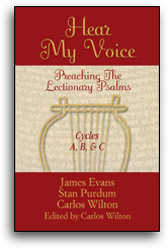
Hear My Voice
Preaching The Lectionary Psalms for Cycles A, B, C
(See Proper 12/Pentecost 10/Ordinary Time 17, Cycle A, for an alternative approach to 105:1-11, 45b; and see Proper 20/Pentecost 18/Ordinary Time 25, Cycle A, for an alternative approach to vv. 1-6, 37-45.)
These selections from the lengthy Psalm 105 are paired, this week, with the Genesis story of the betrayal of Joseph by his brothers. The Psalm provides a note of hope following the narration of that grim episode: for verses 16-22 remind us how the Lord "sent a man ahead of them" in a time of famine: "Joseph, who was sold as a slave" (v. 17). "His feet were hurt with fetters, his neck was put in a collar of iron" (v. 18) -- until such time as Pharaoh released him, and set him up as lord over his entire house.
This psalm is not just about the sufferings of Joseph. Its author -- or, at least, the editor of the book of Psalms, in the event that the original version of this psalm was written earlier -- undoubtedly has in mind the sufferings of his own exiled people at the hands of the Babylonians. Memories of fetters on the feet and a collar around the neck would still have been painful. Hope that sustains people in exile can only happen through the providence of God, the one who sends the champion, Joseph, out ahead of the people.
The Heidelberg Catechism -- one of the great Reformation-era confessions of faith -- defines providence in this way. It is "the almighty and ever-present power of God whereby he still upholds, as it were by his own hand, heaven and earth together with all creatures, and rules in such a way that leaves and grass, rain and drought, fruitful and unfruitful years, food and drink, health and sickness, riches and poverty, and everything else, come to us not by chance but by his fatherly hand."
"What advantage," the Catechism then asks, "comes from acknowledging God's creation and providence?"
"We learn that we are to be patient in adversity, grateful in the midst of blessing, and to trust our faithful God and Father for the future, assured that no creature shall separate us from his love, since all creatures are so completely in his hand that without his will they cannot even move." (Questions 27 and 28.)
The opposite of providence is chance. That is the prevailing secular view, and there is little comfort in it. The secular view is that our lives are aimlessly adrift in a vast and turbulent sea of chance. The psalmist's view of the world -- like that of the authors of the Heidelberg Catechism -- is very different. God cares about us, the people of the covenant: watching over us, protecting us. God may not always give us everything we want, but God will get us through.
Many of our listeners will be familiar with the saga of Antarctic explorer, Ernest Shackleton, who led the crew of his ice-trapped ship, the Endurance, on a perilous journey to safety, by open boat and on foot across barren ice and snow. The final part of that journey was accomplished by a hiking party composed of Shackleton and the two strongest of his men, who made it back to civilization and summoned help to rescue the others. Reflecting on his survival experience, Shackleton later recalled:
When I look back on those days, I have no doubt that Providence guided us, not only across those snow-fields, but across the storm-white sea that separated Elephant Island from our landing place in South Georgia. I know that during that long and racking march of thirty-six hours over the unnamed mountains and glaciers of South Georgia, it seemed to me often that we were four, not three. I said nothing to my companions on the point, but afterwards Worsely said to me: "Boss, I had the curious feeling on the march that there was another person with us."
Maybe it's only in the crises of life, as unexpected trials come our way, that we sense another presence there beside us -- one who is providentially guiding us. Psalms like this one remind us of the cyclical nature of the human life of faith. No generation has a monopoly on sinfulness, or suffering. Neither does any generation have a monopoly on God's goodness and grace. Time and again, God's people engage in the same dance steps -- first away from the Lord in disobedience, then back again, as divine hesed pulls us closer.
-- C. W.
These selections from the lengthy Psalm 105 are paired, this week, with the Genesis story of the betrayal of Joseph by his brothers. The Psalm provides a note of hope following the narration of that grim episode: for verses 16-22 remind us how the Lord "sent a man ahead of them" in a time of famine: "Joseph, who was sold as a slave" (v. 17). "His feet were hurt with fetters, his neck was put in a collar of iron" (v. 18) -- until such time as Pharaoh released him, and set him up as lord over his entire house.
This psalm is not just about the sufferings of Joseph. Its author -- or, at least, the editor of the book of Psalms, in the event that the original version of this psalm was written earlier -- undoubtedly has in mind the sufferings of his own exiled people at the hands of the Babylonians. Memories of fetters on the feet and a collar around the neck would still have been painful. Hope that sustains people in exile can only happen through the providence of God, the one who sends the champion, Joseph, out ahead of the people.
The Heidelberg Catechism -- one of the great Reformation-era confessions of faith -- defines providence in this way. It is "the almighty and ever-present power of God whereby he still upholds, as it were by his own hand, heaven and earth together with all creatures, and rules in such a way that leaves and grass, rain and drought, fruitful and unfruitful years, food and drink, health and sickness, riches and poverty, and everything else, come to us not by chance but by his fatherly hand."
"What advantage," the Catechism then asks, "comes from acknowledging God's creation and providence?"
"We learn that we are to be patient in adversity, grateful in the midst of blessing, and to trust our faithful God and Father for the future, assured that no creature shall separate us from his love, since all creatures are so completely in his hand that without his will they cannot even move." (Questions 27 and 28.)
The opposite of providence is chance. That is the prevailing secular view, and there is little comfort in it. The secular view is that our lives are aimlessly adrift in a vast and turbulent sea of chance. The psalmist's view of the world -- like that of the authors of the Heidelberg Catechism -- is very different. God cares about us, the people of the covenant: watching over us, protecting us. God may not always give us everything we want, but God will get us through.
Many of our listeners will be familiar with the saga of Antarctic explorer, Ernest Shackleton, who led the crew of his ice-trapped ship, the Endurance, on a perilous journey to safety, by open boat and on foot across barren ice and snow. The final part of that journey was accomplished by a hiking party composed of Shackleton and the two strongest of his men, who made it back to civilization and summoned help to rescue the others. Reflecting on his survival experience, Shackleton later recalled:
When I look back on those days, I have no doubt that Providence guided us, not only across those snow-fields, but across the storm-white sea that separated Elephant Island from our landing place in South Georgia. I know that during that long and racking march of thirty-six hours over the unnamed mountains and glaciers of South Georgia, it seemed to me often that we were four, not three. I said nothing to my companions on the point, but afterwards Worsely said to me: "Boss, I had the curious feeling on the march that there was another person with us."
Maybe it's only in the crises of life, as unexpected trials come our way, that we sense another presence there beside us -- one who is providentially guiding us. Psalms like this one remind us of the cyclical nature of the human life of faith. No generation has a monopoly on sinfulness, or suffering. Neither does any generation have a monopoly on God's goodness and grace. Time and again, God's people engage in the same dance steps -- first away from the Lord in disobedience, then back again, as divine hesed pulls us closer.
-- C. W.
