
Proper 21 / Pentecost 19 / Ordinary Time 26
Preaching
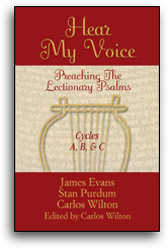
Hear My Voice
Preaching The Lectionary Psalms for Cycles A, B, C
(See Proper 16/Pentecost 14/Ordinary Time 21, Cycle A, for an alternative approach.)
Psalm 124 takes us deep into the thorny issue of claiming to have God on our side. The matter has come up repeatedly, in recent years, during the war in Iraq. Prayers have been offered, from both sides of the conflict, petitioning God's help in defeating "our" enemy and protecting "our" troops.
There is a slightly different nuance in this psalm. For one thing, instead of seeking God's favor in some pending conflict, the matter is already resolved and the psalmist is giving thanks for God's protection. Israel had suffered attack from some enemy and had prevailed. The psalmist interprets this outcome as God's saving power at work. Despite this minor variation, the theme is clear: Israel prevailed because God was on their side.
This is a predictable response for a person or community of faith. When good fortune comes our way -- or, as in this case, salvation -- it is our natural tendency to give God the credit. There is not any necessary sense of privileged position, but rather a general acknowledgment of thanks for a blessing that has touched our lives.
Claiming to have God on our side, however, does become a problem when we begin to take action based on the assumption. Once we assume a position of divine prerogative, the designations "us" and "them" can become severely problematic. If "we" are the Lord's and the Lord is on our side, then "they" are not only our enemy, but also the enemy of God. The gospel offers us a different perspective on this issue (cf. Mark 9:38-50). Jesus turns conventional wisdom on its head by telling us, "Whoever is not against us is for us."
We want to be able to say with the psalmist, "It was the Lord who was on our side." Sensing God's presence in times of trouble, acknowledging God's goodness in times of blessing, these are appropriate expressions of faith.
What we do not want to say, however -- and probably cannot honestly say -- is that "it was the Lord who was on our side exclusively." Once we make this claim, the hope of bridging the distance that exists between us and other human beings all but disappears. In the absolute claim of God's exclusive patronage, fellowship dies.
The tendency to divide the world into "us" and "them" is rooted deeply in our innate insecurity and fear. Hopefully, the love of God can set us free from that fear and suspicion and allow us to see what Jesus saw -- that "those who are not against us are for us." Of course, in the full realization of God's intent for us, all reference to "us" and "them" vanishes. In its place is an ideal vision of human community that may sound something like this: "We found each other as we gathered together on the Lord's side. It was there that we discovered that the Lord was for all of us equally."
-- J. E.
Psalm 124 takes us deep into the thorny issue of claiming to have God on our side. The matter has come up repeatedly, in recent years, during the war in Iraq. Prayers have been offered, from both sides of the conflict, petitioning God's help in defeating "our" enemy and protecting "our" troops.
There is a slightly different nuance in this psalm. For one thing, instead of seeking God's favor in some pending conflict, the matter is already resolved and the psalmist is giving thanks for God's protection. Israel had suffered attack from some enemy and had prevailed. The psalmist interprets this outcome as God's saving power at work. Despite this minor variation, the theme is clear: Israel prevailed because God was on their side.
This is a predictable response for a person or community of faith. When good fortune comes our way -- or, as in this case, salvation -- it is our natural tendency to give God the credit. There is not any necessary sense of privileged position, but rather a general acknowledgment of thanks for a blessing that has touched our lives.
Claiming to have God on our side, however, does become a problem when we begin to take action based on the assumption. Once we assume a position of divine prerogative, the designations "us" and "them" can become severely problematic. If "we" are the Lord's and the Lord is on our side, then "they" are not only our enemy, but also the enemy of God. The gospel offers us a different perspective on this issue (cf. Mark 9:38-50). Jesus turns conventional wisdom on its head by telling us, "Whoever is not against us is for us."
We want to be able to say with the psalmist, "It was the Lord who was on our side." Sensing God's presence in times of trouble, acknowledging God's goodness in times of blessing, these are appropriate expressions of faith.
What we do not want to say, however -- and probably cannot honestly say -- is that "it was the Lord who was on our side exclusively." Once we make this claim, the hope of bridging the distance that exists between us and other human beings all but disappears. In the absolute claim of God's exclusive patronage, fellowship dies.
The tendency to divide the world into "us" and "them" is rooted deeply in our innate insecurity and fear. Hopefully, the love of God can set us free from that fear and suspicion and allow us to see what Jesus saw -- that "those who are not against us are for us." Of course, in the full realization of God's intent for us, all reference to "us" and "them" vanishes. In its place is an ideal vision of human community that may sound something like this: "We found each other as we gathered together on the Lord's side. It was there that we discovered that the Lord was for all of us equally."
-- J. E.
