
Proper 22 / Pentecost 20 / Ordinary Time 27
Preaching
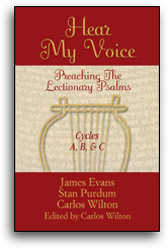
Hear My Voice
Preaching The Lectionary Psalms for Cycles A, B, C
The little-known book of Lamentations was likely composed in the ashes of Jerusalem, following the Babylonian invasion which carried the leaders of the Jewish community off into exile. It speaks to the concerns of the Jerusalem community for their long-term survival under occupation by a foreign power. While the book's title sounds grim, and its setting is dark, the book is fundamentally life-affirming. It is a testimony to the steadfast love of God that may be discovered through renewed faith, even in troubled times.
Although the book is traditionally attributed to Jeremiah and is possibly contemporaneous with him, there is no particular reason to claim him as the author. Still, the tradition of calling it "The Lamentations of Jeremiah" is a strong one in both Judaism and Christianity, despite the lack of textual evidence to that effect. It is entirely possible that the book is an anthology of poetry by different authors.
Lamentations 3:19-26 is part of a larger poem that struggles frankly with the possibility that the Lord is an adversary. In 3:1-18, the author figuratively shakes his fist at the heavens, questioning why God could allow such terrible suffering to come to the people: "[The Lord] is a bear lying in wait for me, a lion in hiding; he led me off my way and tore me to pieces; he has made me desolate" (vv. 10-11).
In today's passage, however, we see the beginning of the transition from despair to hope. The key transition is verses 19-21, in which we can see the poet move from "wormwood and gall" to an abiding awareness of God's faithfulness. Then, in the remaining verses of this selection, we see the poet offer up a defiant song of praise: "The steadfast love of the Lord never ceases, his mercies never come to an end; they are new every morning; great is your faithfulness" (vv. 22-23).
This is, of course, the basis for the well-loved hymn, "Great Is Thy Faithfulness," which is an excellent choice to go along with a sermon on this passage.
Verdan Smailovic, a classical cellist, was famous for playing in the great concert halls of Europe, as well as in the small towns and villages of his native Yugoslavia. "Music is not just for the rich and privileged," he used to say, justifying his decision to play these smaller venues. "Music is for everyone."
Smailovic was the famous lone cellist who sat in the rubble of Sarajevo in formal attire and played his instrument, after his opera theater had been destroyed and many of his neighbors had been killed by mortar rounds. A television reporter asked him if he were crazy for playing his cello while Sarajevo was being shelled. Smailovic replied: "You ask me, 'Am I crazy for playing the cello?' 'Why do you not ask if they are crazy for shelling Sarajevo?' "
Smailovic would have found a kindred spirit in the author of Lamentations, chapter 3.
-- C. W.
Although the book is traditionally attributed to Jeremiah and is possibly contemporaneous with him, there is no particular reason to claim him as the author. Still, the tradition of calling it "The Lamentations of Jeremiah" is a strong one in both Judaism and Christianity, despite the lack of textual evidence to that effect. It is entirely possible that the book is an anthology of poetry by different authors.
Lamentations 3:19-26 is part of a larger poem that struggles frankly with the possibility that the Lord is an adversary. In 3:1-18, the author figuratively shakes his fist at the heavens, questioning why God could allow such terrible suffering to come to the people: "[The Lord] is a bear lying in wait for me, a lion in hiding; he led me off my way and tore me to pieces; he has made me desolate" (vv. 10-11).
In today's passage, however, we see the beginning of the transition from despair to hope. The key transition is verses 19-21, in which we can see the poet move from "wormwood and gall" to an abiding awareness of God's faithfulness. Then, in the remaining verses of this selection, we see the poet offer up a defiant song of praise: "The steadfast love of the Lord never ceases, his mercies never come to an end; they are new every morning; great is your faithfulness" (vv. 22-23).
This is, of course, the basis for the well-loved hymn, "Great Is Thy Faithfulness," which is an excellent choice to go along with a sermon on this passage.
Verdan Smailovic, a classical cellist, was famous for playing in the great concert halls of Europe, as well as in the small towns and villages of his native Yugoslavia. "Music is not just for the rich and privileged," he used to say, justifying his decision to play these smaller venues. "Music is for everyone."
Smailovic was the famous lone cellist who sat in the rubble of Sarajevo in formal attire and played his instrument, after his opera theater had been destroyed and many of his neighbors had been killed by mortar rounds. A television reporter asked him if he were crazy for playing his cello while Sarajevo was being shelled. Smailovic replied: "You ask me, 'Am I crazy for playing the cello?' 'Why do you not ask if they are crazy for shelling Sarajevo?' "
Smailovic would have found a kindred spirit in the author of Lamentations, chapter 3.
-- C. W.
