
Proper 23
Devotional
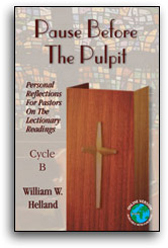
Pause Before The Pulpit
Personal Reflections For Pastors On The Lectionary Readings
Mark 10:17-31
In ministry, we often encounter people who are fully convinced that they are "good enough" to get into heaven. This text clarifies for us what God's definition of "good" is, and how far superior it is to the world's definition.
In the church, we use this word a lot. We talk about how certain people are "good people." We teach our children to "be good kids." We tell them that people who obey the Ten Commandments are "good," yet they hear us call people "good," who fall way short of that perfect standard of goodness. Clearly, even the church's definition is inferior to Christ's definition.
Our text is the familiar account of a rich man who approached Jesus to find out what he must do to inherit eternal life. The man addressed Jesus as a Good Teacher. Apparently he had some foreknowledge about Jesus. But Jesus quickly corrected him, saying: Why do you call me good? No one is good but God alone. That statement is the clearest definition of what it means to be "good." It means to be God! And that rules out all of us, doesn't it?
Jesus tested the man's own ideas in regards to his own goodness by asking how well he was keeping the Ten Commandments. When we hear the man's description of his lifestyle, any of us would be quick to characterize him as a "good man." In fact we would probably welcome people like him on our church council and ask him to teach Sunday school. After all, we are always looking for some "good" people to fill these positions, right?
Well, the rich man failed the test, for although he had been a "good boy," one thing he lacked; complete obedience to the First Commandment. When faced with making a choice between his wealth or following Jesus, his wealth proved to be his god. And he went away grieving. He wasn't good enough, was he?
How important it is that we correct our own thinking in terms of what true, biblical goodness is, and help our parishioners to see goodness from this perspective as well. We should be doing all we can, with the help of the Holy Spirit, to be good people by keeping the Ten Commandments; but the truth of the matter is, we'll never keep them perfectly. We just can't be good enough to please God. What Jesus was asking of the man, he asks of each of us, too -- complete abandonment to him. In the attitude of our hearts, we are to sell everything and follow him. This complete "selling out" is what is required for salvation. It isn't a work we do, as much as an attitude we have, so God can be first and foremost in our lives.
Peter began to question our Lord as to what would come of this complete abandonment to follow him, and Jesus replied: Truly I tell you, there is no one who has left house or brothers or sisters or mother or father or children or fields, for my sake and for the sake of the good news, who will not receive a hundredfold now in this age -- houses, brothers and sisters, mothers and children, and fields, with persecutions -- and in the age to come eternal life.
Perhaps there is no one group of people who find more comfort in this than pastors and missionaries. There is, in one sense, an abandonment of all these things in the attitude of our heart to follow Jesus and allow him to have first place over all our other affections. But then there is the actual, physical abandonment of many of these things and people, due to his call in our lives. He may call us to serve a church on the other side of the nation from our loved ones. He may call us to serve in a mission field halfway around the world. He may ask us to leave our jobs and financial security to serve him in a church that can barely meet our needs.
Does such sacrifice make us "good" people? No, it is merely the obedient response of people who believe, by faith, that Jesus has more to offer them than anything, or anyone, else.
A Pastor's Prayer:
Dear Lord,
Thank you that you are the ultimate standard of goodness. Forgive me for my puffed-up attitudes when I have thought myself to be a good person. Thank you, that on the basis of Christ's blood, you see his goodness in me rather than the sinner that I am. Amen.
Hebrews 4:12-16
This text beautifully presents to us a balance of law and grace. Verses 12 and 13 contain law and certainly don't beat around the bush when describing the activity of God's Word. Verses 14 through 16 apply the salve of God's grace to the wounds inflicted by the necessary surgery of the law. Let's look closer at both passages.
As people whose primary calling is to proclaim God's Word in a variety of settings, through a variety of means, let us never underestimate its power. Our text describes God's Word as living and active. When we read the Bible, we are not reading something that is dead, out-of-date, and ineffective. No! We hold in our hands something that is alive! Like holding a lion cub who wants to get away and pounce on its enemies, so the Word of God is alive and "squirming" -- wanting to get away from our lips to reveal sin and unbelief and bring grace to the broken hearted.
The author uses the metaphor of a sword when describing the activity of God's Word: The word of God is ... sharper than any two-edged sword, piercing until it divides soul from spirit, joints from marrow; it is able to judge the thoughts and intentions of the heart. And before him no creature is hidden, but all are naked and laid bare to the eyes of the one to whom we must render an account.
May we not take lightly what God is doing when we share his word. When it is proclaimed in all its truth and authority, God is cutting deep into the hearts of the listeners. He is speaking to consciences and trying to cut away the hardness of hearts that have grown cold from sin and unbelief. David is a good example of this when the Prophet Nathan came and boldly spoke God's Word to him. The word of God cut deep into David that day, revealing his sin. It did that, because one man obediently spoke what he was told to speak, "Thus saith the Lord...!" He did it with the authority that God's Living Word possesses. He did it for the good of David and the nation, and for God's honor and glory. Was it fun? I'm sure Nathan would have rather done just about anything else that day, but the fact is, he did it; and through him God accomplished much with the law that day. David responded favorably to the law so that God was then able, through his word, to apply the "salve" of grace to David's "wounds."
The author of Hebrews then turns our attention from the horrific picture of God's Law at work to that of his grace bringing forgiveness and healing. He does this through the imagery of Christ as the great high priest. He wants us to know that Jesus is far superior to any earthly high priest. Jesus has passed through the heavens; making him a divine, all-powerful high priest. Yet, in spite of that power and glory, he is not so high and mighty that he is unable to sympathize with our weaknesses. This is where grace begins to get really beautiful!
We don't deserve to have him sympathize with us. We deserve swift judgment and punishment for our sins, but not our great high priest. He is one who in every respect has been tested as we are, yet without sin. That means he identifies with us. He is one who can say to us, "I understand what you are going through. I know it is hard. I felt like giving up, too, but I didn't."
What a beautiful, gracious invitation closes out this text: Let us therefore approach the throne of grace with boldness, so that we may receive mercy and find grace to help in time of need. He invites us to approach his throne of grace after we have sinned against him. This is God's grace at its purest and best! We don't deserve that, nor do the people to whom we proclaim his grace. That is why it is called grace and mercy. That is what we get to share with people after they have been injured, sometimes severely, by God's Law.
Preaching the law is never fun, but when you do it with God's grace in view, your listeners are more likely to respond positively and feel loved by both you and the Lord.
A Pastor's Prayer:
Dear Lord,
Thank you for your word -- that it is alive and active. Thank you, that as I proclaim your law, you are revealing to people their problem with sin; and as I proclaim your grace, you are forgiving their sins and bringing healing to their souls. Lord, help me to faithfully proclaim a balance of both for your sake. Amen.
In ministry, we often encounter people who are fully convinced that they are "good enough" to get into heaven. This text clarifies for us what God's definition of "good" is, and how far superior it is to the world's definition.
In the church, we use this word a lot. We talk about how certain people are "good people." We teach our children to "be good kids." We tell them that people who obey the Ten Commandments are "good," yet they hear us call people "good," who fall way short of that perfect standard of goodness. Clearly, even the church's definition is inferior to Christ's definition.
Our text is the familiar account of a rich man who approached Jesus to find out what he must do to inherit eternal life. The man addressed Jesus as a Good Teacher. Apparently he had some foreknowledge about Jesus. But Jesus quickly corrected him, saying: Why do you call me good? No one is good but God alone. That statement is the clearest definition of what it means to be "good." It means to be God! And that rules out all of us, doesn't it?
Jesus tested the man's own ideas in regards to his own goodness by asking how well he was keeping the Ten Commandments. When we hear the man's description of his lifestyle, any of us would be quick to characterize him as a "good man." In fact we would probably welcome people like him on our church council and ask him to teach Sunday school. After all, we are always looking for some "good" people to fill these positions, right?
Well, the rich man failed the test, for although he had been a "good boy," one thing he lacked; complete obedience to the First Commandment. When faced with making a choice between his wealth or following Jesus, his wealth proved to be his god. And he went away grieving. He wasn't good enough, was he?
How important it is that we correct our own thinking in terms of what true, biblical goodness is, and help our parishioners to see goodness from this perspective as well. We should be doing all we can, with the help of the Holy Spirit, to be good people by keeping the Ten Commandments; but the truth of the matter is, we'll never keep them perfectly. We just can't be good enough to please God. What Jesus was asking of the man, he asks of each of us, too -- complete abandonment to him. In the attitude of our hearts, we are to sell everything and follow him. This complete "selling out" is what is required for salvation. It isn't a work we do, as much as an attitude we have, so God can be first and foremost in our lives.
Peter began to question our Lord as to what would come of this complete abandonment to follow him, and Jesus replied: Truly I tell you, there is no one who has left house or brothers or sisters or mother or father or children or fields, for my sake and for the sake of the good news, who will not receive a hundredfold now in this age -- houses, brothers and sisters, mothers and children, and fields, with persecutions -- and in the age to come eternal life.
Perhaps there is no one group of people who find more comfort in this than pastors and missionaries. There is, in one sense, an abandonment of all these things in the attitude of our heart to follow Jesus and allow him to have first place over all our other affections. But then there is the actual, physical abandonment of many of these things and people, due to his call in our lives. He may call us to serve a church on the other side of the nation from our loved ones. He may call us to serve in a mission field halfway around the world. He may ask us to leave our jobs and financial security to serve him in a church that can barely meet our needs.
Does such sacrifice make us "good" people? No, it is merely the obedient response of people who believe, by faith, that Jesus has more to offer them than anything, or anyone, else.
A Pastor's Prayer:
Dear Lord,
Thank you that you are the ultimate standard of goodness. Forgive me for my puffed-up attitudes when I have thought myself to be a good person. Thank you, that on the basis of Christ's blood, you see his goodness in me rather than the sinner that I am. Amen.
Hebrews 4:12-16
This text beautifully presents to us a balance of law and grace. Verses 12 and 13 contain law and certainly don't beat around the bush when describing the activity of God's Word. Verses 14 through 16 apply the salve of God's grace to the wounds inflicted by the necessary surgery of the law. Let's look closer at both passages.
As people whose primary calling is to proclaim God's Word in a variety of settings, through a variety of means, let us never underestimate its power. Our text describes God's Word as living and active. When we read the Bible, we are not reading something that is dead, out-of-date, and ineffective. No! We hold in our hands something that is alive! Like holding a lion cub who wants to get away and pounce on its enemies, so the Word of God is alive and "squirming" -- wanting to get away from our lips to reveal sin and unbelief and bring grace to the broken hearted.
The author uses the metaphor of a sword when describing the activity of God's Word: The word of God is ... sharper than any two-edged sword, piercing until it divides soul from spirit, joints from marrow; it is able to judge the thoughts and intentions of the heart. And before him no creature is hidden, but all are naked and laid bare to the eyes of the one to whom we must render an account.
May we not take lightly what God is doing when we share his word. When it is proclaimed in all its truth and authority, God is cutting deep into the hearts of the listeners. He is speaking to consciences and trying to cut away the hardness of hearts that have grown cold from sin and unbelief. David is a good example of this when the Prophet Nathan came and boldly spoke God's Word to him. The word of God cut deep into David that day, revealing his sin. It did that, because one man obediently spoke what he was told to speak, "Thus saith the Lord...!" He did it with the authority that God's Living Word possesses. He did it for the good of David and the nation, and for God's honor and glory. Was it fun? I'm sure Nathan would have rather done just about anything else that day, but the fact is, he did it; and through him God accomplished much with the law that day. David responded favorably to the law so that God was then able, through his word, to apply the "salve" of grace to David's "wounds."
The author of Hebrews then turns our attention from the horrific picture of God's Law at work to that of his grace bringing forgiveness and healing. He does this through the imagery of Christ as the great high priest. He wants us to know that Jesus is far superior to any earthly high priest. Jesus has passed through the heavens; making him a divine, all-powerful high priest. Yet, in spite of that power and glory, he is not so high and mighty that he is unable to sympathize with our weaknesses. This is where grace begins to get really beautiful!
We don't deserve to have him sympathize with us. We deserve swift judgment and punishment for our sins, but not our great high priest. He is one who in every respect has been tested as we are, yet without sin. That means he identifies with us. He is one who can say to us, "I understand what you are going through. I know it is hard. I felt like giving up, too, but I didn't."
What a beautiful, gracious invitation closes out this text: Let us therefore approach the throne of grace with boldness, so that we may receive mercy and find grace to help in time of need. He invites us to approach his throne of grace after we have sinned against him. This is God's grace at its purest and best! We don't deserve that, nor do the people to whom we proclaim his grace. That is why it is called grace and mercy. That is what we get to share with people after they have been injured, sometimes severely, by God's Law.
Preaching the law is never fun, but when you do it with God's grace in view, your listeners are more likely to respond positively and feel loved by both you and the Lord.
A Pastor's Prayer:
Dear Lord,
Thank you for your word -- that it is alive and active. Thank you, that as I proclaim your law, you are revealing to people their problem with sin; and as I proclaim your grace, you are forgiving their sins and bringing healing to their souls. Lord, help me to faithfully proclaim a balance of both for your sake. Amen.
