
Proper 24 / Pentecost 22 / Ordinary Time 29
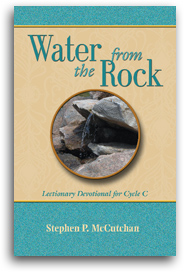
Devotional
Water From the Rock
Lectionary Devotional for Cycle C
Object:
All scripture is inspired by God and is useful for teaching, for reproof, for correction, and for training in righteousness.
-- 2 Timothy 3:16
In an age of confusion, it is natural for people to be attracted to churches and spiritual teachings that emphasize strict disciplines. When our life is in chaos, a very viable strategy is to accept a strong discipline to provide order. Many a distraught person has found comfort in the strict discipline of a fundamentalist church. In times of confusion, we are not good at making lots of decisions, and there is comfort in having someone else lay down the law for us. The danger is that we are tempted to believe that the disciplines themselves are a measure of our faithfulness rather than a means to restore our life to a sense of balance.
Paul was arguing against a false form of asceticism. Apparently some had argued that the truly faithful would be celibate or accept a strict dietary program. It was not that being a vegetarian or choosing a celibate life was wrong in itself. For some it might be the best choice. What Paul was arguing against was the assumption that such behaviors were required for one to be truly faithful. He grounded his belief in the fact that both the material reality and the relationships between people were part of the goodness of God's creation, which according to Genesis 1:31 was "very good." The key is whether any of the realities of our lives are "received with thanksgiving."
There is no aspect of this world that cannot become an idol. Yet when we participate in this world with an attitude of thanksgiving, we are aware that each aspect of life is a reflection of God's love for us, and we can respond accordingly. Strong religious disciplines can be a gift of God to a person, but they should never become the measure by which we judge our neighbor.
-- 2 Timothy 3:16
In an age of confusion, it is natural for people to be attracted to churches and spiritual teachings that emphasize strict disciplines. When our life is in chaos, a very viable strategy is to accept a strong discipline to provide order. Many a distraught person has found comfort in the strict discipline of a fundamentalist church. In times of confusion, we are not good at making lots of decisions, and there is comfort in having someone else lay down the law for us. The danger is that we are tempted to believe that the disciplines themselves are a measure of our faithfulness rather than a means to restore our life to a sense of balance.
Paul was arguing against a false form of asceticism. Apparently some had argued that the truly faithful would be celibate or accept a strict dietary program. It was not that being a vegetarian or choosing a celibate life was wrong in itself. For some it might be the best choice. What Paul was arguing against was the assumption that such behaviors were required for one to be truly faithful. He grounded his belief in the fact that both the material reality and the relationships between people were part of the goodness of God's creation, which according to Genesis 1:31 was "very good." The key is whether any of the realities of our lives are "received with thanksgiving."
There is no aspect of this world that cannot become an idol. Yet when we participate in this world with an attitude of thanksgiving, we are aware that each aspect of life is a reflection of God's love for us, and we can respond accordingly. Strong religious disciplines can be a gift of God to a person, but they should never become the measure by which we judge our neighbor.
