
Proper 25 / Pentecost 23 / Ordinary Time 30
Devotional
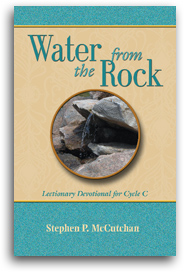
Water From the Rock
Lectionary Devotional for Cycle C
Object:
... I will pour out my spirit on all flesh....
-- Joel 2:28a
Peter drew on this scripture to interpret what was happening at Pentecost. In a similar manner to what the early Christians would later experience at Pentecost, so this early prophet experienced the Spirit of God as a force that transcended human control. It was understandable why Peter chose this passage to describe what was happening when the disciples were given the ability to communicate across language and ethnic barriers. In this passage, Joel described the Spirit as breaking through the artificial barriers imposed by humans as they sought to classify the world. The Spirit was no respecter of the barriers of age or gender. "I will pour out my spirit on all flesh; your sons and your daughters shall prophesy, your old men shall dream dreams, and your young men shall see visions." Nor was the Spirit constrained by the artificial barriers of class. "Even on the male and female slaves, in those days, I will pour out my spirit."
Earlier Joel had described the forces of nature as expressive of God's judgment and blessing. First the locusts were seen as God's army by which the people were judged. Then when the rains came, this too, was seen as God at work. The power of the Spirit released was the power of the presence of God. The injustices of the world led to a hunger for God's presence, which was often referred to as the day of the Lord. Joel suggested that the day of the Lord's coming would be preceded by cosmic signs. The infinite could not be inserted in the finite arena of time and space without severe disruption.
When we experience the infinite mystery infusing our lives, it forces a decision. For Christians, this prophecy would become the prism through which they interpreted the coming of Jesus. Jesus brought with him a bountiful harvest after a severe drought. One can see this in the feeding of the 5,000. But his presence forced a decision as to whether people would welcome God in him or turn away. All of humanity would like to see an overcoming of worldly divisions and a blossoming of peace within the world. The overcoming of such divisions was foreshadowed in Jesus' ministry to adults and children, male and female, and outsiders and insiders. Jerusalem became the critical turning point, and his disciples, those whom Jesus called, did escape.
All of this was confirmed by the Pentecost experience. During that Jewish festival of renewing the covenant with God, those who called on the name of Jesus received the Spirit that overcame all divisions. The church today has to decide whether they will allow this same Spirit to infuse their community. The reluctance of the church to open themselves to the Spirit may well be the awareness that such an experience does mean we are open to a force we cannot control.
-- Joel 2:28a
Peter drew on this scripture to interpret what was happening at Pentecost. In a similar manner to what the early Christians would later experience at Pentecost, so this early prophet experienced the Spirit of God as a force that transcended human control. It was understandable why Peter chose this passage to describe what was happening when the disciples were given the ability to communicate across language and ethnic barriers. In this passage, Joel described the Spirit as breaking through the artificial barriers imposed by humans as they sought to classify the world. The Spirit was no respecter of the barriers of age or gender. "I will pour out my spirit on all flesh; your sons and your daughters shall prophesy, your old men shall dream dreams, and your young men shall see visions." Nor was the Spirit constrained by the artificial barriers of class. "Even on the male and female slaves, in those days, I will pour out my spirit."
Earlier Joel had described the forces of nature as expressive of God's judgment and blessing. First the locusts were seen as God's army by which the people were judged. Then when the rains came, this too, was seen as God at work. The power of the Spirit released was the power of the presence of God. The injustices of the world led to a hunger for God's presence, which was often referred to as the day of the Lord. Joel suggested that the day of the Lord's coming would be preceded by cosmic signs. The infinite could not be inserted in the finite arena of time and space without severe disruption.
When we experience the infinite mystery infusing our lives, it forces a decision. For Christians, this prophecy would become the prism through which they interpreted the coming of Jesus. Jesus brought with him a bountiful harvest after a severe drought. One can see this in the feeding of the 5,000. But his presence forced a decision as to whether people would welcome God in him or turn away. All of humanity would like to see an overcoming of worldly divisions and a blossoming of peace within the world. The overcoming of such divisions was foreshadowed in Jesus' ministry to adults and children, male and female, and outsiders and insiders. Jerusalem became the critical turning point, and his disciples, those whom Jesus called, did escape.
All of this was confirmed by the Pentecost experience. During that Jewish festival of renewing the covenant with God, those who called on the name of Jesus received the Spirit that overcame all divisions. The church today has to decide whether they will allow this same Spirit to infuse their community. The reluctance of the church to open themselves to the Spirit may well be the awareness that such an experience does mean we are open to a force we cannot control.
