
Proper 26
Sermon
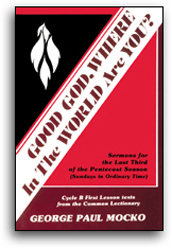
GOOD GOD, WHERE In The WORLD Are YOU?
Sermons for the Last Third of the Pentecost Season
The Central Proposition; Sugar-coated Love; Little God, Big God; (Some Bible Readings); and How Jesus Brings the Distant God Close.
What John 3:16 is to Christianity, Deuteronomy 6:4-5 is to Judaism. "Hear O Israel: the Lord our God is one Lord; and you shall love the Lord your God with all your heart, and with all your soul, and with all your might." These are the words of the Shema, and as the words that follow indicate, the first words committed to memory by a Jewish child; the words that appear on the mezuza on a Jewish doorpost; the words that appear in the phylacteries worn by the pious on wrist and forehead. The Shema is the first two of the Ten Commandments stated positively. It is the central command, the primary creed, the summary statement of the Jewish faith. It is, morever, as we hear in the Gospel for today, the answer Jesus gave when asked what the most important Commandment was.
Since this text is so basic, there are many roads we can take in exploring it, and all could be called central; and there are innumerable tangents on which we could get lost. We will look at loving God. We will look at that God himself. And, then, we'll take a second look at loving him.
I hope I will not offend you when I say that I am not infrequently offended by what is presented as "love for God." Love for God frequently seems little more than a very sugary sentiment. An extreme example here is the man or woman dressed up in shining satin, embroidered cowboy suit with plugged-up six-guns, and western accent, speaking of Jesus as "muh saddle buddy and the best friend a man ever had." The love expressed in the calendar-type pictures of Jesus with the long, flowing L'Oreal wave, sad-eyed, with a twenty watt bulb behind his head, mincing along, draped with enough cloth to fill the window of a yard-goods store. The sentimental love expressed in some of those rather whiny hymns we sometimes sing.
The whole business, of course, rather dreadfully cheapens religious faith, making the accusations of those outside the church that religious faith is nothing more than sentiment and escapism, quite embarrassing. By pointing to such examples, they have rather good evidence all of this may well happen because we miss the majesty, the glory, the all-encompassing vastness that is experienced in those words, "The Lord our God is one." We want a God close to us, to be sure, but in pulling that idea in, so often we make God so small.
To hear some speak, you would think that the only place in this world where God is active and has any real authority is "my little world." Quite like many ancient Jews who seemed to feel that God's only concern on this earth was with the nation to Israel, that he was so wrapped up in this love that he is content to let the rest of the world go by. As if God were Lord only of Israel, or today, Christ were only Lord of the church, and the rest of the world is outside of his authority, at least, that is, until that day when he will assert it by damning the rest of the world to eternal torment.
Those outside the circle of faith are quick to point out the inconsistency and irrationality of all of this. No less a man than that historian, Arnold Toynbee, once chastized us for the smallness of this. "You are so narrow-minded. Do you seriously believe that you have exclusive possession of truth, and that wherever any disagree with you, they are automatically wrong?" "Away with you," says the man approached by a missionary in exasperation, "how can you ask me to accept a God who has been damning generations of people for sins they never understood, and for a lack of faith in a Jesus whose name they never heard?"
It is undeniable that there is in the history, certainly, and in the faith of both Judaism and Christianity, a fundamental exclusivism. Quite basic to both our faiths is the assertion that God has spoken in a particular way through our own particular histories. The second lesson from Hebrews clearly speaks of Jesus as the one high priest. But it is also beyond question that it is a gross distortion to turn this particularity into a rigid exclusivism where God woos only us and only through us and lets the rest of the world go by.
From the creation narratives, which stand there in wonder before the Creator to the crashing "hallelujas," and "glorias" of Revelation, it is clear beyond question that the God experienced and described there is the Lord of the whole universe. He is, in the words of Paul, "the source, guide and goal of all things." (Romans 11:36)
In the Old Testament, this universal lordship is sometimes stated in such startlingly concrete terms that it might even repel us, but if given deeper thought, it ought to thrill us - as when the two Isaiahs speak of God's using, and even guiding the actions of the world conquerers, even the bloody Sargon, and his successor Sennacherib of Assyria, Cyrus of Persia. Modern parallels for such would have us claiming as God's instruments Gorbachev, Ho Chi Minh, Yassar Arafat and Colonel Kadafi. The New Testament which surely found that even Herod and Pilate, whether they knew or liked it or not, served God and were instruments of God, carried to new heights this theme of universal and exalted lordship set forth in the Shema.
Let me just read to you some of these passages. Listen to these words as if you were hearing them for the first time, and maybe it will be the first time that you really hear them. Try to capture the majesty, the wonder, the sweeping, all encompassing vision expressed in these passages.
First, from John 1:1-5: "When all things began, the Word already was. The Word, the personal expression of God dwelt with God, and what God was, the Word was. The Word, then, was with God at the beginning, and through Him all things came to be; no single thing was created without Him. All that came to be was alive with His life, and that life was the light of men. The light shines on in the dark, and the darkness has never quenched it."
From Ephesians 1:9-10: "He has made known to us His hidden purpose, namely, that the universe, all in heaven and on earth might be brought into a unity in Christ." From Romans 8:20-21: "For the created universe waits with eager expectation for God's sons to be revealed. The whole universe groans in all its parts as if in the pangs of childbirth, because the universe itself is to be freed from the shackles of mortality and enter upon the liberty and splendor of the children of God."
From Colossians 1:15-20: "Christ is the visible expression of the invisible God. In Him everything was made, whether spiritual or material, seen or unseen. The whole universe has been created through Him, and for Him. He is both the First Principle, and the Upholding Principle of the whole scheme of creation ... Life from nothing began through Him, and life from the dead began through Him. He is therefore justly called the Lord of all. It was in Him that the full nature of God chose to dwell, and through Him God planned to reconcile in His Person all things whether on earth or in heaven."
Here is a God before whom we bow down and whom we can worship; a God so enormous, so all-pervading, so present, that the mind feels as if it will explode as we are caught by this majesty, and try to absorb it. Here is a God, and presence active in all things, all processes in the wondrous division of a cell; in the awesome, silent wheeling of the galaxies; in the small snail that no eye sees inching across the bottom of the sea; in the opening of a flower; in the tear of a child as that child for the first time feels pain, not for itself, but on behalf of another; in the tides; in the mentally retarded girl for whom so much is incomprehensible, yet who knows that she is she, and is so without guile that you envy her; in the amazing geometric patterns in the coloring of a serpent; in the man who remains a good man despite more than enough temptations and suffering to fill three lives; a God whose purposes encompass all things, quakes and gamma rays, and the meditations of a Buddhist monk; in reproduction; and even in the rebellion of an atheist. A God who embraces and supports all, to whom all things owe their being, in whom all things are held together.
Such a God we can worship and hold in awe. "Hear O Israel, The Lord our God is One Lord." Yes, we worship but the command is to love. Those called pantheists all through history have been able to see this divine activity, and yet have remained untouched by the consciousness of any personal presence. Before we can love, all of this must touch our lives individually.
We must be able to see how this divine activity and presence is not only in the division of the cell, but also in the cells that compose my body and yours. This divine activity and presence is not only in life, in the life of the retarded girl, or the good man, but this activity, this presence, touches my life and yours.
This critical part of the whole business of loving God, the ancient Jews saw, for them as a people, the event of the exodus, and, individually as they were drawn into and made a part of that event, through, especially, their annual participation in the Passover. As Christians, we draw, as those New Testament passages we read make clear, from the coming, the life, the death and resurrection of Jesus Christ. For us in the twentieth century, as for the first century disciples, this event of Christians exposes God's eternal will and activity for you and me.
There it can be seen by us, as it was seen by them, that as God came in humility then, in a very common way, he comes so continuously, and now, reaching for the lost, through common things. As he came then on his own initiative, not waiting for mankind to diagnose its own sickness and write the prescription, so he comes continuously, and now, to us, before we ask. As he returned to them after their treachery, which resulted in the crucifixion, so he comes to us, continuously, now, choosing to disregard our treachery. As with the first disciples, those darkest hours of the crucifixion, when God seemed never more distant and unbelievable, this time turned out in actuality to be the time when his love and presence were never so near. So we can believe that in the dark periods of our lives and the dark periods of history, continuously, and now, he is especially close, taking, if possible more care than ever to move all things, to move mankind, to move me, and you toward our common fulfillment in him. As they found that everything, from the smallest event to the most evil, finally was forced to contribute positively to bringing his life to its fulfillment, so we can believe that continuously God so directs, for nothing exists independently of him, and there is nothing that is not actively involved in the accomplishment of what God purposes. All creation now strains and groans with us toward the common fulfillment God has determined and toward which he inexorably draws all things. Such a God we can love with heart, mind and strength.
Please pray with me a prayer somewhat adapted from some of those prayed by a man named Pierre Teilhard de Chardin: "Almighty God, you are eternal mystery to us, yet mysteriously known to us through the Christ. Cause us to believe ardently and above all things in your active presence. Cause us to prove our belief by taking great care never to stifle, nor distort, nor waste the power to wonder, and the power to love which you give to us. Give us the vision to see your direction which shows us each moment, by every day's events where to take the next step. In this way, draw us together with your whole creation to fulfillment in You. You have caused us to pray; and now, O Lord, crush every internal and external barrier which would prevent us from knowing your answer. Amen."
What John 3:16 is to Christianity, Deuteronomy 6:4-5 is to Judaism. "Hear O Israel: the Lord our God is one Lord; and you shall love the Lord your God with all your heart, and with all your soul, and with all your might." These are the words of the Shema, and as the words that follow indicate, the first words committed to memory by a Jewish child; the words that appear on the mezuza on a Jewish doorpost; the words that appear in the phylacteries worn by the pious on wrist and forehead. The Shema is the first two of the Ten Commandments stated positively. It is the central command, the primary creed, the summary statement of the Jewish faith. It is, morever, as we hear in the Gospel for today, the answer Jesus gave when asked what the most important Commandment was.
Since this text is so basic, there are many roads we can take in exploring it, and all could be called central; and there are innumerable tangents on which we could get lost. We will look at loving God. We will look at that God himself. And, then, we'll take a second look at loving him.
I hope I will not offend you when I say that I am not infrequently offended by what is presented as "love for God." Love for God frequently seems little more than a very sugary sentiment. An extreme example here is the man or woman dressed up in shining satin, embroidered cowboy suit with plugged-up six-guns, and western accent, speaking of Jesus as "muh saddle buddy and the best friend a man ever had." The love expressed in the calendar-type pictures of Jesus with the long, flowing L'Oreal wave, sad-eyed, with a twenty watt bulb behind his head, mincing along, draped with enough cloth to fill the window of a yard-goods store. The sentimental love expressed in some of those rather whiny hymns we sometimes sing.
The whole business, of course, rather dreadfully cheapens religious faith, making the accusations of those outside the church that religious faith is nothing more than sentiment and escapism, quite embarrassing. By pointing to such examples, they have rather good evidence all of this may well happen because we miss the majesty, the glory, the all-encompassing vastness that is experienced in those words, "The Lord our God is one." We want a God close to us, to be sure, but in pulling that idea in, so often we make God so small.
To hear some speak, you would think that the only place in this world where God is active and has any real authority is "my little world." Quite like many ancient Jews who seemed to feel that God's only concern on this earth was with the nation to Israel, that he was so wrapped up in this love that he is content to let the rest of the world go by. As if God were Lord only of Israel, or today, Christ were only Lord of the church, and the rest of the world is outside of his authority, at least, that is, until that day when he will assert it by damning the rest of the world to eternal torment.
Those outside the circle of faith are quick to point out the inconsistency and irrationality of all of this. No less a man than that historian, Arnold Toynbee, once chastized us for the smallness of this. "You are so narrow-minded. Do you seriously believe that you have exclusive possession of truth, and that wherever any disagree with you, they are automatically wrong?" "Away with you," says the man approached by a missionary in exasperation, "how can you ask me to accept a God who has been damning generations of people for sins they never understood, and for a lack of faith in a Jesus whose name they never heard?"
It is undeniable that there is in the history, certainly, and in the faith of both Judaism and Christianity, a fundamental exclusivism. Quite basic to both our faiths is the assertion that God has spoken in a particular way through our own particular histories. The second lesson from Hebrews clearly speaks of Jesus as the one high priest. But it is also beyond question that it is a gross distortion to turn this particularity into a rigid exclusivism where God woos only us and only through us and lets the rest of the world go by.
From the creation narratives, which stand there in wonder before the Creator to the crashing "hallelujas," and "glorias" of Revelation, it is clear beyond question that the God experienced and described there is the Lord of the whole universe. He is, in the words of Paul, "the source, guide and goal of all things." (Romans 11:36)
In the Old Testament, this universal lordship is sometimes stated in such startlingly concrete terms that it might even repel us, but if given deeper thought, it ought to thrill us - as when the two Isaiahs speak of God's using, and even guiding the actions of the world conquerers, even the bloody Sargon, and his successor Sennacherib of Assyria, Cyrus of Persia. Modern parallels for such would have us claiming as God's instruments Gorbachev, Ho Chi Minh, Yassar Arafat and Colonel Kadafi. The New Testament which surely found that even Herod and Pilate, whether they knew or liked it or not, served God and were instruments of God, carried to new heights this theme of universal and exalted lordship set forth in the Shema.
Let me just read to you some of these passages. Listen to these words as if you were hearing them for the first time, and maybe it will be the first time that you really hear them. Try to capture the majesty, the wonder, the sweeping, all encompassing vision expressed in these passages.
First, from John 1:1-5: "When all things began, the Word already was. The Word, the personal expression of God dwelt with God, and what God was, the Word was. The Word, then, was with God at the beginning, and through Him all things came to be; no single thing was created without Him. All that came to be was alive with His life, and that life was the light of men. The light shines on in the dark, and the darkness has never quenched it."
From Ephesians 1:9-10: "He has made known to us His hidden purpose, namely, that the universe, all in heaven and on earth might be brought into a unity in Christ." From Romans 8:20-21: "For the created universe waits with eager expectation for God's sons to be revealed. The whole universe groans in all its parts as if in the pangs of childbirth, because the universe itself is to be freed from the shackles of mortality and enter upon the liberty and splendor of the children of God."
From Colossians 1:15-20: "Christ is the visible expression of the invisible God. In Him everything was made, whether spiritual or material, seen or unseen. The whole universe has been created through Him, and for Him. He is both the First Principle, and the Upholding Principle of the whole scheme of creation ... Life from nothing began through Him, and life from the dead began through Him. He is therefore justly called the Lord of all. It was in Him that the full nature of God chose to dwell, and through Him God planned to reconcile in His Person all things whether on earth or in heaven."
Here is a God before whom we bow down and whom we can worship; a God so enormous, so all-pervading, so present, that the mind feels as if it will explode as we are caught by this majesty, and try to absorb it. Here is a God, and presence active in all things, all processes in the wondrous division of a cell; in the awesome, silent wheeling of the galaxies; in the small snail that no eye sees inching across the bottom of the sea; in the opening of a flower; in the tear of a child as that child for the first time feels pain, not for itself, but on behalf of another; in the tides; in the mentally retarded girl for whom so much is incomprehensible, yet who knows that she is she, and is so without guile that you envy her; in the amazing geometric patterns in the coloring of a serpent; in the man who remains a good man despite more than enough temptations and suffering to fill three lives; a God whose purposes encompass all things, quakes and gamma rays, and the meditations of a Buddhist monk; in reproduction; and even in the rebellion of an atheist. A God who embraces and supports all, to whom all things owe their being, in whom all things are held together.
Such a God we can worship and hold in awe. "Hear O Israel, The Lord our God is One Lord." Yes, we worship but the command is to love. Those called pantheists all through history have been able to see this divine activity, and yet have remained untouched by the consciousness of any personal presence. Before we can love, all of this must touch our lives individually.
We must be able to see how this divine activity and presence is not only in the division of the cell, but also in the cells that compose my body and yours. This divine activity and presence is not only in life, in the life of the retarded girl, or the good man, but this activity, this presence, touches my life and yours.
This critical part of the whole business of loving God, the ancient Jews saw, for them as a people, the event of the exodus, and, individually as they were drawn into and made a part of that event, through, especially, their annual participation in the Passover. As Christians, we draw, as those New Testament passages we read make clear, from the coming, the life, the death and resurrection of Jesus Christ. For us in the twentieth century, as for the first century disciples, this event of Christians exposes God's eternal will and activity for you and me.
There it can be seen by us, as it was seen by them, that as God came in humility then, in a very common way, he comes so continuously, and now, reaching for the lost, through common things. As he came then on his own initiative, not waiting for mankind to diagnose its own sickness and write the prescription, so he comes continuously, and now, to us, before we ask. As he returned to them after their treachery, which resulted in the crucifixion, so he comes to us, continuously, now, choosing to disregard our treachery. As with the first disciples, those darkest hours of the crucifixion, when God seemed never more distant and unbelievable, this time turned out in actuality to be the time when his love and presence were never so near. So we can believe that in the dark periods of our lives and the dark periods of history, continuously, and now, he is especially close, taking, if possible more care than ever to move all things, to move mankind, to move me, and you toward our common fulfillment in him. As they found that everything, from the smallest event to the most evil, finally was forced to contribute positively to bringing his life to its fulfillment, so we can believe that continuously God so directs, for nothing exists independently of him, and there is nothing that is not actively involved in the accomplishment of what God purposes. All creation now strains and groans with us toward the common fulfillment God has determined and toward which he inexorably draws all things. Such a God we can love with heart, mind and strength.
Please pray with me a prayer somewhat adapted from some of those prayed by a man named Pierre Teilhard de Chardin: "Almighty God, you are eternal mystery to us, yet mysteriously known to us through the Christ. Cause us to believe ardently and above all things in your active presence. Cause us to prove our belief by taking great care never to stifle, nor distort, nor waste the power to wonder, and the power to love which you give to us. Give us the vision to see your direction which shows us each moment, by every day's events where to take the next step. In this way, draw us together with your whole creation to fulfillment in You. You have caused us to pray; and now, O Lord, crush every internal and external barrier which would prevent us from knowing your answer. Amen."
