
Proper 27/Pentecost 25/Ordinary Time 32
Preaching
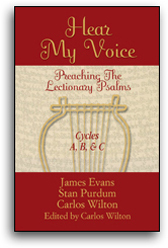
Hear My Voice
Preaching The Lectionary Psalms for Cycles A, B, C
Object:
Psalm 145 is known not so much in its entirety, but piecemeal, by those who are familiar with Christian worship texts. Words like "Great is the Lord, and greatly to be praised" (v. 3); "The eyes of all look to you, and you give them their food in due season" (v. 15) and "The Lord is near to all who call on him, to all who call on him in truth" have often called us to worship. The words, "The Lord is gracious and merciful, slow to anger and abounding in steadfast love" (v. 8) have often called us to confession, or assured us of God's pardon. Psalm 145 is a veritable repository of worship texts.
It would be entirely understandable if a sermon on this psalm zeroed in on one of these familiar texts, and left the rest of it alone. Yet Psalm 145 also has integrity of its own, as a complete work. It is the only psalm identified by superscript as both a praise-song (tehillah) and a psalm of David. It has long had a special place in Jewish liturgical tradition. James Luther Mays quotes the following Talmudic saying, which gives Psalm 145 pride of place in Jewish devotion: "Every one who repeats the Tehillah of David thrice a day may be sure that he is a child of the world to come" (Psalms, in the Interpretation series [Louisville: John Knox Press, 1994], p. 437).
As for its position in the psalter, Psalm 145 is the preface to the concluding section of five hymns of praise, all of which begin and end with the word "Hallelujah!" Its theme is praise, pure and simple. A sermon that seeks to interpret the psalm as a unified whole will undoubtedly have praise and worship as its theme.
A Sunday school teacher once asked her students to discuss how they felt about coming to church. As is often the case, the teacher's question was met with several wisecracks and spurious answers, but then one little girl -- who was new to the class and had not until then found the courage to speak -- raised her hand. Her answer was profound, and caused her less-serious classmates to sit and reflect in awed silence. She said that, for her, going to church was "like walking into the heart of God."
Long ago, in Between God and Man, (Harper, 1959), renowned Jewish biblical scholar Abraham Joseph Heschel penned these words, about the wonder that is worship:
The awareness of the grandeur and the sublime is all but gone from modern man. We teach our children how to measure, how to weigh. We fail to teach them how to revere, how to sense wonder and awe. The sense for the sublime, the sign of the inward greatness of the soul is now a rare gift. Yet without it, the world becomes flat and the soul a vacuum ... The sublime is that which we see and are unable to convey. IT is the silent allusion of things to a meaning greater than themselves. IT is that which our words, our forms, our categories can never reach. The sublime is but a way in which things react to the presence of God. It stands in relation to something beyond itself that the eye can never see. The sublime is not simply there. It is not a thing. IT is a happening, an act of God, a marvel. There are no sublime facts; there are only divine acts.
-- C. W.
It would be entirely understandable if a sermon on this psalm zeroed in on one of these familiar texts, and left the rest of it alone. Yet Psalm 145 also has integrity of its own, as a complete work. It is the only psalm identified by superscript as both a praise-song (tehillah) and a psalm of David. It has long had a special place in Jewish liturgical tradition. James Luther Mays quotes the following Talmudic saying, which gives Psalm 145 pride of place in Jewish devotion: "Every one who repeats the Tehillah of David thrice a day may be sure that he is a child of the world to come" (Psalms, in the Interpretation series [Louisville: John Knox Press, 1994], p. 437).
As for its position in the psalter, Psalm 145 is the preface to the concluding section of five hymns of praise, all of which begin and end with the word "Hallelujah!" Its theme is praise, pure and simple. A sermon that seeks to interpret the psalm as a unified whole will undoubtedly have praise and worship as its theme.
A Sunday school teacher once asked her students to discuss how they felt about coming to church. As is often the case, the teacher's question was met with several wisecracks and spurious answers, but then one little girl -- who was new to the class and had not until then found the courage to speak -- raised her hand. Her answer was profound, and caused her less-serious classmates to sit and reflect in awed silence. She said that, for her, going to church was "like walking into the heart of God."
Long ago, in Between God and Man, (Harper, 1959), renowned Jewish biblical scholar Abraham Joseph Heschel penned these words, about the wonder that is worship:
The awareness of the grandeur and the sublime is all but gone from modern man. We teach our children how to measure, how to weigh. We fail to teach them how to revere, how to sense wonder and awe. The sense for the sublime, the sign of the inward greatness of the soul is now a rare gift. Yet without it, the world becomes flat and the soul a vacuum ... The sublime is that which we see and are unable to convey. IT is the silent allusion of things to a meaning greater than themselves. IT is that which our words, our forms, our categories can never reach. The sublime is but a way in which things react to the presence of God. It stands in relation to something beyond itself that the eye can never see. The sublime is not simply there. It is not a thing. IT is a happening, an act of God, a marvel. There are no sublime facts; there are only divine acts.
-- C. W.

