
Proper 9
Devotional
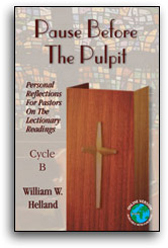
Pause Before The Pulpit
Personal Reflections For Pastors On The Lectionary Readings
Mark 6:1-13
Just as last week's Gospel Lesson was about great faith, this week's lesson is about great unbelief. So great was the unbelief, that even Jesus was amazed! Right away we see what the outcome of the unbelief in Nazareth was: he could do no deed of power there, except that he laid his hands on a few sick people and cured them. What a tragedy, that this community who had raised the Son of God could not swallow their pride and unbelief so they might see and enjoy the blessings of faith in Christ Jesus.
I shudder at the thought of how much of this goes on in Christian churches across America. Our so-called "Christian nation," with its thousands of Christian churches, has become so accustomed to Christ and the gospel that we actually mock and scorn it through our complacency and compromise. Is it any wonder that Christ can do no deed of power in many of our churches?
I'm intrigued by how vulnerable God made himself to our unbelief. He, who is omnipotent and can do anything he wants, anytime he wants, with anyone he wants, designed his relationship with us in such a way that our unbelief actually hinders the working of his power in our individual lives and churches. What a sobering reality that is.
Is there unbelief in your relationship with God? I'm not talking about those nagging doubts that serious Bible students wrestle with from time to time. I'm talking about outright unbelief of God's Word. Are there portions of scripture you refuse to believe, because they seem unbelievable as you filter them through the popular thought processes of modern philosophy and science? Dear friend, if God seems to have quit working powerfully in and through you, this may well be the reason.
Paul wasn't kidding when he wrote to the Corinthians about this: For since, in the wisdom of God, the world did not know God through wisdom, God decided, through the foolishness of our proclamation, to save those who believe (1 Corinthians 1:21). How do people experience the saving power of God? It is not through the wisdom of our world, but rather through the foolishness of our proclamation. We greatly hinder the "wonder working power" of God in our churches when we force his word to be subservient to the so-called wisdom of humanity. Is that not what happened in Nazareth that day? Since Jesus did not fit into the thinking processes of his hometown people, they would not listen to him or receive his miracles. They wanted it all to make sense before they would believe in him. When it didn't, they turned their back on it (and him). May we, and our churches, not be guilty of what the people of Nazareth were condemned for.
The second half of our text gives us some great advice for dealing with difficult people -- specifically those who refuse to believe our message and would rather argue with us. Jesus' advice to the disciples (and I believe all ministers of the gospel) is this: If any place will not welcome you and they refuse to hear you, as you leave, shake off the dust that is on your feet as a testimony against them.
How freeing this is! It is not our responsibility to force people to believe. It is our responsibility to proclaim the good news of God's kingdom, but what people do with it is up to them. I have used this approach often in ministry, and it has helped me avoid unnecessarily beating myself up over people who refuse to believe. Unbelief is a real issue in ministry. There is no way to avoid it and no simple solution to it. There are no formulas and easy steps to faith. It comes through the proclamation of God's Word, and what people do with it determines the outcome. Make sure that, in your personal life and the spiritual life of the church you serve, unbelief is not a problem; otherwise it will greatly hinder (maybe even paralyze) your ministry.
A Pastor's Prayer:
Dear Lord,
Forgive me for times of unbelief. Help me to recognize areas in my relationship with you and your word where I'm refusing to believe what I should. Lord, may I, and the people in my church, not be counted amongst those who refuse to believe, but rather make us people of faith, so you are free to work your deeds of power amongst us. Thank you. Amen.
2 Corinthians 12:2-10
If one were to read this text without any prior knowledge of Paul, we might come to the conclusion that he had a big ego and was a bit eccentric. He wrote verses 7-10 almost in the form of a riddle, in which he enthusiastically tried to share the high points of an experience that he could not adequately describe.
It must have been incredible, for Paul seems to have been greatly impacted by it. As a result, he felt such intense elation that he believed: a thorn was given me in the flesh, a messenger of Satan to torment me, to keep me from being too elated. That's quite a humbling thing to admit.
I wonder how many of God's children actually have similar incredible experiences? I don't recall that I have, but if it were this exciting I think I would have remembered it! However, whether we have some incredible out-of-body experience like Paul or not, one thing we all have in common is the problem of pride. I've come to the conclusion that Christians seem to have a greater problem with this than the average unbeliever. Maybe I'm wrong and hopefully I am. Yet, it seems that many Christians become proud of who they are, what they have, what they believe in, and so on. But pride is repulsive. Like all sins, it is grossly offensive to our Heavenly Father.
Perhaps what more of us need is a thorn in the flesh to torment us. I know from personal experience that they are very effective in humbling us. For a number of years I have lived with what has proven to be an untreatable back pain. In addition, I'm highly susceptible to depression. For years I complained to God about these thorns in the flesh that torment me daily. Often I would reflect upon the fact that Paul asked the Lord only three times to take his thorn away, but I must have asked 3,000 times or more! It wasn't until one day, as I was taking my usual early morning walk and trying to count my blessings, that I realized how good these "thorns" have been for me. Not only have they kept me humble at times when I most likely would have been proud, but through them I have learned so much more about God's grace [which] is sufficient for [me], for power is made perfect in weakness. From that point on, I have never asked God again to take the pain and the depression away. Instead, I have developed the habit of thanking him for both the "thorns" and the things he has taught me about himself through those "thorns."
I still have much room for growth and maturity in this area, for I still can't say as Paul wrote: Therefore I am content with weaknesses, insults, hardships, persecutions, and calamities for the sake of Christ; for whenever I am weak, then I am strong. It is still tempting to complain, moan, and groan, especially when new "thorns" crop up, but I pray for the day that I can be fully content with all of those things for the sake of Christ.
Dear brother or sister in Christ, do you have "thorns" in your life? Maybe it's something similar to mine. Maybe it's some other physical condition. Possibly you are struggling financially like so many pastors. Or maybe your thorn is the difficult congregation you are serving right now. May I encourage you, as a fellow sufferer in Christ, that when we are weak, then the strength and power of God can truly manifest itself in and through us. If you haven't experienced this yet, then it might be hard to understand how marvelous this is. There have been times when I didn't think I could get up to preach or make it through the service, but I did. Some of those Sundays, people who had no idea what physical or mental agony I was going through, would comment on how that had been one of my best and most powerful sermons. There's only one explanation for that, as far as I'm concerned, and that is the power of God being made perfect in weakness, and he will do the same for you. I guarantee it!
A Pastor's Prayer:
Dear Lord,
Thank you for those weaknesses that just won't go away. Thank you that your grace is sufficient for me as your power is made perfect in [my] weakness. Help me to grow to that point where I can honestly be fully content with whatever hardship I am experiencing for your sake. Amen.
Just as last week's Gospel Lesson was about great faith, this week's lesson is about great unbelief. So great was the unbelief, that even Jesus was amazed! Right away we see what the outcome of the unbelief in Nazareth was: he could do no deed of power there, except that he laid his hands on a few sick people and cured them. What a tragedy, that this community who had raised the Son of God could not swallow their pride and unbelief so they might see and enjoy the blessings of faith in Christ Jesus.
I shudder at the thought of how much of this goes on in Christian churches across America. Our so-called "Christian nation," with its thousands of Christian churches, has become so accustomed to Christ and the gospel that we actually mock and scorn it through our complacency and compromise. Is it any wonder that Christ can do no deed of power in many of our churches?
I'm intrigued by how vulnerable God made himself to our unbelief. He, who is omnipotent and can do anything he wants, anytime he wants, with anyone he wants, designed his relationship with us in such a way that our unbelief actually hinders the working of his power in our individual lives and churches. What a sobering reality that is.
Is there unbelief in your relationship with God? I'm not talking about those nagging doubts that serious Bible students wrestle with from time to time. I'm talking about outright unbelief of God's Word. Are there portions of scripture you refuse to believe, because they seem unbelievable as you filter them through the popular thought processes of modern philosophy and science? Dear friend, if God seems to have quit working powerfully in and through you, this may well be the reason.
Paul wasn't kidding when he wrote to the Corinthians about this: For since, in the wisdom of God, the world did not know God through wisdom, God decided, through the foolishness of our proclamation, to save those who believe (1 Corinthians 1:21). How do people experience the saving power of God? It is not through the wisdom of our world, but rather through the foolishness of our proclamation. We greatly hinder the "wonder working power" of God in our churches when we force his word to be subservient to the so-called wisdom of humanity. Is that not what happened in Nazareth that day? Since Jesus did not fit into the thinking processes of his hometown people, they would not listen to him or receive his miracles. They wanted it all to make sense before they would believe in him. When it didn't, they turned their back on it (and him). May we, and our churches, not be guilty of what the people of Nazareth were condemned for.
The second half of our text gives us some great advice for dealing with difficult people -- specifically those who refuse to believe our message and would rather argue with us. Jesus' advice to the disciples (and I believe all ministers of the gospel) is this: If any place will not welcome you and they refuse to hear you, as you leave, shake off the dust that is on your feet as a testimony against them.
How freeing this is! It is not our responsibility to force people to believe. It is our responsibility to proclaim the good news of God's kingdom, but what people do with it is up to them. I have used this approach often in ministry, and it has helped me avoid unnecessarily beating myself up over people who refuse to believe. Unbelief is a real issue in ministry. There is no way to avoid it and no simple solution to it. There are no formulas and easy steps to faith. It comes through the proclamation of God's Word, and what people do with it determines the outcome. Make sure that, in your personal life and the spiritual life of the church you serve, unbelief is not a problem; otherwise it will greatly hinder (maybe even paralyze) your ministry.
A Pastor's Prayer:
Dear Lord,
Forgive me for times of unbelief. Help me to recognize areas in my relationship with you and your word where I'm refusing to believe what I should. Lord, may I, and the people in my church, not be counted amongst those who refuse to believe, but rather make us people of faith, so you are free to work your deeds of power amongst us. Thank you. Amen.
2 Corinthians 12:2-10
If one were to read this text without any prior knowledge of Paul, we might come to the conclusion that he had a big ego and was a bit eccentric. He wrote verses 7-10 almost in the form of a riddle, in which he enthusiastically tried to share the high points of an experience that he could not adequately describe.
It must have been incredible, for Paul seems to have been greatly impacted by it. As a result, he felt such intense elation that he believed: a thorn was given me in the flesh, a messenger of Satan to torment me, to keep me from being too elated. That's quite a humbling thing to admit.
I wonder how many of God's children actually have similar incredible experiences? I don't recall that I have, but if it were this exciting I think I would have remembered it! However, whether we have some incredible out-of-body experience like Paul or not, one thing we all have in common is the problem of pride. I've come to the conclusion that Christians seem to have a greater problem with this than the average unbeliever. Maybe I'm wrong and hopefully I am. Yet, it seems that many Christians become proud of who they are, what they have, what they believe in, and so on. But pride is repulsive. Like all sins, it is grossly offensive to our Heavenly Father.
Perhaps what more of us need is a thorn in the flesh to torment us. I know from personal experience that they are very effective in humbling us. For a number of years I have lived with what has proven to be an untreatable back pain. In addition, I'm highly susceptible to depression. For years I complained to God about these thorns in the flesh that torment me daily. Often I would reflect upon the fact that Paul asked the Lord only three times to take his thorn away, but I must have asked 3,000 times or more! It wasn't until one day, as I was taking my usual early morning walk and trying to count my blessings, that I realized how good these "thorns" have been for me. Not only have they kept me humble at times when I most likely would have been proud, but through them I have learned so much more about God's grace [which] is sufficient for [me], for power is made perfect in weakness. From that point on, I have never asked God again to take the pain and the depression away. Instead, I have developed the habit of thanking him for both the "thorns" and the things he has taught me about himself through those "thorns."
I still have much room for growth and maturity in this area, for I still can't say as Paul wrote: Therefore I am content with weaknesses, insults, hardships, persecutions, and calamities for the sake of Christ; for whenever I am weak, then I am strong. It is still tempting to complain, moan, and groan, especially when new "thorns" crop up, but I pray for the day that I can be fully content with all of those things for the sake of Christ.
Dear brother or sister in Christ, do you have "thorns" in your life? Maybe it's something similar to mine. Maybe it's some other physical condition. Possibly you are struggling financially like so many pastors. Or maybe your thorn is the difficult congregation you are serving right now. May I encourage you, as a fellow sufferer in Christ, that when we are weak, then the strength and power of God can truly manifest itself in and through us. If you haven't experienced this yet, then it might be hard to understand how marvelous this is. There have been times when I didn't think I could get up to preach or make it through the service, but I did. Some of those Sundays, people who had no idea what physical or mental agony I was going through, would comment on how that had been one of my best and most powerful sermons. There's only one explanation for that, as far as I'm concerned, and that is the power of God being made perfect in weakness, and he will do the same for you. I guarantee it!
A Pastor's Prayer:
Dear Lord,
Thank you for those weaknesses that just won't go away. Thank you that your grace is sufficient for me as your power is made perfect in [my] weakness. Help me to grow to that point where I can honestly be fully content with whatever hardship I am experiencing for your sake. Amen.
