
Questions
Sermon
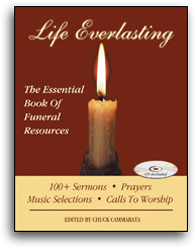
Life Everlasting
The Essential Book of Funeral Resources
Object:
For a young woman following a brief illness
Questions
Psalm 13
• Why is the sky blue?
• Why is the night dark?
• Why do apples fall from the trees?
Questions. We are a people who love to ask questions. As early as we can learn to talk, we are asking questions. Life is fascinating because we can ask questions and learn the answers. The sky is blue because of the filtering effect of our atmosphere upon the sun's light. The night is dark because of the rotation of the earth away from the sun. Apples fall from the trees because of gravity.
There are other questions for which the answers do not come very easily, if at all.
• Why is there death?
• Why do the young have to die?
• Where is the good and gracious God in the midst of life's tragedies?
Questions. We are a people who love to ask questions.
The psalmist also asked questions -- hard questions. "How long, O Lord? How long will you hide yourself from me? Will you forget me forever? How long must I bear pain in my heart day and night?" Because of Kristi's untimely death, we have all asked such questions. We have felt the hurt and the anger and the confusion that the psalmist expresses before the gates of heaven. With the psalmist, we pound with our prayers, hoping that God will open the doors of understanding and shed some light upon the tragedy with which we have to live.
• How long, O Lord? How long must I bear pain in my heart day and night?
Questions. There are many questions for which we will find the answers in time. There are some questions with which we will simply have to learn how to live unanswered. When we carefully look around us, we do discover that's the way life is so much of the time. There are so many deaths without meaning; there are illnesses without noble cause; there are everyday sorrows and distresses which seem to have no design or purpose. After we have spoken all of our questions, after we have asked all of our "why's," and after silence has echoed in our hearts and minds, we are left with the more practical question, "How now are we going to deal with this?"
The Lord Jesus shows us the way. In his greatest hour of suffering, when he faced his own untimely death in the prime of life, he entrusted his life into God's keeping. "Into your hands I commit my spirit."
Jesus, too, asked the hard questions in the crucible of his suffering. Why does this have to be? Is there no other way to show God's great love for the world? Can this bitter cup pass over without having to drink of it? In the garden of Gethsemane, Jesus anguished over the hard questions of life and death and the love of God in the midst of all of it. Scripture does not record any direct answer Jesus received. In fact, we are left with the distinct impression that all Jesus had with him when he went to the cross were questions, questions from the garden and then one last question: "My God, my God, why have you forsaken me?"
Yet, even with all his questions, Jesus entrusted his life to God and thereby passed on to us the mystery as to how to deal with all those unanswered "why's." We are to ask the questions that arise from our hurts and angers and confusions. We are to ask them with all our power; and, then, we are to lay them at the foot of the cross of Jesus, where we are met with all God's power. We will not necessarily find specific answers for specific "why's," but we will find the love of God with us and for us in the depths of our sufferings -- understanding us, accepting us, and lifting us up.
There is power at the foot of the cross, for it was on the cross that Jesus accomplished his greatest work. On the cross, Jesus died for the whole world. He allowed all our enemies -- even death itself -- to crush him and nail him to the cross. It appeared like a great defeat; it appeared as if God had lost in the bid to wrestle the world from out of the clutches of the evil one. But, appearances can be deceiving. For it was precisely through such sacrificial giving of himself that Jesus is able to offer life and salvation to the world. Kristi herself has offered us a parable with which to understand this great truth. With courage and compassion, she faced her own death and decided to offer many of her organs to be used by those who were in need. Through her death, she offered life and wholeness to others. Through the death of Jesus, life and wholeness is offered to us, who will entrust ourselves to such love. The people who will benefit from Kristi's organs simply have to receive what is so graciously offered out of love. So, too, we who would benefit from Jesus' life and death simply have to receive what is so graciously offered out of love.
Just as Jesus suffered the pains and sorrows and death of our human life, Jesus also was raised from the dead. He is the victor. He has conquered death and he holds the keys to unlocking the mystery even of life and death.
"We were buried with him by baptism into death," the Bible says, "so that as Christ was raised from the dead ... we too might walk in newness of life." How can we deal with all our suffering and sorrow? Take it to the Lord; entrust your life to him. He will take your grief upon himself and give you peace in return. He has taken the weight of the world into his own heart and bled and died for Kristi and for you and for me. "With his stripes we are healed," the Bible tells us.
Let us return to the psalmist. Just after he pours out his heart through those bitter questions, he then lifts up his eyes and opens his heart to God by saying, "I rely on your constant love; I will be glad, because you will rescue me."
May the Lord rescue Kristi from her grave. May the Lord rescue all of us from being buried under a mountain of unanswered "why's." May the Lord set us all high upon a hill, like Calvary, so that we might see by the light of the cross the wonder and goodness of God's love for us even in the midst of life's harrowing experiences. Amen.
Questions
Psalm 13
• Why is the sky blue?
• Why is the night dark?
• Why do apples fall from the trees?
Questions. We are a people who love to ask questions. As early as we can learn to talk, we are asking questions. Life is fascinating because we can ask questions and learn the answers. The sky is blue because of the filtering effect of our atmosphere upon the sun's light. The night is dark because of the rotation of the earth away from the sun. Apples fall from the trees because of gravity.
There are other questions for which the answers do not come very easily, if at all.
• Why is there death?
• Why do the young have to die?
• Where is the good and gracious God in the midst of life's tragedies?
Questions. We are a people who love to ask questions.
The psalmist also asked questions -- hard questions. "How long, O Lord? How long will you hide yourself from me? Will you forget me forever? How long must I bear pain in my heart day and night?" Because of Kristi's untimely death, we have all asked such questions. We have felt the hurt and the anger and the confusion that the psalmist expresses before the gates of heaven. With the psalmist, we pound with our prayers, hoping that God will open the doors of understanding and shed some light upon the tragedy with which we have to live.
• How long, O Lord? How long must I bear pain in my heart day and night?
Questions. There are many questions for which we will find the answers in time. There are some questions with which we will simply have to learn how to live unanswered. When we carefully look around us, we do discover that's the way life is so much of the time. There are so many deaths without meaning; there are illnesses without noble cause; there are everyday sorrows and distresses which seem to have no design or purpose. After we have spoken all of our questions, after we have asked all of our "why's," and after silence has echoed in our hearts and minds, we are left with the more practical question, "How now are we going to deal with this?"
The Lord Jesus shows us the way. In his greatest hour of suffering, when he faced his own untimely death in the prime of life, he entrusted his life into God's keeping. "Into your hands I commit my spirit."
Jesus, too, asked the hard questions in the crucible of his suffering. Why does this have to be? Is there no other way to show God's great love for the world? Can this bitter cup pass over without having to drink of it? In the garden of Gethsemane, Jesus anguished over the hard questions of life and death and the love of God in the midst of all of it. Scripture does not record any direct answer Jesus received. In fact, we are left with the distinct impression that all Jesus had with him when he went to the cross were questions, questions from the garden and then one last question: "My God, my God, why have you forsaken me?"
Yet, even with all his questions, Jesus entrusted his life to God and thereby passed on to us the mystery as to how to deal with all those unanswered "why's." We are to ask the questions that arise from our hurts and angers and confusions. We are to ask them with all our power; and, then, we are to lay them at the foot of the cross of Jesus, where we are met with all God's power. We will not necessarily find specific answers for specific "why's," but we will find the love of God with us and for us in the depths of our sufferings -- understanding us, accepting us, and lifting us up.
There is power at the foot of the cross, for it was on the cross that Jesus accomplished his greatest work. On the cross, Jesus died for the whole world. He allowed all our enemies -- even death itself -- to crush him and nail him to the cross. It appeared like a great defeat; it appeared as if God had lost in the bid to wrestle the world from out of the clutches of the evil one. But, appearances can be deceiving. For it was precisely through such sacrificial giving of himself that Jesus is able to offer life and salvation to the world. Kristi herself has offered us a parable with which to understand this great truth. With courage and compassion, she faced her own death and decided to offer many of her organs to be used by those who were in need. Through her death, she offered life and wholeness to others. Through the death of Jesus, life and wholeness is offered to us, who will entrust ourselves to such love. The people who will benefit from Kristi's organs simply have to receive what is so graciously offered out of love. So, too, we who would benefit from Jesus' life and death simply have to receive what is so graciously offered out of love.
Just as Jesus suffered the pains and sorrows and death of our human life, Jesus also was raised from the dead. He is the victor. He has conquered death and he holds the keys to unlocking the mystery even of life and death.
"We were buried with him by baptism into death," the Bible says, "so that as Christ was raised from the dead ... we too might walk in newness of life." How can we deal with all our suffering and sorrow? Take it to the Lord; entrust your life to him. He will take your grief upon himself and give you peace in return. He has taken the weight of the world into his own heart and bled and died for Kristi and for you and for me. "With his stripes we are healed," the Bible tells us.
Let us return to the psalmist. Just after he pours out his heart through those bitter questions, he then lifts up his eyes and opens his heart to God by saying, "I rely on your constant love; I will be glad, because you will rescue me."
May the Lord rescue Kristi from her grave. May the Lord rescue all of us from being buried under a mountain of unanswered "why's." May the Lord set us all high upon a hill, like Calvary, so that we might see by the light of the cross the wonder and goodness of God's love for us even in the midst of life's harrowing experiences. Amen.
