
Responding to What We Hear and see
Sermon
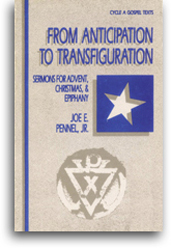
FROM ANTICIPATION TO TRANSFIGURATION
Sermons For Advent, Christmas, & Epiphany
In the semantics of the church, doubt has been a negative word. It is rarely used in a favorable way. Faith, not doubt, is the great word of the church.
As I stand here every Sunday morning and look into your up-lifted faces, you look so proper, so content, so believing. You seem to be so certain, so full of faith, and so free of doubt.
But, I have a suspicion that the way you look is not the way you are. Beneath the skins of many of you there is planted the seed of honest doubt. Perhaps you do not share these feelings with anyone; but your doubts are there, and they are real. Your worship does not express your doubts, uncertainties, and skepticism. In facing this situation, all of us at times cry out with the man in the Gospel, "Lord, I believe; help thou my unbelief." This capacity to doubt can often lead to some of life's most profound questions.
Such was the case with John the Baptizer. His question - "Are you he who is to come, or shall we look for another?" - grew not out of his uncertainty, but out of his doubt. John the Baptizer had heard about the words and deeds of Jesus, but what he had heard did not square with his expectation of the Messiah.
After all, Jesus was born not to royalty, but to a peasant woman. He functioned not as a military ruler, but as a servant. He came not as a judge, but as a forgiving redeemer. He did not bring heavenly condemnation; he brought divine love. He did not associate with the religious establishment, but he went from village to village associating with the rubbish heap of humanity. He spent his time and energy with the least and the lost. He was most concerned with the powerless: the blind and the lame, the lepers and the deaf, and the poor and the outcast. And Jesus dared to teach that the weak occupied the most important place in the Kingdom of God.
John the Baptizer became confused about the way in which Jesus acted out his messiahship. He had doubts about the validity of his contemporary, Jesus of Nazareth. His skepticism caused him to send one of his buddies to Jesus with the question: "Are you he who is to come, or shall we look for another?" Like others in the New Testament, John the Baptizer was not positive. Oh, to be sure, there were fleeting moments of recognition. Mary thought Jesus was a gardener. Those on the road to Emmaus never did recognize him. Even his closest disciples were not certain if he was or was not the true Messiah.
That John the Baptizer had doubts about the messiahship of Jesus is revealed in his question: "Are you the one who is to come, or shall we look for another?" His question is not clear, either in what is being asked or why. But like all good questions, it shoves the reader into deeper regions of thought.
On the other hand, Jesus gave a straightforward answer to the question raised by the disciples of John the Baptizer. Without equivocation he said, "Go and tell John what you hear and see: the blind receive their sight and the lame walk, lepers are cleansed and the deaf hear, and the dead are raised up and the poor have good news preached to them. And blessed is he who takes no offense at me."
The answer that Jesus gave was plain and simple. In essence he said, "You go and tell John that he will have to respond to me based on what he sees and hears." Jesus was asking John the Baptizer to look at His deeds and to listen to His words as a way of getting an answer to his question: "Are you the one who is to come, or shall we look for another?"
And that is one of the ways we will have to respond to the One who comes to us during this season. We will be forced to respond based on what we see and hear. The coming One will not force himself on us. No other person has the power to make us decide. Our response will finally rest upon what we hear with our ears and see with our eyes. That is the way it was for John the Baptizer, and that is the way it must be for you and me.
But, there is a grave danger. The danger is that we will look in the wrong places, and we will listen to the wrong voices. The danger is that we will look to places of power, privilege, and prestige for a sign of Jesus' coming. But, the chances are that we will not see him in rooms filled with people who wear Gucci shoes; Hart, Shaffner & Marx suits; and Gant shirts.
Instead, Jesus will be found where sight is given to the blind, legs to the lame, hearing to the deaf, and new life to the dead. The Messiah will be found whenever and wherever the powerless are given power. If we want to respond to the signs of Christ's presence in today's world, we will look at those places where the weak are being made strong.
Examples abound. We do not have to take a sacred trip to a special place in order to see the powerless getting power. It is happening all over town and right here in this church.
One Tuesday evening in 1987 was one of the greatest nights of the year for our congregation. It was the annual International Christmas dinner party. Tables and chairs for one hundred and twenty people had been set up, and still more had to be added. Almost every square inch of the tables had been covered with food representing forty-two countries.
When our guests arrived, some were decked out in their native dress; others wore Americanized clothing. Many spoke in their native tongue. However, since many of those who attended registered in the congregation's English as a Second Language Program, some guests spoke either broken or fluent English. The world community miraculously squeezed into the Fellowship Hall. It was a joyful event, as joyful as any that I had hoped to experience during Advent.
As I stood in the winding food line, I had a conversation with a woman from Brazil. She said, "Pastor, I want to thank your church for having English as a Second Language and for having this dinner. It is hard for us to be away from home. Our loved ones are so far away. Often, we are so lonely that we cry at night. But, when we come to Elizabeth Duncan's English class and when we come here for these dinners, we feel warm and strong." In her face and in her words, I saw the face and heard the words of the One who is to come. Because of people like Dot, Elizabeth, and Gordon, this woman has been given the power to do what she has to do. In the life of that weak woman who has been made strong, one can see a sign of the coming One.
It happens all the time. Weakness becomes strength for the prisoner who receives a visit, for the homeless family who is given a night's lodging, for the student whose teacher stays after school to tutor without compensation, for the sick person who receives a brief but sincere visit from a good friend, for the hungry child who receives nourishment because of U.N.I.C.E.F., and for all of us when summits bring us one step nearer to peace without arms. Even as Christ is present every time the bread is broken and the wine is served, so is Christ present every time the powerless are given power to stand up and face life with some love and dignity.
The first danger, then, is that we will not respond to the coming One because we look to the places of power and privilege and not to those life situations where the weak are made stronger.
The second danger is that we will not respond to the coming One because we do not hear his Voice. And the reason that we do not hear his Voice is that we will spend this season listening to the wrong voices. Instead of responding to his Voice, we will respond to the voices of a crass, commercial Christmas. We will respond to the voices of buzzing cash registers, bustling crowds, the discordant secular hype. During this time of the year, there are so many voices that appear to be so promising, so alluring, and so full of power. The danger is that we will listen only to those voices that promise us more privilege, security, and power. The danger is that we will listen only to those voices that teach us to adhere to the "Doctrine of More." And, the greater danger is that we will not hear the Voice of the coming One beyond and above the noisy crowd.
If we get caught up in the busy trivia of this season, then we will rush headlong into oblivion. Only when we are alone, quiet and listening to the other Voice, does the inner rhythm begin to flow. Only then do the senses come closer to realization. Only then does one begin to hear the Voice beyond the screaming voices of mass culture.
But, there is an even greater danger than the risk of looking in the wrong places and listening to the wrong voices. It is the danger of not looking afresh at what Jesus did and not listening anew to what he said. One of the ways that we can prepare for Christmas is to study again the deeds of Jesus and to read again the words of Jesus. Like John the Baptizer, we need to respond based on what we see and hear in the life of Jesus of Nazareth. If we do not study Jesus' deeds and listen to his words, then we will make the coming One into something that he is not. The following poem is an example of how far afield we can go:
Jesus, what have you done to us?
We wanted a pet kitten
And you turned into a tiger.
We liked you the way you were.
Why couldn't you leave us alone?
We wanted you to show up when we
wanted you to make us feel good.
We wanted a pretty church for weddings
and baptisms and funerals.
We wanted the cute Easter bunny hopping
around the lawn.
We thought religion was good for the
kiddies.
Now all of a sudden you've turned against us.
We wanted peace and you brought us a sword.
Things were going along all right.
Then you got interested in the poor people.
Now they're strutting around like they
Are going to inherit the earth.
Now all of a sudden you tell us
To love our enemies.
Do you know what will happen if we do?
They will nail our hide to the wall
And what will we do then, keep on praying for them?
We liked you when you were a little boy
Gentle, meek and mild, cooing in your cradle.
All those nice shepherds and angels,
And we felt just awful about King Herod.
Look at all we did for you.
We made a national holiday in your honor.
We built big industries around it - Christmas cards,
Toy machine guns for the kiddies
And all those fancy gift-wrapped whiskey bottles.
We built pretty churches in your honor,
Stained glass, organs, the works,
And when the people moved away from the riff raff,
The church followed them
Straight out into the suburbs.
Looking at all we've done for you, Jesus,
Why can't you leave us alone?
We've got enough troubles now.
Why do you keep pricking our conscience?
What do you want for Christmas, our hearts?
Because of his doubts, John the Baptizer introduced us to the One who is to come. And like him, we will have to respond on the basis of what we hear and see.
As we move swiftly through the rituals of the season, let us not fail to look and to listen. Not looking and not listening might cause us to miss the point of it all, and that would be a sad and terrible thing.
As I stand here every Sunday morning and look into your up-lifted faces, you look so proper, so content, so believing. You seem to be so certain, so full of faith, and so free of doubt.
But, I have a suspicion that the way you look is not the way you are. Beneath the skins of many of you there is planted the seed of honest doubt. Perhaps you do not share these feelings with anyone; but your doubts are there, and they are real. Your worship does not express your doubts, uncertainties, and skepticism. In facing this situation, all of us at times cry out with the man in the Gospel, "Lord, I believe; help thou my unbelief." This capacity to doubt can often lead to some of life's most profound questions.
Such was the case with John the Baptizer. His question - "Are you he who is to come, or shall we look for another?" - grew not out of his uncertainty, but out of his doubt. John the Baptizer had heard about the words and deeds of Jesus, but what he had heard did not square with his expectation of the Messiah.
After all, Jesus was born not to royalty, but to a peasant woman. He functioned not as a military ruler, but as a servant. He came not as a judge, but as a forgiving redeemer. He did not bring heavenly condemnation; he brought divine love. He did not associate with the religious establishment, but he went from village to village associating with the rubbish heap of humanity. He spent his time and energy with the least and the lost. He was most concerned with the powerless: the blind and the lame, the lepers and the deaf, and the poor and the outcast. And Jesus dared to teach that the weak occupied the most important place in the Kingdom of God.
John the Baptizer became confused about the way in which Jesus acted out his messiahship. He had doubts about the validity of his contemporary, Jesus of Nazareth. His skepticism caused him to send one of his buddies to Jesus with the question: "Are you he who is to come, or shall we look for another?" Like others in the New Testament, John the Baptizer was not positive. Oh, to be sure, there were fleeting moments of recognition. Mary thought Jesus was a gardener. Those on the road to Emmaus never did recognize him. Even his closest disciples were not certain if he was or was not the true Messiah.
That John the Baptizer had doubts about the messiahship of Jesus is revealed in his question: "Are you the one who is to come, or shall we look for another?" His question is not clear, either in what is being asked or why. But like all good questions, it shoves the reader into deeper regions of thought.
On the other hand, Jesus gave a straightforward answer to the question raised by the disciples of John the Baptizer. Without equivocation he said, "Go and tell John what you hear and see: the blind receive their sight and the lame walk, lepers are cleansed and the deaf hear, and the dead are raised up and the poor have good news preached to them. And blessed is he who takes no offense at me."
The answer that Jesus gave was plain and simple. In essence he said, "You go and tell John that he will have to respond to me based on what he sees and hears." Jesus was asking John the Baptizer to look at His deeds and to listen to His words as a way of getting an answer to his question: "Are you the one who is to come, or shall we look for another?"
And that is one of the ways we will have to respond to the One who comes to us during this season. We will be forced to respond based on what we see and hear. The coming One will not force himself on us. No other person has the power to make us decide. Our response will finally rest upon what we hear with our ears and see with our eyes. That is the way it was for John the Baptizer, and that is the way it must be for you and me.
But, there is a grave danger. The danger is that we will look in the wrong places, and we will listen to the wrong voices. The danger is that we will look to places of power, privilege, and prestige for a sign of Jesus' coming. But, the chances are that we will not see him in rooms filled with people who wear Gucci shoes; Hart, Shaffner & Marx suits; and Gant shirts.
Instead, Jesus will be found where sight is given to the blind, legs to the lame, hearing to the deaf, and new life to the dead. The Messiah will be found whenever and wherever the powerless are given power. If we want to respond to the signs of Christ's presence in today's world, we will look at those places where the weak are being made strong.
Examples abound. We do not have to take a sacred trip to a special place in order to see the powerless getting power. It is happening all over town and right here in this church.
One Tuesday evening in 1987 was one of the greatest nights of the year for our congregation. It was the annual International Christmas dinner party. Tables and chairs for one hundred and twenty people had been set up, and still more had to be added. Almost every square inch of the tables had been covered with food representing forty-two countries.
When our guests arrived, some were decked out in their native dress; others wore Americanized clothing. Many spoke in their native tongue. However, since many of those who attended registered in the congregation's English as a Second Language Program, some guests spoke either broken or fluent English. The world community miraculously squeezed into the Fellowship Hall. It was a joyful event, as joyful as any that I had hoped to experience during Advent.
As I stood in the winding food line, I had a conversation with a woman from Brazil. She said, "Pastor, I want to thank your church for having English as a Second Language and for having this dinner. It is hard for us to be away from home. Our loved ones are so far away. Often, we are so lonely that we cry at night. But, when we come to Elizabeth Duncan's English class and when we come here for these dinners, we feel warm and strong." In her face and in her words, I saw the face and heard the words of the One who is to come. Because of people like Dot, Elizabeth, and Gordon, this woman has been given the power to do what she has to do. In the life of that weak woman who has been made strong, one can see a sign of the coming One.
It happens all the time. Weakness becomes strength for the prisoner who receives a visit, for the homeless family who is given a night's lodging, for the student whose teacher stays after school to tutor without compensation, for the sick person who receives a brief but sincere visit from a good friend, for the hungry child who receives nourishment because of U.N.I.C.E.F., and for all of us when summits bring us one step nearer to peace without arms. Even as Christ is present every time the bread is broken and the wine is served, so is Christ present every time the powerless are given power to stand up and face life with some love and dignity.
The first danger, then, is that we will not respond to the coming One because we look to the places of power and privilege and not to those life situations where the weak are made stronger.
The second danger is that we will not respond to the coming One because we do not hear his Voice. And the reason that we do not hear his Voice is that we will spend this season listening to the wrong voices. Instead of responding to his Voice, we will respond to the voices of a crass, commercial Christmas. We will respond to the voices of buzzing cash registers, bustling crowds, the discordant secular hype. During this time of the year, there are so many voices that appear to be so promising, so alluring, and so full of power. The danger is that we will listen only to those voices that promise us more privilege, security, and power. The danger is that we will listen only to those voices that teach us to adhere to the "Doctrine of More." And, the greater danger is that we will not hear the Voice of the coming One beyond and above the noisy crowd.
If we get caught up in the busy trivia of this season, then we will rush headlong into oblivion. Only when we are alone, quiet and listening to the other Voice, does the inner rhythm begin to flow. Only then do the senses come closer to realization. Only then does one begin to hear the Voice beyond the screaming voices of mass culture.
But, there is an even greater danger than the risk of looking in the wrong places and listening to the wrong voices. It is the danger of not looking afresh at what Jesus did and not listening anew to what he said. One of the ways that we can prepare for Christmas is to study again the deeds of Jesus and to read again the words of Jesus. Like John the Baptizer, we need to respond based on what we see and hear in the life of Jesus of Nazareth. If we do not study Jesus' deeds and listen to his words, then we will make the coming One into something that he is not. The following poem is an example of how far afield we can go:
Jesus, what have you done to us?
We wanted a pet kitten
And you turned into a tiger.
We liked you the way you were.
Why couldn't you leave us alone?
We wanted you to show up when we
wanted you to make us feel good.
We wanted a pretty church for weddings
and baptisms and funerals.
We wanted the cute Easter bunny hopping
around the lawn.
We thought religion was good for the
kiddies.
Now all of a sudden you've turned against us.
We wanted peace and you brought us a sword.
Things were going along all right.
Then you got interested in the poor people.
Now they're strutting around like they
Are going to inherit the earth.
Now all of a sudden you tell us
To love our enemies.
Do you know what will happen if we do?
They will nail our hide to the wall
And what will we do then, keep on praying for them?
We liked you when you were a little boy
Gentle, meek and mild, cooing in your cradle.
All those nice shepherds and angels,
And we felt just awful about King Herod.
Look at all we did for you.
We made a national holiday in your honor.
We built big industries around it - Christmas cards,
Toy machine guns for the kiddies
And all those fancy gift-wrapped whiskey bottles.
We built pretty churches in your honor,
Stained glass, organs, the works,
And when the people moved away from the riff raff,
The church followed them
Straight out into the suburbs.
Looking at all we've done for you, Jesus,
Why can't you leave us alone?
We've got enough troubles now.
Why do you keep pricking our conscience?
What do you want for Christmas, our hearts?
Because of his doubts, John the Baptizer introduced us to the One who is to come. And like him, we will have to respond on the basis of what we hear and see.
As we move swiftly through the rituals of the season, let us not fail to look and to listen. Not looking and not listening might cause us to miss the point of it all, and that would be a sad and terrible thing.
