
Restoring Pastoral Energies
Preaching
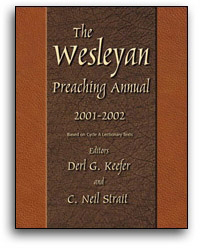
THE WESLEYAN PREACHING ANNUAL 2001--2002
That pastoral energies ebb low is not debatable. And most of us know the causes - too much crammed into a day or a week, stress, criticism, financial pressures, just to name a few. That these are of concern to parishioners, mates and to district leaders is well known. But even a greater concern is how one goes about restoring pastoral energies.
Dennis Kinlaw writes this in his book, Preaching in the Spirit: "The pastor's common mistake is to turn to his work to relieve the pressure, rather than to seek Christ's presence for restoration and needed grace" (Grand Rapids: Francis Asbury Press, 1985, p. 23).
Let me offer some suggestions for restoring pastoral energies. They are not exhaustive, but, I hope, encouraging.
One, listen to the scriptures you share with your parishioners. Many times during a hospital visit I would share a scripture and pray with the person I was visiting. I can remember those occasions when, after the visit, when I was waiting for the elevator, driving or waiting at a light, the thought would come to me, "That would be a good word for my situation." I think it dawned upon me, somewhere along the line of pastoral ministry, that what I shared with my people was also God's Word for me.
Two, listen to the sermons you preach. Learn from them. Take the advice you give. Remember, God's Word from the pulpit is for you, too. I have had parishioners say to me, when they knew I was going through a rough spot, "Remember what you tell us?" And during the low times I have been lifted by thoughts from my own preaching. For you and I must know that in the midst of prayer and preparation, God is speaking not only to the congregation, but He is speaking to His servant.
Three, do not neglect prayer. It sounds so trite, but it must be said - when the low times come that is no time to neglect our prayer lives. In fact, it may be the very exercise which will lift our spirits and set our feet on new paths.
Four, do not neglect preparation. Sermon preparation, for the pastor, is soul--preparation. It is not only crafting a sermon and words, it is nurturing an atmosphere, and establishing an environment. It is the moment God, through His Holy Spirit, prepares the heart, mind and soul to speak a word about God. And often that word is the word that you and I need to hear. Preparation allows God to come close and restore His servant.
Five, do not neglect rest, recreation, exercise and your "day off." Too often are we consumed by the volume of work, until it crowds the soul. And, too often we are jeopardized by a poor organizational system, that lets things pile up on us and raises the stress level to the danger point. One must give attention to time management skills - or better identified as life management skills. Such skills can keep stress at a manageable level.
Proper rest, adequate recreation and exercise are weapons in our arsenal for keeping the energies of life in balance. A day off each week should be part of this arsenal, and it should be kept with diligence. I have been doing this in later years, and, look back on years when I did not do it with regret.
However you choose to restore the pastoral energies, keep in mind that Christ is our most valued resource. His presence and grace bring energies to life that no other discipline will.
C. Neil Strait
October 6, 2002 Twentieth Sunday After Pentecost
WORSHIP HELPS
CALL TO WORSHIP
Leader: "Help us, O God of our salvation, for the glory of your name;
All: Deliver us, and forgive our sins, for your name's sake." (Psalm 79:9 NRSV)
OFFERING THOUGHT
God has entrusted us with earthly and heavenly possessions. He has called us to be faithful, wise, and giving stewards.
BENEDICTION
People are in need of personal help like food and clothing. If you say to them, "God's grace. I hope someone has pity on you and you stay warm and get a bite of food," but you do not give what that person needs, what are your words worth? (James 2:15--16 adapted)
SERMON BRIEFS
First Things First
Philippians 3:4--14
In the world of professional football, one of the most frequently quoted personalities is the late Vince Lombardi. His teams made Green Bay, Wisconsin, one of the best--known pro--football sites in North America. His expressions have been quoted by his players, motivational speakers, and even preachers, from the mid--1960s until today. Here is one of my favorites, reportedly made to his players: "Only three things should matter in life: your religion, your family, and the Green Bay Packers. In that order!"
Not only was Lombardi a great coach; he also knew something about setting and maintaining priorities.
The Apostle Paul was no stranger to the importance of setting priorities for Christian living. He had learned how to keep first things first - or, the main thing the main thing. Here, in his letter to his friends at Philippi, he left a legacy for setting and maintaining priorities. Let's examine them.
I. Know who you are. (v. 12)
Be honest with yourself. Begin with who you are and where you stand spiritually. For Paul, he began with a disclaimer: "Not that I have already obtained all this, or have already been made perfect" (v. 12). He knew he hadn't "arrived" yet at personal or spiritual perfection. He knew his past, and he knew it wasn't pretty. But he didn't waste time in self--pity either. This was simply a place to begin - a point of reference.
Perfection was, in Paul's mind, the goal. But he was candid. He knew in his heart that he hadn't reached the goal. He understood what God meant when he said, "You shall have no other gods (or idols) before me" (Exodus 20:3). Paul confessed, "Brothers, I do not consider myself yet to have taken hold of it (perfection)...." Paul knew who he was.
In our spiritual pilgrimage it is important to recognize where we are with God. While spiritual perfection is our goal, we need to be frank with God, with ourselves, and with others. Those closest to us already know the truth about us. So, why spend time denying what is undeniable?
II. Try to forget the past. (v. 13a)
Dwelling on past failures and unfulfilled promises is wasted effort. There was much in Paul's past that haunted him. He had persecuted believers and stood by while innocent Christians were martyred. He had been a staunch enemy of the followers of Jesus. He must have known that in every audience there was a possible assassin. Enemies lurked everywhere.
To grow spiritually Paul had to put the past behind him. He could not let the memories from his former life intimidate him. He said, "But one thing I do: Forgetting what is behind...."
It is so easy for us to be distracted by the past. It can be overwhelming. There is too much out there that can grab our attention. We must do what Paul did - let the past remain there. Period. We can't change it anyway.
III. Set reasonable, singular goals. (v. 13b)
Multiple goals are confusing and often impossible to reach. Notice what Paul said, "But one thing I do" (v. 13). Or, as the Authorized Version reads, "This one thing I do." Not these forty things I dabble in. Paul focused on what was immediately ahead of him, and refused to be distracted by things past or present.
Goal setting is not rocket science. But it does require that we be reasonable about our priorities. Remember what Lombardi said to his players, "Only three things matter." If we can't reduce our spiritual goals to one, at least limit them to several, we will defeat ourselves before we gain any new ground.
IV. Move ahead with determination. (vv. 12b, 13b, 14a)
It is one thing to plan to do something. One can plan and plan forever, and get nowhere. At some point the planning must cease, and the work must begin. Three times in this passage Paul uses strong expressions to describe action: "press on to take hold ... straining toward what is ahead ... press on toward the goal."
Some might argue that holiness is God's activity, not ours. It is by grace that any of this takes place, but God expects us to engage ourselves in the process. Providing the "prize" is what God does. Moving forward is what we do.
One more thought. The Spirit--filled life is not something we have decided to do on our own. It was never our idea. We do not own the process. Rather, living a life in the Spirit is something to which we have been called. Paul said, "I press on toward the goal to win the prize for which God has called me heavenward in Christ Jesus."
Coach Lombardi was right. Only a few things really do matter in life.
Thomas E. Barnard
Few religious movements in the last century of the millennium just past have spoken so directly
and meaningfully to the heart cry of the Christian believer in search of inner peace, as have
those churches that have preached Christ
from within a Wesleyan--biblical perspective.
God Still Communicates!
Psalm 19
Introduction
My wife and I have a secret way of communicating in a nonverbal fashion. With it we can communicate our love for each in a crowded room, in church or even at a sporting event. It involves no more than a pinch on the hand and it says very clearly, "I love you."
God has unique ways of communicating with us too. He has ways of reaching us individually.
Several years ago I found this to be true in my own life. I was struggling with a call to Phoenix, Arizona. I had been a school principal and enjoyed education, but God was calling me into the ministry. I was willing to go but didn't want it to be a wrong decision or part of a mid--life crisis. God so beautifully communicated His will to me through answering three specific prayers.
God does speak to us individually but He also speaks to the world as a whole. Psalm 19 tells us about three methods that God uses to speak to the world. God still uses those methods to speak today. Let's look at God's methods of communication.
I. Through nature (vv. 1--6)
The psalmist tells us that creation is one method that God uses to speak to us. If you have ever sat in the woods or on a beach and contemplated the immensity of the universe or the beauty of creation, you were moved to awe. You could not help but think about your Creator.
In verse 2, he tells how we can be drawn to God through the sunrise, sunset and evening skies. Those did not just happen. The psalmist goes on to tell us that His creation continually speaks and it speaks to everyone.
God speaks to us through His creation telling us He exists, He is powerful, and He loves us enough to share this creation with us. He communicates with everyone through His creation.
II. Through His Word (vv. 7--11)
The psalmist tells in verses 7--11 that God not only communicates to us through His creation but also through His Word. In fact, he goes farther than just telling us that God communicates through the Word but he also tells the value of the Word.
He gives us reasons to read it and live by it. He tells us the Word is "perfect" which means complete or whole therefore it can revive the soul or convert us. It is trustworthy so we can depend on it for wisdom. It is right and therefore is constant. That constancy brings joy to our hearts. It is an anchor that we can trust will never change.
His Word is "radiant." It gives light to direct and guide us. His Word also causes us to fear or be in awe of God. It shows how majestic and wonderful He is. His Word is sure and right and therefore is extremely valuable (v. 10).
The psalmist ends by telling us the instructive value of the Word and that if we listen to His communication there are rewards! God is so good! He communicates through His creation in such a way that we are drawn to Him and He communicates through His Word in such a way that we find conversion, joy, direction, awe, value and reward.
III. Through our lives (vv. 12--14)
In verses 12--14 the psalmist declares that God can communicate through His children's lives. He is perfect but He forgives our faults, even the hidden ones. He keeps us from willful sin so we can be blameless. He keeps us so that our conversation and our motives are pleasing to Him.
As we allow Him to rule in our lives in this way we become a means of God communicating to others through our lives. As people see Him working in our lives and see the joyful, fulfilling lives we have, they see Him and are communicated to by God Almighty!
Conclusion
God is so good! He communicates to us through His creation, Word, and children. Then we have the wonderful privilege of being His communication to others.
God still communicates. Let's listen attentively and live in such a way that He can communicate through us.
Brian B. Delbridge
Dennis Kinlaw writes this in his book, Preaching in the Spirit: "The pastor's common mistake is to turn to his work to relieve the pressure, rather than to seek Christ's presence for restoration and needed grace" (Grand Rapids: Francis Asbury Press, 1985, p. 23).
Let me offer some suggestions for restoring pastoral energies. They are not exhaustive, but, I hope, encouraging.
One, listen to the scriptures you share with your parishioners. Many times during a hospital visit I would share a scripture and pray with the person I was visiting. I can remember those occasions when, after the visit, when I was waiting for the elevator, driving or waiting at a light, the thought would come to me, "That would be a good word for my situation." I think it dawned upon me, somewhere along the line of pastoral ministry, that what I shared with my people was also God's Word for me.
Two, listen to the sermons you preach. Learn from them. Take the advice you give. Remember, God's Word from the pulpit is for you, too. I have had parishioners say to me, when they knew I was going through a rough spot, "Remember what you tell us?" And during the low times I have been lifted by thoughts from my own preaching. For you and I must know that in the midst of prayer and preparation, God is speaking not only to the congregation, but He is speaking to His servant.
Three, do not neglect prayer. It sounds so trite, but it must be said - when the low times come that is no time to neglect our prayer lives. In fact, it may be the very exercise which will lift our spirits and set our feet on new paths.
Four, do not neglect preparation. Sermon preparation, for the pastor, is soul--preparation. It is not only crafting a sermon and words, it is nurturing an atmosphere, and establishing an environment. It is the moment God, through His Holy Spirit, prepares the heart, mind and soul to speak a word about God. And often that word is the word that you and I need to hear. Preparation allows God to come close and restore His servant.
Five, do not neglect rest, recreation, exercise and your "day off." Too often are we consumed by the volume of work, until it crowds the soul. And, too often we are jeopardized by a poor organizational system, that lets things pile up on us and raises the stress level to the danger point. One must give attention to time management skills - or better identified as life management skills. Such skills can keep stress at a manageable level.
Proper rest, adequate recreation and exercise are weapons in our arsenal for keeping the energies of life in balance. A day off each week should be part of this arsenal, and it should be kept with diligence. I have been doing this in later years, and, look back on years when I did not do it with regret.
However you choose to restore the pastoral energies, keep in mind that Christ is our most valued resource. His presence and grace bring energies to life that no other discipline will.
C. Neil Strait
October 6, 2002 Twentieth Sunday After Pentecost
WORSHIP HELPS
CALL TO WORSHIP
Leader: "Help us, O God of our salvation, for the glory of your name;
All: Deliver us, and forgive our sins, for your name's sake." (Psalm 79:9 NRSV)
OFFERING THOUGHT
God has entrusted us with earthly and heavenly possessions. He has called us to be faithful, wise, and giving stewards.
BENEDICTION
People are in need of personal help like food and clothing. If you say to them, "God's grace. I hope someone has pity on you and you stay warm and get a bite of food," but you do not give what that person needs, what are your words worth? (James 2:15--16 adapted)
SERMON BRIEFS
First Things First
Philippians 3:4--14
In the world of professional football, one of the most frequently quoted personalities is the late Vince Lombardi. His teams made Green Bay, Wisconsin, one of the best--known pro--football sites in North America. His expressions have been quoted by his players, motivational speakers, and even preachers, from the mid--1960s until today. Here is one of my favorites, reportedly made to his players: "Only three things should matter in life: your religion, your family, and the Green Bay Packers. In that order!"
Not only was Lombardi a great coach; he also knew something about setting and maintaining priorities.
The Apostle Paul was no stranger to the importance of setting priorities for Christian living. He had learned how to keep first things first - or, the main thing the main thing. Here, in his letter to his friends at Philippi, he left a legacy for setting and maintaining priorities. Let's examine them.
I. Know who you are. (v. 12)
Be honest with yourself. Begin with who you are and where you stand spiritually. For Paul, he began with a disclaimer: "Not that I have already obtained all this, or have already been made perfect" (v. 12). He knew he hadn't "arrived" yet at personal or spiritual perfection. He knew his past, and he knew it wasn't pretty. But he didn't waste time in self--pity either. This was simply a place to begin - a point of reference.
Perfection was, in Paul's mind, the goal. But he was candid. He knew in his heart that he hadn't reached the goal. He understood what God meant when he said, "You shall have no other gods (or idols) before me" (Exodus 20:3). Paul confessed, "Brothers, I do not consider myself yet to have taken hold of it (perfection)...." Paul knew who he was.
In our spiritual pilgrimage it is important to recognize where we are with God. While spiritual perfection is our goal, we need to be frank with God, with ourselves, and with others. Those closest to us already know the truth about us. So, why spend time denying what is undeniable?
II. Try to forget the past. (v. 13a)
Dwelling on past failures and unfulfilled promises is wasted effort. There was much in Paul's past that haunted him. He had persecuted believers and stood by while innocent Christians were martyred. He had been a staunch enemy of the followers of Jesus. He must have known that in every audience there was a possible assassin. Enemies lurked everywhere.
To grow spiritually Paul had to put the past behind him. He could not let the memories from his former life intimidate him. He said, "But one thing I do: Forgetting what is behind...."
It is so easy for us to be distracted by the past. It can be overwhelming. There is too much out there that can grab our attention. We must do what Paul did - let the past remain there. Period. We can't change it anyway.
III. Set reasonable, singular goals. (v. 13b)
Multiple goals are confusing and often impossible to reach. Notice what Paul said, "But one thing I do" (v. 13). Or, as the Authorized Version reads, "This one thing I do." Not these forty things I dabble in. Paul focused on what was immediately ahead of him, and refused to be distracted by things past or present.
Goal setting is not rocket science. But it does require that we be reasonable about our priorities. Remember what Lombardi said to his players, "Only three things matter." If we can't reduce our spiritual goals to one, at least limit them to several, we will defeat ourselves before we gain any new ground.
IV. Move ahead with determination. (vv. 12b, 13b, 14a)
It is one thing to plan to do something. One can plan and plan forever, and get nowhere. At some point the planning must cease, and the work must begin. Three times in this passage Paul uses strong expressions to describe action: "press on to take hold ... straining toward what is ahead ... press on toward the goal."
Some might argue that holiness is God's activity, not ours. It is by grace that any of this takes place, but God expects us to engage ourselves in the process. Providing the "prize" is what God does. Moving forward is what we do.
One more thought. The Spirit--filled life is not something we have decided to do on our own. It was never our idea. We do not own the process. Rather, living a life in the Spirit is something to which we have been called. Paul said, "I press on toward the goal to win the prize for which God has called me heavenward in Christ Jesus."
Coach Lombardi was right. Only a few things really do matter in life.
Thomas E. Barnard
Few religious movements in the last century of the millennium just past have spoken so directly
and meaningfully to the heart cry of the Christian believer in search of inner peace, as have
those churches that have preached Christ
from within a Wesleyan--biblical perspective.
God Still Communicates!
Psalm 19
Introduction
My wife and I have a secret way of communicating in a nonverbal fashion. With it we can communicate our love for each in a crowded room, in church or even at a sporting event. It involves no more than a pinch on the hand and it says very clearly, "I love you."
God has unique ways of communicating with us too. He has ways of reaching us individually.
Several years ago I found this to be true in my own life. I was struggling with a call to Phoenix, Arizona. I had been a school principal and enjoyed education, but God was calling me into the ministry. I was willing to go but didn't want it to be a wrong decision or part of a mid--life crisis. God so beautifully communicated His will to me through answering three specific prayers.
God does speak to us individually but He also speaks to the world as a whole. Psalm 19 tells us about three methods that God uses to speak to the world. God still uses those methods to speak today. Let's look at God's methods of communication.
I. Through nature (vv. 1--6)
The psalmist tells us that creation is one method that God uses to speak to us. If you have ever sat in the woods or on a beach and contemplated the immensity of the universe or the beauty of creation, you were moved to awe. You could not help but think about your Creator.
In verse 2, he tells how we can be drawn to God through the sunrise, sunset and evening skies. Those did not just happen. The psalmist goes on to tell us that His creation continually speaks and it speaks to everyone.
God speaks to us through His creation telling us He exists, He is powerful, and He loves us enough to share this creation with us. He communicates with everyone through His creation.
II. Through His Word (vv. 7--11)
The psalmist tells in verses 7--11 that God not only communicates to us through His creation but also through His Word. In fact, he goes farther than just telling us that God communicates through the Word but he also tells the value of the Word.
He gives us reasons to read it and live by it. He tells us the Word is "perfect" which means complete or whole therefore it can revive the soul or convert us. It is trustworthy so we can depend on it for wisdom. It is right and therefore is constant. That constancy brings joy to our hearts. It is an anchor that we can trust will never change.
His Word is "radiant." It gives light to direct and guide us. His Word also causes us to fear or be in awe of God. It shows how majestic and wonderful He is. His Word is sure and right and therefore is extremely valuable (v. 10).
The psalmist ends by telling us the instructive value of the Word and that if we listen to His communication there are rewards! God is so good! He communicates through His creation in such a way that we are drawn to Him and He communicates through His Word in such a way that we find conversion, joy, direction, awe, value and reward.
III. Through our lives (vv. 12--14)
In verses 12--14 the psalmist declares that God can communicate through His children's lives. He is perfect but He forgives our faults, even the hidden ones. He keeps us from willful sin so we can be blameless. He keeps us so that our conversation and our motives are pleasing to Him.
As we allow Him to rule in our lives in this way we become a means of God communicating to others through our lives. As people see Him working in our lives and see the joyful, fulfilling lives we have, they see Him and are communicated to by God Almighty!
Conclusion
God is so good! He communicates to us through His creation, Word, and children. Then we have the wonderful privilege of being His communication to others.
God still communicates. Let's listen attentively and live in such a way that He can communicate through us.
Brian B. Delbridge
