
Salvation's From And For
Sermon
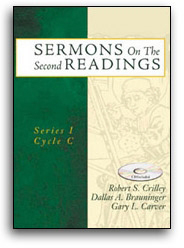
Sermons On The Second Readings
Series I, Cycle C
Despite the zest to adapt when things go amiss with the human body or the mind, a self-alienation and sense of being unacceptable can ooze into our spirit. Part of this self-disliking grows from the disappointment of lost dreams that precedes the discovery of a new purpose. The nerve-wrack of frustration with societal and physical barriers incites estrangement from ourselves. The need to find other ways to manage spawns some of the I-am-not-okay in anyone who encounters a significant change.
Did you know that for the nonvisual person, a user-friendly cellular phone costs five times more than a standard one? The adapter that enables a nonvisual diabetic to use a monitor for blood glucose levels carries an even more outrageous price tag.
Anger with the cost of time, money shortage, and lengthening list of tools necessary to function also contributes. The normal grieving process of loss undercuts joy and causes a once-fervent sense of expectation to sag.
With words from her song, "Into the Dark," youth artist Anna Hill sings, "When my lights are out/I can't see my way/The darkness so overwhelming/I long for the light of day...."1 Then at the critical moment, along came an assuming four-pawed creature called a dog guide who wheedled her way into the scowl and turned everything around.
From the beginning of their team, Leader Dog Dolley endorsed her partner's validity with vigor. Her every action spoke:
"You are acceptable to me. I love you."
"Go ahead and be who you are. I love you."
"I love you as you are, therefore, you will be able to love yourself again and to accept yourself as you are. I love you."
"I will neither let go of you nor will I desert you on your journey. I love you."
The strength of these clear, nonverbal messages gave the human partner of Leader Dog Dolley the permission to be who she is. As far as Dee was concerned, God had sent a dog guide with this dog's particular qualities at the right time. The woman began to comprehend at the level of soul the kindness of an incarnate God.
She revived her created self, the person she recognized. She again practiced the art of "I can." The dog persisted. Day after day, Dolley worked her guiding work with Dee as if blindness were nothing out of the ordinary. Dolley's unconditional love and open acceptance were at once antidote for the venom of self-loathing and vaccine against unacceptability. In becoming teammate with this once-dejected woman, the dog guide transformed a solitary journey into one within community.
This is what reconciliation is about. We bring ourselves to accept. We settle some inner argument that had suggested the broken parts within us cause us to be broken and unworthy people.
As we become reconciled to ourselves, the reestablishment of the inner friendship draws our focus outward toward harmony with God and toward reunion with those around us. Reconciliation presupposes a previous relationship. Reconciliation also notices that the relationship is salvageable.
Here God enters the drama of reconciliation. One may think resolution of dis-ease is a one-person enterprise, but people motivate each other to reach for survival. We also need the intervention of God. Simply put: why does such a closeness grow between a nonvisual person and a dog guide? Absolute necessity for survival. And why does such a closeness grow with God? Absolute necessity for survival.
Reconciliation is difficult. Reconciliation must be from God. It must be a ministry. Reconciliation is effortful, if not impossible, for us to reconcile ourselves by ourselves.
The starting point of our ministry of reconciliation is our perception. "From now on, therefore," Paul tells the Corinthians, "we regard no one from a human point of view; even though we once knew Christ from a human point of view, we know him no longer in that way" (v. 16).
If we are no longer to regard anyone from a human point of view, then you and I will see ourselves and others with different eyes. Perhaps Paul means with these words that we must try to look at others through God's eyes.
Paul might mean also that we are to look for the presence of God in each person we encounter. Think about that. What would happen in the evolution of human relationships were we to look first for God's presence in an individual or within ourselves? Paul might suggest further that we, as God does, see and accept the whole person, human frailties and all.
In today's passage, Paul speaks about God's hand in saving us from ourselves. Paul talks about God's saving us for ourselves. Paul mentions reconciliation five times. First, he says that God "reconciled us to himself through Christ" (v. 18a). Then he says that God "has given us the ministry of reconciliation" (v. 18b).
"That is," Paul explains further, "in Christ God was reconciling the world to himself, not counting their trespasses against them" (v. 19a). Paul then tells us that God's reconciling us to himself through Christ also meant God's "entrusting the message of reconciliation to us" (v. 19b). God saves us not only from ourselves but for others.
Finally, Paul urges and "entreats [us] on behalf of Christ, [to] be reconciled to God" because "we are ambassadors for Christ, since God is making his appeal through us" (v. 21). Rather than reconcile the people of the world to each other, which is the task of the people of the world to work out, Christ reconciled the world to himself. We have been entrusted with the message of reconciliation as ambassadors, but this way of serving is given within this frame of reference: the way of Christ.
"So if anyone is in Christ," Paul tells us, "there is a new creation: everything old has passed away; see, everything has become new!" (v. 17). To reconcile brings us to a new place. Reconciliation countenances a moving on. We are always moving on, not back. We cannot return to Genesis chapter 1 because life changes us. Instead, as we discover that reconciliation is the rebirth of hope, we move on to a new genesis, that of a new beginning.
God continually makes all things new. God's continually making all things new has everything to do with bringing us to this new place in our lives. When God reconciles, God reunites our whole creation to its creator. When we involve ourselves in a ministry of reconciliation, we return the world to God's self.
Reconciliation is not in isolation but is also a saving for. A sense of purpose emerges. Paul phrases this purpose as our being "ambassadors for Christ." God has given us an assignment. We are to be Christ's ambassadors. That will call for a few changes in how we live. Better get ready. This assignment tells us that God/Christ needs us to carry out God's design for unity among neighbors down the hall, across the street, and across the ocean.
The Christ dimension that we take on in becoming ambassadors for Christ makes all the difference. It is our nature to tally up our own trespasses and those of others all the time. Christ, God, asks us to forgive others their errors. What a huge difference exists between our smallness of heart and the generosity of Christ's heart.
This is the difference that being in relationship with Christ makes. In spite of everything, God is continually making all things new. This reconciliation has little to do with changing what cannot be changed, what is aged and worn out, or what is broken about us. We can become new despite the giving out of mind, body, or spirit.
In the beginning, in the middle, and at the end of all this, God is still God who still cares deeply about us, deeply enough to save us from ourselves, deeply enough to save us for ourselves so that we might serve others. In the words, again, of songwriter Anna Hill, "One light shining in this dark place/Makes a world of difference, leaving its trace."2
____________
1. Lyrics and music by Anna Hill, member of the Christian rock musical group, Outspoken, from Friend, Nebraska. Copyright for "Into the Dark" held by the composer. Used by permission.
2. Bridge from "Into the Dark" by Anna Hill.
Did you know that for the nonvisual person, a user-friendly cellular phone costs five times more than a standard one? The adapter that enables a nonvisual diabetic to use a monitor for blood glucose levels carries an even more outrageous price tag.
Anger with the cost of time, money shortage, and lengthening list of tools necessary to function also contributes. The normal grieving process of loss undercuts joy and causes a once-fervent sense of expectation to sag.
With words from her song, "Into the Dark," youth artist Anna Hill sings, "When my lights are out/I can't see my way/The darkness so overwhelming/I long for the light of day...."1 Then at the critical moment, along came an assuming four-pawed creature called a dog guide who wheedled her way into the scowl and turned everything around.
From the beginning of their team, Leader Dog Dolley endorsed her partner's validity with vigor. Her every action spoke:
"You are acceptable to me. I love you."
"Go ahead and be who you are. I love you."
"I love you as you are, therefore, you will be able to love yourself again and to accept yourself as you are. I love you."
"I will neither let go of you nor will I desert you on your journey. I love you."
The strength of these clear, nonverbal messages gave the human partner of Leader Dog Dolley the permission to be who she is. As far as Dee was concerned, God had sent a dog guide with this dog's particular qualities at the right time. The woman began to comprehend at the level of soul the kindness of an incarnate God.
She revived her created self, the person she recognized. She again practiced the art of "I can." The dog persisted. Day after day, Dolley worked her guiding work with Dee as if blindness were nothing out of the ordinary. Dolley's unconditional love and open acceptance were at once antidote for the venom of self-loathing and vaccine against unacceptability. In becoming teammate with this once-dejected woman, the dog guide transformed a solitary journey into one within community.
This is what reconciliation is about. We bring ourselves to accept. We settle some inner argument that had suggested the broken parts within us cause us to be broken and unworthy people.
As we become reconciled to ourselves, the reestablishment of the inner friendship draws our focus outward toward harmony with God and toward reunion with those around us. Reconciliation presupposes a previous relationship. Reconciliation also notices that the relationship is salvageable.
Here God enters the drama of reconciliation. One may think resolution of dis-ease is a one-person enterprise, but people motivate each other to reach for survival. We also need the intervention of God. Simply put: why does such a closeness grow between a nonvisual person and a dog guide? Absolute necessity for survival. And why does such a closeness grow with God? Absolute necessity for survival.
Reconciliation is difficult. Reconciliation must be from God. It must be a ministry. Reconciliation is effortful, if not impossible, for us to reconcile ourselves by ourselves.
The starting point of our ministry of reconciliation is our perception. "From now on, therefore," Paul tells the Corinthians, "we regard no one from a human point of view; even though we once knew Christ from a human point of view, we know him no longer in that way" (v. 16).
If we are no longer to regard anyone from a human point of view, then you and I will see ourselves and others with different eyes. Perhaps Paul means with these words that we must try to look at others through God's eyes.
Paul might mean also that we are to look for the presence of God in each person we encounter. Think about that. What would happen in the evolution of human relationships were we to look first for God's presence in an individual or within ourselves? Paul might suggest further that we, as God does, see and accept the whole person, human frailties and all.
In today's passage, Paul speaks about God's hand in saving us from ourselves. Paul talks about God's saving us for ourselves. Paul mentions reconciliation five times. First, he says that God "reconciled us to himself through Christ" (v. 18a). Then he says that God "has given us the ministry of reconciliation" (v. 18b).
"That is," Paul explains further, "in Christ God was reconciling the world to himself, not counting their trespasses against them" (v. 19a). Paul then tells us that God's reconciling us to himself through Christ also meant God's "entrusting the message of reconciliation to us" (v. 19b). God saves us not only from ourselves but for others.
Finally, Paul urges and "entreats [us] on behalf of Christ, [to] be reconciled to God" because "we are ambassadors for Christ, since God is making his appeal through us" (v. 21). Rather than reconcile the people of the world to each other, which is the task of the people of the world to work out, Christ reconciled the world to himself. We have been entrusted with the message of reconciliation as ambassadors, but this way of serving is given within this frame of reference: the way of Christ.
"So if anyone is in Christ," Paul tells us, "there is a new creation: everything old has passed away; see, everything has become new!" (v. 17). To reconcile brings us to a new place. Reconciliation countenances a moving on. We are always moving on, not back. We cannot return to Genesis chapter 1 because life changes us. Instead, as we discover that reconciliation is the rebirth of hope, we move on to a new genesis, that of a new beginning.
God continually makes all things new. God's continually making all things new has everything to do with bringing us to this new place in our lives. When God reconciles, God reunites our whole creation to its creator. When we involve ourselves in a ministry of reconciliation, we return the world to God's self.
Reconciliation is not in isolation but is also a saving for. A sense of purpose emerges. Paul phrases this purpose as our being "ambassadors for Christ." God has given us an assignment. We are to be Christ's ambassadors. That will call for a few changes in how we live. Better get ready. This assignment tells us that God/Christ needs us to carry out God's design for unity among neighbors down the hall, across the street, and across the ocean.
The Christ dimension that we take on in becoming ambassadors for Christ makes all the difference. It is our nature to tally up our own trespasses and those of others all the time. Christ, God, asks us to forgive others their errors. What a huge difference exists between our smallness of heart and the generosity of Christ's heart.
This is the difference that being in relationship with Christ makes. In spite of everything, God is continually making all things new. This reconciliation has little to do with changing what cannot be changed, what is aged and worn out, or what is broken about us. We can become new despite the giving out of mind, body, or spirit.
In the beginning, in the middle, and at the end of all this, God is still God who still cares deeply about us, deeply enough to save us from ourselves, deeply enough to save us for ourselves so that we might serve others. In the words, again, of songwriter Anna Hill, "One light shining in this dark place/Makes a world of difference, leaving its trace."2
____________
1. Lyrics and music by Anna Hill, member of the Christian rock musical group, Outspoken, from Friend, Nebraska. Copyright for "Into the Dark" held by the composer. Used by permission.
2. Bridge from "Into the Dark" by Anna Hill.
