
Second Sunday In Lent
Preaching
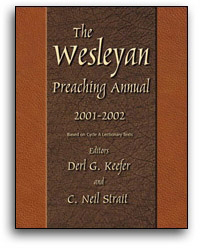
THE WESLEYAN PREACHING ANNUAL 2001--2002
WORSHIP HELPS
CALL TO WORSHIP
King David wrote, "The Lord is my rock and my fortress, and my deliverer; the God of my rock; in Him will I trust; He is my shield, and the horn of my salvation, my high tower, and my refuge, my Savior...." (2 Samuel 22:2--3 KJV)
OFFERING THOUGHT
The bounty of our labor we give to You, our Father. We give, not with regret, but with rejoicing hearts.
BENEDICTION
Speaker 1: We have seen the awesome things God has done.
Speaker 2: He has done them on our behalf!
Speakers 1 & 2: Let us tell all the things He has done to all people on His behalf.
Faith Activated
Genesis 12:1--4
Introduction
In Galatians 3:9, Abraham is described as "the man of faith." Being described as such might make the rest of us feel a bit inferior by comparison. But, Abraham was not a superman. In fact, the Genesis account pictures him in very real terms, warts and all. His story is not a fairy tale to simply be admired, but a very down--to--earth account of a man called by God to follow the unseen, but living God. He is not just naturally religious. His story is to be our story, for we all have the capacity for faith in God. Each person can have his faith activated and his life changed.
How did Abram become a man of faith and activate it at the same time? The Scriptures reveal the answer.
I. The props were pulled. (v. 1)
Abram is told to leave his country, his people, his father's household and go to a land that God would show him. Abram's faith is activated when God said "leave" and "go."
God activates our faith when He pulls the props upon which our lives have rested. Faith's challenge is to action ... No coasting allowed!
In 2 Corinthians 1, Paul describes some of the hardships, difficulties and pressures he had endured. He says about them, "This happened that we might not rely on ourselves but on God" (2 Corinthians 1:9).
Illustration: One of the key events in my spiritual journey took place when I went away to college. Devotions, church attendance, stewardship consistency, moral choices would be under less scrutiny by others. I would either have my faith activated or it would die. I could not longer ride the faith strings of my parents. My faith grew and blossomed.
II. Promises were made. (vv. 2--3)
Notice the "I will" promises of God to Abram. It refers to some time later, a time not yet seen, yet it is anticipated and expected. The promises are huge: a great nation, great blessing, great name, great land. There is not much to hang on to except trusting the Promise--maker.
Abram had no child, no family security, no homeland. All chances of making a name for himself in this strange land were slim. But, that was the point: God would make the name for him. God would give him the land. God would give him a child. God would be his security.
When God makes a promise, He is saying, "Trust me!" God's promises to us seek to activate our faith in Him.
III. Commands were obeyed. (v. 4)
Abram is told to "leave" and "go" so Abram does. Hebrews 11:8 says, "By faith Abraham ... obeyed and went." There is no true faith without obedience.
Warren Wiersbe has written, "Faith is not believing in spite of evidence; it is obeying in spite of consequences."1 Obedience and faith go together. Obedience is the greatest sign of our faith.
Charles Colson writes, "Faith is believing and acting - acting in obedience to the commands of Christ - even though you can't see what's going to happen."2
Peter Haile puts it this way, "Faith is acting on the assumption that God is as good as his word."3
Nothing substitutes for obedience to God.
IV. Prayers were prayed. (vv. 6--9)
Abram built altars of worship at both Shechem and Bethel. It was not an empty ritual for him. He was worshipping the God on whom he was staking his life and future. He prayed to this God who spoke to him. He praised Him and began to get to know Him intimately.
This was the beginning of a lifetime faith walk with God. The relationship became so close he was later described as "a friend of God."
Conclusion
Have the props been kicked out so you will depend more on the Lord? Are you learning to trust the Promise--maker? Has obedience become the pattern for your life with God? Are you developing a friendship with God? Let the Lord activate your faith today.
Gary Reiss
____________
1. Warren Wiersbe, With the Word Bible Commentary, (Nashville: Thomas Nelson Publishers, 1991), p. 14.
2. Charles Colson, Loving God, (Grand Rapids, Michigan: Zondervan Publishing House, 1983), p. 223.
3. Peter Haile, The Difference God Makes, (Minneapolis, MN: World Wide Publications, 1987), p. 16.
Someone To Watch Over Me
Psalm 121
"Mommy, Daddy, watch me!" Most parents have heard such pleas from their children at one time or another. Whether it's a first attempt at a somersault, nervous dive into the pool, or maiden ride on the bicycle without training wheels, children want the attention of parents - they want to be watched. The desire for life to be observed is not unique to children. There must be some primordial urge within the human spirit to live, no, to perform, one's life under the watchful eye of someone who can see and appreciate what is being presented at the moment.
Psalm 121 is a statement of human aspiration and a declaration of Godly observation. It is a "Psalm of Ascent," a song for the journey. These words claim to be helpful advice for pilgrims on their way. The psalmist begins with the telling question, "Where does my help come from?" A good question indeed! This is particularly so if, as some scholars believe, that the reference to casting the eyes to the hills is the recognition of the presence of many other "gods" to whom one might turn for help. In those "hills" were said to dwell other "helpers" who the psalmist might be tempted to turn to for help. Clearly, our world presents multiple options when it comes to the business of where we might turn for comfort and aid. But the declaration of this psalm is unwavering in its affirmation that it is in Yahweh alone that help will be sought. The question is why? With so many options, why choose the Lord?
First and foremost is the fact that in choosing the Lord as his helper, he has chosen the One who has made the heavens and the earth (and the hills as well!). The fact of creation is a powerful rationale throughout the Psalms for the worship of Yahweh. Any Being who can create our world is worthy of praise. In the same way, any Being who could create all this is the kind of Being to whom one would want to look for help. Obviously, the idea of power and might are intimated here. If you are going to choose a helper, you ought to choose one with the means to help. To look past the hills, filled as they were with pagan gods, to the One who made it all is to go the source of all power and strength.
But even the appeal to God as Creator is not the ultimate reason the psalmist chooses Yahweh as his helper. God is not only the creator of the universe, He is also it's Sustainer! That's where watching comes in. God hasn't simply created the cosmos in some fit of arbitrary creativity and then left it to its own devices. No. He watches over it. Watching is a shepherding term. God is the faithful shepherd of the universe. Contrary to the claims of Deists, past and present, God has not created all this and then retired in boredom to another corner of heaven, leaving earth and all in it to its own devices. He is the eternally, present observer. And the steadfastness of God to watch over His creation is what cheers the heart of the psalmist so.
Five separate times, the psalmist affirms the Lord's propensity to watch over his life. Not only does God observe His creation, He observes the individual lives of human beings. Jesus used this to make a fundamental point about our lives in the Sermon on the Mount when He reminded His hearers how God watches out for the birds of the air and the flowers of the fields. In other words, God's watching is not a passive kind of quasi--interested observation, but it is an active participation in our lives! He really is the good shepherd! And because of that we can walk, even through the valley of the shadow of death, because He is watching!
Jesus also reminded His followers of God's faithful involvement in our lives when He said, "Are not two sparrows sold for a penny? Yet not one of them will fall to the ground apart from the will of your Father. And even the very hairs of your head are all numbered. So don't be afraid; you are worth more than many sparrows" (Matthew 10:29--31). What the psalmist has discovered about God has been reiterated by Jesus, God is determined to be intimately involved in our lives.
We live, as it were, an observed life. We are not alone. The Shepherd of Israel is watching.
J. Michael Walters
CALL TO WORSHIP
King David wrote, "The Lord is my rock and my fortress, and my deliverer; the God of my rock; in Him will I trust; He is my shield, and the horn of my salvation, my high tower, and my refuge, my Savior...." (2 Samuel 22:2--3 KJV)
OFFERING THOUGHT
The bounty of our labor we give to You, our Father. We give, not with regret, but with rejoicing hearts.
BENEDICTION
Speaker 1: We have seen the awesome things God has done.
Speaker 2: He has done them on our behalf!
Speakers 1 & 2: Let us tell all the things He has done to all people on His behalf.
Faith Activated
Genesis 12:1--4
Introduction
In Galatians 3:9, Abraham is described as "the man of faith." Being described as such might make the rest of us feel a bit inferior by comparison. But, Abraham was not a superman. In fact, the Genesis account pictures him in very real terms, warts and all. His story is not a fairy tale to simply be admired, but a very down--to--earth account of a man called by God to follow the unseen, but living God. He is not just naturally religious. His story is to be our story, for we all have the capacity for faith in God. Each person can have his faith activated and his life changed.
How did Abram become a man of faith and activate it at the same time? The Scriptures reveal the answer.
I. The props were pulled. (v. 1)
Abram is told to leave his country, his people, his father's household and go to a land that God would show him. Abram's faith is activated when God said "leave" and "go."
God activates our faith when He pulls the props upon which our lives have rested. Faith's challenge is to action ... No coasting allowed!
In 2 Corinthians 1, Paul describes some of the hardships, difficulties and pressures he had endured. He says about them, "This happened that we might not rely on ourselves but on God" (2 Corinthians 1:9).
Illustration: One of the key events in my spiritual journey took place when I went away to college. Devotions, church attendance, stewardship consistency, moral choices would be under less scrutiny by others. I would either have my faith activated or it would die. I could not longer ride the faith strings of my parents. My faith grew and blossomed.
II. Promises were made. (vv. 2--3)
Notice the "I will" promises of God to Abram. It refers to some time later, a time not yet seen, yet it is anticipated and expected. The promises are huge: a great nation, great blessing, great name, great land. There is not much to hang on to except trusting the Promise--maker.
Abram had no child, no family security, no homeland. All chances of making a name for himself in this strange land were slim. But, that was the point: God would make the name for him. God would give him the land. God would give him a child. God would be his security.
When God makes a promise, He is saying, "Trust me!" God's promises to us seek to activate our faith in Him.
III. Commands were obeyed. (v. 4)
Abram is told to "leave" and "go" so Abram does. Hebrews 11:8 says, "By faith Abraham ... obeyed and went." There is no true faith without obedience.
Warren Wiersbe has written, "Faith is not believing in spite of evidence; it is obeying in spite of consequences."1 Obedience and faith go together. Obedience is the greatest sign of our faith.
Charles Colson writes, "Faith is believing and acting - acting in obedience to the commands of Christ - even though you can't see what's going to happen."2
Peter Haile puts it this way, "Faith is acting on the assumption that God is as good as his word."3
Nothing substitutes for obedience to God.
IV. Prayers were prayed. (vv. 6--9)
Abram built altars of worship at both Shechem and Bethel. It was not an empty ritual for him. He was worshipping the God on whom he was staking his life and future. He prayed to this God who spoke to him. He praised Him and began to get to know Him intimately.
This was the beginning of a lifetime faith walk with God. The relationship became so close he was later described as "a friend of God."
Conclusion
Have the props been kicked out so you will depend more on the Lord? Are you learning to trust the Promise--maker? Has obedience become the pattern for your life with God? Are you developing a friendship with God? Let the Lord activate your faith today.
Gary Reiss
____________
1. Warren Wiersbe, With the Word Bible Commentary, (Nashville: Thomas Nelson Publishers, 1991), p. 14.
2. Charles Colson, Loving God, (Grand Rapids, Michigan: Zondervan Publishing House, 1983), p. 223.
3. Peter Haile, The Difference God Makes, (Minneapolis, MN: World Wide Publications, 1987), p. 16.
Someone To Watch Over Me
Psalm 121
"Mommy, Daddy, watch me!" Most parents have heard such pleas from their children at one time or another. Whether it's a first attempt at a somersault, nervous dive into the pool, or maiden ride on the bicycle without training wheels, children want the attention of parents - they want to be watched. The desire for life to be observed is not unique to children. There must be some primordial urge within the human spirit to live, no, to perform, one's life under the watchful eye of someone who can see and appreciate what is being presented at the moment.
Psalm 121 is a statement of human aspiration and a declaration of Godly observation. It is a "Psalm of Ascent," a song for the journey. These words claim to be helpful advice for pilgrims on their way. The psalmist begins with the telling question, "Where does my help come from?" A good question indeed! This is particularly so if, as some scholars believe, that the reference to casting the eyes to the hills is the recognition of the presence of many other "gods" to whom one might turn for help. In those "hills" were said to dwell other "helpers" who the psalmist might be tempted to turn to for help. Clearly, our world presents multiple options when it comes to the business of where we might turn for comfort and aid. But the declaration of this psalm is unwavering in its affirmation that it is in Yahweh alone that help will be sought. The question is why? With so many options, why choose the Lord?
First and foremost is the fact that in choosing the Lord as his helper, he has chosen the One who has made the heavens and the earth (and the hills as well!). The fact of creation is a powerful rationale throughout the Psalms for the worship of Yahweh. Any Being who can create our world is worthy of praise. In the same way, any Being who could create all this is the kind of Being to whom one would want to look for help. Obviously, the idea of power and might are intimated here. If you are going to choose a helper, you ought to choose one with the means to help. To look past the hills, filled as they were with pagan gods, to the One who made it all is to go the source of all power and strength.
But even the appeal to God as Creator is not the ultimate reason the psalmist chooses Yahweh as his helper. God is not only the creator of the universe, He is also it's Sustainer! That's where watching comes in. God hasn't simply created the cosmos in some fit of arbitrary creativity and then left it to its own devices. No. He watches over it. Watching is a shepherding term. God is the faithful shepherd of the universe. Contrary to the claims of Deists, past and present, God has not created all this and then retired in boredom to another corner of heaven, leaving earth and all in it to its own devices. He is the eternally, present observer. And the steadfastness of God to watch over His creation is what cheers the heart of the psalmist so.
Five separate times, the psalmist affirms the Lord's propensity to watch over his life. Not only does God observe His creation, He observes the individual lives of human beings. Jesus used this to make a fundamental point about our lives in the Sermon on the Mount when He reminded His hearers how God watches out for the birds of the air and the flowers of the fields. In other words, God's watching is not a passive kind of quasi--interested observation, but it is an active participation in our lives! He really is the good shepherd! And because of that we can walk, even through the valley of the shadow of death, because He is watching!
Jesus also reminded His followers of God's faithful involvement in our lives when He said, "Are not two sparrows sold for a penny? Yet not one of them will fall to the ground apart from the will of your Father. And even the very hairs of your head are all numbered. So don't be afraid; you are worth more than many sparrows" (Matthew 10:29--31). What the psalmist has discovered about God has been reiterated by Jesus, God is determined to be intimately involved in our lives.
We live, as it were, an observed life. We are not alone. The Shepherd of Israel is watching.
J. Michael Walters
