The Shepherd And His Sheep
Sermon
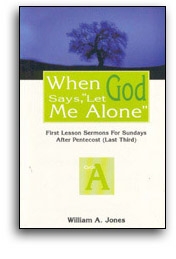
When God Says, 'Let Me Alone'
First Lesson Sermons For Sundays After Pentecost (Last Third)
The scriptures are replete with striking symbols. Wherever one turns in the blessed Book, some striking image tends to present itself. One of the most meaningful of them all is the shepherd/sheep motif. Roeh is the word for "shepherd" in the Hebrew language. It applies to God Himself, the great Shepherd, and is first mentioned in scripture by Jacob, in Genesis 49. Rich in symbolism and powerful with respect to euphony, the shepherd/sheep motif has warmed the hearts of the faithful across the centuries.
The believer's vocabulary would be seriously short without the Psalmist's declaration, "The Lord is my Shepherd. I shall not want." For purposes of identity, few passages ring with the majesty of verse three in Psalm 100. "Know ye that the Lord He is God, it is He that hath made us, and not we ourselves. We are His people and the sheep of His pasture."
Power, protection, and provision are all part and parcel of the shepherd concept. Throughout the scriptural journey, the Shepherd is present to provide care for His sheep. It is a never-ceasing function of the Shepherd. Now, we need to know that there has never been a shepherd problem. The problem all along the pathway of the pilgrimage has been a sheep problem -- sheep assaulted by wolves, sheep driven from the fold, sheep bruised and broken, sheep ravaged by disease, sheep who nibbled away from the flock. And nobody but the great Shepherd is able to tend such a diverse flock. Ezekiel, prophet of the exile, whose attunement to heaven's frequency was keen and profound, learned a lucid lesson on the relationship of the Shepherd and the sheep.
Ezekiel tells us that the great Shepherd told him, "I will feed my flock, I will seek that which was lost and bring again that which was driven away, and will bind up that which was broken and will strengthen that which was sick."
My, what love and what compassion! Earlier he had declared, "I will deliver them out of all places where they have been scattered in the cloudy and dark day." All of the Shepherd's sheep are within the province of the Shepherd's concern -- those of the Diaspora, those that have been scattered, those who are lost, those who were driven away, the broken and the sick, all the sheep, the entire flock.
How deeply dependent are the sheep on the Shepherd. The problem that we face is that of sheep trying to be independent. That's the old Adamic impulse at work; that's existential sin -- sheep trying to be something other than sheep. Sheep are not designed to be independent. Sheep are under the Shepherd's total supervision. It is the attempt at self-sufficiency that causes sheep to wander and wind up in the wasteland of lostness. Forgetting the flock and the Shepherd's care, they independently nibble away, and end up in the lost category. But some sheep are driven away, forced from the flock by terrible enticements and inducements. Let me put it plainly -- by Judas goats and the like. I have observed over the years that most people who break ranks with the people of God, those who backslide and return to a former state of being -- such souls, in the main, are lured by wolves in sheep's clothing, or by Judas goats.
During my college days, I worked summers in a packing house. There they slaughtered cattle and sheep. The sheep were placed in pens prior to their slaughter. And for some reason the sheep seemed to be particularly sensitive to imminent death. They never entered the killing floor willingly, so on sheep and lamb killing days a certain goat was placed in the pen. The Judas goat was placed in the pen with the sheep and the lambs, and his job was simple, plain and pointed. He did not say, "Bye-bye"; he did not look a certain way; all that he did was move in a certain direction. When the door was opened leading to the killing floor, the Judas goat would be the first to exit. He would lead the others to the slaughter, and once they were all in, he would do an about-face and return to the pen.
Judas goats have their human counterparts, even within the ranks of the Church. Deceptive spirits they are. They have "killjoy" mind-sets. Their primary pleasure is derived from making other folks miserable. Have you ever seen anybody like that? They resent your joy, and do everything they can to kill it. Beware of the Judas goat.
Now within the flock, there are also those who are bruised and broken by the exigencies of life. They have had to deal with strong head winds. They fight mean, vicious wolves with whom they have had to deal, and harsh desert sands and sun. They are bruised, battered, and broken. And then there are those sheep who are sick. Sickness, the reality that plagues all of life, has gotten to their bodies and sometimes to their minds. Diseases of every description plague their mortality.
How dreadful the situation would be if there were no Shepherd. But there is the Shepherd. Listen again to His promise, "I will seek that which was lost, and bring again that which was driven away, and will bind up that which was broken and will strengthen that which was sick." How compassionate, how merciful, how loving! But there is more to the promise. It concerns another segment of the same family. Says the great Shepherd, "I will do all of these merciful acts, but I will destroy the fit and the strong, I will feed them with judgment." Can you read between the lines? Do you see the implication? The fit and the strong are those sheep who have benefited from the sufferings of other sheep. They are the exploiters, the vultures, the profiteers who have gotten ahead by taking advantage of others.
The Shepherd says, "I have something for them; I will feed them with judgment." Wrong will not win and justice will triumph. Righteousness is always a winner. I derive great consolation from this passage. You see, it informs me of my true status and the blessings inherent in the sheepfold. It tells me of the care and concern that are tendered me by the Shepherd, and it points to Jesus Christ, who is the Chief Shepherd. I am talking about the One who never writes anybody off. So gracious and so plenteous in mercy is he, that he has even declared, "Other sheep I have that are not of this fold. Them also I must bring." So selfless is he, that he told us, "I am the good Shepherd; the good Shepherd giveth his life for his sheep." And so special was the promise of his coming that Isaiah was instructed, "he shall feed his flock like a shepherd. He shall gather the lambs with his arm and carry them in his bosom, and shall gently lead those that are with young." It is no wonder then, that the church keeps on singing, "The King of love my shepherd is, Whose goodness faileth never, I nothing lack if I am his, and he is mine forever."
The writer of the missive to the Hebrews exalts our Shepherd in his soaring benediction. "Now the God of Peace, that brought again from the dead our Lord Jesus, that great Shepherd of the sheep, through the blood of the everlasting covenant make you perfect in every good work to do His will, working in you that which is well pleasing in His sight, through Jesus Christ, to Whom be glory forever and ever. Amen."
The believer's vocabulary would be seriously short without the Psalmist's declaration, "The Lord is my Shepherd. I shall not want." For purposes of identity, few passages ring with the majesty of verse three in Psalm 100. "Know ye that the Lord He is God, it is He that hath made us, and not we ourselves. We are His people and the sheep of His pasture."
Power, protection, and provision are all part and parcel of the shepherd concept. Throughout the scriptural journey, the Shepherd is present to provide care for His sheep. It is a never-ceasing function of the Shepherd. Now, we need to know that there has never been a shepherd problem. The problem all along the pathway of the pilgrimage has been a sheep problem -- sheep assaulted by wolves, sheep driven from the fold, sheep bruised and broken, sheep ravaged by disease, sheep who nibbled away from the flock. And nobody but the great Shepherd is able to tend such a diverse flock. Ezekiel, prophet of the exile, whose attunement to heaven's frequency was keen and profound, learned a lucid lesson on the relationship of the Shepherd and the sheep.
Ezekiel tells us that the great Shepherd told him, "I will feed my flock, I will seek that which was lost and bring again that which was driven away, and will bind up that which was broken and will strengthen that which was sick."
My, what love and what compassion! Earlier he had declared, "I will deliver them out of all places where they have been scattered in the cloudy and dark day." All of the Shepherd's sheep are within the province of the Shepherd's concern -- those of the Diaspora, those that have been scattered, those who are lost, those who were driven away, the broken and the sick, all the sheep, the entire flock.
How deeply dependent are the sheep on the Shepherd. The problem that we face is that of sheep trying to be independent. That's the old Adamic impulse at work; that's existential sin -- sheep trying to be something other than sheep. Sheep are not designed to be independent. Sheep are under the Shepherd's total supervision. It is the attempt at self-sufficiency that causes sheep to wander and wind up in the wasteland of lostness. Forgetting the flock and the Shepherd's care, they independently nibble away, and end up in the lost category. But some sheep are driven away, forced from the flock by terrible enticements and inducements. Let me put it plainly -- by Judas goats and the like. I have observed over the years that most people who break ranks with the people of God, those who backslide and return to a former state of being -- such souls, in the main, are lured by wolves in sheep's clothing, or by Judas goats.
During my college days, I worked summers in a packing house. There they slaughtered cattle and sheep. The sheep were placed in pens prior to their slaughter. And for some reason the sheep seemed to be particularly sensitive to imminent death. They never entered the killing floor willingly, so on sheep and lamb killing days a certain goat was placed in the pen. The Judas goat was placed in the pen with the sheep and the lambs, and his job was simple, plain and pointed. He did not say, "Bye-bye"; he did not look a certain way; all that he did was move in a certain direction. When the door was opened leading to the killing floor, the Judas goat would be the first to exit. He would lead the others to the slaughter, and once they were all in, he would do an about-face and return to the pen.
Judas goats have their human counterparts, even within the ranks of the Church. Deceptive spirits they are. They have "killjoy" mind-sets. Their primary pleasure is derived from making other folks miserable. Have you ever seen anybody like that? They resent your joy, and do everything they can to kill it. Beware of the Judas goat.
Now within the flock, there are also those who are bruised and broken by the exigencies of life. They have had to deal with strong head winds. They fight mean, vicious wolves with whom they have had to deal, and harsh desert sands and sun. They are bruised, battered, and broken. And then there are those sheep who are sick. Sickness, the reality that plagues all of life, has gotten to their bodies and sometimes to their minds. Diseases of every description plague their mortality.
How dreadful the situation would be if there were no Shepherd. But there is the Shepherd. Listen again to His promise, "I will seek that which was lost, and bring again that which was driven away, and will bind up that which was broken and will strengthen that which was sick." How compassionate, how merciful, how loving! But there is more to the promise. It concerns another segment of the same family. Says the great Shepherd, "I will do all of these merciful acts, but I will destroy the fit and the strong, I will feed them with judgment." Can you read between the lines? Do you see the implication? The fit and the strong are those sheep who have benefited from the sufferings of other sheep. They are the exploiters, the vultures, the profiteers who have gotten ahead by taking advantage of others.
The Shepherd says, "I have something for them; I will feed them with judgment." Wrong will not win and justice will triumph. Righteousness is always a winner. I derive great consolation from this passage. You see, it informs me of my true status and the blessings inherent in the sheepfold. It tells me of the care and concern that are tendered me by the Shepherd, and it points to Jesus Christ, who is the Chief Shepherd. I am talking about the One who never writes anybody off. So gracious and so plenteous in mercy is he, that he has even declared, "Other sheep I have that are not of this fold. Them also I must bring." So selfless is he, that he told us, "I am the good Shepherd; the good Shepherd giveth his life for his sheep." And so special was the promise of his coming that Isaiah was instructed, "he shall feed his flock like a shepherd. He shall gather the lambs with his arm and carry them in his bosom, and shall gently lead those that are with young." It is no wonder then, that the church keeps on singing, "The King of love my shepherd is, Whose goodness faileth never, I nothing lack if I am his, and he is mine forever."
The writer of the missive to the Hebrews exalts our Shepherd in his soaring benediction. "Now the God of Peace, that brought again from the dead our Lord Jesus, that great Shepherd of the sheep, through the blood of the everlasting covenant make you perfect in every good work to do His will, working in you that which is well pleasing in His sight, through Jesus Christ, to Whom be glory forever and ever. Amen."