
Still Small Voice
Sermon
A Long Time Coming
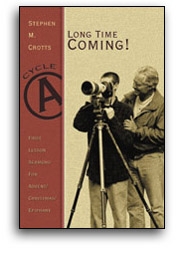
Cycle A First Lesson Sermons for Advent, Christmas, and Epiphany
Object:
Ask any child at Christmas!
There are three ways to look at a Christmas package. The first is to look forward to it. This is best accomplished by squeezing it, shaking it, and guessing its contents by its weight. The second is to open it. Here, anticipation turns to knowledge as layers of wrapping paper, tape, and tissue are torn away and the contents laid bare. And finally there is the memory stage. This happens when you take the gift out of the box and put it on or put it to use over the years of your life and experience just what it can do.
In the Bible we have these same three perspectives of Christ's birth. There were those who looked forward to his coming. They were the prophets -- Isaiah, Hosea, Micah, Balaam, and the like. Seeing Christmas from afar, they predicted his virgin birth, his nativity at Bethlehem, and even his death on the cross.
Then there were those who looked on Christmas. The events of the nativity were literally unwrapped right before their eyes. Such was the experience of Mary and Joseph, Herod, shepherds, wise men, Anna, and Simeon.
And finally, there were those who looked back on Christmas. Men like Paul wrote of the meaning of Christ's birth with an understanding born of years of experience.
Our text today comes from the first perspective, the prophetic. It is an oracle of the prophet Isaiah in which an ideal king is anticipated. And in it the seer beholds Christ from afar. There is a dim outline of salvation; none of the details are filled in, but, nonetheless, Christ is foreseen.
When Isaiah wrote this text, Israel was experiencing a gloomy political existence. From the unity and military prowess of King David's era, the Jews had fallen. Corruption, injustice, and disobedience had toppled the nation. Now Israel was being constantly invaded, conquered, and downtrodden by foreigners. In chapter 10 Isaiah symbolizes Israel as a once proud forest cut down to stumps by the wrath of God.
And now in chapter 2 he turns from judgment to hope, from punishment to deliverance. And this is what he says, "There shall come forth a shoot from the stump of Jesse, and a branch shall grow out of his roots." Let's get into this prophecy and see what it has for us this Christmas.
Hurt
First of all, the prophecy of Isaiah tells us that there is hurt in Christmas. It gives us the symbol of a stump. Once mighty Israel is now cut down and carried away. Only the stump remains.
You'll have to agree that a stump is one of the most hopeless-looking things in all the world. It is quite a come-down from the heights of a mature tree. Where once a tall whispering giant stood providing shade and fruit, now there is only a stump, ugly and dead-looking.
In the Old Testament, when a nation invaded and conquered Israel, quite often they would capture the king and his sons alive. The sons would then be slain in front of the king and then the king himself would be tortured by having his eyes gouged out. The last thing he would ever see then would be his boys' deaths. Next the king's hands would be cut off or his tongue cut out or even his feet crippled. And this poor stump of a man would then be deported and forced to live among his conquerors as a symbol of their international dominance, a living reminder of his failure and their success, a trophy of despair.
It's that type of world, isn't it? There are those in our day who have been cut down in divorce. Their spouse, the courts, have lopped off income, home, children, furniture, friends, and even hope. Where once Christmas meant marriage, children, a fire in the hearth, laughter and feasting and exchanging gifts, now there is only a stump -- a cold half-furnished apartment with a telephone that never rings.
A businessman in the city told me he once had a car dealership with 300 cars to choose from, 27 full-time employees, and customers who'd been loyal to his trust for 25 years! But as he drove along on his way to his new job as an assistant manager in an outlet, he pointed to a vacant lot, windswept and fallen into disrepair. "It was all swept away in the recession, all swept into bankruptcy," he explained. Again, a stump. A living reminder of what once was and what now isn't.
From divorce courts to bankruptcy, Isaiah's vision of an entire nation that has been leveled like a clear-cut forest does not miss our own nation very far. The quality of education in our public schools continues to slump. Then there are the stumps of Vietnam and Watergate, and of course, the stump of good service. Remember how at the gas station they not only used to pump your gas but also wipe your windows and check the oil and tire pressure, too? But that's all gone now. And so many of our once productive factory towns now rust in idleness. Our prisons run full. Our churches are half full. And whole segments of the inner city are kept alive by the hope of another heroin fix or six-pack.
Is there a stump in your life? Some broken friendship? A once vibrant health now cut down? A dream now broken? So it was. So it was in Isaiah's day. And so it now is. But don't miss this!
Happiness
Not only does Isaiah's Christmas vision contain a symbol of despair, the stump, but also it has in it a symbol of joy and that symbol is the "root."
The text says, "There shall come forth a shoot from the stump of Jesse, and a branch shall grow out of his roots."
Some quick explaining here: King David's father was Jesse. And God promised someone from Jesse's and David's lineage would always rule Israel. The people clung to this promise even when all Israel was overrun and ruined by Assyria, Babylon, and others. "God has promised. He will keep His word. He will give us a new David! Where is Jesse's next son, our new king and deliverer, who will build Israel back?"
The text here is also playing on our knowledge of a phenomena that might not be all that familiar to us today. Have you ever noticed how a tree that is chopped down will often sprout again from its stump and grow a new tree? As long as there is life in the roots there is hope for a new beginning. Just add moisture, sunlight, and time and a new tree will grow every bit as grand as the first. This is the symbol of happiness Isaiah shares with a fallen nation. "From the roots of the stump a shoot has burst forth!"
It also helps to see that in scripture a root is a symbol of many positive things. The word "root" can mean "stability" (Colossians 2:7), "strength" (Isaiah 14:30), "the cause of something" (1 Timothy 6:10), "a foundation" (Job 28:9), "parents" (Daniel 11:7), and even "Jesus Christ" (Isaiah 11:10, Revelation 5:5).
So, Isaiah looks at the stump of his nation, the stumps of the lives of the people around him, and from his lips comes a word of happiness. "I see a root," he cries. "I can see new growth! There is life yet!"
There are still people of vision like that among us today, are there not? People who can see in old junk a priceless antique. People who can see in a rusty old car a restorable collector's item. And from ruin they can bring new life.
One such man of our time was George Marshall. After World War II Europe lay in ruins, its youth slain in combat, its economy shattered, its cities smoking rubble. General George Marshall decided it was time to spend as much time and energy and money making peace in Europe as had been done making war. His plan to rebuild Europe became known as the Marshall Plan. And during the decade of its implementation Europe grew from a stump to a tall tree. And this is what Isaiah says God is doing in the world during Israel's day, during Christ's day, during our day every day.
No matter how cut-down we are, no matter our sin, God is here and on his mind is a plan to spend more effort bringing redemption and new life than Satan and man have in bringing sin and death. And God, the Bible says, has more life than we have death. He has more forgiveness than we have sin.
The Good News is that in the stump of man's existence there is a root, always the root! There is in us a stability, a strength, a foundation, a hidden cause, a divine Father, a Christ -- and from this root shall come a shoot, and from that shoot a sapling, and from that a tree!
Now, granted, a root would seem to be small cause for joy. But look at it this way: If you had a favorite houseplant that got knocked to the floor and broken off at the stump you would mourn. But when you saw new life coming from the stump weeks later, you'd take joy knowing that one day your plant would be restored to you.
In a way Jesus, as a direct descendant of David and Jesse, was not much to look at, a small occasion for joy. Isaiah said of him in 53:2: "He grew up before him like a young plant, and like a root out of dry ground; he had no form or comeliness that we should look at him, and no beauty that we should desire him." Jesus' birth for most people went entirely unnoticed. He was just one more peasant child born, another mouth to feed, another baby destined to grow into an adult, do his allotted tasks, die, and find his place in obscurity.
Yet, my, my! Look at how his root has grown! It is a fact of history that fewer than one out of a million people is famous. And most people who are famous achieve their fame during their lifetime. Then, after their death, their fame begins to fade as history writes their worth in fewer and fewer paragraphs.
Yet with Jesus Christ we have one of the true ironies of history, for with him the exact opposite is true! Christ, you see, was born in poverty, reared in obscurity, ministered during a brief three years to at most 500 ardent followers, and was literally crossed out by the powers that be, dying the death of a convicted felon. Yet, instead of quickly fading into obscurity like others, his name has brightened and gathered momentum and risen to the point where no other name among men is given more space in the encyclopedia of history.
Hope
So, Christmas is part hurt, for there is a stump; indeed, there are stumps in our lives. And Christmas is part happiness, because there is a root, a new beginning, a coming king, a restoration begun. And this leads us to the latter part of the text which points us to the future. Isaiah predicts, "There shall come forth a shoot from the stump of Jesse, and a branch shall grow out of his roots. And the Spirit of the Lord shall ..." That's future tense, isn't it? Isaiah is saying, "It might look like a stump to you right now, but look ahead! God is at work. Life is here."
When some things are cut off they don't grow back -- arms, legs, fingers. But tree limbs grow back, vines and blossoms, too. And Isaiah is saying that in the Spirit of God, in Jesus Christ, there is no hurt God will not heal, no loss God will not restore.
Take the root of Jesus Christ himself. From the stump of Israel came a new shoot. It grew into a tree. And man chopped it down, fashioned it into a cruel cross, and nailed Jesus there to die. But God made that cross the root of our salvation and raised Jesus from the dead in triumph!
And this same God who did all that for Jesus is still at work doing the same for the widow, the prisoner, the orphan, the sick and suffering, the bankrupt, the divorced, and the failed. You've but to reach out to him by faith and he is there!
And what's more, the text says this new life is not just growing up among us to inspire. It is growing up to rule. Isaiah 11:1-10 says the spirit will be upon Christ -- wisdom, might, fair judgment, the ability to rule. In him, the earth will become a new garden of Eden where roots flourish, where harm ceases, and harmony prevails. The nations of the world will come to stare in amazement at what has grown out of Jesse's stump!
The only suicide note I've ever seen said this: "My family is gone. My business is wrecked. My feelings are numb. I can't see the future. There is within me no tiny reason for hope. Good-bye." Yet to this man and to you and to me Isaiah points to a tiny root. And never underestimate the power of a tiny hope!
Note, if you will, the emphasis in the text on the little things. Small stumps. Little roots. Tiny shoots. This is an emphasis carried throughout the entire Christmas theme. And it is true to the nature of God who speaks in a "still small voice." There is but a single small star, no banner headline, to guide the wise men to Bethlehem, itself a small town. Mary and Joseph are but wee peasant people in the eyes of the world, hailing themselves from the tiny town of Nazareth. The innkeeper's hotel is so small it cannot accommodate another threesome. Christ was born a tiny baby in a tiny town within a tiny nation. Of Jesus, John the Baptizer would say, "He must increase, but I must decrease." And that is exactly what has been happening in the scheme of things!
Remember the first Saul of the Bible? His Hebrew name means, "One who is big in his own sight." And wasn't King Saul tall and handsome, big in the flesh, yet short in the spirit in obedience? Such is man. But then Christ was born. The root of Jesse began to grow. And the New Testament tells of another Saul born and converted to Christ and nicknamed "Paul," which is Latin for "shorty." But this Saul, though short in stature, was to loom large spiritually by evangelizing Europe and Asia Minor and writing much of the New Testament. Such is the role of Christ! And such is our hope.
Conclusion
Has there been sin in your life? Has the year brought pain and struggle and left you with but a stump? Isaiah looked into all of this and called a stump a stump. But he anticipated what God would do as well. Stirred by the Holy Spirit he set the theme of Christmas that would inspire joy and hope for all time. For in Christ, from tragedy, from the ugly, the unnoticed, the unwanted and forgotten, comes new life, opportunity, a fresh start.
Many years ago I was given an odd gift. It came from a college friend and I thought at first that it was a practical joke. You see, when I opened the package I found nothing but a dried-up plant. Included was a small card that simply said, "Please don't throw me away. I really am a beautiful 'Star of Bethlehem' plant. Just place me in a dark place, water me, and wait." So I did. And in two weeks the plant began to come alive. When I placed it in my window, blossoms of yellow and white, and touches of blue burst forth. There all the time in that dead-looking plant a beauty was stirring, a root of life just waiting to spring forth! And it is just the same with us and God. For within each of us in Christ there is a root stimulated by faith, nourished by worship, watered by obedience, inspired by the Holy Spirit. And it will grow if we but allow it. This is the gift of God! A gift that might seem at first to be a joke. But, nonetheless, a gift with life in it.
To be sure, Christmas is part hurt: "the stump." It is also part happiness: "the root." But it is all hope! "He shall ..." For God only knows what your root in Christ can grow into.
Why not water the spirit of Christmas in your life and wait?
There are three ways to look at a Christmas package. The first is to look forward to it. This is best accomplished by squeezing it, shaking it, and guessing its contents by its weight. The second is to open it. Here, anticipation turns to knowledge as layers of wrapping paper, tape, and tissue are torn away and the contents laid bare. And finally there is the memory stage. This happens when you take the gift out of the box and put it on or put it to use over the years of your life and experience just what it can do.
In the Bible we have these same three perspectives of Christ's birth. There were those who looked forward to his coming. They were the prophets -- Isaiah, Hosea, Micah, Balaam, and the like. Seeing Christmas from afar, they predicted his virgin birth, his nativity at Bethlehem, and even his death on the cross.
Then there were those who looked on Christmas. The events of the nativity were literally unwrapped right before their eyes. Such was the experience of Mary and Joseph, Herod, shepherds, wise men, Anna, and Simeon.
And finally, there were those who looked back on Christmas. Men like Paul wrote of the meaning of Christ's birth with an understanding born of years of experience.
Our text today comes from the first perspective, the prophetic. It is an oracle of the prophet Isaiah in which an ideal king is anticipated. And in it the seer beholds Christ from afar. There is a dim outline of salvation; none of the details are filled in, but, nonetheless, Christ is foreseen.
When Isaiah wrote this text, Israel was experiencing a gloomy political existence. From the unity and military prowess of King David's era, the Jews had fallen. Corruption, injustice, and disobedience had toppled the nation. Now Israel was being constantly invaded, conquered, and downtrodden by foreigners. In chapter 10 Isaiah symbolizes Israel as a once proud forest cut down to stumps by the wrath of God.
And now in chapter 2 he turns from judgment to hope, from punishment to deliverance. And this is what he says, "There shall come forth a shoot from the stump of Jesse, and a branch shall grow out of his roots." Let's get into this prophecy and see what it has for us this Christmas.
Hurt
First of all, the prophecy of Isaiah tells us that there is hurt in Christmas. It gives us the symbol of a stump. Once mighty Israel is now cut down and carried away. Only the stump remains.
You'll have to agree that a stump is one of the most hopeless-looking things in all the world. It is quite a come-down from the heights of a mature tree. Where once a tall whispering giant stood providing shade and fruit, now there is only a stump, ugly and dead-looking.
In the Old Testament, when a nation invaded and conquered Israel, quite often they would capture the king and his sons alive. The sons would then be slain in front of the king and then the king himself would be tortured by having his eyes gouged out. The last thing he would ever see then would be his boys' deaths. Next the king's hands would be cut off or his tongue cut out or even his feet crippled. And this poor stump of a man would then be deported and forced to live among his conquerors as a symbol of their international dominance, a living reminder of his failure and their success, a trophy of despair.
It's that type of world, isn't it? There are those in our day who have been cut down in divorce. Their spouse, the courts, have lopped off income, home, children, furniture, friends, and even hope. Where once Christmas meant marriage, children, a fire in the hearth, laughter and feasting and exchanging gifts, now there is only a stump -- a cold half-furnished apartment with a telephone that never rings.
A businessman in the city told me he once had a car dealership with 300 cars to choose from, 27 full-time employees, and customers who'd been loyal to his trust for 25 years! But as he drove along on his way to his new job as an assistant manager in an outlet, he pointed to a vacant lot, windswept and fallen into disrepair. "It was all swept away in the recession, all swept into bankruptcy," he explained. Again, a stump. A living reminder of what once was and what now isn't.
From divorce courts to bankruptcy, Isaiah's vision of an entire nation that has been leveled like a clear-cut forest does not miss our own nation very far. The quality of education in our public schools continues to slump. Then there are the stumps of Vietnam and Watergate, and of course, the stump of good service. Remember how at the gas station they not only used to pump your gas but also wipe your windows and check the oil and tire pressure, too? But that's all gone now. And so many of our once productive factory towns now rust in idleness. Our prisons run full. Our churches are half full. And whole segments of the inner city are kept alive by the hope of another heroin fix or six-pack.
Is there a stump in your life? Some broken friendship? A once vibrant health now cut down? A dream now broken? So it was. So it was in Isaiah's day. And so it now is. But don't miss this!
Happiness
Not only does Isaiah's Christmas vision contain a symbol of despair, the stump, but also it has in it a symbol of joy and that symbol is the "root."
The text says, "There shall come forth a shoot from the stump of Jesse, and a branch shall grow out of his roots."
Some quick explaining here: King David's father was Jesse. And God promised someone from Jesse's and David's lineage would always rule Israel. The people clung to this promise even when all Israel was overrun and ruined by Assyria, Babylon, and others. "God has promised. He will keep His word. He will give us a new David! Where is Jesse's next son, our new king and deliverer, who will build Israel back?"
The text here is also playing on our knowledge of a phenomena that might not be all that familiar to us today. Have you ever noticed how a tree that is chopped down will often sprout again from its stump and grow a new tree? As long as there is life in the roots there is hope for a new beginning. Just add moisture, sunlight, and time and a new tree will grow every bit as grand as the first. This is the symbol of happiness Isaiah shares with a fallen nation. "From the roots of the stump a shoot has burst forth!"
It also helps to see that in scripture a root is a symbol of many positive things. The word "root" can mean "stability" (Colossians 2:7), "strength" (Isaiah 14:30), "the cause of something" (1 Timothy 6:10), "a foundation" (Job 28:9), "parents" (Daniel 11:7), and even "Jesus Christ" (Isaiah 11:10, Revelation 5:5).
So, Isaiah looks at the stump of his nation, the stumps of the lives of the people around him, and from his lips comes a word of happiness. "I see a root," he cries. "I can see new growth! There is life yet!"
There are still people of vision like that among us today, are there not? People who can see in old junk a priceless antique. People who can see in a rusty old car a restorable collector's item. And from ruin they can bring new life.
One such man of our time was George Marshall. After World War II Europe lay in ruins, its youth slain in combat, its economy shattered, its cities smoking rubble. General George Marshall decided it was time to spend as much time and energy and money making peace in Europe as had been done making war. His plan to rebuild Europe became known as the Marshall Plan. And during the decade of its implementation Europe grew from a stump to a tall tree. And this is what Isaiah says God is doing in the world during Israel's day, during Christ's day, during our day every day.
No matter how cut-down we are, no matter our sin, God is here and on his mind is a plan to spend more effort bringing redemption and new life than Satan and man have in bringing sin and death. And God, the Bible says, has more life than we have death. He has more forgiveness than we have sin.
The Good News is that in the stump of man's existence there is a root, always the root! There is in us a stability, a strength, a foundation, a hidden cause, a divine Father, a Christ -- and from this root shall come a shoot, and from that shoot a sapling, and from that a tree!
Now, granted, a root would seem to be small cause for joy. But look at it this way: If you had a favorite houseplant that got knocked to the floor and broken off at the stump you would mourn. But when you saw new life coming from the stump weeks later, you'd take joy knowing that one day your plant would be restored to you.
In a way Jesus, as a direct descendant of David and Jesse, was not much to look at, a small occasion for joy. Isaiah said of him in 53:2: "He grew up before him like a young plant, and like a root out of dry ground; he had no form or comeliness that we should look at him, and no beauty that we should desire him." Jesus' birth for most people went entirely unnoticed. He was just one more peasant child born, another mouth to feed, another baby destined to grow into an adult, do his allotted tasks, die, and find his place in obscurity.
Yet, my, my! Look at how his root has grown! It is a fact of history that fewer than one out of a million people is famous. And most people who are famous achieve their fame during their lifetime. Then, after their death, their fame begins to fade as history writes their worth in fewer and fewer paragraphs.
Yet with Jesus Christ we have one of the true ironies of history, for with him the exact opposite is true! Christ, you see, was born in poverty, reared in obscurity, ministered during a brief three years to at most 500 ardent followers, and was literally crossed out by the powers that be, dying the death of a convicted felon. Yet, instead of quickly fading into obscurity like others, his name has brightened and gathered momentum and risen to the point where no other name among men is given more space in the encyclopedia of history.
Hope
So, Christmas is part hurt, for there is a stump; indeed, there are stumps in our lives. And Christmas is part happiness, because there is a root, a new beginning, a coming king, a restoration begun. And this leads us to the latter part of the text which points us to the future. Isaiah predicts, "There shall come forth a shoot from the stump of Jesse, and a branch shall grow out of his roots. And the Spirit of the Lord shall ..." That's future tense, isn't it? Isaiah is saying, "It might look like a stump to you right now, but look ahead! God is at work. Life is here."
When some things are cut off they don't grow back -- arms, legs, fingers. But tree limbs grow back, vines and blossoms, too. And Isaiah is saying that in the Spirit of God, in Jesus Christ, there is no hurt God will not heal, no loss God will not restore.
Take the root of Jesus Christ himself. From the stump of Israel came a new shoot. It grew into a tree. And man chopped it down, fashioned it into a cruel cross, and nailed Jesus there to die. But God made that cross the root of our salvation and raised Jesus from the dead in triumph!
And this same God who did all that for Jesus is still at work doing the same for the widow, the prisoner, the orphan, the sick and suffering, the bankrupt, the divorced, and the failed. You've but to reach out to him by faith and he is there!
And what's more, the text says this new life is not just growing up among us to inspire. It is growing up to rule. Isaiah 11:1-10 says the spirit will be upon Christ -- wisdom, might, fair judgment, the ability to rule. In him, the earth will become a new garden of Eden where roots flourish, where harm ceases, and harmony prevails. The nations of the world will come to stare in amazement at what has grown out of Jesse's stump!
The only suicide note I've ever seen said this: "My family is gone. My business is wrecked. My feelings are numb. I can't see the future. There is within me no tiny reason for hope. Good-bye." Yet to this man and to you and to me Isaiah points to a tiny root. And never underestimate the power of a tiny hope!
Note, if you will, the emphasis in the text on the little things. Small stumps. Little roots. Tiny shoots. This is an emphasis carried throughout the entire Christmas theme. And it is true to the nature of God who speaks in a "still small voice." There is but a single small star, no banner headline, to guide the wise men to Bethlehem, itself a small town. Mary and Joseph are but wee peasant people in the eyes of the world, hailing themselves from the tiny town of Nazareth. The innkeeper's hotel is so small it cannot accommodate another threesome. Christ was born a tiny baby in a tiny town within a tiny nation. Of Jesus, John the Baptizer would say, "He must increase, but I must decrease." And that is exactly what has been happening in the scheme of things!
Remember the first Saul of the Bible? His Hebrew name means, "One who is big in his own sight." And wasn't King Saul tall and handsome, big in the flesh, yet short in the spirit in obedience? Such is man. But then Christ was born. The root of Jesse began to grow. And the New Testament tells of another Saul born and converted to Christ and nicknamed "Paul," which is Latin for "shorty." But this Saul, though short in stature, was to loom large spiritually by evangelizing Europe and Asia Minor and writing much of the New Testament. Such is the role of Christ! And such is our hope.
Conclusion
Has there been sin in your life? Has the year brought pain and struggle and left you with but a stump? Isaiah looked into all of this and called a stump a stump. But he anticipated what God would do as well. Stirred by the Holy Spirit he set the theme of Christmas that would inspire joy and hope for all time. For in Christ, from tragedy, from the ugly, the unnoticed, the unwanted and forgotten, comes new life, opportunity, a fresh start.
Many years ago I was given an odd gift. It came from a college friend and I thought at first that it was a practical joke. You see, when I opened the package I found nothing but a dried-up plant. Included was a small card that simply said, "Please don't throw me away. I really am a beautiful 'Star of Bethlehem' plant. Just place me in a dark place, water me, and wait." So I did. And in two weeks the plant began to come alive. When I placed it in my window, blossoms of yellow and white, and touches of blue burst forth. There all the time in that dead-looking plant a beauty was stirring, a root of life just waiting to spring forth! And it is just the same with us and God. For within each of us in Christ there is a root stimulated by faith, nourished by worship, watered by obedience, inspired by the Holy Spirit. And it will grow if we but allow it. This is the gift of God! A gift that might seem at first to be a joke. But, nonetheless, a gift with life in it.
To be sure, Christmas is part hurt: "the stump." It is also part happiness: "the root." But it is all hope! "He shall ..." For God only knows what your root in Christ can grow into.
Why not water the spirit of Christmas in your life and wait?
