
Straight Talk, Due Process and Grace
Sermon
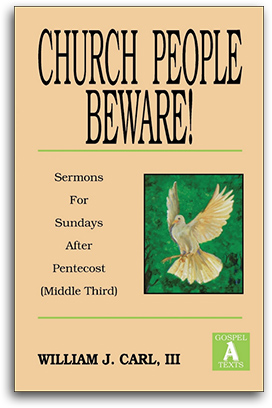
Church People Beware!
Sermons For Sundays After Pentecost (Middle Third)
It never ceases to amaze me how periodically someone joins the church thinking with great naivete that he or she has now left the imperfect, money-grubbing, power-hungry secular world and entered some holy, monastic community where everyone is good and kind and loving and no one ever gossips or spreads rumors or disagrees on any subject. When this happens, I usually watch to see how long it takes before this person's whole idyllic image of the church comes tumbling down like the proverbial deck of cards.
Usually, all it takes is serving on one committee or doing one job for the church. Whatever it is, sooner or later it happens. And then I watch what comes next: either total loss of enthusiasm and withdrawal, maybe a little sabbatical to regroup and re-evaluate or more church hopping, ever in search of that ever elusive, "perfect" church or, with some, it's complete abandonment and a return back into the more predictable secular world.
I never cease to be amazed at how perfect some people think the church is supposed to be. Presbyterians particularly shouldn't be so naive. After all, we believe in the depravity of humankind. It's good Calvinist doctrine. Pride and power will always creep in somewhere says Niebuhr, especially in the church. So, said Henry Ward Beecher, "I don't need John Calvin to tell me about total depravity, I have my own congregation to show me that!"
But some still join the church thinking that this isn't true. Pretty soon they begin to think that Jesus must have been misquoted. Surely, he must have meant to say "where two or more Christians are gathered in my name, there's bound to be an argument."
The interesting thing about Jesus is that though he was divinely incarnate, he was not divinely naive. He knew there were going to be disagreements and fights when well-meaning people got together in his name. He knew it wouldn't be easy. So in this passage he sets up a way for dealing with disputes.
Just as in a marriage, the issue was never whether there would be fights; the issue has always been whether folks were going to fight fair. A marriage, a friendship and a church are a lot alike in this area. The front of an anniversary card being sent these days to couples married 20 years or more spells out the four stages of marriage: The honeymoon, The shock of reality, The adjustment, and finally, The stage of quiet contentment. Inside it reads, "If you two don't hurry, you'll never get past the honeymoon stage!"
The fact is, sooner or later everyone gets past the honeymoon stage and if you can live through it all, if there is good communication and compatibility, you can grow to a richer and fuller depth of intimacy than ever experienced in the honeymoon because of honesty and understanding and real friendship, especially in the crisis moments, and there will be crisis moments. It's not a marriage without them. Unfortunately, not all marriages get this far and for them there should be nothing but lots of love and support especially in the church.
Just as in a marriage, so in a church there will be fights and disagreements. That's not the issue, says Jesus. The issue is, "Will you fight fair?" And what Jesus is doing in this passage very simply is laying down some ground rules, if you will, for "fighting fair." It's a kind of theological Robert's Rules of Order. Basically what Jesus is saying, is that we should never tolerate any situation in which there is a breach of personal relationships between us and another member of the Christian community. When something goes wrong what do we do about it? What Jesus is doing here is presenting a whole scheme of action for the mending of broken relationships within the Christian fellowship.
How does he spell it out? First of all, he recommends straight talk. That's one of the differences between the Midwest or the Southwest and say, the Southeast. In the Midwest or Southwest, people tell you straight out if there's a problem, in the Southeast, you have to go around the barn to find out. Straight talk, says Jesus, is prescription number one. You've got a problem with someone or something in the church? Deal with it directly. Don't embarrass that person in public -- deal with it one-on-one if you can. Don't do it on the telephone; certainly not in a letter. Words on paper can be misinterpreted. Do it in person; and don't beat around the bush or sugarcoat it. Get right to it.
But that's so hard for some of us to do. So we don't or we talk behind others' backs, tear them down without them ever knowing about it or getting a chance to respond in person. If you've got a problem with someone and you don't have the gumption to go to that person yourself, then keep it to yourself. More harm has been done to others with "I shouldn't be telling you this, but did you know…?" than with any other line in the church. Leviticus 19, as a prelude to the famous "love thy neighbor as thyself," says "You shall not go up and down as a slanderer among your people…"
What Jesus is saying is this: "If your brother does wrong or your sister makes a mistake or you have a problem, speak to them for heaven's sake." Speak, speak, speak; don't keep your mouth shut. You will be held responsible for your silence and for the consequences of your unwillingness to speak.
Once a member of a seminary board shared a concern with an older member. "Share it with the board," said the old man abruptly. "Oh, I don't know," said the younger one, "I'm fairly new. I don't know if I should." The now retired president of a large management firm looked his younger counterpart in the eye and said, "There are times in my life when I could have spoken up and didn't; now I regret it. State your piece." So the timid, fledgling did and to his surprise, it resulted in a significant change in seminary policy on that subject and a change that should have occurred much earlier.
But it's so hard to do, you say. Of course it is. So we don't, or we do it around behind the scenes in destructive ways or we store up all our problems, which is called gunnysacking and dump them out on some poor soul or group when we really originally had only one item of contention. Bosses often do this to employees and spouses especially do it to each other. Straight talk without pretense or hidden agenda is so hard for some of us that we either gossip or gunnysack.
But for some of us, it's not hard at all. In fact, we rather enjoy taking our spouses, our children, our employees and friends and, yes, even fellow church members down a notch or two. The trouble is we seem to enjoy it too much. George Bernard Shaw was such a person. While he was still a music critic, he was dining with a friend one night in a restaurant that provided as entertainment an orchestra that was at best mediocre. The leader, recognizing Shaw, wrote him a note asking him what he would like the orchestra to play next. Shaw replied, "Dominoes."
Of course, Shaw met his match for speaking straight when he took on Churchill. Shaw once sent Churchill two tickets to the opening night of his play, Saint Joan with this note, "One for yourself and one for a friend -- if you have one." Churchill replied expressing regret at being unable to attend, but asking for tickets for the second night, "that is, if there is one." And then, of course, there's the famous old rivalry between Lady Astor and Churchill where with some exasperation she said, "Winston, if I were married to you, I'd put poison in your coffee," to which Churchill replied, "And, if you were my wife, I'd drink it!"
Some people seem to have no trouble talking straight. In fact, the trouble is they seem to enjoy it too much. I don't think that this is what Jesus or Paul had in mind. Paul says when you have to speak the truth to a loved one, a friend or a fellow church member, speak the truth in love.
In a way that's what preaching and teaching are week after week in a local church. They are straight talk about Scripture with nothing held back. It's what preachers and teachers are called on to do all the time. Sometimes it's uncomfortable for ministers to have to say a hard word to their congregations about the great gap between the way they're living and what God wants. The freedom of the pulpit and the teacher's podium involves an awesome responsibility which we should never abuse; but unfortunately some do. In attempting to talk straight, some preachers sound like stricken Elijahs as they scold their people. Usually their congregations let them know when they get too close to that. If they don't, you can be sure their spouses or at least close friends do.
Paul, carrying on the true intention of Jesus, says speak the truth in love, for in the end it is a good word, isn't it? Malcolm Muggeridge once put it this way: "Though this life at times seems like the theater of the absurd, there is a point where you realize that there is a reality, a meaning that as Blake's fine phrase suggests, life is the theater of fearful symmetry, there's something going on here which is real" and it's our job as preachers and teachers to help our congregations see the truth that our existence on this earth is not the whole story, for "in existing we fulfill the purpose of our creator which is a loving purpose, not a maligning purpose, a creative purpose, not a destructive purpose, an eternal purpose, not a temporal one." (This was said in a television interview with Bill Moyers on the Public Broadcasting Station.)
It's our job to speak that truth in a loving and genuine way even when the words are sometimes hard. So also in our relationships with one another.
If straight talk doesn't work in resolving the problem, then get others involved, says Jesus. It's due process. Take it to the elders. Try to settle it out of court with a few wise, patient, and loving friends. If that doesn't work, if the persons still refuse to listen, then be done with them. Show them the door. Treat them as gentiles or tax collectors. Treat them as you would a Saddam Hussein: no diplomatic relations.
There's only one problem with this approach. Jesus would never have said it. Practically all the commentators agree that this is the early church talking, working off the old rabbinical saying, "Love thy neighbor, hate thine enemy." But Jesus has transformed that saying to "Love thy neighbor as thyself and even love thine enemy."
So how do you deal with one with whom you have a problem? Talk straight first, speaking the truth in love. If that doesn't work, get others involved. When that fails, don't take the early church's advice; go with the intention of Jesus' full gospel message. In the end, remember grace. Grace is the bottom line when dealing with conflict because you never know how your actions and words toward another are going to affect the world.
In a little church in a small village, an altar boy serving the priest at Sunday Mass accidentally dropped the cruet of wine. The village priest struck the altar boy sharply on the cheek and in a gruff voice shouted "Leave the altar and don't come back." That boy became Tito, the Communist leader. In the cathedral of a large city in another place another altar boy serving the bishop at Sunday Mass also accidentally dropped the cruet of wine. With a warm twinkle in his eyes, the bishop gently whispered, "Someday you will be a priest." Do you know who that boy was? Archbishop Fulton Sheen.
How do you deal with others who have caused problems for you? Jesus has the answer. With straight talk, due process, but most of all, with grace. In so doing, you will fulfill more than the law and the prophets; you will fulfill the gospel of Jesus Christ.
Usually, all it takes is serving on one committee or doing one job for the church. Whatever it is, sooner or later it happens. And then I watch what comes next: either total loss of enthusiasm and withdrawal, maybe a little sabbatical to regroup and re-evaluate or more church hopping, ever in search of that ever elusive, "perfect" church or, with some, it's complete abandonment and a return back into the more predictable secular world.
I never cease to be amazed at how perfect some people think the church is supposed to be. Presbyterians particularly shouldn't be so naive. After all, we believe in the depravity of humankind. It's good Calvinist doctrine. Pride and power will always creep in somewhere says Niebuhr, especially in the church. So, said Henry Ward Beecher, "I don't need John Calvin to tell me about total depravity, I have my own congregation to show me that!"
But some still join the church thinking that this isn't true. Pretty soon they begin to think that Jesus must have been misquoted. Surely, he must have meant to say "where two or more Christians are gathered in my name, there's bound to be an argument."
The interesting thing about Jesus is that though he was divinely incarnate, he was not divinely naive. He knew there were going to be disagreements and fights when well-meaning people got together in his name. He knew it wouldn't be easy. So in this passage he sets up a way for dealing with disputes.
Just as in a marriage, the issue was never whether there would be fights; the issue has always been whether folks were going to fight fair. A marriage, a friendship and a church are a lot alike in this area. The front of an anniversary card being sent these days to couples married 20 years or more spells out the four stages of marriage: The honeymoon, The shock of reality, The adjustment, and finally, The stage of quiet contentment. Inside it reads, "If you two don't hurry, you'll never get past the honeymoon stage!"
The fact is, sooner or later everyone gets past the honeymoon stage and if you can live through it all, if there is good communication and compatibility, you can grow to a richer and fuller depth of intimacy than ever experienced in the honeymoon because of honesty and understanding and real friendship, especially in the crisis moments, and there will be crisis moments. It's not a marriage without them. Unfortunately, not all marriages get this far and for them there should be nothing but lots of love and support especially in the church.
Just as in a marriage, so in a church there will be fights and disagreements. That's not the issue, says Jesus. The issue is, "Will you fight fair?" And what Jesus is doing in this passage very simply is laying down some ground rules, if you will, for "fighting fair." It's a kind of theological Robert's Rules of Order. Basically what Jesus is saying, is that we should never tolerate any situation in which there is a breach of personal relationships between us and another member of the Christian community. When something goes wrong what do we do about it? What Jesus is doing here is presenting a whole scheme of action for the mending of broken relationships within the Christian fellowship.
How does he spell it out? First of all, he recommends straight talk. That's one of the differences between the Midwest or the Southwest and say, the Southeast. In the Midwest or Southwest, people tell you straight out if there's a problem, in the Southeast, you have to go around the barn to find out. Straight talk, says Jesus, is prescription number one. You've got a problem with someone or something in the church? Deal with it directly. Don't embarrass that person in public -- deal with it one-on-one if you can. Don't do it on the telephone; certainly not in a letter. Words on paper can be misinterpreted. Do it in person; and don't beat around the bush or sugarcoat it. Get right to it.
But that's so hard for some of us to do. So we don't or we talk behind others' backs, tear them down without them ever knowing about it or getting a chance to respond in person. If you've got a problem with someone and you don't have the gumption to go to that person yourself, then keep it to yourself. More harm has been done to others with "I shouldn't be telling you this, but did you know…?" than with any other line in the church. Leviticus 19, as a prelude to the famous "love thy neighbor as thyself," says "You shall not go up and down as a slanderer among your people…"
What Jesus is saying is this: "If your brother does wrong or your sister makes a mistake or you have a problem, speak to them for heaven's sake." Speak, speak, speak; don't keep your mouth shut. You will be held responsible for your silence and for the consequences of your unwillingness to speak.
Once a member of a seminary board shared a concern with an older member. "Share it with the board," said the old man abruptly. "Oh, I don't know," said the younger one, "I'm fairly new. I don't know if I should." The now retired president of a large management firm looked his younger counterpart in the eye and said, "There are times in my life when I could have spoken up and didn't; now I regret it. State your piece." So the timid, fledgling did and to his surprise, it resulted in a significant change in seminary policy on that subject and a change that should have occurred much earlier.
But it's so hard to do, you say. Of course it is. So we don't, or we do it around behind the scenes in destructive ways or we store up all our problems, which is called gunnysacking and dump them out on some poor soul or group when we really originally had only one item of contention. Bosses often do this to employees and spouses especially do it to each other. Straight talk without pretense or hidden agenda is so hard for some of us that we either gossip or gunnysack.
But for some of us, it's not hard at all. In fact, we rather enjoy taking our spouses, our children, our employees and friends and, yes, even fellow church members down a notch or two. The trouble is we seem to enjoy it too much. George Bernard Shaw was such a person. While he was still a music critic, he was dining with a friend one night in a restaurant that provided as entertainment an orchestra that was at best mediocre. The leader, recognizing Shaw, wrote him a note asking him what he would like the orchestra to play next. Shaw replied, "Dominoes."
Of course, Shaw met his match for speaking straight when he took on Churchill. Shaw once sent Churchill two tickets to the opening night of his play, Saint Joan with this note, "One for yourself and one for a friend -- if you have one." Churchill replied expressing regret at being unable to attend, but asking for tickets for the second night, "that is, if there is one." And then, of course, there's the famous old rivalry between Lady Astor and Churchill where with some exasperation she said, "Winston, if I were married to you, I'd put poison in your coffee," to which Churchill replied, "And, if you were my wife, I'd drink it!"
Some people seem to have no trouble talking straight. In fact, the trouble is they seem to enjoy it too much. I don't think that this is what Jesus or Paul had in mind. Paul says when you have to speak the truth to a loved one, a friend or a fellow church member, speak the truth in love.
In a way that's what preaching and teaching are week after week in a local church. They are straight talk about Scripture with nothing held back. It's what preachers and teachers are called on to do all the time. Sometimes it's uncomfortable for ministers to have to say a hard word to their congregations about the great gap between the way they're living and what God wants. The freedom of the pulpit and the teacher's podium involves an awesome responsibility which we should never abuse; but unfortunately some do. In attempting to talk straight, some preachers sound like stricken Elijahs as they scold their people. Usually their congregations let them know when they get too close to that. If they don't, you can be sure their spouses or at least close friends do.
Paul, carrying on the true intention of Jesus, says speak the truth in love, for in the end it is a good word, isn't it? Malcolm Muggeridge once put it this way: "Though this life at times seems like the theater of the absurd, there is a point where you realize that there is a reality, a meaning that as Blake's fine phrase suggests, life is the theater of fearful symmetry, there's something going on here which is real" and it's our job as preachers and teachers to help our congregations see the truth that our existence on this earth is not the whole story, for "in existing we fulfill the purpose of our creator which is a loving purpose, not a maligning purpose, a creative purpose, not a destructive purpose, an eternal purpose, not a temporal one." (This was said in a television interview with Bill Moyers on the Public Broadcasting Station.)
It's our job to speak that truth in a loving and genuine way even when the words are sometimes hard. So also in our relationships with one another.
If straight talk doesn't work in resolving the problem, then get others involved, says Jesus. It's due process. Take it to the elders. Try to settle it out of court with a few wise, patient, and loving friends. If that doesn't work, if the persons still refuse to listen, then be done with them. Show them the door. Treat them as gentiles or tax collectors. Treat them as you would a Saddam Hussein: no diplomatic relations.
There's only one problem with this approach. Jesus would never have said it. Practically all the commentators agree that this is the early church talking, working off the old rabbinical saying, "Love thy neighbor, hate thine enemy." But Jesus has transformed that saying to "Love thy neighbor as thyself and even love thine enemy."
So how do you deal with one with whom you have a problem? Talk straight first, speaking the truth in love. If that doesn't work, get others involved. When that fails, don't take the early church's advice; go with the intention of Jesus' full gospel message. In the end, remember grace. Grace is the bottom line when dealing with conflict because you never know how your actions and words toward another are going to affect the world.
In a little church in a small village, an altar boy serving the priest at Sunday Mass accidentally dropped the cruet of wine. The village priest struck the altar boy sharply on the cheek and in a gruff voice shouted "Leave the altar and don't come back." That boy became Tito, the Communist leader. In the cathedral of a large city in another place another altar boy serving the bishop at Sunday Mass also accidentally dropped the cruet of wine. With a warm twinkle in his eyes, the bishop gently whispered, "Someday you will be a priest." Do you know who that boy was? Archbishop Fulton Sheen.
How do you deal with others who have caused problems for you? Jesus has the answer. With straight talk, due process, but most of all, with grace. In so doing, you will fulfill more than the law and the prophets; you will fulfill the gospel of Jesus Christ.
