
Surprised By Grace
Sermon
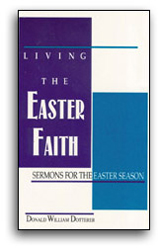
Living The Easter Faith
Sermons For The Easter Season
Let us pray: Gracious and eternal Father, we come to you this
day seeking to understand the ways in which your Spirit moves in
our lives. Lord, in these moments, may we be moved by love in our
hearts and receive wisdom in our minds. In Jesus' name we pray,
Amen.
Abraham Lincoln's Gettysburg Address has been called America's
"greatest gathering of words."1 Lincoln's message was given over
130 years ago on the Civil War battlefield in Pennsylvania named
Gettysburg. The burial of the Union dead was still underway on
November 19, 1863, when Lincoln delivered his speech. We should
not forget that it was a cemetery that the president had been
invited to dedicate that day.
What makes the Gettysburg Address the greatest speech in
American history is the way in which Lincoln gave firm definition
to that famous proposition written by Thomas Jefferson in the
American Constitution, that "Four score and seven years ago, our
fathers brought forth upon this continent, a new nation,
conceived in liberty, and dedicated to the proposition that all
people are created equal."
The power of President Lincoln's speech is carried out in
those five simple words -- that all people are created equal.
Now, we know, of course, that from the perspective of human
judgment, men and women are certainly not created equal. We know
that there are differences between us in personality, in
intelligence, in natural talents, in bodily appearance and in
physical strength and ability.
We also know that some people are born, as they say, with a
"silver spoon in their mouth." These are the ones, of course,
who are born with the advantages of wealth and privilege and
family connections which open doors and make life comfortable and
pleasant and enjoyable.
And then of course there are those who are born literally with
nothing at all, children who are so poor that they do not even
receive proper nourishment, and therefore suffer from
malnutrition and disease. Others suffer from physical abuse and
neglect.
A recent study indicated that poverty among children spread
rampantly throughout the 1980s from large urban centers to
smaller United States cities. More than one-fourth of children
living in cities are impoverished. Such widespread child poverty
threatens our children's health, their ability to learn, and
their opportunity to lead quality lives.
No, the hard, cold truth is that we are not created with equal
circumstances. But the point of the phrase, "all people are
created equal," says to us that this is indeed how God sees the
men, women and children whom he has created. God's love is not
withheld from any person, regardless of his or her circumstances.
And we as Christian people are called to do likewise. We are
called to be like our Father in heaven in the way in which we
treat other human beings.
In our gospel lesson for the morning, Jesus tells a parable
which reveals a truth of God that is very disturbing to the
conventional, human way of seeing the world. Indeed, President
Clinton would not have been elected had he tried to sell the
economic policy described in this parable.
Jesus tells of a landowner who went out to hire workers for
his vineyard. He agreed to pay them one denarius, which was a
better-than-average wage for a day's work. In those days, such a
verbal agreement for pay was considered to be legally binding.
And so the men begin their work at dawn in what was usually a 12-
hour workday, from dawn to sunset.
However, the landowner realized three hours later that more
help was needed. And so he saw other persons standing around with
nothing to do, and he offers them work. He did the same thing six
and then nine hours later. Even at the
60
11th hour, with only one hour of work left in the day, the
landowner offered work to those who wanted it.
Now the problem arose when the time came to pay up. The
landowner directed his assistant to pay each of the workers the
same wage -- which was one denarius, again, a generous pay for
one day's work.
This was quite a surprise, to say the least. The men who had
worked all day, from sunrise to sunset, began to grumble. They
felt it was unjust that the men who had worked just one hour
would receive the same pay as those who had worked 12 long and
hard hours. They felt that because of these circumstances, they
should receive more money for doing that which they had agreed to
do for one denarius.
But the landowner tells them to take what rightfully belonged
to them and to go home. As the master of the vineyard, the man
believed, quite rightly, that he was free to give what he wanted
to the people he had hired, as long as he had fulfilled his basic
agreement. He was free to be just as generous as he liked.
This of course bothered the workers. But the landowner asks,
in effect, this difficult question of the disgruntled workers:
"Am I not allowed to do what I choose with what belongs to me? Or
are you envious because I am generous?" Jesus concludes, "So the
last will be first, and the first will be last."
As Neal Fisher suggests, in the parable of the workers in the
vineyard, the point is not the wage policy of the employer.
Rather we have here a situation in which the sheer, immeasurable
grace of God is at work in a surprising way.2
The parable is addressed to the Pharisees, men who had spent
their entire lives carefully attending to even the smallest
details of religious life. They had spent their lifetimes doing
what they thought was "right" in the eyes of God. Because of the
sacrifices they had made, they thought that they deserved to be
richly rewarded. The Pharisees were offended by the idea that
those who had not engaged in life-long serious study of God's
Word and holy law could at a late hour walk into God's kingdom
alongside those who labored for that reward all of their lives.
The point of Jesus' teaching is that it is not the
industriousness of the laborer that counts. The message of the
parable is the great goodness that God shows to all of the
workers in his kingdom, regardless of when they come in to live
and to work.3
All people are created equal. That, my friends, is the way
that God thinks of us, no matter what our opinion is of this very
unconventional way of thinking about and assessing human value.
There are those who think they have earned what they have, rather
than seeing their opportunities and accomplishments as gifts from
God. There are those who may think that they have earned a
special place in society or even in heaven because of what they
have done as good persons.
But God does not measure you and me by worldly standards. He
does not count how many hours we have worked. God does not look
at how much stuff we have accumulated. The teaching here is
clear. God sees us equally. God treats us equally. We deserve
nothing on our own. Everything we have is a free gift from God.
The great English mystic Thomas Traherne in the 17th century
advises us to enjoy the whole world, indeed the whole universe,
and to be grateful for all of it. If we view God's world in this
way, then we can see a beauty and experience a joy of which legal
owners of property may never dream.4
We can indeed be owners of nothing, and yet be possessors of
all things in God. We are created equal in our calling to
recognize the loving power of God in every created thing. Because
it is when we begin to seek out the love and power of God in the
world in which we have been created equal to all other humans
that we can thereby be truly surprised by God's grace and God's
love.
Are not you and I surprised by God's grace each and every day
we live? Are you not thrilled by the goodness and greatness of
God? It doesn't matter who you are or what you have done, it does
not matter where you live or how much money you have in the bank.
God's love and grace is free, and it is there for all to
experience.
62
Do we not need this word of hope in our world today? A
psychologist once conducted a poll. He asked people: "What do you
have to live for?"' He was surprised and shocked to learn that 94
percent were just enduring the present, while they waited for the
future. They were all waiting for "something to happen."
Some of these people were waiting for the children to grow up
and leave home. Some were just waiting for next year, hoping that
things would be better. Others were waiting to take a trip which
they had dreamed about for a long time. Some were waiting for
retirement. Others were waiting to die.
As I read the New Testament, and especially these parables of
Jesus, I think we get the very clear message that we should be
living for today. We live in a new age which has been inaugurated
by the life, death and resurrection of Jesus Christ. Each and
every day we can be surprised by the beauty and wonder of the
sheer grace of God.
George Bernanos, in a book titled Diary of a Country Priest,
describes the ministry of a humble and unsuccessful country
pastor. Most of the time the pastor is inept. The bored villagers
he serves ignore him, his church all but deserts him. There is
one wealthy parishioner who is particularly harsh on the poor
minister. In part this is because of her personal bitterness
toward God.
However, as this woman draws near death, the priest somehow
manages to break through the barriers and helps this woman to
surrender her life to God. With his help, she is able to believe
in eternal life.
The pastor shares these words with the woman at the moment of
death. "Be at peace," he tells her. And as the woman kneels to
receive this peace of Christ, the pastor prays to God: "May she
keep it forever; it will be I who gave it to her." He prayed, "Oh
miracle -- thus to be able to give what we ourselves do not
possess, sweet miracle of empty hands. Hope which was shriveling
in my heart flowered again in hers; the spirit of prayer which I
thought lost in me for ever was given back to her by God and --
who can tell -- perhaps in my name!"5
63
My friends in Christ, have you ever experienced the "miracle
of empty hands?" Have you ever felt inadequate and unsure of
yourself as you have tried to help someone who was hurting,
someone who was in deep emotional pain? It happens to pastors
quite often. We utter stumbling words and prayers that we do not
feel are fitting or adequate for the situation. We feel awkward
and think that we are bothering a person who needs his rest. And
yet that parishioner will later say to us that our prayers and
visits were very comforting.6
When this happens, we should remember the miracle of empty
hands. Because we never know how the Spirit of God will work in
and through us, both pastors and lay persons. This is what it
means to be surprised by grace.
Brothers and sisters in Christ, we do indeed have something
great and wonderful to live for in this world in which God has
placed us. It is so easy to get down and depressed about that
which is happening to us and all around us.
But if we are able to lift our eyes to heaven, and open our
hearts and minds to the unlimited love of God, we will experience
the beauty and wonder of the world all around us. We can be
"surprised by grace" in our homes, at work, and especially in
this church where so many good things are happening every week.
All that we need are eyes to see the good, voices to praise and
thank the Lord, and hearts in which to feel the peace of Christ
and the presence of God. God in Christ will always be there for
you if you let him. Why not give him your all this day? Because
this inaugurated is the way that God intends for us to live in
the new age by the life and resurrection of our Lord Jesus.
My prayer for you this day is that you may be surprised by
grace in all that you do. May you be blessed in your service of
Christ now and always.
Benediction: Let us pray: Gracious and everliving Father, we
have worshiped together and shared love with one another. We have
experienced your grace among us in your house. As we go from this
place, may we look for your love in encounters we have with
others. Amen.
1-William McFeely, "How We Were Created Equal," New York Times
Book Review, June 7, 1992, p. 1.
2-Fisher, The Parables of Jesus, p. 88.
3-Ibid., p. 87.
4-H. Boone Porter, The Living Church, October 13, 1991, p.
5-George Bernanos, Diary of a Country Priest (Toronto: Macmillan,
1937), p. 157.
6-This insight is from an unknown source.
day seeking to understand the ways in which your Spirit moves in
our lives. Lord, in these moments, may we be moved by love in our
hearts and receive wisdom in our minds. In Jesus' name we pray,
Amen.
Abraham Lincoln's Gettysburg Address has been called America's
"greatest gathering of words."1 Lincoln's message was given over
130 years ago on the Civil War battlefield in Pennsylvania named
Gettysburg. The burial of the Union dead was still underway on
November 19, 1863, when Lincoln delivered his speech. We should
not forget that it was a cemetery that the president had been
invited to dedicate that day.
What makes the Gettysburg Address the greatest speech in
American history is the way in which Lincoln gave firm definition
to that famous proposition written by Thomas Jefferson in the
American Constitution, that "Four score and seven years ago, our
fathers brought forth upon this continent, a new nation,
conceived in liberty, and dedicated to the proposition that all
people are created equal."
The power of President Lincoln's speech is carried out in
those five simple words -- that all people are created equal.
Now, we know, of course, that from the perspective of human
judgment, men and women are certainly not created equal. We know
that there are differences between us in personality, in
intelligence, in natural talents, in bodily appearance and in
physical strength and ability.
We also know that some people are born, as they say, with a
"silver spoon in their mouth." These are the ones, of course,
who are born with the advantages of wealth and privilege and
family connections which open doors and make life comfortable and
pleasant and enjoyable.
And then of course there are those who are born literally with
nothing at all, children who are so poor that they do not even
receive proper nourishment, and therefore suffer from
malnutrition and disease. Others suffer from physical abuse and
neglect.
A recent study indicated that poverty among children spread
rampantly throughout the 1980s from large urban centers to
smaller United States cities. More than one-fourth of children
living in cities are impoverished. Such widespread child poverty
threatens our children's health, their ability to learn, and
their opportunity to lead quality lives.
No, the hard, cold truth is that we are not created with equal
circumstances. But the point of the phrase, "all people are
created equal," says to us that this is indeed how God sees the
men, women and children whom he has created. God's love is not
withheld from any person, regardless of his or her circumstances.
And we as Christian people are called to do likewise. We are
called to be like our Father in heaven in the way in which we
treat other human beings.
In our gospel lesson for the morning, Jesus tells a parable
which reveals a truth of God that is very disturbing to the
conventional, human way of seeing the world. Indeed, President
Clinton would not have been elected had he tried to sell the
economic policy described in this parable.
Jesus tells of a landowner who went out to hire workers for
his vineyard. He agreed to pay them one denarius, which was a
better-than-average wage for a day's work. In those days, such a
verbal agreement for pay was considered to be legally binding.
And so the men begin their work at dawn in what was usually a 12-
hour workday, from dawn to sunset.
However, the landowner realized three hours later that more
help was needed. And so he saw other persons standing around with
nothing to do, and he offers them work. He did the same thing six
and then nine hours later. Even at the
60
11th hour, with only one hour of work left in the day, the
landowner offered work to those who wanted it.
Now the problem arose when the time came to pay up. The
landowner directed his assistant to pay each of the workers the
same wage -- which was one denarius, again, a generous pay for
one day's work.
This was quite a surprise, to say the least. The men who had
worked all day, from sunrise to sunset, began to grumble. They
felt it was unjust that the men who had worked just one hour
would receive the same pay as those who had worked 12 long and
hard hours. They felt that because of these circumstances, they
should receive more money for doing that which they had agreed to
do for one denarius.
But the landowner tells them to take what rightfully belonged
to them and to go home. As the master of the vineyard, the man
believed, quite rightly, that he was free to give what he wanted
to the people he had hired, as long as he had fulfilled his basic
agreement. He was free to be just as generous as he liked.
This of course bothered the workers. But the landowner asks,
in effect, this difficult question of the disgruntled workers:
"Am I not allowed to do what I choose with what belongs to me? Or
are you envious because I am generous?" Jesus concludes, "So the
last will be first, and the first will be last."
As Neal Fisher suggests, in the parable of the workers in the
vineyard, the point is not the wage policy of the employer.
Rather we have here a situation in which the sheer, immeasurable
grace of God is at work in a surprising way.2
The parable is addressed to the Pharisees, men who had spent
their entire lives carefully attending to even the smallest
details of religious life. They had spent their lifetimes doing
what they thought was "right" in the eyes of God. Because of the
sacrifices they had made, they thought that they deserved to be
richly rewarded. The Pharisees were offended by the idea that
those who had not engaged in life-long serious study of God's
Word and holy law could at a late hour walk into God's kingdom
alongside those who labored for that reward all of their lives.
The point of Jesus' teaching is that it is not the
industriousness of the laborer that counts. The message of the
parable is the great goodness that God shows to all of the
workers in his kingdom, regardless of when they come in to live
and to work.3
All people are created equal. That, my friends, is the way
that God thinks of us, no matter what our opinion is of this very
unconventional way of thinking about and assessing human value.
There are those who think they have earned what they have, rather
than seeing their opportunities and accomplishments as gifts from
God. There are those who may think that they have earned a
special place in society or even in heaven because of what they
have done as good persons.
But God does not measure you and me by worldly standards. He
does not count how many hours we have worked. God does not look
at how much stuff we have accumulated. The teaching here is
clear. God sees us equally. God treats us equally. We deserve
nothing on our own. Everything we have is a free gift from God.
The great English mystic Thomas Traherne in the 17th century
advises us to enjoy the whole world, indeed the whole universe,
and to be grateful for all of it. If we view God's world in this
way, then we can see a beauty and experience a joy of which legal
owners of property may never dream.4
We can indeed be owners of nothing, and yet be possessors of
all things in God. We are created equal in our calling to
recognize the loving power of God in every created thing. Because
it is when we begin to seek out the love and power of God in the
world in which we have been created equal to all other humans
that we can thereby be truly surprised by God's grace and God's
love.
Are not you and I surprised by God's grace each and every day
we live? Are you not thrilled by the goodness and greatness of
God? It doesn't matter who you are or what you have done, it does
not matter where you live or how much money you have in the bank.
God's love and grace is free, and it is there for all to
experience.
62
Do we not need this word of hope in our world today? A
psychologist once conducted a poll. He asked people: "What do you
have to live for?"' He was surprised and shocked to learn that 94
percent were just enduring the present, while they waited for the
future. They were all waiting for "something to happen."
Some of these people were waiting for the children to grow up
and leave home. Some were just waiting for next year, hoping that
things would be better. Others were waiting to take a trip which
they had dreamed about for a long time. Some were waiting for
retirement. Others were waiting to die.
As I read the New Testament, and especially these parables of
Jesus, I think we get the very clear message that we should be
living for today. We live in a new age which has been inaugurated
by the life, death and resurrection of Jesus Christ. Each and
every day we can be surprised by the beauty and wonder of the
sheer grace of God.
George Bernanos, in a book titled Diary of a Country Priest,
describes the ministry of a humble and unsuccessful country
pastor. Most of the time the pastor is inept. The bored villagers
he serves ignore him, his church all but deserts him. There is
one wealthy parishioner who is particularly harsh on the poor
minister. In part this is because of her personal bitterness
toward God.
However, as this woman draws near death, the priest somehow
manages to break through the barriers and helps this woman to
surrender her life to God. With his help, she is able to believe
in eternal life.
The pastor shares these words with the woman at the moment of
death. "Be at peace," he tells her. And as the woman kneels to
receive this peace of Christ, the pastor prays to God: "May she
keep it forever; it will be I who gave it to her." He prayed, "Oh
miracle -- thus to be able to give what we ourselves do not
possess, sweet miracle of empty hands. Hope which was shriveling
in my heart flowered again in hers; the spirit of prayer which I
thought lost in me for ever was given back to her by God and --
who can tell -- perhaps in my name!"5
63
My friends in Christ, have you ever experienced the "miracle
of empty hands?" Have you ever felt inadequate and unsure of
yourself as you have tried to help someone who was hurting,
someone who was in deep emotional pain? It happens to pastors
quite often. We utter stumbling words and prayers that we do not
feel are fitting or adequate for the situation. We feel awkward
and think that we are bothering a person who needs his rest. And
yet that parishioner will later say to us that our prayers and
visits were very comforting.6
When this happens, we should remember the miracle of empty
hands. Because we never know how the Spirit of God will work in
and through us, both pastors and lay persons. This is what it
means to be surprised by grace.
Brothers and sisters in Christ, we do indeed have something
great and wonderful to live for in this world in which God has
placed us. It is so easy to get down and depressed about that
which is happening to us and all around us.
But if we are able to lift our eyes to heaven, and open our
hearts and minds to the unlimited love of God, we will experience
the beauty and wonder of the world all around us. We can be
"surprised by grace" in our homes, at work, and especially in
this church where so many good things are happening every week.
All that we need are eyes to see the good, voices to praise and
thank the Lord, and hearts in which to feel the peace of Christ
and the presence of God. God in Christ will always be there for
you if you let him. Why not give him your all this day? Because
this inaugurated is the way that God intends for us to live in
the new age by the life and resurrection of our Lord Jesus.
My prayer for you this day is that you may be surprised by
grace in all that you do. May you be blessed in your service of
Christ now and always.
Benediction: Let us pray: Gracious and everliving Father, we
have worshiped together and shared love with one another. We have
experienced your grace among us in your house. As we go from this
place, may we look for your love in encounters we have with
others. Amen.
1-William McFeely, "How We Were Created Equal," New York Times
Book Review, June 7, 1992, p. 1.
2-Fisher, The Parables of Jesus, p. 88.
3-Ibid., p. 87.
4-H. Boone Porter, The Living Church, October 13, 1991, p.
5-George Bernanos, Diary of a Country Priest (Toronto: Macmillan,
1937), p. 157.
6-This insight is from an unknown source.
