
Thanksgiving Day
Preaching
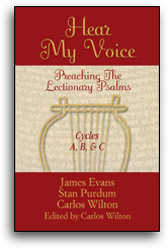
Hear My Voice
Preaching The Lectionary Psalms for Cycles A, B, C
(See Proper 25/Pentecost 23/Ordinary Time 30, Cycle C, for an alternative approach.)
I've been unable to learn who first coined the phrase "the groaning board," with its implication of a table so loaded with food that it threatens to topple, but it comes to mind every time I read Psalm 65. This is especially so when I read it in the RSV. In that version, verse 11 speaks of the tracks of the Lord's chariot that "drip with fatness," and verse 12 says that the wilderness pastures also "drip." The NRSV renditions -- that "your wagon tracks overflow with richness" and "the pastures of the wilderness also overflow" -- just don't carry the same punch.
In any case, the imagery is one of bounty, of a planet upon which the Creator has lavished wonderful resources in great abundance. Thus, it is not difficult to see why the lectionary committee designated this psalm for Thanksgiving. If God's material abundance is to be the message, verses 9-13 are certainly a fine text.
The whole psalm, however, is the designated reading, and in its entirety it speaks of more than simply a profusion of provisions. Verses 1-4 remind us that praise is due to God, which calls into question whether one day a year is sufficient to render such "payment." (It's not, of course.) A life lived in gratitude to the God who "forgives our transgressions" and satisfies us "with the goodness of your house" is more like it.
Verses 5-9 praise God for the gift of life itself. God makes "the gateways of the morning and the evening shout for joy." These two times bracket the days of our lives, days that are God's gift to us.
In Yuma, Arizona, one of the hotels carries a sign over its veranda that reads, "Free board every day the sun doesn't shine." A new arrival, checking in during a downpour, often hopes to capitalize on that. But the proprietor doesn't worry. He has lived in Yuma many years, and always during some part of the day the sun appears, even if only for a few moments. So far, no one has been able to get a free day's board at the hotel. Life tends to be like that too. It never rains all the time, and when we think about our lives, we are likely to see some blessings there as well, even amidst pain.
As a preacher, though, I always find it hard to use verses referring to God's bounty. That's because I am haunted by pictures of starving children in other parts of the world, people who have none of that bounty. But in the end, of course, thanksgiving isn't about how many blessings we have received, but about who God is. This psalm, which refuses to look only at the bounty of the earth, reminds us that praise is indeed due for who God is, not for how much we have.
-- S. P.
I've been unable to learn who first coined the phrase "the groaning board," with its implication of a table so loaded with food that it threatens to topple, but it comes to mind every time I read Psalm 65. This is especially so when I read it in the RSV. In that version, verse 11 speaks of the tracks of the Lord's chariot that "drip with fatness," and verse 12 says that the wilderness pastures also "drip." The NRSV renditions -- that "your wagon tracks overflow with richness" and "the pastures of the wilderness also overflow" -- just don't carry the same punch.
In any case, the imagery is one of bounty, of a planet upon which the Creator has lavished wonderful resources in great abundance. Thus, it is not difficult to see why the lectionary committee designated this psalm for Thanksgiving. If God's material abundance is to be the message, verses 9-13 are certainly a fine text.
The whole psalm, however, is the designated reading, and in its entirety it speaks of more than simply a profusion of provisions. Verses 1-4 remind us that praise is due to God, which calls into question whether one day a year is sufficient to render such "payment." (It's not, of course.) A life lived in gratitude to the God who "forgives our transgressions" and satisfies us "with the goodness of your house" is more like it.
Verses 5-9 praise God for the gift of life itself. God makes "the gateways of the morning and the evening shout for joy." These two times bracket the days of our lives, days that are God's gift to us.
In Yuma, Arizona, one of the hotels carries a sign over its veranda that reads, "Free board every day the sun doesn't shine." A new arrival, checking in during a downpour, often hopes to capitalize on that. But the proprietor doesn't worry. He has lived in Yuma many years, and always during some part of the day the sun appears, even if only for a few moments. So far, no one has been able to get a free day's board at the hotel. Life tends to be like that too. It never rains all the time, and when we think about our lives, we are likely to see some blessings there as well, even amidst pain.
As a preacher, though, I always find it hard to use verses referring to God's bounty. That's because I am haunted by pictures of starving children in other parts of the world, people who have none of that bounty. But in the end, of course, thanksgiving isn't about how many blessings we have received, but about who God is. This psalm, which refuses to look only at the bounty of the earth, reminds us that praise is indeed due for who God is, not for how much we have.
-- S. P.
