
Is There Life After We Die?
Bible Study
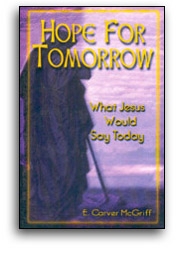
Hope For Tomorrow
What Jesus Would Say Today
Object:
To live is to risk dying. I'm ready for it. Don't you dare shed one tear if you hear that Buscaglia blew up in the air or dropped dead. He did it with enthusiasm.
-- Professor Leo Buscaglia
* * *
When I go down to the grave, I can say, like many others, I have finished my day's work, but I cannot say I have finished my life. My day's work will begin the next morning. The tomb is not a blind alley; it is a thoroughfare. It closes on the twilight, to open on the dawn.
-- Victor Hugo
* * *
Life is a narrow veil between the cold and barren peaks of two eternities. We strive to look beyond their heights. We cry aloud and the only answer is the echo of our wailing cry. But hope sees a star, and in the night of death, listening love can hear the rustle of an angel's wing.
-- Robert Ingersol
Is There Life After We Die?
"I am telling you the truth: he who believes has eternal life."
-- John 6:47
Leslie Weatherhead told about a church leader in England who was asked in an interview what he believed about life after death. The man replied something like this: "I expect it to be a beautiful experience, and to be reunited with all my loved ones. But let's not talk about such a depressing subject." That expresses the ambivalence most of us Christians feel about dying. "Death has a hundred hands and walks by a thousand ways," wrote T.S. Eliot. It does, indeed, await us all.
The Bible clearly teaches that there is life beyond the grave. The Apostle Paul wrote eloquently on this subject, including this observation: "If our hope in Christ is good for this life only and no more, then we deserve more pity than anyone else in all the world. But the truth is that Christ has been raised from death, as the guarantee that those who sleep in death will also be raised" (1 Corinthians 15:20). The writer of the Gospel of John, in one of that book's most frequently quoted lines, wrote: "For God loved the world so much that he gave his only Son, so that everyone who believes in him may not die but have eternal life" (John 3:16).
* * *
I am also convinced that we have a larger purpose which will only be fulfilled in the next life.
* * *
Our problem is that we would dearly love to have some evidence that these promises are true, although deep down we know there will be no proof. So Fitzgerald wrote:
Strange, is it not? That of the myriads who,
Before us pass'd the door of darkness through --
Not one returns to tell of the road
Which to discover, we must travel too.
When we think about that, it's obvious that if we had some kind of proof, we would no longer need faith. I for one would be as good as gold from this day forward, if someone could show me absolute proof that I will go on to an even better life by doing what I'm supposed to do. But such proof is not to be. We all must face death with or without faith, but without any proof.
We do have something else, though: logic. Even as I was writing this, a fine young 26-year-old member of my church was killed in a bizarre accident. He had been playing basketball and had sat down to rest, when a wayward car crashed through the side of the gymnasium where he was playing and killed him instantly. The boy had a large circle of friends, a fine family, and appeared to have a great future. This same week, I assisted in placing a ninety-year-old lady in a nursing home where she appears to be healthy enough to break the hundred mark. I refuse to believe that if God is really a loving God, he would allow such a loss and such inequity to be permanent. I don't believe it. I believe we are each here for a purpose in this life, but I am also convinced that we have a larger purpose which will only be fulfilled in the next life. It is the only answer to death which enables us to make any sense out of this life, with all of its tragedy and triumph.
If I may be autobiographical for a moment, I must share the basis for my own convictions. Several years ago, in a short period of time, my wife was killed in a car accident, my only brother died unexpectedly while still very young, and my father died in his sleep. All of a sudden, I had to decide what I really believe. I had preached a number of sermons affirming my belief in a hereafter. But no longer could I do so at arm's length. Most of my immediate family was suddenly gone. My dear mother was diagnosed with a fatal illness, and I was soon to be left alone with my only daughter. No longer did easy reassurances suffice. I had to "go to the mat with God," as it were, wrestle with the harsh reality of death and what lies beyond. Now -- what could I really believe?
I have recorded the following in detail elsewhere and will only make brief mention here. One night, a few days after my wife's death, I went to the darkened sanctuary of my church. Alone, late, the room only dimly illuminated by moonlight through some skylight windows, I had the overwhelming feeling that someone was there. I was struggling with grief and also guilt, a feeling known to nearly all of you who have lost someone you genuinely loved. Although this must be taken on faith, I felt sure that Ruthanne had come back to me. Not physically, of course. No touch, no voice, only a deep certainty. But I discovered a peace in those moments which has remained with me through the years. I left that sanctuary persuaded that she forgave me all my failures, that she was happy with her new adventure, and that there is indeed a hereafter. It was a gift from God, a brief encounter never repeated. But it was enough.
A friend of mine died recently. He and I had been good friends for many years, having lunch together about once a month, occasionally getting together with our wives for dinner. He served for many years as a chaplain and counselor. He was a man with a great love for life, a marvelous sense of humor, a man who was always interested in other people and their problems. A couple years ago, it was discovered that he had cancer. There followed radiation, chemotherapy, and days of optimism, followed by setbacks. As time passed, my friend's body, once that of a handsome athlete, began to wither. We continued to have lunch together every few days in the last several weeks of his life. Each time, his body was more fragile, his laboring efforts to make his way into the restaurant even more halting. My friend was a quietly devout believer in the most important teachings of our faith. This showed in his always present laughter, his inquiries of waiters and waitresses about their health, his remarkable interest in the condition of his front yard and the things that would need to be done in the springtime which he knew he would not see. Toward the end, my friend said to me: "This is probably the happiest time of my life." Knowing that he had lived a wonderful life, I showed my amazement, and he explained: "My wife and I have been closer than ever before. I have discovered how unimportant so many things are which I used to think important. I have all I need now."
My friend never complained, never showed one bit of self-pity. He didn't even talk much about his faith. We each knew it was something we shared and didn't need to verbalize. A few days after our last visit together, I received the call that he was gone. "You will be sad, but your sadness will turn into gladness," Jesus said. My friend showed it.
There is to be no absolute assurance. It has occurred to me that if we had some certainty, we might be too quick to accept or even to hasten death. I believe we all have responsibilities in this life which must be fulfilled. I believe that there is a life force which drives us and refuses to quit, if our faith is secure. That's why we struggle to stay alive and that's what God wants us to do.
The Bible does sometimes speak of resurrection, and sometimes of immortality. Technically, among those purists who are troubled by the distinction, "resurrection" presumes death, followed by restoration of life, whereas "immortality" refers to a continuation of life when the body has ceased to function. I used to wrestle with this seeming contradiction, but have decided it doesn't matter. It's mainly semantics. Probably, as Christianity moved into the Greek and Gentile world, the idea of immortality was current, whereas the idea of resurrection was a Jewish one. Christian language underwent some changes as the years passed and the faith spread. What's important for us is to know that Jesus promised life beyond what we know as death. In the absence of someone walking around whom we know to have died, we must presume the setting for that life will be elsewhere. Beyond that, we're guessing, and the one assurance we have been given is that God's love will have prepared something better than we could imagine for ourselves (John 14:1-3).
Most of us try to dodge the issue as long as we can, either with denial or with humor. Dwight L. Moody once said, "If there's no hereafter, I'll give fifty dollars to start one." Someone told of a tombstone over in England with the words: "He lived with his wife for thirty years, and died in the hope of a better life." Or there's another tombstone somewhere which reads: "Here lies the body of poor John Pound. He was lost at sea and never found." A cantankerous old gentleman passed away a few weeks ago, and his grandson, straight-faced, remarked: "Poor God." However, if Jesus is to be believed, what follows death will be a beautiful experience.
Jesus spoke of "the Kingdom of God," and "the Kingdom of Heaven." The two phrases are interchangeable, both referring to what C. H. Dodd called "the final and absolute state of bliss in a transcendent order" (p. 23), but also, apparently, to an immediate state of being when the Holy Spirit has begun to work in us. In Matthew 12:28 (and in Luke 11:20), Jesus is quoted as saying, "The Kingdom of God has already come upon us." It is to be a gift. "Do not be afraid, little flock," he said, "for your Father is pleased to give you the Kingdom" (Luke 12:32). He used a variety of analogies to enable his listeners to have a hint of the meaning of the Kingdom, parables about such things as a mustard seed, yeast, weeds, a pearl -- all pointing out that the Kingdom will be the fulfillment of their hopes and dreams, and more.
Suppose you live in a cold climate, the winter has been long and hard, your work has been demanding, you've suffered with a winter cold, you wonder if winter will ever end, and suddenly, to your delight, you learn that a loving relative has made arrangements for you to have a long vacation on, let's say, a beautiful island in the Caribbean. From that point, there will be two dimensions to your vacation. The first is the anticipation. For a few days you still must do your work, face the cold, and perhaps endure a few more sniffles. But your spirits are sky high now, because you know what lies ahead. All of a sudden, you find yourself able to handle all your problems with a happy heart. Then the second dimension to your vacation will be the reality, the sunshine and music and scrumptious meals.
Allow that to be a homey parable for us. When Jesus assured us that the Kingdom has come upon us, it didn't mean we were henceforth to live in a "state of bliss." There were still many earthly responsibilities to be borne. We have to work, to wrestle with our aches and pains, to endure the "thousand natural shocks the flesh is heir to," and in one sense life will be as it was. But there's a difference now. We know what lies ahead, or at least we have been told. The "state of bliss" will be there, our destination, if we follow Christ. Now, with a new attitude and the discovery of a higher power at work in our lives, we can face life's problems with a new optimism.
* * *
"Death cannot hold my beautiful boy."
-- Emerson, on the death of his son
* * *
We also have access to a Higher Power in our lives through prayer and through the work of the Holy Spirit. But actually, that has always been true. What has changed is that we now understand the nature of God in a new way. Now, through the revelation in Jesus' life and death, we know that God is not only the creative force behind the universe. God is like a loving parent, caring for each one of us, understanding the unique circumstances of each of our lives, knowing exactly when and when not to help us, and in what way so as to respect our freedom and to enable our continuing growth. But ultimately, though our little minds are unable to imagine that "transcendent order," we are destined to be part of it. And the doorway to that joyous world is called "death."
George Buttrick, former preacher to the student body of Harvard University, wrote a fanciful definition of what death is all about. In a fine book on God, Pain and Evil, he wrote this: "Good News. But if you ask me what it is, I know not. It is a trace of feet in the snow. It is a lantern showing a path. It is a door set ajar. This I know: when we are born, our feet are set to a journey. And it will lead over mountaintops drenched with sunshine, and through valleys dark with fear and pain. These things I cannot explain, but this I know: one day, you will arrive at a dwelling place, and the door will stand ajar. As you step inside, you will see half a glimpse of a table that has been set for you. And you will hear the sound of a fire crackling in a hearth. And in the other room, you will hear the sounds of laughter and voices which are familiar to you. And you will discover that at last you have arrived home. And this I know, it's worth the journey."
What would Jesus say today? I think he would repeat something he said a long time ago: "Whoever believes in me will live, even though he dies; and whoever lives and believes in me will never die" (John 11:26).
Questions For Discussion
1. Have you ever lost someone close to you in death?
2. How do your feelings about death affect your life?
3. What does your faith lead you to believe about life after death?
4. What about those who die outside the Christian faith?
5. Shakespeare called death "a consummation devoutly to be wished." What might he have meant by that?
-- Professor Leo Buscaglia
* * *
When I go down to the grave, I can say, like many others, I have finished my day's work, but I cannot say I have finished my life. My day's work will begin the next morning. The tomb is not a blind alley; it is a thoroughfare. It closes on the twilight, to open on the dawn.
-- Victor Hugo
* * *
Life is a narrow veil between the cold and barren peaks of two eternities. We strive to look beyond their heights. We cry aloud and the only answer is the echo of our wailing cry. But hope sees a star, and in the night of death, listening love can hear the rustle of an angel's wing.
-- Robert Ingersol
Is There Life After We Die?
"I am telling you the truth: he who believes has eternal life."
-- John 6:47
Leslie Weatherhead told about a church leader in England who was asked in an interview what he believed about life after death. The man replied something like this: "I expect it to be a beautiful experience, and to be reunited with all my loved ones. But let's not talk about such a depressing subject." That expresses the ambivalence most of us Christians feel about dying. "Death has a hundred hands and walks by a thousand ways," wrote T.S. Eliot. It does, indeed, await us all.
The Bible clearly teaches that there is life beyond the grave. The Apostle Paul wrote eloquently on this subject, including this observation: "If our hope in Christ is good for this life only and no more, then we deserve more pity than anyone else in all the world. But the truth is that Christ has been raised from death, as the guarantee that those who sleep in death will also be raised" (1 Corinthians 15:20). The writer of the Gospel of John, in one of that book's most frequently quoted lines, wrote: "For God loved the world so much that he gave his only Son, so that everyone who believes in him may not die but have eternal life" (John 3:16).
* * *
I am also convinced that we have a larger purpose which will only be fulfilled in the next life.
* * *
Our problem is that we would dearly love to have some evidence that these promises are true, although deep down we know there will be no proof. So Fitzgerald wrote:
Strange, is it not? That of the myriads who,
Before us pass'd the door of darkness through --
Not one returns to tell of the road
Which to discover, we must travel too.
When we think about that, it's obvious that if we had some kind of proof, we would no longer need faith. I for one would be as good as gold from this day forward, if someone could show me absolute proof that I will go on to an even better life by doing what I'm supposed to do. But such proof is not to be. We all must face death with or without faith, but without any proof.
We do have something else, though: logic. Even as I was writing this, a fine young 26-year-old member of my church was killed in a bizarre accident. He had been playing basketball and had sat down to rest, when a wayward car crashed through the side of the gymnasium where he was playing and killed him instantly. The boy had a large circle of friends, a fine family, and appeared to have a great future. This same week, I assisted in placing a ninety-year-old lady in a nursing home where she appears to be healthy enough to break the hundred mark. I refuse to believe that if God is really a loving God, he would allow such a loss and such inequity to be permanent. I don't believe it. I believe we are each here for a purpose in this life, but I am also convinced that we have a larger purpose which will only be fulfilled in the next life. It is the only answer to death which enables us to make any sense out of this life, with all of its tragedy and triumph.
If I may be autobiographical for a moment, I must share the basis for my own convictions. Several years ago, in a short period of time, my wife was killed in a car accident, my only brother died unexpectedly while still very young, and my father died in his sleep. All of a sudden, I had to decide what I really believe. I had preached a number of sermons affirming my belief in a hereafter. But no longer could I do so at arm's length. Most of my immediate family was suddenly gone. My dear mother was diagnosed with a fatal illness, and I was soon to be left alone with my only daughter. No longer did easy reassurances suffice. I had to "go to the mat with God," as it were, wrestle with the harsh reality of death and what lies beyond. Now -- what could I really believe?
I have recorded the following in detail elsewhere and will only make brief mention here. One night, a few days after my wife's death, I went to the darkened sanctuary of my church. Alone, late, the room only dimly illuminated by moonlight through some skylight windows, I had the overwhelming feeling that someone was there. I was struggling with grief and also guilt, a feeling known to nearly all of you who have lost someone you genuinely loved. Although this must be taken on faith, I felt sure that Ruthanne had come back to me. Not physically, of course. No touch, no voice, only a deep certainty. But I discovered a peace in those moments which has remained with me through the years. I left that sanctuary persuaded that she forgave me all my failures, that she was happy with her new adventure, and that there is indeed a hereafter. It was a gift from God, a brief encounter never repeated. But it was enough.
A friend of mine died recently. He and I had been good friends for many years, having lunch together about once a month, occasionally getting together with our wives for dinner. He served for many years as a chaplain and counselor. He was a man with a great love for life, a marvelous sense of humor, a man who was always interested in other people and their problems. A couple years ago, it was discovered that he had cancer. There followed radiation, chemotherapy, and days of optimism, followed by setbacks. As time passed, my friend's body, once that of a handsome athlete, began to wither. We continued to have lunch together every few days in the last several weeks of his life. Each time, his body was more fragile, his laboring efforts to make his way into the restaurant even more halting. My friend was a quietly devout believer in the most important teachings of our faith. This showed in his always present laughter, his inquiries of waiters and waitresses about their health, his remarkable interest in the condition of his front yard and the things that would need to be done in the springtime which he knew he would not see. Toward the end, my friend said to me: "This is probably the happiest time of my life." Knowing that he had lived a wonderful life, I showed my amazement, and he explained: "My wife and I have been closer than ever before. I have discovered how unimportant so many things are which I used to think important. I have all I need now."
My friend never complained, never showed one bit of self-pity. He didn't even talk much about his faith. We each knew it was something we shared and didn't need to verbalize. A few days after our last visit together, I received the call that he was gone. "You will be sad, but your sadness will turn into gladness," Jesus said. My friend showed it.
There is to be no absolute assurance. It has occurred to me that if we had some certainty, we might be too quick to accept or even to hasten death. I believe we all have responsibilities in this life which must be fulfilled. I believe that there is a life force which drives us and refuses to quit, if our faith is secure. That's why we struggle to stay alive and that's what God wants us to do.
The Bible does sometimes speak of resurrection, and sometimes of immortality. Technically, among those purists who are troubled by the distinction, "resurrection" presumes death, followed by restoration of life, whereas "immortality" refers to a continuation of life when the body has ceased to function. I used to wrestle with this seeming contradiction, but have decided it doesn't matter. It's mainly semantics. Probably, as Christianity moved into the Greek and Gentile world, the idea of immortality was current, whereas the idea of resurrection was a Jewish one. Christian language underwent some changes as the years passed and the faith spread. What's important for us is to know that Jesus promised life beyond what we know as death. In the absence of someone walking around whom we know to have died, we must presume the setting for that life will be elsewhere. Beyond that, we're guessing, and the one assurance we have been given is that God's love will have prepared something better than we could imagine for ourselves (John 14:1-3).
Most of us try to dodge the issue as long as we can, either with denial or with humor. Dwight L. Moody once said, "If there's no hereafter, I'll give fifty dollars to start one." Someone told of a tombstone over in England with the words: "He lived with his wife for thirty years, and died in the hope of a better life." Or there's another tombstone somewhere which reads: "Here lies the body of poor John Pound. He was lost at sea and never found." A cantankerous old gentleman passed away a few weeks ago, and his grandson, straight-faced, remarked: "Poor God." However, if Jesus is to be believed, what follows death will be a beautiful experience.
Jesus spoke of "the Kingdom of God," and "the Kingdom of Heaven." The two phrases are interchangeable, both referring to what C. H. Dodd called "the final and absolute state of bliss in a transcendent order" (p. 23), but also, apparently, to an immediate state of being when the Holy Spirit has begun to work in us. In Matthew 12:28 (and in Luke 11:20), Jesus is quoted as saying, "The Kingdom of God has already come upon us." It is to be a gift. "Do not be afraid, little flock," he said, "for your Father is pleased to give you the Kingdom" (Luke 12:32). He used a variety of analogies to enable his listeners to have a hint of the meaning of the Kingdom, parables about such things as a mustard seed, yeast, weeds, a pearl -- all pointing out that the Kingdom will be the fulfillment of their hopes and dreams, and more.
Suppose you live in a cold climate, the winter has been long and hard, your work has been demanding, you've suffered with a winter cold, you wonder if winter will ever end, and suddenly, to your delight, you learn that a loving relative has made arrangements for you to have a long vacation on, let's say, a beautiful island in the Caribbean. From that point, there will be two dimensions to your vacation. The first is the anticipation. For a few days you still must do your work, face the cold, and perhaps endure a few more sniffles. But your spirits are sky high now, because you know what lies ahead. All of a sudden, you find yourself able to handle all your problems with a happy heart. Then the second dimension to your vacation will be the reality, the sunshine and music and scrumptious meals.
Allow that to be a homey parable for us. When Jesus assured us that the Kingdom has come upon us, it didn't mean we were henceforth to live in a "state of bliss." There were still many earthly responsibilities to be borne. We have to work, to wrestle with our aches and pains, to endure the "thousand natural shocks the flesh is heir to," and in one sense life will be as it was. But there's a difference now. We know what lies ahead, or at least we have been told. The "state of bliss" will be there, our destination, if we follow Christ. Now, with a new attitude and the discovery of a higher power at work in our lives, we can face life's problems with a new optimism.
* * *
"Death cannot hold my beautiful boy."
-- Emerson, on the death of his son
* * *
We also have access to a Higher Power in our lives through prayer and through the work of the Holy Spirit. But actually, that has always been true. What has changed is that we now understand the nature of God in a new way. Now, through the revelation in Jesus' life and death, we know that God is not only the creative force behind the universe. God is like a loving parent, caring for each one of us, understanding the unique circumstances of each of our lives, knowing exactly when and when not to help us, and in what way so as to respect our freedom and to enable our continuing growth. But ultimately, though our little minds are unable to imagine that "transcendent order," we are destined to be part of it. And the doorway to that joyous world is called "death."
George Buttrick, former preacher to the student body of Harvard University, wrote a fanciful definition of what death is all about. In a fine book on God, Pain and Evil, he wrote this: "Good News. But if you ask me what it is, I know not. It is a trace of feet in the snow. It is a lantern showing a path. It is a door set ajar. This I know: when we are born, our feet are set to a journey. And it will lead over mountaintops drenched with sunshine, and through valleys dark with fear and pain. These things I cannot explain, but this I know: one day, you will arrive at a dwelling place, and the door will stand ajar. As you step inside, you will see half a glimpse of a table that has been set for you. And you will hear the sound of a fire crackling in a hearth. And in the other room, you will hear the sounds of laughter and voices which are familiar to you. And you will discover that at last you have arrived home. And this I know, it's worth the journey."
What would Jesus say today? I think he would repeat something he said a long time ago: "Whoever believes in me will live, even though he dies; and whoever lives and believes in me will never die" (John 11:26).
Questions For Discussion
1. Have you ever lost someone close to you in death?
2. How do your feelings about death affect your life?
3. What does your faith lead you to believe about life after death?
4. What about those who die outside the Christian faith?
5. Shakespeare called death "a consummation devoutly to be wished." What might he have meant by that?
