
Third Sunday After Pentecost
Preaching
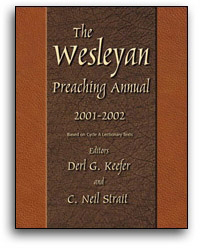
THE WESLEYAN PREACHING ANNUAL 2001--2002
WORSHIP HELPS
CALL TO WORSHIP
Leader: May God be gracious to us and bless us and make His face shine upon us.
Men: That Your ways may be known on earth, Your salvation among all nations.
Leader: May the peoples praise You, O God; may all the peoples praise You.
Women: May the nations be glad and sing for You, for You rule the peoples justly and guide the nations of the earth.
Youth: May the peoples praise You, O God; may all the peoples praise You.
Leader: Then the land will yield its harvest, and God our God will bless us.
All: God will bless us, and all the ends of the earth will fear Him.
OFFERING THOUGHT
You are so gracious to Your church by giving it to Your divine love.
BENEDICTION
He painted a rainbow of bright colors today. Let's go enjoy His rainbow throughout the week.
SERMON BRIEFS
Please Pass The Blessing
Genesis 12:1--9
Table manners are one of the signs of a civilized society, they are an important part of the heritage we share with the next generation. The word "please" indicates that we are on the receiving end of the food chain.
Often when we say our table grace, we include the words, "And bless the hands that prepared it." It's an indication that the blessings we are about to receive came at a price. We are on the receiving end. Someone sacrificed his or her time and convenience so that we could enjoy a meal.
That is true with so many other blessings as well. For example, the blessing of freedom was paid for by the sacrifice of brave soldiers who sacrificed their very life so that we could live free.
Christ himself taught us to remember. As he distributed the elements of what we now call the Lord's Supper, he taught his disciples how to pass the blessing. "He took bread, gave thanks and broke it, and gave it to them, saying, 'This is my body given for you; do this in remembrance of me' " (Luke 22:19).
For the Christian, "please" is a link in the chain of faith. The polite in heart recognize God's blessings - and they pass them along.
That principle is seen vividly in the life of the Old Testament patriarch Abraham. Blessed with fortune, family, and faith, he was a man on the receiving end of God's blessing. But Abraham didn't hoard the blessing. He passed it along. Abraham became an important link in the wonderful chain of salvation. Genesis 12:3b, God said, "All the people on earth will be blessed through you."
So, responsibility comes with blessing. That's seen in another example as well. The privileges of our freedoms came by the sacrifice of others. Those privileges are preserved by the exercise of our freedom. That's why we vote. That's why we pay our taxes. That's why we respect the laws of the land. We are passing the blessing. God blesses us so that we can bless others.
This portion of God's Word seems to say, "Please pass the blessing." And then it reveals some practical ways we can politely fulfill that command.
I. We can pass along the blessing of God's favor by our acceptance of others. (v. 3)
"I will bless those who bless you, and whoever curses you I will curse." Paul reminds us of the time before our salvation when we were out of God's favor in Ephesians 2:12--13.
Accepting others can be a very daunting task. It's far too easy to become judgmental and condemning over the weaknesses of others.
Jesus told a story that illustrates this truth in Matthew 18. A certain king had a servant who owed him a vast amount of money, but was unable to pay. The king was furious and ordered the man's family be sold as slaves to cover the debt. But the servant fell on his knees, begging the king for mercy. Moved to compassion, the king relented. He forgave the entire debt.
Later, the servant met up with a co--worker who owed him just a few dollars. He grabbed the fellow and began to choke him, demanding to be paid what he was owed. His co--worker begged for mercy, but the servant wouldn't relent. He had the fellow thrown into prison because he couldn't repay the small debt.
That is typical of us. God has forgiven us of so much, yet we often bear grudges with each other over the slightest faults. Jesus said, "If you forgive men when they sin against you, your heavenly Father will also forgive you. But if you do not forgive men their sins, your Father will not forgive your sins" (Matthew 6:14--15).
The Word advises us to remember that God accepts us as we are. The church is the Israel of God. He favors us because of His promise to us.
Imperfect us ... vulnerable us ... intolerant us. God loves us enough to say to everyone else, "Don't condemn them, they belong to me."
Committing to passing the blessing of God's favor will create a whole new mindset in us. We will look at others through our "Father's Eyes," as the contemporary song says. We will look with compassion on the weakness of others. We will look with inclusion on the heritage or race of others. We will look with resolution on the divisions and resentment of others.
Will you covenant in your heart to pass the blessing of God's favor along to someone you meet this week?
II. We can pass along the blessing of God's supply by giving to those in need. (v. 5)
"He took his wife Sarai, his nephew Lot, all the possessions they had accumulated and the people they had acquired in Haran, and they set out for the land of Canaan." God had obviously blessed Abraham with great riches. But the history of Abraham is best seen in what he did with his riches. He wasn't known by what he had, but rather by what he gave. His generosity is as exemplary as his faith.
After battling an alliance of enemy kings, Abraham encounters a mysterious priest--king who pays an homage of thanksgiving bread and wine to him. Abraham's response is very revealing in Genesis 14:20--24.
So much of the world seems to be without the basic necessities of life. The bread that we throw away would be like a precious gem to the starving masses in some corners of the world. Abraham's covenant to give instead of hoarding is a great personal declaration for these times. "I will live within my means so that I may share my wealth with those who are in poverty."
Granted, everyone has a right to make a living. And everyone has a right to enjoy the fruits of their labor. But pure Christianity is always on the lookout for those who need a helping hand ... to be giving.
Jesus said "Freely you have received, freely give" (Matthew 10:8). Will you pass the blessing of God's supply on to someone in need this week?
III. We can pass along the blessing of God's presence by leading others in worship. (v. 7)
Throughout the Bible, God calls His people to acknowledge his presence by pausing for a worship service. See that in the account of the exodus. Exodus 3:12 "God said, 'I will be with you. And this will be the sign to you that it is I who have sent you: When you have brought the people out of Egypt, you will worship God on this mountain.' "
Often, Israel would build an altar and worship God for his protection and providential supply. See that in Joshua's instructions after Israel had crossed the Jordan with the Ark of Covenant in Joshua 4:4--7.
Passing the blessing includes taking the time to acknowledge God in times of worship. For example, acknowledging God's presence in your life by your church attendance is passing the blessing.
Acknowledging God's presence in your life by your family worship is passing the blessing.
Acknowledging God's presence in your life by your personal devotions is passing the blessing. Those individual acts of spiritual acknowledgment serve as "memorial stones" to your loved ones and friends.
And there are other ways we can pass the blessing. Our expressions of love pass along the blessing of God's unconditional love.
Our peacemaking passes along the blessing of God's acceptance and peace.
Our joyful spirit in spite of circumstances passes along the blessing of the inner joy that God has brought to our heart.
The poet trying to express the depth of his love advised, "Let me count the ways."
The hymn--writer caught the vision, "Count your blessings, name them one by one: Count your blessings see what God has done."
Stan Toler
You Can't Isolate Jesus
Matthew 9:9--13
A friend of mine was visiting his brother who was hospitalized in a large university medical center awaiting a liver transplant. As my friend spent time with his brother, he noticed one room that had a large sign which indicated that the person who was confined was in isolation. Visitors were limited to the immediate family and the medical staff. The patient in the designated room was virtually quarantined from the outside world.
In the Scripture we are looking at today for guidance, we see Jesus who refused to be isolated from people who were sinners. Isolation aptly describes what the Pharisees expected Jesus to do, separate himself from sinners.
Is it possible that the church in the twenty--first century is guilty of the same isolation that the Pharisees practiced? When the church retreats within the walls of its own security, keeping itself away from a hurting, suffering world, is it not guilty of placing Jesus in isolation?
When we name the name of Christ and then proceed to compartmentalize life - religion over here, business over there, pleasure somewhere else - we become guilty of confining Jesus to "his quarters." If we try to limit Jesus to the religious, we do not free him to go to town and get mixed up with business, politics, and pleasure. Jesus breaks down the "off--limit" signs we put up, and refuses to stay within the boundaries where we try to isolate him.
Jesus refused to be isolated and went to those who needed Him. In so doing, he broke the rules and traditions of the Pharisees.
In our Scripture lesson, Jesus breaks free from the isolation unit of the Pharisees. How does He do it? He does it in a drama which unfolds in two scenes.
Scene One: The call of an Internal Revenue agent
A few years ago there were hearings in the Congress of the United States on the abuses of the Internal Revenue Service. Person after person was paraded before the committee conducting the hearings to tell of the unscrupulous practices on the part of certain Internal Revenue offices and agents. Because of the unethical conduct of certain agents, individuals and families had lost their homes, businesses, reputations, and life savings. As the members of the committee listened to one story after another, they were horrified. The end result of the hearing was that the Internal Revenue Service was to become more user--friendly and stop all unethical tactics and intimidations.
Internal Revenue agents in the time of Christ were not popular people. They were called by the not--so--nice title of "tax--collector." Palestine was under Roman rule and for those who were unscrupulous and amoral, one of the "cushy" jobs was that of "tax--collector." The position usually went to the highest bidder. Tax--collectors betrayed their fellow citizens for their own personal financial gain. A tax--collector was considered morally untouchable.
Matthew was one of the "untouchables." Somehow, someway, Matthew must have had some contact with this young Galilean who had come with a message that was new and who spoke with an authority which had not been heard before. One day Matthew found Jesus standing in front of him, and Jesus issues a challenge to this untouchable, "Come, follow me." Matthew gave up his comfortable job with all of its financial security and became a new recruit in the Kingdom of God.
Jesus is still calling contemporary Matthews to come and follow Him. When Christ issues a call to discipleship, he speaks a word of power. This Word has the power to tear persons away from all that they deem important and to come and follow Christ.
From the call of Matthew, the Internal Revenue agent, we move to ...
Scene Two: Jesus eats with Internal Revenue agents and other sinners. (vv. 10--13)
Jesus not only calls "tax--collectors" to discipleship, but in Scene Two we see him eating dinner in a home with them and some other sinners. The Pharisees are aghast and offended by the sight of Jesus in the midst of this social rabble. They begin an interrogation of Jesus' disciples about his conduct. The Pharisees cannot understand why Jesus would allow his table to be dirtied by such unrighteous people. Jesus overhears their question and responds by offering a proverb, quoting from the prophets, and stating the nature of his ministry (vv. 12--13).
Jesus, in proverbial form, responds to his critics by stating, "Those who are well have no need of a physician, but those who are sick." This proverb points to the dual role of Jesus: healing and saving. Jesus is the great physician, and as a physician his work is among the sick. He deeply desires to touch the diseased in body, mind, and spirit. Jesus wants to restore them to full health.
Our Lord moves from a proverb to a quotation from the prophets: "I desire steadfast love and not sacrifice" (Hosea 6:6). At first, reading this quotation seems out of place since sacrifice is not an issue in this passage. A closer look at the quotation reveals that it comes from a section in Hosea describing God as the healer of Israel (see Hosea 6:1). Jesus wants the Pharisees to understand that God is a loving and merciful healer. Those who are true servants of God will be genuinely loving and merciful, not just ceremoniously religious.
Jesus' third response is a dynamic and shocking declaration (v. 13). Jesus is declaring that his whole ministry is a physician's office, open to the wicked and not to the religious. Too many people think of righteousness in terms of living a particular way or doing good deeds. Jesus explodes this myth in this passage because he knows that righteous practices can easily become not love of God or neighbor, but love of oneself - self--righteousness. Righteousness for the Pharisee was retreat and separation. For Jews, righteousness is love of God and neighbor, which issues forth in the restoration of sinners and doing the will of God.
Scene Two is a picture of what the church should be and do. The church is called to be healer and restorer of broken people from all walks of life.
The story is told of Diogenes, one of the great teachers of ancient Greece. Diogenes was a very virtuous man with a caustic tongue. He was continually comparing the evils of Athens with the simplicity of Sparta. One day someone said to him, "If you think so much of Sparta and so little of Athens, why don't you leave Athens and go to Sparta?" His reply was, "Whatever I may wish to do, I must stay where men need me most." It was sinners who needed Jesus most, and it was with sinners that he would spend his time.
Conclusion
In John Masefield's Trial of Jesus, the Roman centurion who carried out the crucifixion answers Procula's question: "Where is Jesus?" with "Let loose in the world, where none can stop his truth." Jesus will not isolate himself. Like the Pharisees, we sometimes isolate him, but sooner or later Jesus breaks out of isolation. When he does, he makes friends with the most unlikely people, people like you and me. And guess what he does? He calls us to himself, and then, of all things, He throws a party. Jesus refuses to be kept in isolation. I'm glad, aren't you?
Curtis Lewis
CALL TO WORSHIP
Leader: May God be gracious to us and bless us and make His face shine upon us.
Men: That Your ways may be known on earth, Your salvation among all nations.
Leader: May the peoples praise You, O God; may all the peoples praise You.
Women: May the nations be glad and sing for You, for You rule the peoples justly and guide the nations of the earth.
Youth: May the peoples praise You, O God; may all the peoples praise You.
Leader: Then the land will yield its harvest, and God our God will bless us.
All: God will bless us, and all the ends of the earth will fear Him.
OFFERING THOUGHT
You are so gracious to Your church by giving it to Your divine love.
BENEDICTION
He painted a rainbow of bright colors today. Let's go enjoy His rainbow throughout the week.
SERMON BRIEFS
Please Pass The Blessing
Genesis 12:1--9
Table manners are one of the signs of a civilized society, they are an important part of the heritage we share with the next generation. The word "please" indicates that we are on the receiving end of the food chain.
Often when we say our table grace, we include the words, "And bless the hands that prepared it." It's an indication that the blessings we are about to receive came at a price. We are on the receiving end. Someone sacrificed his or her time and convenience so that we could enjoy a meal.
That is true with so many other blessings as well. For example, the blessing of freedom was paid for by the sacrifice of brave soldiers who sacrificed their very life so that we could live free.
Christ himself taught us to remember. As he distributed the elements of what we now call the Lord's Supper, he taught his disciples how to pass the blessing. "He took bread, gave thanks and broke it, and gave it to them, saying, 'This is my body given for you; do this in remembrance of me' " (Luke 22:19).
For the Christian, "please" is a link in the chain of faith. The polite in heart recognize God's blessings - and they pass them along.
That principle is seen vividly in the life of the Old Testament patriarch Abraham. Blessed with fortune, family, and faith, he was a man on the receiving end of God's blessing. But Abraham didn't hoard the blessing. He passed it along. Abraham became an important link in the wonderful chain of salvation. Genesis 12:3b, God said, "All the people on earth will be blessed through you."
So, responsibility comes with blessing. That's seen in another example as well. The privileges of our freedoms came by the sacrifice of others. Those privileges are preserved by the exercise of our freedom. That's why we vote. That's why we pay our taxes. That's why we respect the laws of the land. We are passing the blessing. God blesses us so that we can bless others.
This portion of God's Word seems to say, "Please pass the blessing." And then it reveals some practical ways we can politely fulfill that command.
I. We can pass along the blessing of God's favor by our acceptance of others. (v. 3)
"I will bless those who bless you, and whoever curses you I will curse." Paul reminds us of the time before our salvation when we were out of God's favor in Ephesians 2:12--13.
Accepting others can be a very daunting task. It's far too easy to become judgmental and condemning over the weaknesses of others.
Jesus told a story that illustrates this truth in Matthew 18. A certain king had a servant who owed him a vast amount of money, but was unable to pay. The king was furious and ordered the man's family be sold as slaves to cover the debt. But the servant fell on his knees, begging the king for mercy. Moved to compassion, the king relented. He forgave the entire debt.
Later, the servant met up with a co--worker who owed him just a few dollars. He grabbed the fellow and began to choke him, demanding to be paid what he was owed. His co--worker begged for mercy, but the servant wouldn't relent. He had the fellow thrown into prison because he couldn't repay the small debt.
That is typical of us. God has forgiven us of so much, yet we often bear grudges with each other over the slightest faults. Jesus said, "If you forgive men when they sin against you, your heavenly Father will also forgive you. But if you do not forgive men their sins, your Father will not forgive your sins" (Matthew 6:14--15).
The Word advises us to remember that God accepts us as we are. The church is the Israel of God. He favors us because of His promise to us.
Imperfect us ... vulnerable us ... intolerant us. God loves us enough to say to everyone else, "Don't condemn them, they belong to me."
Committing to passing the blessing of God's favor will create a whole new mindset in us. We will look at others through our "Father's Eyes," as the contemporary song says. We will look with compassion on the weakness of others. We will look with inclusion on the heritage or race of others. We will look with resolution on the divisions and resentment of others.
Will you covenant in your heart to pass the blessing of God's favor along to someone you meet this week?
II. We can pass along the blessing of God's supply by giving to those in need. (v. 5)
"He took his wife Sarai, his nephew Lot, all the possessions they had accumulated and the people they had acquired in Haran, and they set out for the land of Canaan." God had obviously blessed Abraham with great riches. But the history of Abraham is best seen in what he did with his riches. He wasn't known by what he had, but rather by what he gave. His generosity is as exemplary as his faith.
After battling an alliance of enemy kings, Abraham encounters a mysterious priest--king who pays an homage of thanksgiving bread and wine to him. Abraham's response is very revealing in Genesis 14:20--24.
So much of the world seems to be without the basic necessities of life. The bread that we throw away would be like a precious gem to the starving masses in some corners of the world. Abraham's covenant to give instead of hoarding is a great personal declaration for these times. "I will live within my means so that I may share my wealth with those who are in poverty."
Granted, everyone has a right to make a living. And everyone has a right to enjoy the fruits of their labor. But pure Christianity is always on the lookout for those who need a helping hand ... to be giving.
Jesus said "Freely you have received, freely give" (Matthew 10:8). Will you pass the blessing of God's supply on to someone in need this week?
III. We can pass along the blessing of God's presence by leading others in worship. (v. 7)
Throughout the Bible, God calls His people to acknowledge his presence by pausing for a worship service. See that in the account of the exodus. Exodus 3:12 "God said, 'I will be with you. And this will be the sign to you that it is I who have sent you: When you have brought the people out of Egypt, you will worship God on this mountain.' "
Often, Israel would build an altar and worship God for his protection and providential supply. See that in Joshua's instructions after Israel had crossed the Jordan with the Ark of Covenant in Joshua 4:4--7.
Passing the blessing includes taking the time to acknowledge God in times of worship. For example, acknowledging God's presence in your life by your church attendance is passing the blessing.
Acknowledging God's presence in your life by your family worship is passing the blessing.
Acknowledging God's presence in your life by your personal devotions is passing the blessing. Those individual acts of spiritual acknowledgment serve as "memorial stones" to your loved ones and friends.
And there are other ways we can pass the blessing. Our expressions of love pass along the blessing of God's unconditional love.
Our peacemaking passes along the blessing of God's acceptance and peace.
Our joyful spirit in spite of circumstances passes along the blessing of the inner joy that God has brought to our heart.
The poet trying to express the depth of his love advised, "Let me count the ways."
The hymn--writer caught the vision, "Count your blessings, name them one by one: Count your blessings see what God has done."
Stan Toler
You Can't Isolate Jesus
Matthew 9:9--13
A friend of mine was visiting his brother who was hospitalized in a large university medical center awaiting a liver transplant. As my friend spent time with his brother, he noticed one room that had a large sign which indicated that the person who was confined was in isolation. Visitors were limited to the immediate family and the medical staff. The patient in the designated room was virtually quarantined from the outside world.
In the Scripture we are looking at today for guidance, we see Jesus who refused to be isolated from people who were sinners. Isolation aptly describes what the Pharisees expected Jesus to do, separate himself from sinners.
Is it possible that the church in the twenty--first century is guilty of the same isolation that the Pharisees practiced? When the church retreats within the walls of its own security, keeping itself away from a hurting, suffering world, is it not guilty of placing Jesus in isolation?
When we name the name of Christ and then proceed to compartmentalize life - religion over here, business over there, pleasure somewhere else - we become guilty of confining Jesus to "his quarters." If we try to limit Jesus to the religious, we do not free him to go to town and get mixed up with business, politics, and pleasure. Jesus breaks down the "off--limit" signs we put up, and refuses to stay within the boundaries where we try to isolate him.
Jesus refused to be isolated and went to those who needed Him. In so doing, he broke the rules and traditions of the Pharisees.
In our Scripture lesson, Jesus breaks free from the isolation unit of the Pharisees. How does He do it? He does it in a drama which unfolds in two scenes.
Scene One: The call of an Internal Revenue agent
A few years ago there were hearings in the Congress of the United States on the abuses of the Internal Revenue Service. Person after person was paraded before the committee conducting the hearings to tell of the unscrupulous practices on the part of certain Internal Revenue offices and agents. Because of the unethical conduct of certain agents, individuals and families had lost their homes, businesses, reputations, and life savings. As the members of the committee listened to one story after another, they were horrified. The end result of the hearing was that the Internal Revenue Service was to become more user--friendly and stop all unethical tactics and intimidations.
Internal Revenue agents in the time of Christ were not popular people. They were called by the not--so--nice title of "tax--collector." Palestine was under Roman rule and for those who were unscrupulous and amoral, one of the "cushy" jobs was that of "tax--collector." The position usually went to the highest bidder. Tax--collectors betrayed their fellow citizens for their own personal financial gain. A tax--collector was considered morally untouchable.
Matthew was one of the "untouchables." Somehow, someway, Matthew must have had some contact with this young Galilean who had come with a message that was new and who spoke with an authority which had not been heard before. One day Matthew found Jesus standing in front of him, and Jesus issues a challenge to this untouchable, "Come, follow me." Matthew gave up his comfortable job with all of its financial security and became a new recruit in the Kingdom of God.
Jesus is still calling contemporary Matthews to come and follow Him. When Christ issues a call to discipleship, he speaks a word of power. This Word has the power to tear persons away from all that they deem important and to come and follow Christ.
From the call of Matthew, the Internal Revenue agent, we move to ...
Scene Two: Jesus eats with Internal Revenue agents and other sinners. (vv. 10--13)
Jesus not only calls "tax--collectors" to discipleship, but in Scene Two we see him eating dinner in a home with them and some other sinners. The Pharisees are aghast and offended by the sight of Jesus in the midst of this social rabble. They begin an interrogation of Jesus' disciples about his conduct. The Pharisees cannot understand why Jesus would allow his table to be dirtied by such unrighteous people. Jesus overhears their question and responds by offering a proverb, quoting from the prophets, and stating the nature of his ministry (vv. 12--13).
Jesus, in proverbial form, responds to his critics by stating, "Those who are well have no need of a physician, but those who are sick." This proverb points to the dual role of Jesus: healing and saving. Jesus is the great physician, and as a physician his work is among the sick. He deeply desires to touch the diseased in body, mind, and spirit. Jesus wants to restore them to full health.
Our Lord moves from a proverb to a quotation from the prophets: "I desire steadfast love and not sacrifice" (Hosea 6:6). At first, reading this quotation seems out of place since sacrifice is not an issue in this passage. A closer look at the quotation reveals that it comes from a section in Hosea describing God as the healer of Israel (see Hosea 6:1). Jesus wants the Pharisees to understand that God is a loving and merciful healer. Those who are true servants of God will be genuinely loving and merciful, not just ceremoniously religious.
Jesus' third response is a dynamic and shocking declaration (v. 13). Jesus is declaring that his whole ministry is a physician's office, open to the wicked and not to the religious. Too many people think of righteousness in terms of living a particular way or doing good deeds. Jesus explodes this myth in this passage because he knows that righteous practices can easily become not love of God or neighbor, but love of oneself - self--righteousness. Righteousness for the Pharisee was retreat and separation. For Jews, righteousness is love of God and neighbor, which issues forth in the restoration of sinners and doing the will of God.
Scene Two is a picture of what the church should be and do. The church is called to be healer and restorer of broken people from all walks of life.
The story is told of Diogenes, one of the great teachers of ancient Greece. Diogenes was a very virtuous man with a caustic tongue. He was continually comparing the evils of Athens with the simplicity of Sparta. One day someone said to him, "If you think so much of Sparta and so little of Athens, why don't you leave Athens and go to Sparta?" His reply was, "Whatever I may wish to do, I must stay where men need me most." It was sinners who needed Jesus most, and it was with sinners that he would spend his time.
Conclusion
In John Masefield's Trial of Jesus, the Roman centurion who carried out the crucifixion answers Procula's question: "Where is Jesus?" with "Let loose in the world, where none can stop his truth." Jesus will not isolate himself. Like the Pharisees, we sometimes isolate him, but sooner or later Jesus breaks out of isolation. When he does, he makes friends with the most unlikely people, people like you and me. And guess what he does? He calls us to himself, and then, of all things, He throws a party. Jesus refuses to be kept in isolation. I'm glad, aren't you?
Curtis Lewis
