
Twenty--fifth Sunday After Pentecost
Preaching
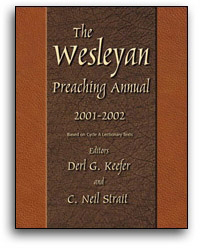
THE WESLEYAN PREACHING ANNUAL 2001--2002
WORSHIP HELPS
CALL TO WORSHIP
Leader: Quiet living is praise to the God who dwells in you.
People: Obedience is the prayer of the heart of God.
Leader: We place our guilt before You.
People: You take our guilt and sin from us once and for all.
Leader: We expect our fill of heavenly blessings today in Your house.
People: On display in your trophy room is our salvation.
All: Praise be to God!
OFFERING THOUGHT
You know the grace of Jesus, the Lord. He was rich in heaven, but for our sakes He became earthly poor. Through His poverty we have become rich. (2 Corinthians 8:9 adapted)
BENEDICTION
"The grace of the Lord Jesus Christ, and the love of God and the communion of the Holy Ghost, be with you all. Amen." (2 Corinthians 13:14 KJV)
SERMON BRIEFS
We Will Be With The Lord Forever
1 Thessalonians 4:13--18
From the very start of this epistle (1:3) the apostle emphasizes his trilogy of Christian virtue: faith, hope, and love. Many Christians think that this trilogy is located only in 1 Corinthians 13, but it is in practically everything the Apostle Paul writes. These are the essential marks of the Christian, for Paul. But here, the order is changed to faith, love, and hope. This re--ordering is practiced consistently through this letter to focus the reader upon the importance of hope for the church in Thessalonica.
I. It seems there had been some troublers at work in the Thessalonian church.
Trying to reconstruct the teaching or identify the teacher that was at work is difficult. Indeed the early church was already surprised and troubled that the second coming of Christ had not happened as soon as they had expected. It now seemed that it might not occur for yet some time. It appears likely that a teacher (was it Apollos?) in Thessalonica was proclaiming, that those who had already died had missed the resurrection. This was disturbing news to those widows and others who were already grieving their loss.
II. Pastor Paul addresses his troubled parishioners with words of hope.
They were losing hope, and Paul addresses them at their point of need. That was his approach here and with so many others. Paul's proclamation and teaching of the Gospel was practical through and through. In this instance, Paul addressed their need for hope, by proclaiming the hope of the gospel.
III. Unlike the troubler(s), Paul here uses eschatology (i.e. the teachings about "last things") to build up the faith of the hearer.
This is so refreshing to hear! So many modern exhorters approach eschatology in very different ways. They teach such convoluted esoteric ideas which speculate greatly about the future. Their teachings tend to focus more attention upon their own erudition than upon the needy congregations who are listening. For others, eschatology becomes a way of producing anxiety and placing in the heart of the hearer. It appears that was the undesirable effect in Thessalonica.
Paul avoids unnecessary speculation in his message here. Unlike the Thessalonian troubler, he did not cast his eschatology in terrifying or disheartening images. His purposes were much more pastoral and gospel--centered.
IV. He calls the hearer to a positive application of the teaching as being "good news" indeed.
This calling is to be understood in two ways, actually.
First, he envisioned the future for the Thessalonians in ways that were hopeful. He refused to allow their continued lack of understanding to make them easy prey to false anxiety--producing teachings about the future. They were not to be like the person depicted by the troubler. They were not to be persons who were without hope. Instead, they had every reason to be hopeful.
Second, they were not only receivers of the gospel of hope. They were also to be proclaimers themselves. Paul was calling them to encourage one another with the words he was giving to them. They were being called to a role of responsibility toward one another ... the role of encourager.
V. That is what God would call out to us.
Encourage one another with the words of the gospel. There are far too many who are bent on troubling the people of God for personal gain, and no pastor is capable of handling so many troubles and troublers. We each and every one must have a mindset to distribute the good news of God's great grace every time we have opportunity. Our actions toward one another should not intend to prove our erudition in Bible knowledge or theological studies. Such selfish goals surely distract the hearer from what they really need to hear through us. Our actions toward one another should not intend only to produce greater anxiety. We are called here to encourage the body of Christ when it is being troubled with the strong message of good news. That is the church's need. That is our calling by the apostle.
Ron Dalton
From Generation To Generation
Psalm 78:1--7; Matthew 25:1--13
Introduction
Passing the generational baton has never been easy. We fear the loss of core values as we entrust the church to our children and grandchildren. Even good and necessary changes can be discomforting and concerning.
This instructional historical psalm challenges the people of Israel to proactively pass the torch of faith and values to the next generation. Learning from the courageous obedience and the fatal mistakes of history, God's people are now challenged to listen and teach again.
I. Listen to the parables of God's hidden majestic things. (vv. 1--3)
Today we labor in a pressure cooker life style that does not allow us to really listen. We must first review our heritage of God--history and God--teachings before we attempt to pass the baton. The psalmist calls the people to listen again to the treasure of truths our spiritual and physical fathers taught us. We need to be reminded again of who we are as God's chosen people, renewing our passion for the core values that guide and shape us.
II. Tell your children of the deeds, power, and wonders the Lord has done. (vv. 4--5)
There is no substitute for telling the story of God's mighty and praiseworthy activity. Our children and new members of our fellowship need to hear the testimonies of God's miraculous grace movements. From the stories we tell they will visualize the Lord's majestic interventions in our lives. We tell the stories of Scripture that exalt the glorious God whose grace is actively invading our world with hope and new beginnings. We also narrate personal grace vignettes of our Savior's power moves in and through us. Tell the next generation of the awesome God moments that have brought us to this historic time.
III. Teach the commands of the Kingdom. (v. 5)
We not only tell the grace story, but also teach without apology the never--changing cosmic commands of God. In this day of relativism with no absolute norms, it is imperative and delightful to teach the next generation the eternal truths and commands of the Kingdom. These attitude and conduct boundaries are the very applied practical implications of Christlikeness. We teach these commands best by our lives rather by than our curriculum. Our life is the textbook they will study.
IV. Teach teachers. (vv. 6--7)
The psalmist speaks of teaching the children to teach their children so that the unborn children will be able to teach their children! Our task is not only to pass the baton of leadership to the next generation but also to teach them how to teach other generations. It is not enough to listen. It is more than telling the story. It goes beyond teaching the Kingdom commands. It is literally teaching teachers how to teach their successors how to pass on the God--virtues and values.
Conclusion
Dr. William Prince, General Superintendent in the Church of the Nazarene, has insisted that "we must give the church away or we will lose it." Our fear is that they may not be wise stewards of the treasure we are entrusting into their immature hands. To effect this transition we must clarify the difference between essence and form.
Dr. L. Guy Nees visited me in Costa Rica when I was the Rector of the Nazarene Seminary of the Americas. As he granted me permission to implement some changes in the life of the institution, he taught me a great truth. "The Church of the Nazarene in her greatest hour has been liberal in message and conservative in method." The danger of passing the torch is that those who follow will change the message and stray from the God--path. Some things are negotiable. Others are not. If the next generation clearly embraces the non--negotiable essentials then the transaction is not extremely dangerous. We need innovative new leaders, who, as they reach their generation for Christ, will introduce creative changes to the life of the church. This is good and necessary. What we dread is a generation that tampers with the essential non--negotiable message. God's living water poured into any shape container still retains its attributes. Just don't alter the chemistry of the water!
This passage in Psalm 78 is the introduction to a historic rehearsal of God's activity on behalf of his people and the reminder of the tragic consequences that were unleashed when the tribe of Ephraim failed to keep the covenant of God nor walk in his law (vv. 9--10).
Grant us, Lord, sanctified passion for you that will allow us to be effective in listening, in telling grace stories, in teaching Kingdom commands, and in teaching our disciples how to pass on the virtues and values of the eternal Kingdom from generation to generation. Amen.
Jerry D. Porter
CALL TO WORSHIP
Leader: Quiet living is praise to the God who dwells in you.
People: Obedience is the prayer of the heart of God.
Leader: We place our guilt before You.
People: You take our guilt and sin from us once and for all.
Leader: We expect our fill of heavenly blessings today in Your house.
People: On display in your trophy room is our salvation.
All: Praise be to God!
OFFERING THOUGHT
You know the grace of Jesus, the Lord. He was rich in heaven, but for our sakes He became earthly poor. Through His poverty we have become rich. (2 Corinthians 8:9 adapted)
BENEDICTION
"The grace of the Lord Jesus Christ, and the love of God and the communion of the Holy Ghost, be with you all. Amen." (2 Corinthians 13:14 KJV)
SERMON BRIEFS
We Will Be With The Lord Forever
1 Thessalonians 4:13--18
From the very start of this epistle (1:3) the apostle emphasizes his trilogy of Christian virtue: faith, hope, and love. Many Christians think that this trilogy is located only in 1 Corinthians 13, but it is in practically everything the Apostle Paul writes. These are the essential marks of the Christian, for Paul. But here, the order is changed to faith, love, and hope. This re--ordering is practiced consistently through this letter to focus the reader upon the importance of hope for the church in Thessalonica.
I. It seems there had been some troublers at work in the Thessalonian church.
Trying to reconstruct the teaching or identify the teacher that was at work is difficult. Indeed the early church was already surprised and troubled that the second coming of Christ had not happened as soon as they had expected. It now seemed that it might not occur for yet some time. It appears likely that a teacher (was it Apollos?) in Thessalonica was proclaiming, that those who had already died had missed the resurrection. This was disturbing news to those widows and others who were already grieving their loss.
II. Pastor Paul addresses his troubled parishioners with words of hope.
They were losing hope, and Paul addresses them at their point of need. That was his approach here and with so many others. Paul's proclamation and teaching of the Gospel was practical through and through. In this instance, Paul addressed their need for hope, by proclaiming the hope of the gospel.
III. Unlike the troubler(s), Paul here uses eschatology (i.e. the teachings about "last things") to build up the faith of the hearer.
This is so refreshing to hear! So many modern exhorters approach eschatology in very different ways. They teach such convoluted esoteric ideas which speculate greatly about the future. Their teachings tend to focus more attention upon their own erudition than upon the needy congregations who are listening. For others, eschatology becomes a way of producing anxiety and placing in the heart of the hearer. It appears that was the undesirable effect in Thessalonica.
Paul avoids unnecessary speculation in his message here. Unlike the Thessalonian troubler, he did not cast his eschatology in terrifying or disheartening images. His purposes were much more pastoral and gospel--centered.
IV. He calls the hearer to a positive application of the teaching as being "good news" indeed.
This calling is to be understood in two ways, actually.
First, he envisioned the future for the Thessalonians in ways that were hopeful. He refused to allow their continued lack of understanding to make them easy prey to false anxiety--producing teachings about the future. They were not to be like the person depicted by the troubler. They were not to be persons who were without hope. Instead, they had every reason to be hopeful.
Second, they were not only receivers of the gospel of hope. They were also to be proclaimers themselves. Paul was calling them to encourage one another with the words he was giving to them. They were being called to a role of responsibility toward one another ... the role of encourager.
V. That is what God would call out to us.
Encourage one another with the words of the gospel. There are far too many who are bent on troubling the people of God for personal gain, and no pastor is capable of handling so many troubles and troublers. We each and every one must have a mindset to distribute the good news of God's great grace every time we have opportunity. Our actions toward one another should not intend to prove our erudition in Bible knowledge or theological studies. Such selfish goals surely distract the hearer from what they really need to hear through us. Our actions toward one another should not intend only to produce greater anxiety. We are called here to encourage the body of Christ when it is being troubled with the strong message of good news. That is the church's need. That is our calling by the apostle.
Ron Dalton
From Generation To Generation
Psalm 78:1--7; Matthew 25:1--13
Introduction
Passing the generational baton has never been easy. We fear the loss of core values as we entrust the church to our children and grandchildren. Even good and necessary changes can be discomforting and concerning.
This instructional historical psalm challenges the people of Israel to proactively pass the torch of faith and values to the next generation. Learning from the courageous obedience and the fatal mistakes of history, God's people are now challenged to listen and teach again.
I. Listen to the parables of God's hidden majestic things. (vv. 1--3)
Today we labor in a pressure cooker life style that does not allow us to really listen. We must first review our heritage of God--history and God--teachings before we attempt to pass the baton. The psalmist calls the people to listen again to the treasure of truths our spiritual and physical fathers taught us. We need to be reminded again of who we are as God's chosen people, renewing our passion for the core values that guide and shape us.
II. Tell your children of the deeds, power, and wonders the Lord has done. (vv. 4--5)
There is no substitute for telling the story of God's mighty and praiseworthy activity. Our children and new members of our fellowship need to hear the testimonies of God's miraculous grace movements. From the stories we tell they will visualize the Lord's majestic interventions in our lives. We tell the stories of Scripture that exalt the glorious God whose grace is actively invading our world with hope and new beginnings. We also narrate personal grace vignettes of our Savior's power moves in and through us. Tell the next generation of the awesome God moments that have brought us to this historic time.
III. Teach the commands of the Kingdom. (v. 5)
We not only tell the grace story, but also teach without apology the never--changing cosmic commands of God. In this day of relativism with no absolute norms, it is imperative and delightful to teach the next generation the eternal truths and commands of the Kingdom. These attitude and conduct boundaries are the very applied practical implications of Christlikeness. We teach these commands best by our lives rather by than our curriculum. Our life is the textbook they will study.
IV. Teach teachers. (vv. 6--7)
The psalmist speaks of teaching the children to teach their children so that the unborn children will be able to teach their children! Our task is not only to pass the baton of leadership to the next generation but also to teach them how to teach other generations. It is not enough to listen. It is more than telling the story. It goes beyond teaching the Kingdom commands. It is literally teaching teachers how to teach their successors how to pass on the God--virtues and values.
Conclusion
Dr. William Prince, General Superintendent in the Church of the Nazarene, has insisted that "we must give the church away or we will lose it." Our fear is that they may not be wise stewards of the treasure we are entrusting into their immature hands. To effect this transition we must clarify the difference between essence and form.
Dr. L. Guy Nees visited me in Costa Rica when I was the Rector of the Nazarene Seminary of the Americas. As he granted me permission to implement some changes in the life of the institution, he taught me a great truth. "The Church of the Nazarene in her greatest hour has been liberal in message and conservative in method." The danger of passing the torch is that those who follow will change the message and stray from the God--path. Some things are negotiable. Others are not. If the next generation clearly embraces the non--negotiable essentials then the transaction is not extremely dangerous. We need innovative new leaders, who, as they reach their generation for Christ, will introduce creative changes to the life of the church. This is good and necessary. What we dread is a generation that tampers with the essential non--negotiable message. God's living water poured into any shape container still retains its attributes. Just don't alter the chemistry of the water!
This passage in Psalm 78 is the introduction to a historic rehearsal of God's activity on behalf of his people and the reminder of the tragic consequences that were unleashed when the tribe of Ephraim failed to keep the covenant of God nor walk in his law (vv. 9--10).
Grant us, Lord, sanctified passion for you that will allow us to be effective in listening, in telling grace stories, in teaching Kingdom commands, and in teaching our disciples how to pass on the virtues and values of the eternal Kingdom from generation to generation. Amen.
Jerry D. Porter
