
Unless A Grain Of Wheat ...
Worship
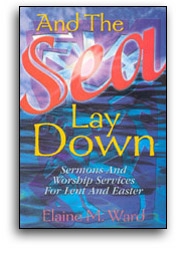
And The Sea Lay Down
Sermons And Worship Services For Lent And Easter
Call to Worship
Jesus said, "I, when I am lifted up from the earth, will draw all people to myself." Come, let us worship God who lifts us up.
Processional Hymn
"The God Of Abraham Praise" (words: Daniel ben Judah, 1404; music: Hebrew melody).
Children's Time
Once upon a time there was an old man and his wife who lived at the edge of a small mountain village in the snow country of Japan. One winter morning the old man set out for the village with a bundle of firewood to sell.
As he trudged through the falling snow he heard a pitiful cry, "Koh, koh." Turning from the path to look, he came upon a great white crane frantically trying to free herself from a trap. The old man had compassion for the magnificent bird and released the cruel spring of the trap. At once the crane flew up, joyfully calling, "Koh, koh," and disappeared into the snowy sky.
With a lighter step the old man went on through the snow, and when he returned once more to his humble home, he told his wife about rescuing the crane. "That was a good deed," she said. As she spoke, there was a tapping on the door. Opening the door, she saw a beautiful young girl standing in the swirling snow. "I have lost my way. May I share the warmth of your fire tonight?" she said. "My name is Tsuru-san." "Come in, poor child, before you freeze in the bitter cold," cried the old wife. Together they shared a simple supper of hot porridge, and then they gave her their bed with its warm quilts, while they slept the night huddled on a pile of straw.
In the morning the old man and the old woman were surprised to see a fire already burning on the hearth, the water urn filled with fresh water, the floors swept, and all the rooms clean and tidy. Tsuru-san was busily stirring a pot over the fire. "Good morning," she said, bowing to the old couple. "The porridge is cooked and ready." They were delighted and because Tsuru-san had no parents, it was decided she would remain as a daughter.
The children of the neighborhood found the girl a delight, as well, and the house rang with happy laughter. The hearts of the old man and the old woman were filled with joy and the early days of winter passed happily, but soon there was no money, therefore, no food. Tsuru-san said, "I wish to help. I will weave cloth for you to sell in the village." The cloth was as beautiful as Tsuru-san and sold quickly.
Tsuru-san continued to weave with only one request -- not to be watched while she worked. But one day Curiosity caused the old woman to peek. There sitting at the loom was the white crane, pulling feathers from her body, weaving them into cloth. But now the Promise was broken. Her eyes filled with tears. "I can no longer stay with you." With a great whish of her wings, she flew up into the sky and the crane maiden was gone forever.
Talk Together
What did the crane maiden give? Why? What can you and I give? Jesus said, "Whoever loses his life for my sake will find it." And then he said, "Follow me."
Prayer of Confession
Loving God, forgive us our refusal to grow, to let go, to change, and create in us raw vulnerability, open receptiveness, and deep sensitivity through the cross that invites us to participate in our suffering and darkness. Help us let go of clinging to things so that you may become God in us. Amen.
Words of Assurance
God is God of Darkness and Silence as well as Light and Word. God is Both/And, Lord of History and of Creation. "Go your way, your trust has saved you." Amen.
Psalter Reading
Psalm 51:1-12
Old Testament
Jeremiah 31:31-34
Epistle Lesson
Hebrews 5:5-10
New Testament
John 12:20-33
Sermon
Moon had a message for man and woman and called Insect to come and carry the message to earth. The message of Moon was, "As I die and in dying, live, so you in dying will live also." Insect took the message of Moon to earth and on the way met Hare. "Where are you going?" asked Hare. "I have a message from Moon to man and woman. Moon said, 'As I die and in dying, live again, so you in dying will live also.' " "Insect, you are so slow. Let me take it," insisted Hare. Insect gave the message to Hare. Hare ran off fast and in his hurry, when he found man and woman, said, "Moon has sent you a message that in dying, Moon dies, so you too in dying shall perish." When Moon heard what Hare had said, Moon was angry and took a stick and hit Hare on the nose. That is why hares have split noses and men and women think that when they die, they perish.
This is Lent when we are aware of death. The most passionate sermon on death I ever read was written by a preacher two weeks after his 24-year-old son "beat his father to the grave." His message was one of rage. Not that death took his son, although that was certainly part of it, but because someone in his presence called it the "will of God." In great anguish and rage his faith exploded: "My own consolation lies in knowing that it was not the will of God that Alex die; that when the waves closed over the sinking car, God's heart was the first of all our hearts to break" (William Sloan Coffin).
Facing the prospect of a torturous, agonizing death on a cross, Jesus cried, "My heart is breaking. And what should I say, 'Father, save me from this hour'?"
Our text says that they came to Philip and said, "We wish to see Jesus," and Jesus answered, "The hour has come for the Son of Man to be glorified." And then he told them, "Unless a grain of wheat falls into the earth and dies, it remains just a single grain; but if it dies, it bears much fruit."
Living some three generations after the death and resurrection of Jesus, John wrote his "good news" to people who were risking their lives for Christ. To be a Christian meant facing one's immediate death, be it lion or cross. But Jesus had been there. Strength to face "a broken heart" can come from remembering Jesus too faced his own hour of heartbreak.
Whenever my deeply depressed grown son phones me to express the reality of his life, which is a broken one, and cries out in deep pain, my heart breaks anew. The cross of Christ invites us to participate in our own pain, to enter our emptiness, to discern our darkness.
"He was the sunshine of my day," moaned Kisa Gotami, as she rocked back and forth with her sorrow. Barely aware of her words, she changed them without thinking. "He is the sunshine of my day!" Kisa Gotami, called the Frail One, had nursed her son, the sunshine of her life, and as he grew, watched him play and run. Now, as she held her dead son in her lap, her sorrow was so great that she would not accept the boy's death. She took to the streets, carrying her dead son on her hip. Going from house to house, knocking at each door, she demanded, "Give me medicine for my son." The people saw that she was mad. They told her, "There is no medicine for the dead." But she acted as if she did not understand and only went on asking.
Now a certain wise old man saw Kisa Gotami and understood that it was her sorrow for her dead son that had driven her out of her mind. He did not mock her but said, "Go to the monastery. There is one there who might know of medicine for your son."
Seeing that the wise man spoke the truth, she went to the monastery and asked for medicine for her son. "This is what you must do. You must go to each house in the city, one by one, and from each you must seek tiny grains of mustard seed. But not just any house will do. You must only take mustard seeds from those houses in which no one has ever died."
Gotami agreed and began at once, knocking and saying, "I am Gotami. Please give me tiny grains of mustard seed for my son." When they brought her the seed, she added, "Before I take the seed, tell me, is this a house in which no one has died?" "Oh no, Gotami, the dead from this house are beyond counting." "Then I must go elsewhere."
She went from house to house, but always the answer was the same. In the entire city there was no house which death had not entered. Finally she understood why she had been sent on this hopeless task. She left the city, overcome with her feelings, and gave up her dead son. When she returned to the monastery, she said, "Most honored sir, there are no houses where death is not known. I see now that whoever is born must die. Everything passes away. There is no cure but the knowing."1
We hold death in common. Though science has pushed back its possibility in time, its inevitability surrounds us all. Everything dies ... fleas and flies, mice and men, all die. In order to make death less threatening, we personify it. We speak of death as an ugly hag, an old man, or even "the mother of beauty" (Wallace Stevens). Because we are aware of the proximity of death, we appreciate life's beauty here and now. We are hooked on living. Death is not only the mother of beauty but the equality. We are on a par with flies and fleas and flowers that die. But the Christian sees beyond death.
Yet it takes courage to die. A young boy dying of cancer gave Elisabeth Kubler-Ross a picture of a cannon with a large barrel aimed at a small boy with a stop sign in his hand, his interpretation of death, the great destroyer, before whom he felt helpless. Elisabeth accepted the picture and did not remove the cannon, as most of us would want to do, thus denying death. Instead, she drew a large figure next to the small one to assure him that he would not be alone. Three days later the boy gave her a picture of a peace bird on which was written, "This is my peace bird, and I have sunshine on my wings."
"Unless a seed dies ..." I once heard the story of a seven-year-old girl exploring the land of "Let's pretend" where it was dark, very, very dark, and cold, very, very cold; and she was lost, very lost. There was nothing she could do about it so she just lay down in the snow and died. This attitude permeated her every experience. She repudiated the idea that she could do anything about it and was constantly defeated by her own sense of inadequacy and her terror of life itself. Her intuition was correct. Her mother went away. There was a divorce, and the child was put in a boarding school. Forty years later the very sorrow of her loss worked its miracle, for what we experience is ours forever. She went into the darkness and found there a ray of hope that created a miracle of transformation, an insight into what life might be, and what she could do about it, and she said, "Yes," to life. Since death is part of life, she could say, "Yes," to death, as well, and meet it as a friend, opening a door into a new morning that she herself had made possible by her own deep change of attitude toward the force that works in every human heart, transforming the spirit. She who lives her life with compassion and creativity finds it.
As a youth Thor Heyerdahl, the famous sea adventurer, was afraid of water. He could not swim. Yet here he was, dipping the paddle of his canoe into the rapidly flowing river with his two friends. Suddenly he felt the canoe capsize and Thor was thrown into the water. When he surfaced, the canoe was racing toward the falls, and one of his companions was swimming toward the shore. With his fear of water and his heavy army clothes dragging him down, he knew that soon he would know which of his parents was right. His father believed in resurrection, the "Yes!" of life after death. His mother said, "No!" Thor's mind filled with the words of the Lord's Prayer and he prayed, and with the prayer burst the power of possibility. Each time he thought of giving up, a strange surge of strength came, and he went on. When his companion, clinging to the branch of a tree on the shore, stretched out his hand, Thor struggled toward it, and exhausted they drew the third one from the waters. That day Thor lost his fear of water and gained an insight into death -- the assurance of his father's faith.
There is no cure for death. Death, as Gotami learned, is a part of life. There is a freedom that comes from accepting all of our fears, uncertainities, and sorrows, so well expressed in the prayer: God grant me the serenity to accept the things I cannot change, the courage to change the things I can, and the wisdom to know the difference. As Christians we add, "The cure is with God who creates life and creates new life, and the cosmic Christ of all creation, who said, 'The hour has come for the Son of Man to be glorified.' " In the cross of Christ we too glory. Amen and Amen.
Hymn of Response
"Lead On, O King Eternal" (words: Ernest W. Shurtleff, 1888; music: Henry Thomas Smart, c. 1835).
Prayers of the People, the Pastor, and The Lord's Prayer
Pastoral Prayer
Living Lord, help us become aware this Lenten season that preoccupation with our own sinfulness is preoccupation with ourself in history, ignoring our place in creation. Help us remember that unless a grain of wheat falls into the earth and dies, it remains just a single grain; but if it dies, it bears much fruit. Those who live life in compassion and creativity will find it.
Offering
Doxology
Hymn of Commitment
"Here I Am, Lord" (text and music, 1983, Daniel L. Schutte and New Dawn Music, P.O. Box 13248, Portland, Oregon 97215-0248).
Benediction
Go now in the name of God, who created the heaven and the earth and gives us much fruit, and in Jesus Christ, who showed us how to plant the seed and die the death, and the Holy Spirit, who gives fruition to the earth and to its creatures. Amen.
____________
1. Adapted from Sheldon Kopp, Metaphors from a Psychotherapist (Palo Alta: Science and Behavior Book, 1971).
Jesus said, "I, when I am lifted up from the earth, will draw all people to myself." Come, let us worship God who lifts us up.
Processional Hymn
"The God Of Abraham Praise" (words: Daniel ben Judah, 1404; music: Hebrew melody).
Children's Time
Once upon a time there was an old man and his wife who lived at the edge of a small mountain village in the snow country of Japan. One winter morning the old man set out for the village with a bundle of firewood to sell.
As he trudged through the falling snow he heard a pitiful cry, "Koh, koh." Turning from the path to look, he came upon a great white crane frantically trying to free herself from a trap. The old man had compassion for the magnificent bird and released the cruel spring of the trap. At once the crane flew up, joyfully calling, "Koh, koh," and disappeared into the snowy sky.
With a lighter step the old man went on through the snow, and when he returned once more to his humble home, he told his wife about rescuing the crane. "That was a good deed," she said. As she spoke, there was a tapping on the door. Opening the door, she saw a beautiful young girl standing in the swirling snow. "I have lost my way. May I share the warmth of your fire tonight?" she said. "My name is Tsuru-san." "Come in, poor child, before you freeze in the bitter cold," cried the old wife. Together they shared a simple supper of hot porridge, and then they gave her their bed with its warm quilts, while they slept the night huddled on a pile of straw.
In the morning the old man and the old woman were surprised to see a fire already burning on the hearth, the water urn filled with fresh water, the floors swept, and all the rooms clean and tidy. Tsuru-san was busily stirring a pot over the fire. "Good morning," she said, bowing to the old couple. "The porridge is cooked and ready." They were delighted and because Tsuru-san had no parents, it was decided she would remain as a daughter.
The children of the neighborhood found the girl a delight, as well, and the house rang with happy laughter. The hearts of the old man and the old woman were filled with joy and the early days of winter passed happily, but soon there was no money, therefore, no food. Tsuru-san said, "I wish to help. I will weave cloth for you to sell in the village." The cloth was as beautiful as Tsuru-san and sold quickly.
Tsuru-san continued to weave with only one request -- not to be watched while she worked. But one day Curiosity caused the old woman to peek. There sitting at the loom was the white crane, pulling feathers from her body, weaving them into cloth. But now the Promise was broken. Her eyes filled with tears. "I can no longer stay with you." With a great whish of her wings, she flew up into the sky and the crane maiden was gone forever.
Talk Together
What did the crane maiden give? Why? What can you and I give? Jesus said, "Whoever loses his life for my sake will find it." And then he said, "Follow me."
Prayer of Confession
Loving God, forgive us our refusal to grow, to let go, to change, and create in us raw vulnerability, open receptiveness, and deep sensitivity through the cross that invites us to participate in our suffering and darkness. Help us let go of clinging to things so that you may become God in us. Amen.
Words of Assurance
God is God of Darkness and Silence as well as Light and Word. God is Both/And, Lord of History and of Creation. "Go your way, your trust has saved you." Amen.
Psalter Reading
Psalm 51:1-12
Old Testament
Jeremiah 31:31-34
Epistle Lesson
Hebrews 5:5-10
New Testament
John 12:20-33
Sermon
Moon had a message for man and woman and called Insect to come and carry the message to earth. The message of Moon was, "As I die and in dying, live, so you in dying will live also." Insect took the message of Moon to earth and on the way met Hare. "Where are you going?" asked Hare. "I have a message from Moon to man and woman. Moon said, 'As I die and in dying, live again, so you in dying will live also.' " "Insect, you are so slow. Let me take it," insisted Hare. Insect gave the message to Hare. Hare ran off fast and in his hurry, when he found man and woman, said, "Moon has sent you a message that in dying, Moon dies, so you too in dying shall perish." When Moon heard what Hare had said, Moon was angry and took a stick and hit Hare on the nose. That is why hares have split noses and men and women think that when they die, they perish.
This is Lent when we are aware of death. The most passionate sermon on death I ever read was written by a preacher two weeks after his 24-year-old son "beat his father to the grave." His message was one of rage. Not that death took his son, although that was certainly part of it, but because someone in his presence called it the "will of God." In great anguish and rage his faith exploded: "My own consolation lies in knowing that it was not the will of God that Alex die; that when the waves closed over the sinking car, God's heart was the first of all our hearts to break" (William Sloan Coffin).
Facing the prospect of a torturous, agonizing death on a cross, Jesus cried, "My heart is breaking. And what should I say, 'Father, save me from this hour'?"
Our text says that they came to Philip and said, "We wish to see Jesus," and Jesus answered, "The hour has come for the Son of Man to be glorified." And then he told them, "Unless a grain of wheat falls into the earth and dies, it remains just a single grain; but if it dies, it bears much fruit."
Living some three generations after the death and resurrection of Jesus, John wrote his "good news" to people who were risking their lives for Christ. To be a Christian meant facing one's immediate death, be it lion or cross. But Jesus had been there. Strength to face "a broken heart" can come from remembering Jesus too faced his own hour of heartbreak.
Whenever my deeply depressed grown son phones me to express the reality of his life, which is a broken one, and cries out in deep pain, my heart breaks anew. The cross of Christ invites us to participate in our own pain, to enter our emptiness, to discern our darkness.
"He was the sunshine of my day," moaned Kisa Gotami, as she rocked back and forth with her sorrow. Barely aware of her words, she changed them without thinking. "He is the sunshine of my day!" Kisa Gotami, called the Frail One, had nursed her son, the sunshine of her life, and as he grew, watched him play and run. Now, as she held her dead son in her lap, her sorrow was so great that she would not accept the boy's death. She took to the streets, carrying her dead son on her hip. Going from house to house, knocking at each door, she demanded, "Give me medicine for my son." The people saw that she was mad. They told her, "There is no medicine for the dead." But she acted as if she did not understand and only went on asking.
Now a certain wise old man saw Kisa Gotami and understood that it was her sorrow for her dead son that had driven her out of her mind. He did not mock her but said, "Go to the monastery. There is one there who might know of medicine for your son."
Seeing that the wise man spoke the truth, she went to the monastery and asked for medicine for her son. "This is what you must do. You must go to each house in the city, one by one, and from each you must seek tiny grains of mustard seed. But not just any house will do. You must only take mustard seeds from those houses in which no one has ever died."
Gotami agreed and began at once, knocking and saying, "I am Gotami. Please give me tiny grains of mustard seed for my son." When they brought her the seed, she added, "Before I take the seed, tell me, is this a house in which no one has died?" "Oh no, Gotami, the dead from this house are beyond counting." "Then I must go elsewhere."
She went from house to house, but always the answer was the same. In the entire city there was no house which death had not entered. Finally she understood why she had been sent on this hopeless task. She left the city, overcome with her feelings, and gave up her dead son. When she returned to the monastery, she said, "Most honored sir, there are no houses where death is not known. I see now that whoever is born must die. Everything passes away. There is no cure but the knowing."1
We hold death in common. Though science has pushed back its possibility in time, its inevitability surrounds us all. Everything dies ... fleas and flies, mice and men, all die. In order to make death less threatening, we personify it. We speak of death as an ugly hag, an old man, or even "the mother of beauty" (Wallace Stevens). Because we are aware of the proximity of death, we appreciate life's beauty here and now. We are hooked on living. Death is not only the mother of beauty but the equality. We are on a par with flies and fleas and flowers that die. But the Christian sees beyond death.
Yet it takes courage to die. A young boy dying of cancer gave Elisabeth Kubler-Ross a picture of a cannon with a large barrel aimed at a small boy with a stop sign in his hand, his interpretation of death, the great destroyer, before whom he felt helpless. Elisabeth accepted the picture and did not remove the cannon, as most of us would want to do, thus denying death. Instead, she drew a large figure next to the small one to assure him that he would not be alone. Three days later the boy gave her a picture of a peace bird on which was written, "This is my peace bird, and I have sunshine on my wings."
"Unless a seed dies ..." I once heard the story of a seven-year-old girl exploring the land of "Let's pretend" where it was dark, very, very dark, and cold, very, very cold; and she was lost, very lost. There was nothing she could do about it so she just lay down in the snow and died. This attitude permeated her every experience. She repudiated the idea that she could do anything about it and was constantly defeated by her own sense of inadequacy and her terror of life itself. Her intuition was correct. Her mother went away. There was a divorce, and the child was put in a boarding school. Forty years later the very sorrow of her loss worked its miracle, for what we experience is ours forever. She went into the darkness and found there a ray of hope that created a miracle of transformation, an insight into what life might be, and what she could do about it, and she said, "Yes," to life. Since death is part of life, she could say, "Yes," to death, as well, and meet it as a friend, opening a door into a new morning that she herself had made possible by her own deep change of attitude toward the force that works in every human heart, transforming the spirit. She who lives her life with compassion and creativity finds it.
As a youth Thor Heyerdahl, the famous sea adventurer, was afraid of water. He could not swim. Yet here he was, dipping the paddle of his canoe into the rapidly flowing river with his two friends. Suddenly he felt the canoe capsize and Thor was thrown into the water. When he surfaced, the canoe was racing toward the falls, and one of his companions was swimming toward the shore. With his fear of water and his heavy army clothes dragging him down, he knew that soon he would know which of his parents was right. His father believed in resurrection, the "Yes!" of life after death. His mother said, "No!" Thor's mind filled with the words of the Lord's Prayer and he prayed, and with the prayer burst the power of possibility. Each time he thought of giving up, a strange surge of strength came, and he went on. When his companion, clinging to the branch of a tree on the shore, stretched out his hand, Thor struggled toward it, and exhausted they drew the third one from the waters. That day Thor lost his fear of water and gained an insight into death -- the assurance of his father's faith.
There is no cure for death. Death, as Gotami learned, is a part of life. There is a freedom that comes from accepting all of our fears, uncertainities, and sorrows, so well expressed in the prayer: God grant me the serenity to accept the things I cannot change, the courage to change the things I can, and the wisdom to know the difference. As Christians we add, "The cure is with God who creates life and creates new life, and the cosmic Christ of all creation, who said, 'The hour has come for the Son of Man to be glorified.' " In the cross of Christ we too glory. Amen and Amen.
Hymn of Response
"Lead On, O King Eternal" (words: Ernest W. Shurtleff, 1888; music: Henry Thomas Smart, c. 1835).
Prayers of the People, the Pastor, and The Lord's Prayer
Pastoral Prayer
Living Lord, help us become aware this Lenten season that preoccupation with our own sinfulness is preoccupation with ourself in history, ignoring our place in creation. Help us remember that unless a grain of wheat falls into the earth and dies, it remains just a single grain; but if it dies, it bears much fruit. Those who live life in compassion and creativity will find it.
Offering
Doxology
Hymn of Commitment
"Here I Am, Lord" (text and music, 1983, Daniel L. Schutte and New Dawn Music, P.O. Box 13248, Portland, Oregon 97215-0248).
Benediction
Go now in the name of God, who created the heaven and the earth and gives us much fruit, and in Jesus Christ, who showed us how to plant the seed and die the death, and the Holy Spirit, who gives fruition to the earth and to its creatures. Amen.
____________
1. Adapted from Sheldon Kopp, Metaphors from a Psychotherapist (Palo Alta: Science and Behavior Book, 1971).
