
The Victory
Sermon
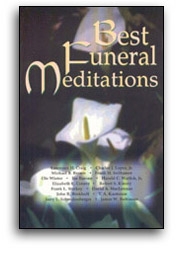
Best Funeral Meditations
for a church member who suffered a heart attack
Robert S. Kinsey
On that first Easter morning, three women were hurrying through the dark, narrow streets of Jerusalem. According to God's plan on that first Easter, the sun was destined to rise on the greatest day in history. No, the women did not carry brightly colored pocketbooks on that first Easter, nor did they wear bright colors. Weren't they in mourning? Didn't they have a sad and solemn duty to perform? They were not hurrying to greet a risen Savior; they were going to anoint a corpse, a corpse buried in a borrowed tomb on Good Friday. One question dominated their thinking: "Who will roll away the stone for us from the entrance to the tomb?" (Mark 16:3). You know the outcome of this event which began in sorrow and ended in joy. The stone was rolled away. There was no corpse to anoint. They listened to the greatest - and probably the shortest - Easter sermon ever preached. A sermon preached not by a seminary graduate but by an angel from the eternal heavens: "Don't be alarmed," he said. "You are looking for Jesus of Nazareth who was nailed to the cross. But he is not here - he has risen! Look, here is the place where they laid him...."
You and I love and worship and serve the Risen Lord. Because he lives, our loved ones shall live. He has overcome sin, death, and the grave. Wasn't the first item on the agenda of the early church to proclaim the resurrection of God's Son? Up and down the Mediterranean world they went, not with a Bible under their arms, but with the message of the Risen Savior in their hearts and on their lips. Jesus Christ is alive. He lives and reigns for all eternity. Because he lives, you and I shall live, and our loved ones whom we give over to his care will live!
To you, Bev, Barb, Gene, and the rest of the family, I say ... remember! Remember that death does not have the last word. No one can deny that death is an enemy. Doesn't God's book describe death as the last enemy to be overcome (1 Corinthians 15:26)? Remember, though, that death does not have the last word: the Word Incarnate has the final word, a word of victory and hope!
Today we honor the memory of Marshall E. Leiter, father, brother, grandfather, and friend ... a faithful member of Trinity Church. Recently Marshall returned to Ashland and joined again the church where his parents were so faithful and where Marshall had been baptized and confirmed by Dr. Arthur Smith. Marshall planned to come to one of the Holy Communion services last Sunday. Doesn't Holy Communion foreshadow that Messianic banquet in heaven when our Lord himself will be the host? In faith, we know that Marshall will be a guest at that banquet.
As we sit here in the presence of death, what do we learn? Life is short. Didn't Job say, "My days are swifter than a runner" (Job 9:25)? If Job were living today, he would probably say, "My days are swifter than a jet." Since life is short, shouldn't the prayer of the psalmist be on our lips, too: "So teach us to count our days that we may gain a wise heart" (Psalm 90:12, NRSV).
Marshall's death makes that other world even more real. Wasn't Henry Ward Beecher trying to express the same thought when he said, "Tears are often the telescope through which men see far into heaven"?
As a family, a time like this will bring you even closer together in your common sorrow. As you comfort each other and as you meditate on the ultimate issues of life, you will be inspired to minister to others who walk through the valley of sorrows.
On that first Easter morning, the women were sure that they had a sad and solemn duty to perform. They did not anoint a corpse; they learned about a Risen Savior - your Savior and mine. In faith we commit Marshall into Christ's loving care. Together with Paul we sing the victory song: "Where, O death, is your victory? Where, O death, is your sting? ... But thanks be to God, who gives us the victory through our Lord Jesus Christ!" (1 Corinthians 15:55, 57, NRSV).
(Reprinted from "Through The Valley Of The Shadow," CSS Publishing Company, Inc., (c) 1976.)
Robert S. Kinsey
On that first Easter morning, three women were hurrying through the dark, narrow streets of Jerusalem. According to God's plan on that first Easter, the sun was destined to rise on the greatest day in history. No, the women did not carry brightly colored pocketbooks on that first Easter, nor did they wear bright colors. Weren't they in mourning? Didn't they have a sad and solemn duty to perform? They were not hurrying to greet a risen Savior; they were going to anoint a corpse, a corpse buried in a borrowed tomb on Good Friday. One question dominated their thinking: "Who will roll away the stone for us from the entrance to the tomb?" (Mark 16:3). You know the outcome of this event which began in sorrow and ended in joy. The stone was rolled away. There was no corpse to anoint. They listened to the greatest - and probably the shortest - Easter sermon ever preached. A sermon preached not by a seminary graduate but by an angel from the eternal heavens: "Don't be alarmed," he said. "You are looking for Jesus of Nazareth who was nailed to the cross. But he is not here - he has risen! Look, here is the place where they laid him...."
You and I love and worship and serve the Risen Lord. Because he lives, our loved ones shall live. He has overcome sin, death, and the grave. Wasn't the first item on the agenda of the early church to proclaim the resurrection of God's Son? Up and down the Mediterranean world they went, not with a Bible under their arms, but with the message of the Risen Savior in their hearts and on their lips. Jesus Christ is alive. He lives and reigns for all eternity. Because he lives, you and I shall live, and our loved ones whom we give over to his care will live!
To you, Bev, Barb, Gene, and the rest of the family, I say ... remember! Remember that death does not have the last word. No one can deny that death is an enemy. Doesn't God's book describe death as the last enemy to be overcome (1 Corinthians 15:26)? Remember, though, that death does not have the last word: the Word Incarnate has the final word, a word of victory and hope!
Today we honor the memory of Marshall E. Leiter, father, brother, grandfather, and friend ... a faithful member of Trinity Church. Recently Marshall returned to Ashland and joined again the church where his parents were so faithful and where Marshall had been baptized and confirmed by Dr. Arthur Smith. Marshall planned to come to one of the Holy Communion services last Sunday. Doesn't Holy Communion foreshadow that Messianic banquet in heaven when our Lord himself will be the host? In faith, we know that Marshall will be a guest at that banquet.
As we sit here in the presence of death, what do we learn? Life is short. Didn't Job say, "My days are swifter than a runner" (Job 9:25)? If Job were living today, he would probably say, "My days are swifter than a jet." Since life is short, shouldn't the prayer of the psalmist be on our lips, too: "So teach us to count our days that we may gain a wise heart" (Psalm 90:12, NRSV).
Marshall's death makes that other world even more real. Wasn't Henry Ward Beecher trying to express the same thought when he said, "Tears are often the telescope through which men see far into heaven"?
As a family, a time like this will bring you even closer together in your common sorrow. As you comfort each other and as you meditate on the ultimate issues of life, you will be inspired to minister to others who walk through the valley of sorrows.
On that first Easter morning, the women were sure that they had a sad and solemn duty to perform. They did not anoint a corpse; they learned about a Risen Savior - your Savior and mine. In faith we commit Marshall into Christ's loving care. Together with Paul we sing the victory song: "Where, O death, is your victory? Where, O death, is your sting? ... But thanks be to God, who gives us the victory through our Lord Jesus Christ!" (1 Corinthians 15:55, 57, NRSV).
(Reprinted from "Through The Valley Of The Shadow," CSS Publishing Company, Inc., (c) 1976.)
