
What To Do With Bad Guys
Sermon
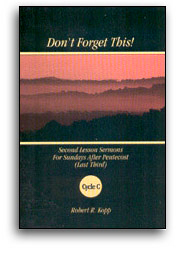
Don't Forget This!
Second Lesson Sermons For Sundays After Pentecost (Last Third) Cycle C
When I asked Dad to go to Israel with Mom and me about fifteen years ago, he said, "Son, I've been in two wars. That's enough dodging bullets for one lifetime."
But after almost two decades of trips to Israel, I've discovered Jerusalem is a lot safer than walking around Yankee Stadium or Central Park. Indeed, I'd be willing to wager a round at Pebble Beach that there are more crimes committed in America every day than in Israel every year.
However, the isolated instances of violent behavior in Israel attract international headlines because of the religious overtones. People in our neck of the woods are motivated to prey on others for the baser instincts of jealousy, addiction, anger, hatred, spontaneous combustion, or the jollies associated with A Clockwork Orange. People over there pick on each other for prophetic purposes. They really think God is on their side while they're sticking it to each other; bringing to mind a few lines from Roland Bainton within the context of "The Dark Ages" on why a just war theory has a lot more to do with just us than justice (Christendom, 1964):
The degree to which centralized government had collapsed is illustrated by the fate of Augustine's doctrine of the just war ... Christian princes were feuding with each other, one prince had as much right as another to call his cause just, and no superior power was in a position to adjudicate. Consequently, theory was thrown to the winds, and those attacked took care of themselves, including bishops, priests, monks, and nuns, though the clergy often scrupled to use swords and, instead, bashed the enemy with clubs, because "the Church abhors the shedding of blood." The code had utterly collapsed.
Besides, it's a lot more juicy talking about people killing each other for God than for something to stick in a nose or vein.
The truth is Israel -- especially Jerusalem -- is the hub of the world's most historically dominating religions: Christianity, Islam, and Judaism. Therefore, as concisely yet comprehensively concluded by Ahron Bregman and Jihan El-Tahri in the preface to The Fifty Years War: Israel and the Arabs (1998), "No other territory on earth has aroused such passion."
While the city of peace has become known for its polemics as much as its prophets, pilgrims continue to pass through its gates to connect with the holy.
Admittedly, I return regularly to Israel because my Lord Jesus walked the land. Because I want to know more about him, I've felt compelled to study about and in Israel.
Though my academic intent is keen and vocationally understandable, the primary reasons for my pilgrimages are sharpened Christological focus, pastoral patience, and personal peace which are renewed with every visit.
Certainly, I cannot explain how that happens when I'm in Israel. But it does.
I also go to see the Bible along with faith come alive for new pilgrims. I'll never forget watching my mom reading the Bible on a tree stump near Tiberius on the Sea of Galilee. She was never much of a Bible reader or student. But our trip to Israel changed that. Now she's even teaching Bible studies! It's a story repeated many times over.
I used to know everything when I was in eighth grade. Now I'm satisfied with knowing God loves the world and the world loves God by loving everyone in it.
Of course, that's why I always leave Israel more than a trifle troubled too.
I don't understand people who hate people to love God.
I'll never understand aberrations of Christianity like the Crusades or Holocaust or even local churches which completely contradict the invitational, inclusive, and unconditional love of Jesus.
I'll never understand aberrations of Judaism like what's happening to Palestinian children and non-combatants.
I'll never understand aberrations of Islam like mosques holding parties to celebrate another terrorist act.
But as I tell folks who criticize Christianity, don't blame Jesus for Christians.
So I go back to the city of peace and the land of my Lord's incarnation every few years to learn more about him, renew my life in Christ, and try to figure out whose Father is really in charge.
By the way, I won't be going back until 2001. There will be too many end-of-the-world-return-of-the-messiah wackos hanging out in the holy land in 2000.
Parenthetically, anyone who pretends to have the market on an eschatological dating service is a fraud. Read Mark 13. But like the big three's aberrations, too many folks are auto-suggestively re-writing Genesis 1: "So man created God. In the image of man, man created God."
If you decide to join me in Jerusalem next time, I can promise the Bible will come alive for you, ancient and current events will make sense, and the truth of a song by the Imperials will become evident: "There will never be any peace until God is seated at the conference table."
But I can't predict what will happen between your ears and in your hearts. That will depend on you. It's like Jesus said, "Here I am! I stand at the door and knock. If anyone hears my voice and opens the door, I will come in" (see Revelation 3:14ff).
Shalom!
But what can we do about the bad guys? What can we do about those twisted souls who hit, hurt, bruise, beat, batter, and cause all kinds of mischief in the names of their little godlets?
Before Jesus comes back to establish his Kingdom, the bad guys will raise a lot of hell. Paul warned, "As to the coming of our Lord Jesus Christ and our being gathered together to him ... that day will not come unless the rebellion comes first" (see 2 Thessalonians 2:1ff).
But it's not enough to admit bad guys exist and raise hell.
People who love God and know loving people proves love for God must develop a strategy to overcome the bad guys and raise heaven because there are times when those bad guys cause problems even bigger than a divided church in Pittsburgh or a lifted wallet in East Jerusalem or any of the other rip-offs of life in the modern world.
Sometimes the evil is so pronounced, profound, and grotesque that sophomoric discussion groups and armchair peaceniks are more nauseating than hopeful.
That becomes starkly startling every time pilgrims visit Yad Vashem in Jerusalem.
Yad Vashem -- "a monument and a name" -- is the memorial to "the six million members of the Jewish people who died a martyr's death at the hands of the Nazis and their collaborators" (from the Martyrs' and Heroes' Remembering Law unanimously adopted by the Israel Knesset on August 15, 1953).
There is no way to articulate a visit to Yad Vashem.
Zola Levitt's extemporaneous speech in Yad Vashem's Hall of Names comes close (The Promised Land, 1983):
I'm in the Hall of Names ... There are big volumes here containing sheets of paper -- 3.8 million sheets of paper -- each one the record of a human being. For thirty years they've been collected in an effort to humanize those who perished in this Holocaust ... They died in such a dehumanized way. Their families were taken away ... their possessions ... their jewelry, their clothing. They went into those ovens naked. Even their gold teeth were pulled out ... The hair was taken from women to stuff mattresses. And finally their names were taken away and they were given numbers on their arms ... Most of those numbers weren't used very long.
This effort to individualize these human beings is a holy effort... Some of my family is in here....
Well, I want to tell you something while I'm here. Don't try to kill me again... Not because now I'm armed and ready, but because it's wrong. Pharaoh killed me -- he threw down my Temple of God and took away my people of Judah in captivity. Antiochus killed me -- he put a Greek statue in my Temple and he sacrificed a pig on my altar. Titus killed me -- he threw down my second Temple. He burned my Holy City. He dispersed my people throughout the world. The Moslems killed me -- they put their shrine on my land, on my Temple site. The Crusaders killed me -- they came carrying crosses to teach me peace. They pushed my people into wooden synagogues and burned them to the ground. The inquisitors killed me -- slowly, with the rack and torch. The Turks killed me ... They desecrated my land. The British killed me -- they wouldn't let me come back ... When I survived this Holocaust and came here in ships, they sank in the harbors before they would let me back into my land. And now the PLO wants to kill me.
Well, let me ask you something. What have we done? Do you remember us attacking anyone? Do you remember us persecuting anyone? ... We have a pretty good record, except they keep coming to kill us.
Don't do this anymore. Remember what they did to us. We came here personally to show it to you so you would remember. For God's sake, let my people go.
And before we surmise such inhumanity is a relic of Nazi Germany, I must tell you about a horrific moment in our neck of the woods only months ago. A faithful Jewish woman who helps produce Howard and Kopp with Real People for Adelphia cablevision was castigated by Christians for working on our show. Essentially, she was told Judaism is substandard.
Doesn't that kind of talk ring a bell? Didn't that kind of talk incarnate itself into the actions that resulted in Yad Vashem?
I think of Norman Lear's subtle brilliance in this theological exchange between Archie Bunker and Meathead:
Meathead: "You know, Arch, Jesus was a Jew!"
Archie: "No, he was not! He was a Christian!"
But what can we do about the bad guys?
Jesus outlined the strategy (see Matthew 18:15-17):
If your brother does you wrong, go talk it out privately between the two of you. If he sees your point, you've won your brother. But if he won't see your side of it, take one or two others, since every fact, in order to stand, must have two or three witnesses. If he will pay them no mind, bring it up before the church. If he won't pay attention to them, chalk him up as a hopeless case.
That's The Cotton Patch Version of Matthew (1970). Here's my interpretation of our Lord's rules of reconciliation:
1. Try to work it out face to face.
2. If that doesn't work, bring along a few fair and objective folks who will tell the truth to the both of you while insuring neither of you is tempted to lie about the conversation to others at a later date.
3. If that doesn't work, try a committee, board, jury, or bunch of good folks to sort it all out.
4. If that doesn't work, avoid and isolate 'em! Or as eighth graders like to say, just blow 'em off!
But what can we do when that doesn't work?
Sometimes, as the Psalmist lamented, "I am for peace; but when I speak, they are for war" (Psalm 120).
What can we do then?
"Have a happy day," Helen Steiner Rice urged, "and give a smile away."
Mother Teresa often said, "Smile at each other." She explained (from Malcolm Muggeridge's Something Beautiful for God, 1971):
Be kind and merciful. Let no one come to you without coming away better and happier. Be the living expression of God's kindness: kindness in your face, kindness in your eyes, kindness is your smile, kindness in your warm greeting ... Give them not only your care, but also your heart.
But what happens when the bad guys don't smile back and reject our Mary Poppins' "Just-a-spoonful-of-sugar-helps-the-medicine-go-down" peacemaking efforts?
Paul counseled, "Avoid them... For such people do not serve our Lord Christ, but their own appetites" (see Romans 16:17ff.).
But what happens when our avoiding and isolating don't work? What happens when the bad guys disrupt the peace and destroy people?
Paul was much firmer in 2 Thessalonians 2:15: "Stand firm and hold fast."
In other words, confront the bad guys with their behavior, control their behavior, and keep them away from everybody else until their behavior becomes good.
I've also come to realize it's often better to talk to God about some people than to talk to some people about God.
Some folks just don't open the door for Jesus. And that's why polemics are more popular than peace in this world.
Again, it's like the Imperials sing, "There will never be any peace until God is seated at the conference table."
Or as someone started chanting years ago:
Know Jesus!
Know peace!
No Jesus!
No peace!
It's like people who look at the continuing crisis in the Middle East and ask, "Why don't they just get along together? Why can't they just act like good Christians?"
Well...
Stan Bell, a youth pastor and good friend who worked with me while he was attending Pittsburgh Theological Seminary, recently told me about old Fred. Old Fred's pastor visited him in the hospital. And as the pastor stood by old Fred's bed, Fred's condition grew worse, and he frantically asked for a pen and paper. Old Fred used his last bit of energy to scribble a note. Then he died. The pastor stuffed the note into his jacket pocket and forgot about it until the funeral. During the service for old Fred, the pastor remembered the note. He was wearing the same jacket. So he took it out and said, "You know, old Fred handed me a note just before he died. I haven't looked at it. But knowing old Fred, I'm sure there's a word of wisdom and comfort in it for all of us." So the pastor opened the note and read, "you're standing on my oxygen tube!"
The world will never breathe peacefully until Jesus is Lord of all. For when Jesus is Lord, people are loved invitationally, and inclusively, and unconditionally.
So what can we do about bad guys?
Jesus!
But after almost two decades of trips to Israel, I've discovered Jerusalem is a lot safer than walking around Yankee Stadium or Central Park. Indeed, I'd be willing to wager a round at Pebble Beach that there are more crimes committed in America every day than in Israel every year.
However, the isolated instances of violent behavior in Israel attract international headlines because of the religious overtones. People in our neck of the woods are motivated to prey on others for the baser instincts of jealousy, addiction, anger, hatred, spontaneous combustion, or the jollies associated with A Clockwork Orange. People over there pick on each other for prophetic purposes. They really think God is on their side while they're sticking it to each other; bringing to mind a few lines from Roland Bainton within the context of "The Dark Ages" on why a just war theory has a lot more to do with just us than justice (Christendom, 1964):
The degree to which centralized government had collapsed is illustrated by the fate of Augustine's doctrine of the just war ... Christian princes were feuding with each other, one prince had as much right as another to call his cause just, and no superior power was in a position to adjudicate. Consequently, theory was thrown to the winds, and those attacked took care of themselves, including bishops, priests, monks, and nuns, though the clergy often scrupled to use swords and, instead, bashed the enemy with clubs, because "the Church abhors the shedding of blood." The code had utterly collapsed.
Besides, it's a lot more juicy talking about people killing each other for God than for something to stick in a nose or vein.
The truth is Israel -- especially Jerusalem -- is the hub of the world's most historically dominating religions: Christianity, Islam, and Judaism. Therefore, as concisely yet comprehensively concluded by Ahron Bregman and Jihan El-Tahri in the preface to The Fifty Years War: Israel and the Arabs (1998), "No other territory on earth has aroused such passion."
While the city of peace has become known for its polemics as much as its prophets, pilgrims continue to pass through its gates to connect with the holy.
Admittedly, I return regularly to Israel because my Lord Jesus walked the land. Because I want to know more about him, I've felt compelled to study about and in Israel.
Though my academic intent is keen and vocationally understandable, the primary reasons for my pilgrimages are sharpened Christological focus, pastoral patience, and personal peace which are renewed with every visit.
Certainly, I cannot explain how that happens when I'm in Israel. But it does.
I also go to see the Bible along with faith come alive for new pilgrims. I'll never forget watching my mom reading the Bible on a tree stump near Tiberius on the Sea of Galilee. She was never much of a Bible reader or student. But our trip to Israel changed that. Now she's even teaching Bible studies! It's a story repeated many times over.
I used to know everything when I was in eighth grade. Now I'm satisfied with knowing God loves the world and the world loves God by loving everyone in it.
Of course, that's why I always leave Israel more than a trifle troubled too.
I don't understand people who hate people to love God.
I'll never understand aberrations of Christianity like the Crusades or Holocaust or even local churches which completely contradict the invitational, inclusive, and unconditional love of Jesus.
I'll never understand aberrations of Judaism like what's happening to Palestinian children and non-combatants.
I'll never understand aberrations of Islam like mosques holding parties to celebrate another terrorist act.
But as I tell folks who criticize Christianity, don't blame Jesus for Christians.
So I go back to the city of peace and the land of my Lord's incarnation every few years to learn more about him, renew my life in Christ, and try to figure out whose Father is really in charge.
By the way, I won't be going back until 2001. There will be too many end-of-the-world-return-of-the-messiah wackos hanging out in the holy land in 2000.
Parenthetically, anyone who pretends to have the market on an eschatological dating service is a fraud. Read Mark 13. But like the big three's aberrations, too many folks are auto-suggestively re-writing Genesis 1: "So man created God. In the image of man, man created God."
If you decide to join me in Jerusalem next time, I can promise the Bible will come alive for you, ancient and current events will make sense, and the truth of a song by the Imperials will become evident: "There will never be any peace until God is seated at the conference table."
But I can't predict what will happen between your ears and in your hearts. That will depend on you. It's like Jesus said, "Here I am! I stand at the door and knock. If anyone hears my voice and opens the door, I will come in" (see Revelation 3:14ff).
Shalom!
But what can we do about the bad guys? What can we do about those twisted souls who hit, hurt, bruise, beat, batter, and cause all kinds of mischief in the names of their little godlets?
Before Jesus comes back to establish his Kingdom, the bad guys will raise a lot of hell. Paul warned, "As to the coming of our Lord Jesus Christ and our being gathered together to him ... that day will not come unless the rebellion comes first" (see 2 Thessalonians 2:1ff).
But it's not enough to admit bad guys exist and raise hell.
People who love God and know loving people proves love for God must develop a strategy to overcome the bad guys and raise heaven because there are times when those bad guys cause problems even bigger than a divided church in Pittsburgh or a lifted wallet in East Jerusalem or any of the other rip-offs of life in the modern world.
Sometimes the evil is so pronounced, profound, and grotesque that sophomoric discussion groups and armchair peaceniks are more nauseating than hopeful.
That becomes starkly startling every time pilgrims visit Yad Vashem in Jerusalem.
Yad Vashem -- "a monument and a name" -- is the memorial to "the six million members of the Jewish people who died a martyr's death at the hands of the Nazis and their collaborators" (from the Martyrs' and Heroes' Remembering Law unanimously adopted by the Israel Knesset on August 15, 1953).
There is no way to articulate a visit to Yad Vashem.
Zola Levitt's extemporaneous speech in Yad Vashem's Hall of Names comes close (The Promised Land, 1983):
I'm in the Hall of Names ... There are big volumes here containing sheets of paper -- 3.8 million sheets of paper -- each one the record of a human being. For thirty years they've been collected in an effort to humanize those who perished in this Holocaust ... They died in such a dehumanized way. Their families were taken away ... their possessions ... their jewelry, their clothing. They went into those ovens naked. Even their gold teeth were pulled out ... The hair was taken from women to stuff mattresses. And finally their names were taken away and they were given numbers on their arms ... Most of those numbers weren't used very long.
This effort to individualize these human beings is a holy effort... Some of my family is in here....
Well, I want to tell you something while I'm here. Don't try to kill me again... Not because now I'm armed and ready, but because it's wrong. Pharaoh killed me -- he threw down my Temple of God and took away my people of Judah in captivity. Antiochus killed me -- he put a Greek statue in my Temple and he sacrificed a pig on my altar. Titus killed me -- he threw down my second Temple. He burned my Holy City. He dispersed my people throughout the world. The Moslems killed me -- they put their shrine on my land, on my Temple site. The Crusaders killed me -- they came carrying crosses to teach me peace. They pushed my people into wooden synagogues and burned them to the ground. The inquisitors killed me -- slowly, with the rack and torch. The Turks killed me ... They desecrated my land. The British killed me -- they wouldn't let me come back ... When I survived this Holocaust and came here in ships, they sank in the harbors before they would let me back into my land. And now the PLO wants to kill me.
Well, let me ask you something. What have we done? Do you remember us attacking anyone? Do you remember us persecuting anyone? ... We have a pretty good record, except they keep coming to kill us.
Don't do this anymore. Remember what they did to us. We came here personally to show it to you so you would remember. For God's sake, let my people go.
And before we surmise such inhumanity is a relic of Nazi Germany, I must tell you about a horrific moment in our neck of the woods only months ago. A faithful Jewish woman who helps produce Howard and Kopp with Real People for Adelphia cablevision was castigated by Christians for working on our show. Essentially, she was told Judaism is substandard.
Doesn't that kind of talk ring a bell? Didn't that kind of talk incarnate itself into the actions that resulted in Yad Vashem?
I think of Norman Lear's subtle brilliance in this theological exchange between Archie Bunker and Meathead:
Meathead: "You know, Arch, Jesus was a Jew!"
Archie: "No, he was not! He was a Christian!"
But what can we do about the bad guys?
Jesus outlined the strategy (see Matthew 18:15-17):
If your brother does you wrong, go talk it out privately between the two of you. If he sees your point, you've won your brother. But if he won't see your side of it, take one or two others, since every fact, in order to stand, must have two or three witnesses. If he will pay them no mind, bring it up before the church. If he won't pay attention to them, chalk him up as a hopeless case.
That's The Cotton Patch Version of Matthew (1970). Here's my interpretation of our Lord's rules of reconciliation:
1. Try to work it out face to face.
2. If that doesn't work, bring along a few fair and objective folks who will tell the truth to the both of you while insuring neither of you is tempted to lie about the conversation to others at a later date.
3. If that doesn't work, try a committee, board, jury, or bunch of good folks to sort it all out.
4. If that doesn't work, avoid and isolate 'em! Or as eighth graders like to say, just blow 'em off!
But what can we do when that doesn't work?
Sometimes, as the Psalmist lamented, "I am for peace; but when I speak, they are for war" (Psalm 120).
What can we do then?
"Have a happy day," Helen Steiner Rice urged, "and give a smile away."
Mother Teresa often said, "Smile at each other." She explained (from Malcolm Muggeridge's Something Beautiful for God, 1971):
Be kind and merciful. Let no one come to you without coming away better and happier. Be the living expression of God's kindness: kindness in your face, kindness in your eyes, kindness is your smile, kindness in your warm greeting ... Give them not only your care, but also your heart.
But what happens when the bad guys don't smile back and reject our Mary Poppins' "Just-a-spoonful-of-sugar-helps-the-medicine-go-down" peacemaking efforts?
Paul counseled, "Avoid them... For such people do not serve our Lord Christ, but their own appetites" (see Romans 16:17ff.).
But what happens when our avoiding and isolating don't work? What happens when the bad guys disrupt the peace and destroy people?
Paul was much firmer in 2 Thessalonians 2:15: "Stand firm and hold fast."
In other words, confront the bad guys with their behavior, control their behavior, and keep them away from everybody else until their behavior becomes good.
I've also come to realize it's often better to talk to God about some people than to talk to some people about God.
Some folks just don't open the door for Jesus. And that's why polemics are more popular than peace in this world.
Again, it's like the Imperials sing, "There will never be any peace until God is seated at the conference table."
Or as someone started chanting years ago:
Know Jesus!
Know peace!
No Jesus!
No peace!
It's like people who look at the continuing crisis in the Middle East and ask, "Why don't they just get along together? Why can't they just act like good Christians?"
Well...
Stan Bell, a youth pastor and good friend who worked with me while he was attending Pittsburgh Theological Seminary, recently told me about old Fred. Old Fred's pastor visited him in the hospital. And as the pastor stood by old Fred's bed, Fred's condition grew worse, and he frantically asked for a pen and paper. Old Fred used his last bit of energy to scribble a note. Then he died. The pastor stuffed the note into his jacket pocket and forgot about it until the funeral. During the service for old Fred, the pastor remembered the note. He was wearing the same jacket. So he took it out and said, "You know, old Fred handed me a note just before he died. I haven't looked at it. But knowing old Fred, I'm sure there's a word of wisdom and comfort in it for all of us." So the pastor opened the note and read, "you're standing on my oxygen tube!"
The world will never breathe peacefully until Jesus is Lord of all. For when Jesus is Lord, people are loved invitationally, and inclusively, and unconditionally.
So what can we do about bad guys?
Jesus!
