
What Good Is Doubt?
Sermon
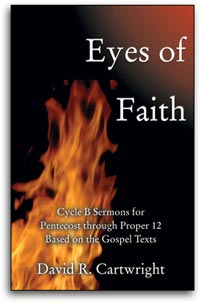
Eyes of Faith
Cycle B Gospel Text Sermons for Pentecost First Third
Doubt has been around for a long time. At least as long as faith and trust. At least as long as the story of the stilling of the storm in Mark's gospel. At least as long as my professional experience as a minister. That's why I think by the time I'm finished, you will know what I mean when I say that the Lord doesn't put as much stock in our doubts and uncertainties as we sometimes do.
What I love about this story of the stilling of the storm is how lightly God seems to treat our doubts and uncertainties. In other words, doubt can serve to deepen our faith rather than destroy it. It certainly did with the disciples and it certainly has with me.
When I was first a minister, I had several conversations with my supervising pastor about whether I was up to the job. His words of encouragement to me often went like this: "Preach your beliefs and not your doubts. Preach your conclusions and not your processes." Since my supervisor was a loyal Methodist, he often quoted the ultimate authority, John Wesley, who once said to a young green minister, "Preach faith until you get it." In divinity school, my preaching professor was big on preaching with authority. He once told me, "Leave the red pencil in the study. Don't be grading yourself while you're delivering your sermon. You'll cheat your people if you do that."
Now as I look back on all that advice, it was good advice. But I wonder if it can give the wrong impression. This way of going about things may make ministers appear like we're more certain than we actually are. It could look like we have it all figured out, when in truth, we don't. It could look like we don't have a doubt in the world, when, in truth, we do. I'll tell you straight out that I am one minister who does not have it all figured out and I've been at it for more than 45 years now. In fact, I thought by this time in my life I'd pretty much have it all worked out. It was only recently when I ran across a comment by my spiritual hero Henri Nouwen that I began to realize what an illusion that is. Shortly before his death, Nouwen said that he was less certain of what he believed at the end of his life than at the beginning. Doubt seems to come with the territory. We might as well accept it and make the most of it.
That's why I like the title for this message: "What Good Is Doubt?" Over my ministry, I've come to the conclusion that doubt serves some very good purposes. That's why I have come to think that God is not nearly as concerned about it as we are.
First of all, doubt keeps faith alive. It keeps us from getting set in our ways, most of all, in our religious ways. Paul Tillich, the theologian who has had the most influence in my life, put it this way: "Faith without doubt is stillborn." He would go so far as to say that if you are not doubting, you're not growing. Looking back on my ministry, I can see how this works. If I had thrown in the towel because of some of the difficulties I had with the Christian faith back when, I would have stopped short of reaching where I am now. I'd have been like that fellow in one of Kierkegaard's stories, the one who stopped at the sign at the city limits and never went into the city because he thought he'd arrived. It's like stopping dead in our tracks when we see the sign that says, "New York" and never going on to find such things as the Empire State Building and Statue of Liberty. Doubt forces us to continue the journey. It leads us into the city.
Another way of saying this is to say that doubt not only keeps our faith alive, it makes us go deeper. One of my recurring doubts about the goodness of God has to do with storms and natural disasters. I'm particularly disturbed by the harm they bring to innocent people. We have only to think about the tsunami in Japan or the tornadoes and floods in the US. Not only does the rain fall on the just and unjust alike, but so do tornadoes and hurricanes. Over the years I've kept trying to come to terms with this. I didn't give up on God. A few years ago, I got a new glimpse on how this might all work in God's plan. I was reading a book and the author said that we have to realize that nature is also free, just as human beings are free. Freedom is so important to God that it's possible for things like tornadoes and hurricanes to happen. It all began to fall in place for me. Not completely, but a little. I'm still trying to work out in my mind how things like birth defects are a part of God's good creation. The point is this: My doubts led me to a deeper understanding than I would have ever had, had I stopped somewhere along the way.
There is one more way I can put this. Doubts keep us humble. I sometimes marvel at how some people, particularly some religious people, think they have it all worked out. They have the right answer and they know for sure that they have the right answer. They have no doubts about it whatsoever, whatever it is. At times I almost envy them. Then I realize that along with all that certainty seems to come a great deal of arrogance and intolerance. I wouldn't trade my doubts and uncertainty for all the certainty in the world and if the rest has to go along with it, it's not worth it. It's not a fair trade.
Perhaps the most arresting and humbling experience I've had in the last couple of years was when we were in Venice. We were enjoying the beauty of the piazza before San Marco's when my eye caught sight of a fellow in a black T-shirt. I could only see his back but that was enough. On his T-shirt was the outline of the Church of the Nativity in Bethlehem. I'm sure you would recognize it once you saw it. Superimposed on this drawing of this holy site of Christianity was one of those international red circles with a slash mark indicating, NO! Like no parking, no smoking, and then underneath were these words: "Bad Religion!" It almost took my breath away. To think that there was someone who thought that my beloved Christianity was a bad religion. And not only that, there must be enough of those who felt that way that it was possible to go someplace and purchase a T-shirt to proclaim to all the world your feelings. I thought to myself, "What have we Christians done to provoke such a display?" Have we Christians been so arrogant and thoughtless in the way we proclaim the gospel that we assume we are the best of all religions and we're now looked upon as being among the worst? It's a picture I can't get out of my mind to this day.
So doubts serve another good purpose. They keep us humble. Too much certainty seems to lead to misunderstanding and even hostility and hate.
The story of Jesus stilling the storm is an interesting story. It's particularly interesting when looked at from the perspective of the relationship of doubt and faith. It is evening. Jesus and his disciples evidently are in a boat near the shore of the Sea of Galilee. Jesus says to them, " 'Let us go across to the other side.' And leaving the crowd behind, they took him with them in the boat, just as he was" (Mark 4:35-36 NRSV). For some reason, we are told that there were other boats around with them. This may be Mark's way of underscoring that what is about to happen was in public view, out there for all the world to see and witness. A great windstorm rises up, which it can in that area without much notice, and Mark tells us that the waves beat upon the sides of the boat swamping it. All the while, Jesus was quietly asleep on a cushion on the dry end of the boat. The disciples are upset that Jesus doesn't seem to care. How can he be asleep on a cushion in the boat while they're being tossed to and fro? They raised the same question faithful people have asked over the ages: "God, don't you care what's happening to us?" The disciples were so concerned that they woke Jesus up from his sleep and said to him, "Teacher (that is, rabbi) do you not care that we are perishing?" (Mark 4:38b NRSV). Interestingly, Jesus does not address their question in words. He chooses to ignore them. He has more important things at the moment to do than to deal with their fears. Instead, he rebukes the wind and calms the sea. "Peace! Be still!" (Mark 4:39 NRSV). Mark says, "The wind ceased, and there was a dead calm" (Mark 4:39 NRSV). Even Jesus' rebuke of the disciples, if you can call it that, is rather gentle in my estimation. It's more of a wonder and a puzzlement than anything else. With all that they have seen and heard in their time with Jesus it is understandable why he asks them, "Why are you afraid? Have you still no faith?" (Mark 4:40 NRSV).
Notice Jesus does not say, "Why do you not believe? Or, why do you doubt?" But he asks, "Why are you afraid?" As I read this story, Jesus is telling us that the opposite of faith is not doubt, but fear. Fear is what eats away at our faith, not doubt. Doubts lead us to deeper faith. Fear is the real enemy of faith. Fear makes us throw in the towel. Doubt keeps our faith alive, pushes us to delve deeper, and keeps us humble.
It was indeed a humbling experience that night for the disciples. The result of this experience for the disciples in the boat on the Sea of Galilee was that they found it all not only puzzling but also humbling. "And they were filled with great awe and said to one another, 'Who then is this, that even the wind and the sea obey him?' " (Mark 4:41 NRSV). Jesus' questioning of their fear left them questioning who he was. He brought them down to earth, even though they were out in the middle of the sea, terrified for their very lives.
If I've learned anything about the life of faith it's this: We can't be on a high all the time. Thank God for the good times and the mountaintop experiences! They are to be cherished but there are dry spots. There is such a thing as the dark valley of the shadow of doubt. At these times we need to rely on God's grace to see us through. Even the giants of the faith have gone through this. I understand that on his deathbed even Martin Luther, the great Reformer and founder of the Protestant church, asked to be reassured: "Did I do the right thing? Tell me that I was right to break from the church at Rome."
One more thing: Let us not misdiagnose our doubts. That is the main way we take them too seriously. Often it's simply pain, tiredness, or distress talking. Take away the pain, take away the tiredness, take away the stress, and doubts fly out the window. One of my favorite lines from Dickens' A Christmas Carol is when Scrooge is trying to decide if the Ghost from Christmas Past is real or simply "a piece of undigested beef." Are our doubts real or not?
Doubt has been around a long time -- at least as long as faith. There are all kinds of doubt: real ones and imaginary ones. There are inner conversations we have with ourselves when we wonder if our prayers are working. There are moral doubts when we wonder whether we're as good as we should be. With Saint Paul we say, "The good that I would do, I do not, and the evil that I would not do, I would do." Like one of my beloved professors, we wonder whether we're doing the right thing about our spouse who has Alzheimer's.
Sometimes we may even be tempted to solve things the Woody Allen way. Perhaps God is either incompetent, senile, or on a prolonged vacation. Or worse yet, perhaps he has not left anybody in charge. Oops!
Then it is that these words of my mentor, Paul Tillich, come rushing into my mind. They are words he gave to a graduating class of Union Seminary:
There will be no period in your life, so long as it remains creative and has healing power, in which demons will not split your souls and produce doubts about your faith, your vocation, your whole being. If they fail to succeed, they may accomplish something else -- self-assurance and pride with respect to your power to heal and cast out demons.1
And we all know what the Bible says about pride. It's what goes before a fall.
So what good is doubt? It keeps faith alive. It makes faith deeper. It keeps us humble. "So doubt bravely, more bravely have faith!"
Always be sure to ask the right question, the one Jesus asked his disciples that evening in the boat on the Sea of Galilee: "Why are you afraid?" That's the real way to deal with our doubts. Figure out where they're coming from. After all, these disciples were also highly experienced fishermen who at this moment for some reason were scared out of their wits by a storm that they should have been quite accustomed. Why? Only they would know for sure but for us it's simple. When we let God help us get rid of our fears, our doubts will take care of themselves. Amen.
__________
1. Paul Tillich, The Eternal Now (London: SCM Press, 2002), 65.
What I love about this story of the stilling of the storm is how lightly God seems to treat our doubts and uncertainties. In other words, doubt can serve to deepen our faith rather than destroy it. It certainly did with the disciples and it certainly has with me.
When I was first a minister, I had several conversations with my supervising pastor about whether I was up to the job. His words of encouragement to me often went like this: "Preach your beliefs and not your doubts. Preach your conclusions and not your processes." Since my supervisor was a loyal Methodist, he often quoted the ultimate authority, John Wesley, who once said to a young green minister, "Preach faith until you get it." In divinity school, my preaching professor was big on preaching with authority. He once told me, "Leave the red pencil in the study. Don't be grading yourself while you're delivering your sermon. You'll cheat your people if you do that."
Now as I look back on all that advice, it was good advice. But I wonder if it can give the wrong impression. This way of going about things may make ministers appear like we're more certain than we actually are. It could look like we have it all figured out, when in truth, we don't. It could look like we don't have a doubt in the world, when, in truth, we do. I'll tell you straight out that I am one minister who does not have it all figured out and I've been at it for more than 45 years now. In fact, I thought by this time in my life I'd pretty much have it all worked out. It was only recently when I ran across a comment by my spiritual hero Henri Nouwen that I began to realize what an illusion that is. Shortly before his death, Nouwen said that he was less certain of what he believed at the end of his life than at the beginning. Doubt seems to come with the territory. We might as well accept it and make the most of it.
That's why I like the title for this message: "What Good Is Doubt?" Over my ministry, I've come to the conclusion that doubt serves some very good purposes. That's why I have come to think that God is not nearly as concerned about it as we are.
First of all, doubt keeps faith alive. It keeps us from getting set in our ways, most of all, in our religious ways. Paul Tillich, the theologian who has had the most influence in my life, put it this way: "Faith without doubt is stillborn." He would go so far as to say that if you are not doubting, you're not growing. Looking back on my ministry, I can see how this works. If I had thrown in the towel because of some of the difficulties I had with the Christian faith back when, I would have stopped short of reaching where I am now. I'd have been like that fellow in one of Kierkegaard's stories, the one who stopped at the sign at the city limits and never went into the city because he thought he'd arrived. It's like stopping dead in our tracks when we see the sign that says, "New York" and never going on to find such things as the Empire State Building and Statue of Liberty. Doubt forces us to continue the journey. It leads us into the city.
Another way of saying this is to say that doubt not only keeps our faith alive, it makes us go deeper. One of my recurring doubts about the goodness of God has to do with storms and natural disasters. I'm particularly disturbed by the harm they bring to innocent people. We have only to think about the tsunami in Japan or the tornadoes and floods in the US. Not only does the rain fall on the just and unjust alike, but so do tornadoes and hurricanes. Over the years I've kept trying to come to terms with this. I didn't give up on God. A few years ago, I got a new glimpse on how this might all work in God's plan. I was reading a book and the author said that we have to realize that nature is also free, just as human beings are free. Freedom is so important to God that it's possible for things like tornadoes and hurricanes to happen. It all began to fall in place for me. Not completely, but a little. I'm still trying to work out in my mind how things like birth defects are a part of God's good creation. The point is this: My doubts led me to a deeper understanding than I would have ever had, had I stopped somewhere along the way.
There is one more way I can put this. Doubts keep us humble. I sometimes marvel at how some people, particularly some religious people, think they have it all worked out. They have the right answer and they know for sure that they have the right answer. They have no doubts about it whatsoever, whatever it is. At times I almost envy them. Then I realize that along with all that certainty seems to come a great deal of arrogance and intolerance. I wouldn't trade my doubts and uncertainty for all the certainty in the world and if the rest has to go along with it, it's not worth it. It's not a fair trade.
Perhaps the most arresting and humbling experience I've had in the last couple of years was when we were in Venice. We were enjoying the beauty of the piazza before San Marco's when my eye caught sight of a fellow in a black T-shirt. I could only see his back but that was enough. On his T-shirt was the outline of the Church of the Nativity in Bethlehem. I'm sure you would recognize it once you saw it. Superimposed on this drawing of this holy site of Christianity was one of those international red circles with a slash mark indicating, NO! Like no parking, no smoking, and then underneath were these words: "Bad Religion!" It almost took my breath away. To think that there was someone who thought that my beloved Christianity was a bad religion. And not only that, there must be enough of those who felt that way that it was possible to go someplace and purchase a T-shirt to proclaim to all the world your feelings. I thought to myself, "What have we Christians done to provoke such a display?" Have we Christians been so arrogant and thoughtless in the way we proclaim the gospel that we assume we are the best of all religions and we're now looked upon as being among the worst? It's a picture I can't get out of my mind to this day.
So doubts serve another good purpose. They keep us humble. Too much certainty seems to lead to misunderstanding and even hostility and hate.
The story of Jesus stilling the storm is an interesting story. It's particularly interesting when looked at from the perspective of the relationship of doubt and faith. It is evening. Jesus and his disciples evidently are in a boat near the shore of the Sea of Galilee. Jesus says to them, " 'Let us go across to the other side.' And leaving the crowd behind, they took him with them in the boat, just as he was" (Mark 4:35-36 NRSV). For some reason, we are told that there were other boats around with them. This may be Mark's way of underscoring that what is about to happen was in public view, out there for all the world to see and witness. A great windstorm rises up, which it can in that area without much notice, and Mark tells us that the waves beat upon the sides of the boat swamping it. All the while, Jesus was quietly asleep on a cushion on the dry end of the boat. The disciples are upset that Jesus doesn't seem to care. How can he be asleep on a cushion in the boat while they're being tossed to and fro? They raised the same question faithful people have asked over the ages: "God, don't you care what's happening to us?" The disciples were so concerned that they woke Jesus up from his sleep and said to him, "Teacher (that is, rabbi) do you not care that we are perishing?" (Mark 4:38b NRSV). Interestingly, Jesus does not address their question in words. He chooses to ignore them. He has more important things at the moment to do than to deal with their fears. Instead, he rebukes the wind and calms the sea. "Peace! Be still!" (Mark 4:39 NRSV). Mark says, "The wind ceased, and there was a dead calm" (Mark 4:39 NRSV). Even Jesus' rebuke of the disciples, if you can call it that, is rather gentle in my estimation. It's more of a wonder and a puzzlement than anything else. With all that they have seen and heard in their time with Jesus it is understandable why he asks them, "Why are you afraid? Have you still no faith?" (Mark 4:40 NRSV).
Notice Jesus does not say, "Why do you not believe? Or, why do you doubt?" But he asks, "Why are you afraid?" As I read this story, Jesus is telling us that the opposite of faith is not doubt, but fear. Fear is what eats away at our faith, not doubt. Doubts lead us to deeper faith. Fear is the real enemy of faith. Fear makes us throw in the towel. Doubt keeps our faith alive, pushes us to delve deeper, and keeps us humble.
It was indeed a humbling experience that night for the disciples. The result of this experience for the disciples in the boat on the Sea of Galilee was that they found it all not only puzzling but also humbling. "And they were filled with great awe and said to one another, 'Who then is this, that even the wind and the sea obey him?' " (Mark 4:41 NRSV). Jesus' questioning of their fear left them questioning who he was. He brought them down to earth, even though they were out in the middle of the sea, terrified for their very lives.
If I've learned anything about the life of faith it's this: We can't be on a high all the time. Thank God for the good times and the mountaintop experiences! They are to be cherished but there are dry spots. There is such a thing as the dark valley of the shadow of doubt. At these times we need to rely on God's grace to see us through. Even the giants of the faith have gone through this. I understand that on his deathbed even Martin Luther, the great Reformer and founder of the Protestant church, asked to be reassured: "Did I do the right thing? Tell me that I was right to break from the church at Rome."
One more thing: Let us not misdiagnose our doubts. That is the main way we take them too seriously. Often it's simply pain, tiredness, or distress talking. Take away the pain, take away the tiredness, take away the stress, and doubts fly out the window. One of my favorite lines from Dickens' A Christmas Carol is when Scrooge is trying to decide if the Ghost from Christmas Past is real or simply "a piece of undigested beef." Are our doubts real or not?
Doubt has been around a long time -- at least as long as faith. There are all kinds of doubt: real ones and imaginary ones. There are inner conversations we have with ourselves when we wonder if our prayers are working. There are moral doubts when we wonder whether we're as good as we should be. With Saint Paul we say, "The good that I would do, I do not, and the evil that I would not do, I would do." Like one of my beloved professors, we wonder whether we're doing the right thing about our spouse who has Alzheimer's.
Sometimes we may even be tempted to solve things the Woody Allen way. Perhaps God is either incompetent, senile, or on a prolonged vacation. Or worse yet, perhaps he has not left anybody in charge. Oops!
Then it is that these words of my mentor, Paul Tillich, come rushing into my mind. They are words he gave to a graduating class of Union Seminary:
There will be no period in your life, so long as it remains creative and has healing power, in which demons will not split your souls and produce doubts about your faith, your vocation, your whole being. If they fail to succeed, they may accomplish something else -- self-assurance and pride with respect to your power to heal and cast out demons.1
And we all know what the Bible says about pride. It's what goes before a fall.
So what good is doubt? It keeps faith alive. It makes faith deeper. It keeps us humble. "So doubt bravely, more bravely have faith!"
Always be sure to ask the right question, the one Jesus asked his disciples that evening in the boat on the Sea of Galilee: "Why are you afraid?" That's the real way to deal with our doubts. Figure out where they're coming from. After all, these disciples were also highly experienced fishermen who at this moment for some reason were scared out of their wits by a storm that they should have been quite accustomed. Why? Only they would know for sure but for us it's simple. When we let God help us get rid of our fears, our doubts will take care of themselves. Amen.
__________
1. Paul Tillich, The Eternal Now (London: SCM Press, 2002), 65.
