
The Wicked Husbandmen
Drama
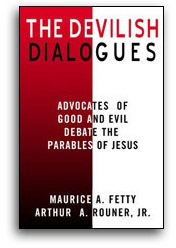
The Devilish Dialogues
Advocates Of Good And Evil Debate The Parables Of Jesus
The Devil's Advocate:
Well, Mr. Lord's Advocate and fellow hypocrites, this is my last time to be with you discussing the parables. I must say that these discussions have been a delight for me. I always welcome the chance for further elucidation of my views. And it has been most rewarding to find such a sympathetic reception among your people. In fact, I often feel that I can call them my people.
This parable is most interesting. As I see it, the parable has to do with stewardship and ownership. But more than that, it has to do with absentee ownership --Êsomething which my opponent must certainly not advocate, for he frequently rails against the absentee landlords of the slum properties. So tonight's story is about an absentee landlord and his claims on his property and how his property should be treated.
The parable is so explicit that it could be called an allegory. It is obvious that the vineyard represents the people of Israel, for as the prophet Isaiah said long before, "The vineyard of the Lord is the house of Israel." The owner of the vineyard is God, and the cultivators are the religious leaders of Israel who had charge of the religious welfare of their people. The messengers represent the prophets who were sent by God. And, of course, the only son who was killed by the cultivators or tenants was Jesus Christ.
As usual, my opponent will try to twist this parable, or allegory, for his own purposes. He will support the idea of absentee landlordship and even go so far as to claim that there is such a thing as a heavenly landlord.
But I want you to know that if there is such a thing as a heavenly landlord, he is certainly an absentee one. He claims ownership of everything, but have you ever seen him? The tenants had the right idea. Even if there is such a thing as an absentee landlord, there shouldn't be. So they acted to take over what was properly theirs.
The Lord's Advocate:
Mr. Devil's Advocate, you overpower me with your arguments. You are all over the board, checkmating all efforts to make sense for the Savior. Maybe, for self-sufficient modern man, the Jesus way just doesn't make sense! In fact, last night, as I sat nodding in my chair, trying to think of something to say to you, I concluded that you are unbeatable. After all, we should give the Devil his due, as the fellow says. In short, it seemed, I must concede!
You win, Mr. Devil's Advocate. You are well known around here. You do have many a secret admirer -- if not any open converts! We like your flair -- the way you dare to go just anywhere to sow your insinuations, to spread your sin, to make men think that they can win anything and everything.
It certainly swells their egos and inflates their pride: "I am the captain of my ship -- I am the master of my fate."
Take the landlord thing. Absentee landlordism is evil. If, in being absent, the landlord does nothing for his renters: lets the toilets clog and the lights go out.
But do you think the Lord was such a one? Jesus does not say the landlord cheated his tenants, that he let the place go to rack and ruin. That he overcharged and underserved.
He just said the tenants were using his farm, and didn't pay up. It was his farm, his world, his kingdom. After all, you're the great free enterpriser, the maker of self-made men! Why should not men on the make pay their rent?
Turn simple injustice and premeditated murder into rightful possession by those who have the power to extort at will, and you've succeeded in making evil good, and black white, and I congratulate you -- and I concede!
II
The Devil's Advocate:
Well! Thank you very much! Now if the servant or messengers in this parable represent the prophets that have been sent to Israel, Jesus may have had in mind someone like Amos. And Amos is a perfect example of the point I wish to make.
Amos lived and preached and wrote around 750 B.C.E. He directed his message against the Northern Kingdom, Israel. Now, you think he would leave them alone. Israel had prospered wonderfully. Their capital city, Samaria, was a beautiful place set on a hill. Many people had both winter and summer houses, built substantially of cut stone. They enjoyed such luxuries as carved ivories and delicate foods. Business was booming and the city was strongly fortified. Who could ask for more? The Great Society had arrived.
But now listen to old Amos, the religious spoilsport, as he comes and attempts to ruin it all. He says:
Woe to those who are at ease in Zion,
and to those who feel secure on the
mountains of Samaria.
Woe to those who lie upon beds of ivory,
and stretch themselves upon their couches ...
Who sing idle songs to the sound of the harp,
and like David invent for themselves
instruments of music,
Who drink wine in bowls,
and anoint themselves with the finest oils,
but are not grieved over the ruin of Joseph!
Do you see my point? He was unable to enjoy life. He felt guilty over the good life when it came, just as many of you feel guilty -- with your wealth. But that is nonsense.
Let me tell you something else. Amos was a southerner and he was preaching in a northern city. In the first place, he was an outsider. And in the second place, he had a southern accent. Besides all that, he was not even a professional speaker or writer. He was an unsophisticated farmer trying to speak to the sophisticated people of Samaria.
He just wasn't with it. He didn't understand the new ways. He had never experienced the delights of wealth and sophisticated living. Amos was unacquainted with real life. He was jealous.
Is it any wonder they asked him to go back to the farm and preach there? He tried to claim that everything they had belonged to God. But the people knew that it was their own political and economic skill that had gotten them where they were. And they weren't going to give it up to the claims of some so-called absentee landlord. It was theirs. So go back home, Amos, and take care of your cheap sheep and sycamore trees.
The Lord's Advocate:
Cheap sheep and sycamore trees maybe: but at least it was close to the land. At least he knew "summer and winter, spring-time and harvest." At least he knew the rising of the sun and the going down of the same!
Country-man, yes; and with an eye that could scan the horizon of the hills for a lost sheep, but could also scan the horizons of the heart and find lost men. Uncanny crofter from the country!
Maybe he was embarrassed and offended by wealth, especially when he saw rich men doing others in by stealth, and saw them rolling in riches while the poor perished.
How can we sleep when others have no beds? How can we eat when others have no food? How can we live in luxury when others lie in lonely slums waiting for death's deliverance?
Oh, sure, I understand their rejecting a prophet like Amos. They could not live with their consciences as long as he was there. Only when you dare to give it up can you look life in the eye and say, "I, too, once wanted pie in the sky by and by," but "I live for Jesus now, and have new life. For my life is God's: and all my goods are God's. And I am glad to share and help people be aware that they are my brothers and sisters."
We're not so different, are we? Who is more "at ease in Zion" than we, in our idyllic suburbs? Who wants to think about starvation in Africa when we had meatloaf or roast beef or chicken today --Êand vegetables, bread, butter, tea, and cookies?
Oh, no, it takes a man to come and tell us we cannot rest until we have built Jerusalem in this, our green and pleasant land.
And if he troubles our consciences, and makes us join the army of the Lord and enter into the battle of life and fight for the right -- so much the better!
Any takers?
III
The Devil's Advocate:
Not many, I'll bet! According to Jesus' parable, one or two other messengers were sent to the people of Israel. They too were supposed to represent some prophets. Let us imagine that one of them might have been Jeremiah. He came on the scene about 626 B.C.E. He was from the south, but at least he did his preaching and teaching in the south. So at least he had that in his favor. He didn't go meddling in other people's business. But he certainly meddled in the business of his own people.
Let me tell you a little more about this man, Jeremiah. He was from a family of priests. He came from a small village outside Jerusalem, but it wasn't long until Jeremiah knew his way around Jerusalem. In fact, quite soon he became an insider, a man well acquainted with the Jerusalem Establishment.
Jeremiah was not a rustic rube like Amos. He was a cultured, sophisticated man of the city. Familiar with the political and economic realities of Jerusalem and the whole Southern Kingdom, Jeremiah could not be accused, like Amos, of not knowing the score. Just the contrary, Jeremiah was "in the know."
That's why his activity is so hard to understand. He was one of the "in-crowd"; he had it made in the power structure and its society. Yet, he began to speak out against that very power structure. He began to criticize his own establishment. He accused the priests and prophets of phoniness and fakery. He began knocking the alleged hypocrisy of some of his cronies in the Downtown Club of Jerusalem.
Listen to a few of Jeremiah's more juicy pronouncements:
An appalling and horrible thing
has happened in the land:
The prophets prophesy falsely,
and the priests rule at their direction;
My people love to have it so,
but what will you do when the end comes?
And in another place:
For from the least to the greatest of them,
everyone is greedy for unjust gain;
And from prophet to priest,
everyone deals falsely.
They have healed the wound of my people lightly,
saying, "Peace, peace
when there is no peace."
And yet again, Jeremiah says:
Cursed is the man who trusts in man
and makes flesh his arm,
whose heart turns away from the Lord.
But who else can you trust in than man? Your Lord is not around. He is an absentee, remember! So Jeremiah begins to repudiate his buddies. The very people he had come to love and trust, he now excoriates. And why? Just because they practiced a little favoritism among each other at the expense of the poor?
Then Jeremiah went way too far. He even hoped for the destruction of his country so that some of his religious notions of judgment and repentance might be met. Is it any wonder that they locked him up? He was a dangerously religious fanatic and traitor.
Yet, Jesus condones that sort of person in his parable. I think the tenants, the husbandmen, had a right to stone the messengers. They were nuts, mad, possessed. There was no absentee landlord up in the sky. Such a concept was only perverted, inflamed imagination of the religious fanatics. And yet again, Jeremiah says:
Cursed is the man who trusts in man
and makes flesh his arm,
whose heart turns away from the Lord.
But who else can you trust in than man? Your Lord is not around. He is an absentee, remember!
The Lord's Advocate:
Well, the religious men of zeal have never had much appeal, have they? We don't like to be exposed. We don't like to be caught with our emotions down, and our heart showing, do we?
I'm interested that the prophets puzzle even you, Mr. Devil's Advocate. You really don't like religious enthusiasm, do you? I suppose when people begin to feel really wholehearted about their faith, and begin to talk about the Lord, and to sing and shout their enthusiasm, and to be earnest in their faith, you become really quite nervous. That's when you begin to lose your grip on my people, isn't it?
It's funny how much we all are like those tenant farmers. We forget the world we live in has been given to us, that we are trespassers in God's domain. We forget we're borrowers of everything we have. And what God asks back is very little. But how we do begrudge God's claim on us! We do not want to owe him anything, and it is a shock to think, in fact, we owe him everything.
And we do not like to be told. We particularly do not like our own kind telling us -- people as educated as we are, people as cultured as we are, people as widely traveled as we are, people as acquainted with the good things of life as we are: people who have every reason to be self-centered and self-serving as we are! When they, the sophisticates, the cosmopolitans, begin to needle the establishment, and speak up against its sins and blindness, it's one of our own doing us in and that hatred is so close to love, that revenge lies so close to the surface -- and retaliation becomes a terrible temptation!
So Jeremiah was even less forgivable than Amos. An ignorant shepherd you can excuse. But what can you do with a Harvard man, or a Union Seminary man -- but trap him if you can. Charge him with turning against his own --Êeven against his fellow-clergy --Êwhen he accuses them with:
They have healed the wounds of my people
lightly saying, "Peace, peace,
when there is no peace."
Jesus was so right: God's children, who owed him everything, killed the prophets when they were sent to them, because they did not want to hear the truth. How many here tonight have hearts humble enough to hear the truth, and believe, and accept the Lord, and accept his messengers, and give back to God what is his due?
That is the test -- and you'll know who's yours among these people, Mr. Devil-Man, by how each one's colors fly on this question.
IV
The Devil's Advocate:
Now the last guy in this parable, the beloved son, undoubtedly represents Jesus, who was purported to be the Son of God. According to the story, the absentee landlord decides to send the son, thinking the tenants will listen to him.
But the tenants are too smart for that. They could see a troublemaker a mile away. After all, hadn't they heard those prophetic types before? They knew all about Amos and Jeremiah and the others. Jesus sounded just like them. He claimed that the earth and its people belonged to God, and that they ought to give him his due in worship and obedience.
However, it's all rather funny, because Jesus alienated the very people who could have helped him most. First of all, he alienated the Pharisees by breaking some of their most important religious rules, such as not working on the Sabbath. He further displeased them by associating with poor people, with half-breed Samaritans, and with prostitutes and tax collectors. In their eyes, therefore, Jesus was not religious enough to be God's Son and special messenger.
Secondly, Jesus alienated the Sadducees, who were mainly the priests, by criticizing their Temple. The Temple was, of course, the very center of their religion and nation and culture. Yet Jesus claimed that the place of worship was relatively unimportant, because God was a Spirit, and should therefore be worshiped in spirit and truth. Furthermore, Jesus predicted that the Temple would be destroyed, and he acted almost as if he didn't care if it was. Imagine the fury that caused with the Sadducees and the whole Jewish nation.
So it was that Jesus had the religious leaders against him -- the very people whom you would think would have been his strongest allies. But he just continued to alienate them by claiming they themselves had been lousy stewards of religion. Is it any wonder they killed him?
Well, in conclusion, I must say that I am delighted that most of you feel that way about Jesus too. This is not God's world. It is our world. God has no right to collect anything from us even if he does exist. We have to make it on our own. If God is, he isn't here. He's an absentee landlord. Anybody acquainted with the slums knows the absentee landlord cares nothing about the tenants. The only interest he has in them is the money they pay him for rent.
So Jesus had no right to make such radical, fanatical claims. He got what was coming to him. He was trying to upset everything -- our whole political, economical, and yes, even our religious system. Things were going well until the likes of him and Amos and Jeremiah came along. They disturbed everything so there's no peace anymore. But you and I know it is our world, our life, our future, and no absentee God has any business making claim on us.
The Lord's Advocate:
If it is our world, and God has no part in it, why can we not run it by ourselves? Why do our human plans go wrong? Why is there trial and error? Why are "the best-laid plans of mice and men" so often foiled?
No, it's not our world. Even at our most powerful, we do not control it. We are human --Êmerely human. And we die. Even the great and good among us die.
No --Êit is only when we in our deepest hearts are in tune with God that we come even close to controlling our world, having power in our world, and taming and using and triumphing through and over our world. And anyone who's ever really been up against it, or who, on the other hand, has ever sat dwarfed and spellbound in a lone canoe on a northern lake, beneath the great arch of the heavens and looked up at the silent stars, knows that it's Someone Else's world, someone who has a secret, whose power he can share only when we learn that secret.
And I say, Mr. Devil's Advocate, in spite of your cackling, offstage laughter, that learning that secret is the one ultimate thing humanity is about. Trying to find out what's with this God of the universe, and how, in heaven's name, we can ever screw up the courage to trust that God! That's what living is! That's what growing up is. That's what maturing and becoming wise really is! Learning the humility to "become as a little child" and trust God.
And the tragedy of those tenant farmers is that, like so many people today, they thought they were going to get away with something by shortcutting and short circuiting the law, and human responsibility and certainly love, by doing in those whom they thought stood between them and easy street!
And a tragedy doubly-compounded when the last messenger they did in -- the heir himself -- was the one man of all the messengers who came with forgiveness and "healing in his wings," who was "the man for others," the man for them, the man who ultimately, through their deed of treachery, actually laid down his life for them. By Jesus' own words, there is no greater love than that!
He pointed the finger, and prodded the conscience, and grieved over them because they needed to face the accusing finger: they needed to repent in order to be healed and forgiven! It was their chance of a lifetime. And they botched it. And only in hell would they ever know how badly they had botched it!
You can say Jesus got what was coming to him. And the wicked husbandmen got what was coming to them! Indeed, they determined what was coming to them. They asked for it -- destruction and rejection.
But that isn't what the Landlord wanted for them. That isn't what God wanted for them. He sent his Son, with life and with love.
My friends, our Antagonist here would make you wicked husbandmen, too! Narrow, self-centered, self-serving, self-gratifying sinners, too! He'd suck you down to death with all the others in all the ages who have wanted only to serve and to save themselves.
Let me tell you. They all lost. And he lost them. And he wants to send you there too -- if you'll let him "sell" you.
It's no deal! No deal for people who are God's sons and daughters, and who have a rightful heritage as God's children to claim. And the way you claim it is by identifying, accepting, signing up with Jesus. He is the last messenger, who comes to us, the tenant-farmers, to collect the rent.
Do you know what it is? Just your life, that's all. Just your heart, for Jesus. Give him that, and the whole blooming vineyard is yours -- life is yours, love is yours, hope is yours, daily help is yours.
I dare you to pay the rent, tonight!
Well, Mr. Lord's Advocate and fellow hypocrites, this is my last time to be with you discussing the parables. I must say that these discussions have been a delight for me. I always welcome the chance for further elucidation of my views. And it has been most rewarding to find such a sympathetic reception among your people. In fact, I often feel that I can call them my people.
This parable is most interesting. As I see it, the parable has to do with stewardship and ownership. But more than that, it has to do with absentee ownership --Êsomething which my opponent must certainly not advocate, for he frequently rails against the absentee landlords of the slum properties. So tonight's story is about an absentee landlord and his claims on his property and how his property should be treated.
The parable is so explicit that it could be called an allegory. It is obvious that the vineyard represents the people of Israel, for as the prophet Isaiah said long before, "The vineyard of the Lord is the house of Israel." The owner of the vineyard is God, and the cultivators are the religious leaders of Israel who had charge of the religious welfare of their people. The messengers represent the prophets who were sent by God. And, of course, the only son who was killed by the cultivators or tenants was Jesus Christ.
As usual, my opponent will try to twist this parable, or allegory, for his own purposes. He will support the idea of absentee landlordship and even go so far as to claim that there is such a thing as a heavenly landlord.
But I want you to know that if there is such a thing as a heavenly landlord, he is certainly an absentee one. He claims ownership of everything, but have you ever seen him? The tenants had the right idea. Even if there is such a thing as an absentee landlord, there shouldn't be. So they acted to take over what was properly theirs.
The Lord's Advocate:
Mr. Devil's Advocate, you overpower me with your arguments. You are all over the board, checkmating all efforts to make sense for the Savior. Maybe, for self-sufficient modern man, the Jesus way just doesn't make sense! In fact, last night, as I sat nodding in my chair, trying to think of something to say to you, I concluded that you are unbeatable. After all, we should give the Devil his due, as the fellow says. In short, it seemed, I must concede!
You win, Mr. Devil's Advocate. You are well known around here. You do have many a secret admirer -- if not any open converts! We like your flair -- the way you dare to go just anywhere to sow your insinuations, to spread your sin, to make men think that they can win anything and everything.
It certainly swells their egos and inflates their pride: "I am the captain of my ship -- I am the master of my fate."
Take the landlord thing. Absentee landlordism is evil. If, in being absent, the landlord does nothing for his renters: lets the toilets clog and the lights go out.
But do you think the Lord was such a one? Jesus does not say the landlord cheated his tenants, that he let the place go to rack and ruin. That he overcharged and underserved.
He just said the tenants were using his farm, and didn't pay up. It was his farm, his world, his kingdom. After all, you're the great free enterpriser, the maker of self-made men! Why should not men on the make pay their rent?
Turn simple injustice and premeditated murder into rightful possession by those who have the power to extort at will, and you've succeeded in making evil good, and black white, and I congratulate you -- and I concede!
II
The Devil's Advocate:
Well! Thank you very much! Now if the servant or messengers in this parable represent the prophets that have been sent to Israel, Jesus may have had in mind someone like Amos. And Amos is a perfect example of the point I wish to make.
Amos lived and preached and wrote around 750 B.C.E. He directed his message against the Northern Kingdom, Israel. Now, you think he would leave them alone. Israel had prospered wonderfully. Their capital city, Samaria, was a beautiful place set on a hill. Many people had both winter and summer houses, built substantially of cut stone. They enjoyed such luxuries as carved ivories and delicate foods. Business was booming and the city was strongly fortified. Who could ask for more? The Great Society had arrived.
But now listen to old Amos, the religious spoilsport, as he comes and attempts to ruin it all. He says:
Woe to those who are at ease in Zion,
and to those who feel secure on the
mountains of Samaria.
Woe to those who lie upon beds of ivory,
and stretch themselves upon their couches ...
Who sing idle songs to the sound of the harp,
and like David invent for themselves
instruments of music,
Who drink wine in bowls,
and anoint themselves with the finest oils,
but are not grieved over the ruin of Joseph!
Do you see my point? He was unable to enjoy life. He felt guilty over the good life when it came, just as many of you feel guilty -- with your wealth. But that is nonsense.
Let me tell you something else. Amos was a southerner and he was preaching in a northern city. In the first place, he was an outsider. And in the second place, he had a southern accent. Besides all that, he was not even a professional speaker or writer. He was an unsophisticated farmer trying to speak to the sophisticated people of Samaria.
He just wasn't with it. He didn't understand the new ways. He had never experienced the delights of wealth and sophisticated living. Amos was unacquainted with real life. He was jealous.
Is it any wonder they asked him to go back to the farm and preach there? He tried to claim that everything they had belonged to God. But the people knew that it was their own political and economic skill that had gotten them where they were. And they weren't going to give it up to the claims of some so-called absentee landlord. It was theirs. So go back home, Amos, and take care of your cheap sheep and sycamore trees.
The Lord's Advocate:
Cheap sheep and sycamore trees maybe: but at least it was close to the land. At least he knew "summer and winter, spring-time and harvest." At least he knew the rising of the sun and the going down of the same!
Country-man, yes; and with an eye that could scan the horizon of the hills for a lost sheep, but could also scan the horizons of the heart and find lost men. Uncanny crofter from the country!
Maybe he was embarrassed and offended by wealth, especially when he saw rich men doing others in by stealth, and saw them rolling in riches while the poor perished.
How can we sleep when others have no beds? How can we eat when others have no food? How can we live in luxury when others lie in lonely slums waiting for death's deliverance?
Oh, sure, I understand their rejecting a prophet like Amos. They could not live with their consciences as long as he was there. Only when you dare to give it up can you look life in the eye and say, "I, too, once wanted pie in the sky by and by," but "I live for Jesus now, and have new life. For my life is God's: and all my goods are God's. And I am glad to share and help people be aware that they are my brothers and sisters."
We're not so different, are we? Who is more "at ease in Zion" than we, in our idyllic suburbs? Who wants to think about starvation in Africa when we had meatloaf or roast beef or chicken today --Êand vegetables, bread, butter, tea, and cookies?
Oh, no, it takes a man to come and tell us we cannot rest until we have built Jerusalem in this, our green and pleasant land.
And if he troubles our consciences, and makes us join the army of the Lord and enter into the battle of life and fight for the right -- so much the better!
Any takers?
III
The Devil's Advocate:
Not many, I'll bet! According to Jesus' parable, one or two other messengers were sent to the people of Israel. They too were supposed to represent some prophets. Let us imagine that one of them might have been Jeremiah. He came on the scene about 626 B.C.E. He was from the south, but at least he did his preaching and teaching in the south. So at least he had that in his favor. He didn't go meddling in other people's business. But he certainly meddled in the business of his own people.
Let me tell you a little more about this man, Jeremiah. He was from a family of priests. He came from a small village outside Jerusalem, but it wasn't long until Jeremiah knew his way around Jerusalem. In fact, quite soon he became an insider, a man well acquainted with the Jerusalem Establishment.
Jeremiah was not a rustic rube like Amos. He was a cultured, sophisticated man of the city. Familiar with the political and economic realities of Jerusalem and the whole Southern Kingdom, Jeremiah could not be accused, like Amos, of not knowing the score. Just the contrary, Jeremiah was "in the know."
That's why his activity is so hard to understand. He was one of the "in-crowd"; he had it made in the power structure and its society. Yet, he began to speak out against that very power structure. He began to criticize his own establishment. He accused the priests and prophets of phoniness and fakery. He began knocking the alleged hypocrisy of some of his cronies in the Downtown Club of Jerusalem.
Listen to a few of Jeremiah's more juicy pronouncements:
An appalling and horrible thing
has happened in the land:
The prophets prophesy falsely,
and the priests rule at their direction;
My people love to have it so,
but what will you do when the end comes?
And in another place:
For from the least to the greatest of them,
everyone is greedy for unjust gain;
And from prophet to priest,
everyone deals falsely.
They have healed the wound of my people lightly,
saying, "Peace, peace
when there is no peace."
And yet again, Jeremiah says:
Cursed is the man who trusts in man
and makes flesh his arm,
whose heart turns away from the Lord.
But who else can you trust in than man? Your Lord is not around. He is an absentee, remember! So Jeremiah begins to repudiate his buddies. The very people he had come to love and trust, he now excoriates. And why? Just because they practiced a little favoritism among each other at the expense of the poor?
Then Jeremiah went way too far. He even hoped for the destruction of his country so that some of his religious notions of judgment and repentance might be met. Is it any wonder that they locked him up? He was a dangerously religious fanatic and traitor.
Yet, Jesus condones that sort of person in his parable. I think the tenants, the husbandmen, had a right to stone the messengers. They were nuts, mad, possessed. There was no absentee landlord up in the sky. Such a concept was only perverted, inflamed imagination of the religious fanatics. And yet again, Jeremiah says:
Cursed is the man who trusts in man
and makes flesh his arm,
whose heart turns away from the Lord.
But who else can you trust in than man? Your Lord is not around. He is an absentee, remember!
The Lord's Advocate:
Well, the religious men of zeal have never had much appeal, have they? We don't like to be exposed. We don't like to be caught with our emotions down, and our heart showing, do we?
I'm interested that the prophets puzzle even you, Mr. Devil's Advocate. You really don't like religious enthusiasm, do you? I suppose when people begin to feel really wholehearted about their faith, and begin to talk about the Lord, and to sing and shout their enthusiasm, and to be earnest in their faith, you become really quite nervous. That's when you begin to lose your grip on my people, isn't it?
It's funny how much we all are like those tenant farmers. We forget the world we live in has been given to us, that we are trespassers in God's domain. We forget we're borrowers of everything we have. And what God asks back is very little. But how we do begrudge God's claim on us! We do not want to owe him anything, and it is a shock to think, in fact, we owe him everything.
And we do not like to be told. We particularly do not like our own kind telling us -- people as educated as we are, people as cultured as we are, people as widely traveled as we are, people as acquainted with the good things of life as we are: people who have every reason to be self-centered and self-serving as we are! When they, the sophisticates, the cosmopolitans, begin to needle the establishment, and speak up against its sins and blindness, it's one of our own doing us in and that hatred is so close to love, that revenge lies so close to the surface -- and retaliation becomes a terrible temptation!
So Jeremiah was even less forgivable than Amos. An ignorant shepherd you can excuse. But what can you do with a Harvard man, or a Union Seminary man -- but trap him if you can. Charge him with turning against his own --Êeven against his fellow-clergy --Êwhen he accuses them with:
They have healed the wounds of my people
lightly saying, "Peace, peace,
when there is no peace."
Jesus was so right: God's children, who owed him everything, killed the prophets when they were sent to them, because they did not want to hear the truth. How many here tonight have hearts humble enough to hear the truth, and believe, and accept the Lord, and accept his messengers, and give back to God what is his due?
That is the test -- and you'll know who's yours among these people, Mr. Devil-Man, by how each one's colors fly on this question.
IV
The Devil's Advocate:
Now the last guy in this parable, the beloved son, undoubtedly represents Jesus, who was purported to be the Son of God. According to the story, the absentee landlord decides to send the son, thinking the tenants will listen to him.
But the tenants are too smart for that. They could see a troublemaker a mile away. After all, hadn't they heard those prophetic types before? They knew all about Amos and Jeremiah and the others. Jesus sounded just like them. He claimed that the earth and its people belonged to God, and that they ought to give him his due in worship and obedience.
However, it's all rather funny, because Jesus alienated the very people who could have helped him most. First of all, he alienated the Pharisees by breaking some of their most important religious rules, such as not working on the Sabbath. He further displeased them by associating with poor people, with half-breed Samaritans, and with prostitutes and tax collectors. In their eyes, therefore, Jesus was not religious enough to be God's Son and special messenger.
Secondly, Jesus alienated the Sadducees, who were mainly the priests, by criticizing their Temple. The Temple was, of course, the very center of their religion and nation and culture. Yet Jesus claimed that the place of worship was relatively unimportant, because God was a Spirit, and should therefore be worshiped in spirit and truth. Furthermore, Jesus predicted that the Temple would be destroyed, and he acted almost as if he didn't care if it was. Imagine the fury that caused with the Sadducees and the whole Jewish nation.
So it was that Jesus had the religious leaders against him -- the very people whom you would think would have been his strongest allies. But he just continued to alienate them by claiming they themselves had been lousy stewards of religion. Is it any wonder they killed him?
Well, in conclusion, I must say that I am delighted that most of you feel that way about Jesus too. This is not God's world. It is our world. God has no right to collect anything from us even if he does exist. We have to make it on our own. If God is, he isn't here. He's an absentee landlord. Anybody acquainted with the slums knows the absentee landlord cares nothing about the tenants. The only interest he has in them is the money they pay him for rent.
So Jesus had no right to make such radical, fanatical claims. He got what was coming to him. He was trying to upset everything -- our whole political, economical, and yes, even our religious system. Things were going well until the likes of him and Amos and Jeremiah came along. They disturbed everything so there's no peace anymore. But you and I know it is our world, our life, our future, and no absentee God has any business making claim on us.
The Lord's Advocate:
If it is our world, and God has no part in it, why can we not run it by ourselves? Why do our human plans go wrong? Why is there trial and error? Why are "the best-laid plans of mice and men" so often foiled?
No, it's not our world. Even at our most powerful, we do not control it. We are human --Êmerely human. And we die. Even the great and good among us die.
No --Êit is only when we in our deepest hearts are in tune with God that we come even close to controlling our world, having power in our world, and taming and using and triumphing through and over our world. And anyone who's ever really been up against it, or who, on the other hand, has ever sat dwarfed and spellbound in a lone canoe on a northern lake, beneath the great arch of the heavens and looked up at the silent stars, knows that it's Someone Else's world, someone who has a secret, whose power he can share only when we learn that secret.
And I say, Mr. Devil's Advocate, in spite of your cackling, offstage laughter, that learning that secret is the one ultimate thing humanity is about. Trying to find out what's with this God of the universe, and how, in heaven's name, we can ever screw up the courage to trust that God! That's what living is! That's what growing up is. That's what maturing and becoming wise really is! Learning the humility to "become as a little child" and trust God.
And the tragedy of those tenant farmers is that, like so many people today, they thought they were going to get away with something by shortcutting and short circuiting the law, and human responsibility and certainly love, by doing in those whom they thought stood between them and easy street!
And a tragedy doubly-compounded when the last messenger they did in -- the heir himself -- was the one man of all the messengers who came with forgiveness and "healing in his wings," who was "the man for others," the man for them, the man who ultimately, through their deed of treachery, actually laid down his life for them. By Jesus' own words, there is no greater love than that!
He pointed the finger, and prodded the conscience, and grieved over them because they needed to face the accusing finger: they needed to repent in order to be healed and forgiven! It was their chance of a lifetime. And they botched it. And only in hell would they ever know how badly they had botched it!
You can say Jesus got what was coming to him. And the wicked husbandmen got what was coming to them! Indeed, they determined what was coming to them. They asked for it -- destruction and rejection.
But that isn't what the Landlord wanted for them. That isn't what God wanted for them. He sent his Son, with life and with love.
My friends, our Antagonist here would make you wicked husbandmen, too! Narrow, self-centered, self-serving, self-gratifying sinners, too! He'd suck you down to death with all the others in all the ages who have wanted only to serve and to save themselves.
Let me tell you. They all lost. And he lost them. And he wants to send you there too -- if you'll let him "sell" you.
It's no deal! No deal for people who are God's sons and daughters, and who have a rightful heritage as God's children to claim. And the way you claim it is by identifying, accepting, signing up with Jesus. He is the last messenger, who comes to us, the tenant-farmers, to collect the rent.
Do you know what it is? Just your life, that's all. Just your heart, for Jesus. Give him that, and the whole blooming vineyard is yours -- life is yours, love is yours, hope is yours, daily help is yours.
I dare you to pay the rent, tonight!
