
The Backfire Effect
Children's sermon
Illustration
Preaching
Sermon
Worship
For September 29, 2019:
The Backfire Effect
by Dean Feldmeyer
Luke 16:19-31
But Father Abraham, says the rich man from his place in hell, I know my brothers didn’t believe Moses and the prophets but, if someone who has come back from the dead warns them, they will believe him.
Father Abraham responds, “Yeah, fat chance.”
We tend to believe what we want to believe.
If I walk into a room of 100 people and 99 of them disagree with me about something, I congratulate the one who agrees with me for being so bright and prescient and I roll my eyes at the 99 who are obviously fools. If the 99 agree with me I talk to them about what an idiot the one who disagrees with me is.
If a politician confirms our previously held ideas, we vote for him. If a preacher’s theology meshes with our own, we congratulate her on her penetrating insight. If a critic likes the movie I liked, I read that critic’s other reviews, if not, I find another critic.
What we choose to believe says more about us than it does about the veracity of that which we believe.
In the News
President Trump has an ambivalent relationship with facts and truth. The Washington Post has created a database cataloging more than 12,000 untrue, misleading, erroneous statements or outright lies that the president has told since he took office, roughly 1,000 days ago. That’s about 120 per day for those keeping score at home.
In one of his most recent examples, he issued a number of tweets about why he shouldn’t be impeached. Those tweets contained six erroneous statements. Whether he was mistaken, misinformed, or lying, the Post does not say. That all these statements are untrue, is demonstrable.
The Democrats have no room to gloat, however.
Former Vice President Joe Biden has told (over and over) a moving story about a war veteran upon whom the vice president was going to pin an award for valor but the young man begged Mr. Biden not to give it to him because the man he was trying to save with his heroic act died.
It is a very moving and effective story. The problem is that it isn’t true. Or, at least, most of it isn’t true. Republicans say Biden is just lying, plain and simple. Psychology Today offers that he may have created a “false memory,” a not uncommon phenomenon that most of us have done from time to time. (Ever notice how that house you grew up in is so much smaller than you remember it?) Rather than just admit that he mistakenly conflated the facts of a couple or three stories, Joe insists, like any practiced storyteller, that the veracity of the details in the story don’t matter as long as the central point is, in fact, the case. As storytellers often say, and Biden should have said to introduce his story, “I don’t know if this really happened or not but I know it’s true.” (You can also see more about this at Snopes.com)
And then there’s “Sharpie-gate.”
Using weeks old data, the president, warned, on national television, that several states, including Alabama, could be devastated by hurricane Dorian only to discover that, by the time he made the statement, the hurricane was moving in the opposite direction and Alabama would not be significantly affected. Rather than simply say, “Oops, my bad. I was using some old data,” which everyone would have forgotten about by the next day, the president chose to double down on his ersatz weather report, refused to admit that he was wrong, and to prove that he was right, presented a weather map that had obviously been doctored with a Sharpie, his favorite writing instrument.
When people noticed that the added line looked suspicious, President Trump issued a directive to the National Oceanic and Atmospheric Administration (NOAA) that they were not to issue any statements that ran counter to his own.
Politics and truth live, it would seem, in two different places, and yet, this fact seems to have no bearing on how people vote. Trump’s base continues to believe everything he says or dismiss the untruths as little mistakes. Or they say the things he says are not meant to be taken literally. As long as he does what they want — appoint conservative, anti-abortion judges, lower taxes, keep immigrants out of the country, talk about patriotism, disparage the people they don’t like, especially democrats and the mainstream media, and protect their guns — they don’t care whether what he says is true or not.
No matter how many “gaffs” Joe Biden makes, whether they are factual errors, offensive statements, or rambling, incoherent responses to questions, he still leads the pack in the Democratic race for president.
It’s not just politics that makes strange bedfellows, it’s politics and truth that are strange bedfellows. And, apparently, it doesn’t matter to the voters.
In the Scriptures
This morning, the lectionary brings us to Luke’s account of Jesus’ parable of Lazarus and the rich man. That the rich man is nameless in the parable has not kept interpreters from giving him a name down through ages. The traditional name, Dives, (usually pronounced DIV-eez, is not actually a name, but instead a word for "rich man,” in the text of the Latin Bible, the Vulgate (circa 350-450 CE). The rich man was also given the names Neuēs (i.e. Nineveh) and Fineas (i.e. Phineas) in the 3rd and 4th centuries.
In the story, the rich man is not so much mean or cruel to destitute Lazarus who lies by the rich man’s gate, as he is oblivious. He doesn’t notice him. Lazarus does not so much as even exist within the rich man’s world view.
Both Lazarus and the rich man die. Lazarus goes to heaven to sit in the lap of Father Abraham and the rich man goes to hell, presumably as punishment for his lack of sensitivity to the poor. There he is tortured day and night with heat and fire.
Looking up, he sees Lazarus sitting next to Abraham and calls out to Abraham telling, not asking, him to send Lazarus to get him a drink of water. Even in hell he has not abandoned his classism. He still sees Lazarus as lower class than himself, suitable only for servile work and he expects that Abraham will share his point of view.
But, alas, Abraham does not. Sorry, he says to the rich man. You had your good stuff in the previous life while Lazarus suffered. Now the roles are reversed and there’s nothing any of us can do about it. The estrangement you created between yourself and the poor is now part of the torture you must endure in eternity.
In that case, says the rich man, send Lazarus to my father’s house to warn my brothers so they don’t make the same mistake I did. Now he has given Lazarus a promotion from errand boy to messenger, but Abraham isn’t having any of it. They have already been warned by Moses (the law) and the prophets (preaching), he replies.
Well, yeah, says the rich man, but no one believes the law and the prophets. Maybe if someone rose from the dead and came to them, then they would believe.
Abraham ends the argument with what some believe is actually a post-Easter reference and a nod to what has, two thousand years later, become known as the “Backfire Effect.” Your brothers will believe what they want to believe no matter who tells them that they are wrong, even if that person has risen from the dead.
In the Sermon
Hey, why so glum?
I just got back from my annual physical and my doctor says I need to lose 40 pounds, quit smoking, and cut back on the high cholesterol foods.
Oh, wow. Sounds like you need to…
Yeah, I know, find another doctor.
The “Backfire Effect”
The "backfire effect" is, according to The Skeptic’s Dictionary, a term coined by Brendan Nyhan and Jason Reifler to describe how some individuals, when confronted with evidence that conflicts with their beliefs, come to hold their original position even more strongly.
Examples abound but this one by Yale political scientist John Bullock is especially telling. He found that “a group of Democratic volunteers who did not favor the appointment of John G. Roberts Jr. to the U.S. Supreme Court became even more negative in their views about Roberts when told that he had been accused in an ad by an abortion-rights group of "supporting violent fringe groups and a convicted clinic bomber." The increase from 56% disapproval to 80% disapproval after being provided with data confirming their opinion is understandable. We know that providing political misinformation works by feeding into people's pre-existing beliefs. We're likely to accept information uncritically, true or false, that fits with what we already believe. What isn't so understandable is why, after being shown a refutation of the ad by abortion-rights supporters and being told that the advocacy group had withdrawn the ad, Democratic disapproval of Roberts dropped only [8 points] to 72 percent. For many, the facts didn't have a significant effect on belief in the direction of the evidence. Despite strong evidence contrary to their belief, many were led to strengthen their pre-existing belief.”
The Backfire Effect is even more evident in smart, well educated people than in those who are less intelligent and less educated. Apparently, when 90 percent of what we think or know is demonstrably true, it is even harder to convince us about the erroneous nature of the other 10 percent.
And religious folk are, of course, not immune to its power.
Progressives and fundamentalists hold on with equal tenacity to our theological notions and biblical interpretations whether they are true or false. Rare is that Christian who is glad to discover that our ideas have been rendered obsolete by new scholarship. I know pastors who have not even opened, much less purchased, a new commentary since they graduated from seminary decades ago.
Knowledge is power and never more so than when countering the Backfire Effect. If we know that we are inclined to reject facts that challenge our beliefs we can arm ourselves against those kinds of prejudices. We can, through acts of will and with God’s help, keep our minds open, and our brains engaged.
Effective sermons on this text might do well to emphasize that point lest we fall into the trap that the rich man’s siblings were already in, having rejected saving instruction because we did not wish to be challenged. How, the preacher, might well ask, will this knowledge affect how we react to arguments about the appropriate Christian response to such topics as responsible gun ownership, the amassing of property, how we treat people of other races or people of other gender identities, corporal punishment of children, the care of the environment, war and peace, the manipulative calls of politicians to patriotism, and what should be done with statues of confederate generals.
Are we so cemented to our opinions that nothing, including the gospel of Jesus Christ, will change us?
Or are we willing and able to open our minds and hearts to new arguments, new ideas, new challenges, and the grace of God as it comes to us in Jesus Christ?
 SECOND THOUGHTS
Investing in Hope
by Bethany Peerbolte
Jeremiah 32:1-15
I love the prophets, I don’t understand them all the time, but I love them. I tell the youth in my church prophets are the ones who are always enthusiastically doing bizarre things to prove a point. Feel like you are losing your youth’s attention? Throw in a lesson about Ezekiel cooking food over human poop and suddenly they are all ears. Prophets have a unique way of getting our attention and tricking us into thinking deeply about an issue. God can tell the people they are loved even though they tend to wander a hundred times and not get through. Have a guy marry a sex worker who keeps leaving him for her former life and suddenly God’s love comes into focus. This week the lectionary has us looking at one of these passionate yet bizarre acts of a prophet.
Jeremiah is imprisoned in the court of the king of Judah. Outside the Babylonians are setting up their final attack and takeover of Jerusalem. God sends Jeremiah a vision for God’s people. One would hope that a prophet of God would announce that the coming attack is about to fail and that God’s people are going to prevail. Unfortunately, that is not the vision Jeremiah presents to the court. Instead, he says the Babylonians will win, God’s people will be in exile, and it’s not going to be a short or easy exile. The only good bit is that God promises that eventually, though not anytime soon, the land will return to God’s people and living and business will continue as before.
Then the bizarre bit comes in. Jeremiah buys a piece of land in the area he just said would soon be under Babylonian control. When that happens, Jeremiah will not be able to live on the land. He will not be able to farm the land; he will not be able to benefit from his purchase in any way. In fact, if the exile happens the way Jeremiah says, he may never see the land in his lifetime. Jeremiah suspects this will be the case, so he puts the deed to the land in a jar to protect the paperwork and has it buried in the land. When the time comes that Israel is allowed back into the area he or more likely his next of kin can dig up the deed and take possession of the land.
This investment is bonkers. Jeremiah gets nothing out of the purchase. In fact, it puts him down seventeen shekels of silver just as he is about to be thrown out into exile. The more pressing problem is surviving the Babylonians, that money could be useful. To spend it on a future he can only hope for is irrational. Yet, that’s what prophets do.
I once lamented that we did not have prophets around anymore as Israel did. I guess God took my moaning as a challenge because now I see them everywhere. Workers on strike willing to risk their jobs to get fair pay. Runners who run across the United States to raise money for a charity. Even Walmart can be prophetic and take a stand against e-cigarettes and guns. This week we saw the rise of another prophet in Greta Thunberg.
Thunberg presented at the United Nations. Her emotional plea was made after a two-week sailing trip from Sweden, where she lives, to New York, where the UN is meeting. Two weeks on a boat, in the middle of the ocean, to attend a conference at which she had a scheduled speech to give. I would be anxious the whole time that something would go wrong and I would miss my time slot. Like a good prophet, her transportation choice was made because it was a non-emission producing way to travel. As a climate change activist, this was not just a fun way to check something off her bucket list. Traveling to the UN meeting in a sailboat was a statement. Thunberg wanted the world to take notice of their own choices. She wanted to highlight that we do still have options and can still make a meaningful impact on the climate crisis in which we find ourselves.
Some have pointed out how counterproductive this choice may be. She will be flying home, and three crew members will be flying to New York to pick up the yacht to take back across the ocean. As with all prophets, some people miss the point. Hopefully, those who missed the message in the demonstration will hear what she has to say in her speech. Though even that is catching a lot of hate.
Just like watching a friend get yelled at by their parents, her presentation is not easy to watch. Greta is 16 years old, and she is mad. She pulls no punches as she tells the UN how they are failing her generation. She calls the adult out for looking to the young for hope even while they saddle them with finding all the solutions. Greta pleads with them to invest in the future, her future, their grandchildren’s future.
The biggest injustice is that these world leaders have taken hope away from Greta Thunberg. The problems they are tasked with changing are huge but currently, the UN only has a plan to maybe get us to 2030 and the budget is due to run out before that, as Thunberg points out. There is no long term plan that is aggressive enough to ensure children born today will live in the same world in which these leaders grew up.
I think Jeremiah would suggest we buy oceanfront property for every member of the UN but tell them they cannot take possession of the land until 2050. I know I would be motivated to make sure the icecaps stay where they are if I could retire to an oceanfront home. Jeremiah’s actions show how much he believes in the vision God sends him. He trusts, unequivocally, that this investment will pay off. Maybe not for him, but it absolutely will for Israel’s descendants. Jeremiah is willing to put himself in a tight place financially in the present because of his hope for what will be in the future. This is what we need from our leaders. We need someone who will invest in the future and take a strong stance against carbon emissions. We need someone to give us some hope no matter what bizarre step they need to take.
ILLUSTRATIONS

From team member Mary Austin:
Jeremiah 32:1-3a, 6-15
Unusual Investments
Jeremiah claims his hope in God’s plans for the future by making an investment in a piece of land, and then he secures the deed, so he’ll be ready when the land can be reclaimed. Lots of people put their money in banks, stocks and bonds, but some people make investments as unusual as Jeremiah’s. For example, “Let's hope mom didn't throw out your comic books along with the baseball cards. If she did, pray there wasn't a Superman No. 1 in the pile. If there was, you could have been a millionaire. In March 2010, a mint copy of Action Comics No. 1, the debut of Superman, sold at auction for $1.5 million. The comic was in pristine condition. It was squirreled away for 50 years inside a movie magazine. Why are comic books such a good investment? Back in the day, kids read comic books and generally tossed them in the trash or shared them with a buddy. Very few survived.”
Another unusual possibility is music royalties. “Do you remember the theme song from the Monkees? Hey, hey, we’re the Monkees. That song still produces on average $10,000 a year in royalties and believe it or not, it’s possible to earn a piece of them by purchasing a share of the song at auction. Songwriters often sell a share of their royalties on websites like SongVest.com and TheRoyaltyExchange.com and the auctions are open to anyone. The Monkees’ theme song is just one of several currently up for sale, and the shares start at $3,000. You continue receiving royalties on the song until the copyright ends, which is typically 95 years after the artist’s death (the Monkees’s song will produce royalties until 2099!).”
For people who love books, our old books may be more valuable than we think. “Books don’t necessarily need to be old to be valuable. Meier and Sons Rare Books says that because the hardback version of The Philosopher’s Stone, the first book in the Harry Potter series, had a small first run, a copy in good shape is rare, and worth $25,000 or more. That’s despite being less than 20 years old! As with other investments in collectibles, you can start small with books. One list of what to look for in rummage sales and thrift stores has dozens of examples of books you might find for a few bucks that can be sold for $50 to $5,000.”
* * *
Luke 16:19-31
Philadelphia Day
In the story about Lazarus and his wealthy neighbor, the tragedy of the story is their missed opportunity to connect with each other. If they were modern neighbors, we might imagine that they didn’t know where to start. Author Priya Parker has given a lot of thought to how we meet up with each other. She says that the first step in getting to know our neighbors, or anyone, is to “do less. It's very difficult to feel deeply when you're a machine, frankly. And to begin thinking very consciously about how do you spend your time and with who. And then when you're with them, how? I think a second thing — we'll go back to technology. There have been studies that have recently shown just among teenagers and middle schoolers — that different social media outlets lead to different levels of anxiety…So, part of it is also intentionally using technology or not using it. And then I think the third is asking when you are spending time with people one on one, How do I create an environment — how do I connect with people in a meaningful way?”
She adds that her relationship with her father has always been challenging. “One of the dynamics that I was getting into with my father was that when we would get together — me as an adult — it was a complicated dynamic because of the other relationships involved on both sides of our families. We kept basically getting into these same stuck roles. Long story short, I invited him . . . he lives in Washington. I live in New York. I invited him to meet me in Philadelphia once a month, and we call it "the Philadelphia day." It was on kind of neutral territory, if you will. Like, not in his home, not in mine. We'd take the bus down or up, or the train, and meet and spend eight hours together kind of roaming the city. Sitting in parks, going to — once I had a child, going to a playground, doing very simple stuff. Going to a public museum. It completely changed our dynamic. It took us out of this always specific role that we would play into when there was other context of other relationships that were involved. And so, some of it is just thinking very specifically about how [you] meet people in a context where you don't have to play the same role that you always play.”
There are ways to meet up with each other, if we take the time and energy to do it.
* * *
Luke 16:19-31
Dinner With New Friends
Lazarus and the rich man, who doesn’t get the dignity of a name, live near each other and never connect. A new movement is helping contemporary people in their situation meet and form connections. Julia Hotz is the host of LokPal — which she set up as a local cooking workshop, with the idea of strangers “sharing a meal and sharing a bond.” In four weeks, the group meets, cooks and bonds. She created the group as a master’s degree research project, and was surprised to find out how many people in the community felt lonely.
She describes some people in the group. “Abby arrives, wearing cherry-red lipstick as bright as her smile. As I hand over her name tag and prepare to ask the usual barrage of small-talk questions, Abby makes the first move, deftly breaking the ice with tales of her kindergarten classroom. Next is Tania, a marketing specialist with the down-to-earth manner characteristic of England’s ‘North.’ She’s followed by Sana, an Indian woman with unending enthusiasm and a penchant for vegetarian cooking. Stanley arrives, and then Doris, two salt-and-pepper-haired strangers radiating a gentleness that makes you feel you’ve known them for years. Last is Alex, whose serious face stands in stark contrast to his neon-yellow jacket and quirky sense of humor.”
All of them admit to feeling a lack of deep connection with people in their lives. Hotz adds, “Neuroscientist John Cacioppo offered an illuminating analogy: Just as hunger can happen where food is abundant, loneliness can happen where people are plentiful. Dr. Vivek Murthy, a former U.S surgeon general, recently echoed that point when he called loneliness an ‘epidemic,’ as deadly as smoking a pack of cigarettes a day.”
At LokPal, “many participants speak, spontaneously, about the increasingly isolated nature of British life. “My son is a student in London and lives in a shared house with four people. They actually share the kitchen, bathroom, everything … but they don’t speak to each other,” Doris reveals with astonishment. “I can’t believe it, they just pass each other. They live completely independently.” Tania agrees, her voice tinged with nostalgia for her Yorkshire hometown, where, she says, neighbors are friends and strangers don’t think twice before pouring out their life stories. “In Cambridge, I’ve never spoken to any of my neighbors, and I hate that,” she notes. But the area is so transient, she says, she wonders why bother to meet people who will be moving soon.
LokPal offers the kind of community that Lazarus and his wealthy neighbor could have used — and one that’s good for all us who are seeking community.
* * * * * *
 From team member Ron Love:
Jeremiah 32:15
For thus says the LORD of hosts, the God of Israel: Houses and fields and vineyards shall again be bought in this land.
The Rev. Dr. Cleland McAfee has too many accomplishments associated with his name to even begin to write a biographical sketch of his life. As a Presbyterian minister he served the most prestigious churches in Chicago and New York. He taught at McCormick Theological Seminary. For most people though, he is known as a prolific and outstanding hymn writer. When he learned that his two beloved nieces died of diphtheria, he wrote a hymn of comfort and solitude. In 1903 he published the well-known hymn Nearer to the Heart of God. The refrain reads:
O Jesus, blest Redeemer,
sent from the heart of God,
hold us, who wait before thee,
near to the heart of God.
* * *
Psalm 91:2
I will say to the LORD, "My refuge and my fortress; my God, in whom I trust.
The movie Glory was released in 1989. It is about the first all-colored regiment in the Union army that was allowed to be engaged in battle. The movie spends time demonstrating their training and the racism they had to endure. At the close of the movie 54th Massachusetts Regiment volunteers for a dangerous, if not impossible, charge on the Confederate forces on Morris Island in South Carolina. This was an attempt to capture the fortress, Battery Wagner. The fort's only landward approach is via a small strip of beach with little cover, and the first regiment to charge is sure to suffer extremely heavy casualties. General Shaw volunteers to have the 54th lead the charge. The night before the battle, the black soldiers conduct a religious service where individual soldiers offer their prayers amid the singing of hymns. One of the prayers offered at the service has these spiritual words:
O my Lord,
Lord, Lord, Lord
Lord, we stand before You
this evenin'...
to say thank you.
We thank You, Father,
for Your grace...
and Your many blessings.
Now, I run off...
and left all my young'uns
and my kinfolk in bondage.
So I'm standing here this evening,
Heavenly Father...
to ask Your blessings
on all of us...
so that if tomorrow
is our great getting-up mornin'...
if tomorrow we have to meet
the Judgment Day...
O Heavenly Father,
we want You to let our foIks know...
that we died tacin' the enemy.
We want 'em to know
that we went down standin' up--
Yes, Lord!
among those that are fightin'
against our oppression!
We want 'em to know, Heavenly Father,
that we died for freedom.
We ask these blessings
in Jesus' name. Amen!
* * *
Jeremiah 32:15
For thus says the Lord of hosts, the God of Israel: Houses and fields and vineyards shall again be bought in this land.
After the death of the great Protestant reformer, Martin Luther, his wife, Katherina “Katie” von Bora Luther, had to take in borders. These were students who were attending Wittenberg University, where Martin Luther taught for many years. In 1552 a plague broke out, and the students relocated to Torgau where it was considered safer. Katie, having lost her income, accompanied the students to Torgau. At the end of the 60-mile trip her horse bolted near the gate, and the 53-year-old women had to leap from her carriage, landing at the edge of a lake. She was taken into the city seriously injured. For the next three months she fought for her life, but finally realized death was near. She died on December 20, 1552. Throughout her life she always relied on her savior. This is best known by the last words she spoke, “I will cling to my Lord Christ as a burr on a coat.”
* * *
Jeremiah 32:1
The word came to Jeremiah from the Lord
When Mary took the throne as the queen of England, as an ardent Catholic she began to dispose all things Protestant. Two outstanding leaders and pastors of the Protestant church, Hugh Latimer and Bishop Ridley, were condemned to be burned at the stake. Tied to the stake the two had to listen to a fifteen-minute oration on their sins. They were then given a chance to speak, but only if it was to recant. Both men remined silent. A relative of the bishop tied a small sack of gunpowder around the neck of each man, to hasten their death. Latimer died quickly. It took hours for Ridley to die for the wind blew the flames away from his torso. Just before the executioner lit the fire, Latimer said to Ridley, “Be of good cheer, Master Ridley; and play the man. We shall this day light up such a candle, by God’s grace, in England, as I trust, shall never be put out!”
* * *
Jeremiah 32:1
The word came to Jeremiah from the Lord
Louis Moreau Gottschalk was an outstanding American pianist. At the age of 12 he went to Paris to study music. He then toured Europe. He was known especially for his Caribbean compositions. These compositions were composed by combining the traditions of his Haitian grandmother and her slave Sally. With his music he traveled the world, spending most of his time in Central and South America. In 1861, when the Civil War broke out, as a fervent unionist he undertook a grueling recital tour to raise money for the cause. It is estimated that in the course of five years he traveled 100,000 miles and gave more than 1,000 performances. After the war, falsely accused of rape, Gottschalk began a grand tour of South America. This tour established himself as the first truly Pan-American cultural advocate. After four years of touring, he suddenly died on the concert stage, having just performed one of his most emotional works titled She Is Dead.
* * * * * *
 From team member Chris Keating
Jeremiah 32:1-3a, 6-15
Investments of hope
As Jerusalem is about to fall, Jeremiah makes an incredible — some might even say improbable — statement of hope by purchasing a field in the very place where destruction will occur. His purchase is symbolic of his faith in Yahweh’s compassionate promise of redemption. “Houses and vineyards shall again be bought in this land,” he argues.
There’s a parallel here to the rebuilding of Paradise, California, a town virtually destroyed by the blazing Camp Fire in 2018. The residents of Paradise have begun the process of investing in the future by rebuilding the town described as an “apocalyptic wasteland.” Most residents have relocated to other areas temporarily. Some have already begun the task of sorting through ash heaps to rebuild.
David and Chenoa Rivera, formerly hosts of an HGTV television show “Rustic Rehab,” are turning their attention to building the future. The couple approached their task as a calling. “This isn’t something we’ve done before,” said David Rivera, 36, as he sat in the living room of his own home, a onetime fixer-upper that mostly survived the Camp Fire. “It’s definitely a risk. But I feel like it’s our calling.”
The town’s residents face a challenge akin to Jeremiah’s — should rebuilding take place at all? Losses are estimated to be well over $8.3 billion. Roughly 90% of the homes were destroyed, and clean water isn't expected to start flowing for another two years. Should it rebuild? “So far,” reports the San Francisco Chronicle, “the consensus seems to be yes. Paradise leaders insist that a hardier and lovelier town can emerge.”
* * *
Jeremiah 32:1-3a, 6-15
One hive at a time
In some of urban Detroit’s vacant lots, nothing could be sweeter than the promise of hope. Unless, of course, it was locally grown honey. According to the National Geographic, a couple from Detroit has found a way of turning some of the city’s 90,000 vacant lots into bee habitats. Detroit Hives, a nonprofit founded by Paule and Nicole Lindsey, has converted a handful of vacant lots into apiaries for bees that also provide places to grow produce for local markets.
“I didn’t know anything about bees, neither did she, so like, there was no ego involved. We both brought our mutual passion and knowledge together,” Paule says “It’s something we can do together. We built this together, we both have invested into this, we both have a lot of sweat equity put into this.”
* * *
Jeremiah 32:1-3a, 6-15
Taking action now
Though he is imprisoned, Jeremiah finds a way of taking action. It’s not dissimilar to the ways millions of youth took action on September 20th to draw attention toward climate change. Global Climate Strikes claimed as many as four million participants on September 20th, mostly inspired by Swedish activist and teenager Greta Thunberg. It could possibly be the largest protest for action on climate change in the world history.
While exact numbers may be impossible to calculate, it does appear that the global protest was well organized, with as many as 2,500 events across 163 countries on all seven continents. The action of youth — most of whom will endure the most dreadful impacts of climate change — was an inspiring reminder that hope is always a proclamation of a preferred future.
* * *
Psalm 91:1-6, 14-16
Dwelling secure
The psalmist’s declaration rings in our hearts as well as in our ears, “Those who love me, I will deliver; I will protect those who know my name.” It’s a critical reminder, especially in a world where violence has become an everyday part of life.
According to the 2019 InterNation Expat Insider Survey, an extensive survey of what it is like to live and work abroad, the United States is considered one of the 20 most dangerous places to live. The US is ranked 16, far behind number 1 ranked Brazil, followed closely by South Africa and Nigeria. About one in seven expats reported feeling unsafe in the United States, with gun violence cited as a major concern. A substantial number of respondents indicated that violent crime involving guns or lack of gun control laws is among their concerns about life in the United States.
* * *
1 Timothy 6:6-19
Becoming content with our discontent
The writer of the epistle explores the meaning of contentment in a life that is often transitory, filled with “many senseless and harmful desires that plunge people into ruin and destruction.” Now there’s a happy thought! Writer Paul Kingsnorth’s new book Savage Gods explores similar questions about discovering meaning in life. Kingsforth moved his family to a small farm in Ireland to become closer to the land. Gabino Iglesias, in a review of Savage Gods for NPR notes that the book can be viewed as an exploration: “questions that wriggle around like termites inside the wood of Kingsnorth’s heart: What does it mean to belong? Can we connect to culture in a world where there is none? Can words truly communicate life?”
Yet Kingsforth fails to find contentment. In looking for some sense of deeper connection in life, Kingsforth comes up empty. While the Epistle writer speaks to discovering a spiritual sense of contentment, Kingsforth looks for some tangible expression of belonging, but finds none. Iglesias offers this quote from Savage Gods: "I walk the world looking for something to belong to, but there is nothing to belong to because there is no culture for us anymore, only civilization, and they are not the same thing. There is no connection between the wild and the tame, the human and the beyond-human, the sacred and the profane. In the world I was born in, Eros and Psyche have gone their separate ways, and now my words are eating themselves alive."
* * *
1 Timothy 6:6-19
Searching for the Snow Leopard
Over 18 years ago, theologian and retired professor of theology Belden Lane contemplated the meaning of finding contentment in one’s work. “Halfway through the school year — the bone weariness of work robbing the world of mystery — I find myself reaching for metaphor, stalking an image that might give life,” he wrote in The Solace of Fierce Landscapes (Oxford, 1998, p. 79). His eyes wander until they focus on a book by biologist/explorer Peter Matthiessen, who had set out on a trek across the Himalayas to study Himalayan blue sheep. But the real quest for Matthiessen was always the “elusive possibility along the way of seeing the rarest and most beautiful of the great cats, the snow leopard.” It becomes a symbol of ultimate reality, what Lane calls a “cover” for the search of what is most important. “The metaphor,” writes Lane, “is rich in nuance for a consumer society where one’s job becomes the primary measure of one’s worth.” To place our daily work as a “cover” for a search for something more important is similar to what the Epistle writer calls taking hold “of the life that really is life.” “The holy is seldom captured in the places where we seek it most,” Lane continues. “While we’re preoccupied with Himalayan blue sheep, it slips onto the periphery of our vision in the furtive silhouette of a great cat.”
* * *
Luke 16:19-31
The Ever-widening gap between rich and poor
The image of Lazarus waiting for the scraps that fall from the rich man’s table only captures one dimension of the rising gap between rich and poor. In the United States, another indicator of income disparity is longevity and health. According to data released by the Government Accountability Office, those who are wealthy live longer than those who are poor. The New York Times reported on September 10th that about three quarters of wealthy Americans who were in their 50s and 60s in 1992 are still alive, while just over half of those who were poor made it to 2014. Lower income people are at risk to see their longevity shrink when compared to their parents.
* * *
Luke 16:19-31
Listening to the prophets
At 16, climate activist Greta Thunberg is known for making adults uncomfortable. Her direct approach at addressing issues of climate change can be disarming, and even frightening. But her straightforward teenaged honesty may be the sort of prophetic words we need to hear, even if, like the rich man’s family, we’re not paying attention.
Robinson Meyer interviewed Thunberg for The Atlantic. Meyer says it is her “extreme teenager-ness” which may be the key to her global influence:
She is strikingly nonradical, at least in tactics. Unlike other young climate activists—such as members of the Sunrise Movement in the United States, which is led by college students and early 20-somethings—she rejects specific policy proposals such as the Green New Deal, instructing politicians instead to “listen to the science.” She has even declined to endorse a specific platform in the European Union, where her “Fridays for Future” movement has taken hold. When I asked how other teenagers should fight climate change, she said, “They can do everything. There are so many ways to make a difference.” Then she gave, as examples, joining an activist movement and “also to, if you can, vote.”
* * *
Luke 16:19-31
Paying attention to warning signs
It may seem a bit tangential, but Lazarus’ pleadings with Father Abraham to send more prophets to warn his brothers will strike home with suicide survivors. September is suicide awareness month, yet we often neglect to address suicide in sermons. Here’s a reminder to be sure the National Suicide Prevention Lifeline number (1-800-273-8255) and information about local hotlines or resources are routinely printed in your church announcements and/or posted throughout the church. Check to see if the American Foundation for Suicide Prevention has a chapter in your area or reach out to care providers. Take time to learn, and practice asking the question, “Are you going to harm yourself?”
* * * * * *
 WORSHIP
by George Reed
Call to Worship:
Leader: Rejoice, all who live in the shelter of the Most High.
People: Take hope, all who abide in the shadow of the Almighty,
Leader: God is our refuge and our fortress.
People: This is our God, in whom we trust.
Leader: Under God’s wings we will find refuge.
People: God’s faithfulness is a shield and buckler.
OR
Leader: The God of creation calls us to gather in hope.
People: We want to hope but we fear the future.
Leader: We remind each other to keep of eyes of God.
People: We get distracted by all the things around us.
Leader: Together we can focus on what God is doing.
People: We will join together to work in God’s garden.
Hymns and Songs:
Hope of the World
UMH: 178
H82: 472
PH: 360
NCH: 46
CH: 538
LBW: 493
W&P: 404
O God, Our Help in Ages Past
UMH: 117
H82: 680
PH:
AAHH: 170
NNBH: 46
NCH: 25
CH: 67
LBW: 320
ELW: 632
W&P: 84
AMEC: 61
STLT: 281
Hymn of Promise
UMH: 707
NCH: 433
CH: 638
W&P: 515
God of the Sparrow, God of the Whale
UMH: 122
PH: 272
NCH: 32
CH: 70
ELW: 740
W&P: 29
Lift Every Voice and Sing
UMH: 519
H82: 599
PH: 563
AAHH: 540
NNBH: 457
CH: 631
LBW: 562
ELW: 841
W&P: 729
AMEC: 571
STLT: 149
How Firm a Foundation
UMH: 529
H82: 636/637
PH: 361
AAHH: 146
NNBH: 48
NCH: 407
CH: 618
LBW: 507
ELW: 796
W&P: 411
AMEC: 433
We Shall Overcome
UMH: 533
AAHH: 542
NNBH: 501
NCH: 570
CH: 630
W&P: 512
STLT 169
Be Still, My Soul
UMH: 534
AAHH: 135
NNBH: 263
NCH: 488
CH: 566
W&P: 451
AMEC: 426
All I Need Is You
CCB: 100
Something Beautiful
CCB: 84
Music Resources Key:
UMH: United Methodist Hymnal
H82: The Hymnal 1982
PH: Presbyterian Hymnal
AAHH: African American Heritage Hymnal
NNBH: The New National Baptist Hymnal
NCH: The New Century Hymnal
CH: Chalice Hymnal
LBW: Lutheran Book of Worship
ELW: Evangelical Lutheran Worship
W&P: Worship & Praise
AMEC: African Methodist Episcopal Church Hymnal
STLT: Singing the Living Tradition
CCB: Cokesbury Chorus Book
Renew: Renew! Songs & Hymns for Blended Worship
Prayer for the Day/Collect
O God who created and is bringing creation to its fullness;
Grant us the faith to trust in your good work
to bring all things under your reign;
through Jesus Christ our Savior. Amen.
OR
We praise you, O God, because you continue to bring creation to its fullness. Open our eyes to see beyond what is now to what will be when your work is complete. Amen.
Prayer of Confession
Leader: Let us confess to God and before one another our sins and especially our lack of faith and hope.
People: We confess to you, O God, and before one another that we have sinned. We talk about being people of faith and hope but often act out of hopelessness and despair. We spend more time preparing for the worst case scenario rather than working for a better outcome. We say we believe in the Reign of Christ but don’t act like we really expect it. Forgive our lack of faith and restore us to our task of working with you to complete creation. Amen.
Leader: God is still at work in creation and in us. Receive God’s grace and God’s Spirit of hope to be part of God’s good work.
Prayers of the People
Praise and glory are yours, O God of creation. We are in awe of all you have made and off your bringing to completion.
(The following paragraph may be used if a separate prayer of confession has not been used.)
We confess to you, O God, and before one another that we have sinned. We talk about being people of faith and hope but often act out of hopelessness and despair. We spend more time preparing for the worst case scenario rather than working for a better outcome. We say we believe in the Reign of Christ but don’t act like we really expect it. Forgive our lack of faith and restore us to our task of working with you to complete creation.
We thank you for the creation which supports us and brings us so much delight. We thank you for your creating presence in the midst of our lives.
(Other thanksgivings may be offered.)
We pray for one another in our need. We pray for those are excluded from the table and are not able to partake of the good things of creation. We pray for those who have lost all hope.
(Other intercessions may be offered.)
All these things we ask in the Name of our Savior Jesus Christ who taught us to pray together saying:
Our Father....Amen.
(Or if the Our Father is not used at this point in the service)
All this we ask in the Name of the Blessed and Holy Trinity. Amen.
Children’s Sermon Starter
Jeremiah lived in a difficult time but he believed in God and so he had hope. He also did something about it, he invested in the hope for the future. Sometimes things may not go well for us: someone at school may be mean to us or we may have a difficult time learning some things. But God reminds us to have hope and to work to make that hope real. It may mean studying harder or asking for help either with our school work or with dealing with bullies.
 CHILDREN'S SERMON
The Real Estate Market in Anathoth
by Tom Willadsen
Jeremiah 32:1-3a, 6-15
No props, just the ability to tell a story well.
The Babylonians are destroying Judah. Everything looks grim; Judah may be wiped out completely. God tells Jeremiah to buy some land in Judah. “Invest,” the Lord says; “put roots down in Anathoth, Jeremiah. And make a big show of making the purchase public, decent and in order.”
This morning’s reading goes into excruciating detail about how land is purchased in Judah during the tenth year of the reign of Zedekiah. Excruciating detail. Every. Single. Little. Bit. Of. Legal. Rigamarole. Is. Spelled. Out. Jeremiah makes sure everyone knows that all the i’s are dotted and all the t’s crossed. When someone complains about the Bible being repetitive, this story is one that they can point to. Why is there so much detail? Because God wants Judah to know that buying real estate in Anothoth is a good investment.
To put it in modern terms, tell the kids how you bought gas for your car:
In the second year of President Trump’s term in office, I did observe that verily, the gas gauge that dwells in my Prius indicated that I would have to purchase fuel if I had any hope of motoring to Aurora Hospital. The light on the dashboard did appear and indicate a severe shortage of fuel. Decisive action was required. I unlocked the driver’s side door of the vehicle, by pressing the button on the key fob which did dwell in my pocket. After confirming that all of the mirrors in the vehicle were oriented to maximize the visibility of the driver, on all sides and in all directions, I waited for a sufficiently large opening in traffic to appear adjacent to the driveway of my two story home in the 1000 block of the Street Named for Bowen, one of the early settlers of my fair community before merging onto the south bound lane of this thoroughfare. I attained the legal maximum speed of 25 miles per hour, then set the cruise control by depressing the button for that purpose on the steering wheel, which is, itself also adjustable for maximum safety and comfort for the driver. (Me, in this case.) My progress to the emporium which sells the fuel which my particular automotive machine requires was encumbered, that is delayed, slightly as the traffic management device at the intersection of Bowen, the aforementioned thoroughfare and its cross street, Irving, which was named after a prominent and popular author in the early years of the American republic. After the traffic management device changed its hue from red — which requires a complete cessation of forward motion, to green — which permits legal traverse of the intersection I continued to proceed south on Bowen Street. When I reached the thoroughfare named “Washington” after the American republic’s initial chief executive, I was again stymied by another traffic management device. When it changed hue, as the prior device had less than a half mile before, I proceeded to the Citgo station by negotiating a left turn, that is by turning to the east 90 degrees. It is not commonly known that the correct pronunciation of this fuel dispensing emporium is “See-It-Go.” Which is a fitting appellation, as the purchase of fuel in this place, would enable my automotive machine to proceed to my scheduled rounds at Aurora Hospital. I stopped and marked my vehicle beside fuel dispenser #5, continuing to face east. I extricated myself from the vehicle, after engaging the lever which opens the hatch with access to the fuel tank.
I extracted my Visa card from my wallet, and inserted it into the fuel dispensing machine, after indicating that the fuel I desired on this occasion was rated at 87 octane by chemists in the employ of the See-It-Go Corporation. On this occasion I opted to set the fuel dispensing device to fill the tank without my vigilance, as I checked the level of oil in the engine and removed a large number of winged insects who had found themselves affixed to the windscreen of the motor vehicle which was in my possession.
When the Prius had received 8.324 gallons of 87 octane fuel I returned the dispensing hose to its rightful place, extracted my receipt, which thanked me for my patronage while also indicating, in writing, the amount of fuel I had purchased and the amount in American dollars that my Visa card had been authorized to transfer to the See-It-Go Corporation. With this task completed, and its historic record preserved for eternity, I resumed my trek to the fare west side of this community where I visited two members of the local franchise location of the Presbyterian Church (U.S.A.) whom I serve as pastor.
When it’s obvious that the kids, and everyone else is bored to tears by the level of detail — keep going! Pour on the detail! God told Jeremiah to be as public, visible and conspicuous as possible — God needed everyone to know that the day was coming when they’d return to communities like Anathoth. Make no mistake, Judah…one day you’re coming home!
* * *
Jesus’ Timeline
by Tom Willadsen
1 Timothy 6:6-19
Materials: For this one you will need a chalk board, white board or big piece of newsprint, and whatever device that surface needs to affix writing on that will be visible to the congregation.
Make a horizontal line starting at the left side of the surface to about 2/3s of the way across.
Tell the kids that you’re putting a time line together, for history from when the Bible started. Ask what God did first—they’ll know, probably, “In the beginning God created…”
What happened next? Noah and the flood. Make a spot on the time line for that
What happened next? Do about four or five of these from the Old Testament.
Tower of Babel, Call of Abram, Joseph sold to the Egyptians. Slavery. Exodus. Ten Commandments. Throw in a couple battled. The prophets. King David.
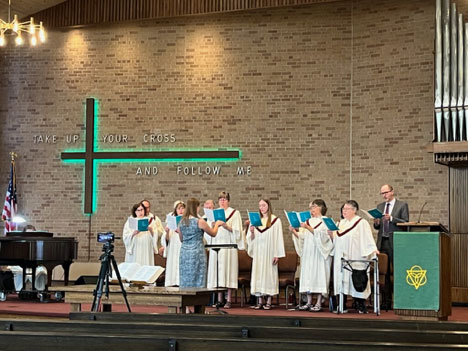
When you get to Jesus stop. Draw a huge line coming down from the top of the sheet through the time line. That’s God entering creation as a human being. I mean that’s God breaking into history. Continue the time line after that. We’re still on the timeline. We’re still waiting for Jesus to come back.
What you’ve drawn is a Barthian Cross. It is not evenly balanced left to right. It perpendicular like the crosses we’re used to, but the asymmetry leaves us, and history, open to the very presence of God coming into history again.
Here’s the Barthian Cross that is at the front of the sanctuary at First Presbyterian Church in Willmar, Minnesota.
* * * * * * * * * * * * *
The Immediate Word, September 29, 2019 issue.
Copyright 2019 by CSS Publishing Company, Inc., Lima, Ohio.
All rights reserved. Subscribers to The Immediate Word service may print and use this material as it was intended in sermons and in worship and classroom settings only. No additional permission is required from the publisher for such use by subscribers only. Inquiries should be addressed to or to Permissions, CSS Publishing Company, Inc., 5450 N. Dixie Highway, Lima, Ohio 45807.
- The Backfire Effect by Dean Feldmeyer — When we hold an erroneous belief and are proven wrong, we tend to hang onto that belief even more fervently than before. That’s called the “Backfire Effect,” and Jesus knew about it.
- Second Thoughts: Investing in Hope by Bethany Peerbolte — We need someone who will invest in the future and take a strong stance against carbon emissions.
- Sermon illustrations by Mary Austin, Ron Love and Chris Keating.
- Worship resources by George Reed focusing on things we choose to believe; long term view of hope.
- Children’s sermon: The Real Estate Market in Anathoth / Jesus’ Timeline by Tom Willadsen — This week Tom has two options for children’s messages! One based on Jeremiah 32:1-3a, 6-15 and one based on 1 Timothy 6:6-19.
The Backfire Effect
by Dean Feldmeyer
Luke 16:19-31
But Father Abraham, says the rich man from his place in hell, I know my brothers didn’t believe Moses and the prophets but, if someone who has come back from the dead warns them, they will believe him.
Father Abraham responds, “Yeah, fat chance.”
We tend to believe what we want to believe.
If I walk into a room of 100 people and 99 of them disagree with me about something, I congratulate the one who agrees with me for being so bright and prescient and I roll my eyes at the 99 who are obviously fools. If the 99 agree with me I talk to them about what an idiot the one who disagrees with me is.
If a politician confirms our previously held ideas, we vote for him. If a preacher’s theology meshes with our own, we congratulate her on her penetrating insight. If a critic likes the movie I liked, I read that critic’s other reviews, if not, I find another critic.
What we choose to believe says more about us than it does about the veracity of that which we believe.
In the News
President Trump has an ambivalent relationship with facts and truth. The Washington Post has created a database cataloging more than 12,000 untrue, misleading, erroneous statements or outright lies that the president has told since he took office, roughly 1,000 days ago. That’s about 120 per day for those keeping score at home.
In one of his most recent examples, he issued a number of tweets about why he shouldn’t be impeached. Those tweets contained six erroneous statements. Whether he was mistaken, misinformed, or lying, the Post does not say. That all these statements are untrue, is demonstrable.
The Democrats have no room to gloat, however.
Former Vice President Joe Biden has told (over and over) a moving story about a war veteran upon whom the vice president was going to pin an award for valor but the young man begged Mr. Biden not to give it to him because the man he was trying to save with his heroic act died.
It is a very moving and effective story. The problem is that it isn’t true. Or, at least, most of it isn’t true. Republicans say Biden is just lying, plain and simple. Psychology Today offers that he may have created a “false memory,” a not uncommon phenomenon that most of us have done from time to time. (Ever notice how that house you grew up in is so much smaller than you remember it?) Rather than just admit that he mistakenly conflated the facts of a couple or three stories, Joe insists, like any practiced storyteller, that the veracity of the details in the story don’t matter as long as the central point is, in fact, the case. As storytellers often say, and Biden should have said to introduce his story, “I don’t know if this really happened or not but I know it’s true.” (You can also see more about this at Snopes.com)
And then there’s “Sharpie-gate.”
Using weeks old data, the president, warned, on national television, that several states, including Alabama, could be devastated by hurricane Dorian only to discover that, by the time he made the statement, the hurricane was moving in the opposite direction and Alabama would not be significantly affected. Rather than simply say, “Oops, my bad. I was using some old data,” which everyone would have forgotten about by the next day, the president chose to double down on his ersatz weather report, refused to admit that he was wrong, and to prove that he was right, presented a weather map that had obviously been doctored with a Sharpie, his favorite writing instrument.
When people noticed that the added line looked suspicious, President Trump issued a directive to the National Oceanic and Atmospheric Administration (NOAA) that they were not to issue any statements that ran counter to his own.
Politics and truth live, it would seem, in two different places, and yet, this fact seems to have no bearing on how people vote. Trump’s base continues to believe everything he says or dismiss the untruths as little mistakes. Or they say the things he says are not meant to be taken literally. As long as he does what they want — appoint conservative, anti-abortion judges, lower taxes, keep immigrants out of the country, talk about patriotism, disparage the people they don’t like, especially democrats and the mainstream media, and protect their guns — they don’t care whether what he says is true or not.
No matter how many “gaffs” Joe Biden makes, whether they are factual errors, offensive statements, or rambling, incoherent responses to questions, he still leads the pack in the Democratic race for president.
It’s not just politics that makes strange bedfellows, it’s politics and truth that are strange bedfellows. And, apparently, it doesn’t matter to the voters.
In the Scriptures
This morning, the lectionary brings us to Luke’s account of Jesus’ parable of Lazarus and the rich man. That the rich man is nameless in the parable has not kept interpreters from giving him a name down through ages. The traditional name, Dives, (usually pronounced DIV-eez, is not actually a name, but instead a word for "rich man,” in the text of the Latin Bible, the Vulgate (circa 350-450 CE). The rich man was also given the names Neuēs (i.e. Nineveh) and Fineas (i.e. Phineas) in the 3rd and 4th centuries.
In the story, the rich man is not so much mean or cruel to destitute Lazarus who lies by the rich man’s gate, as he is oblivious. He doesn’t notice him. Lazarus does not so much as even exist within the rich man’s world view.
Both Lazarus and the rich man die. Lazarus goes to heaven to sit in the lap of Father Abraham and the rich man goes to hell, presumably as punishment for his lack of sensitivity to the poor. There he is tortured day and night with heat and fire.
Looking up, he sees Lazarus sitting next to Abraham and calls out to Abraham telling, not asking, him to send Lazarus to get him a drink of water. Even in hell he has not abandoned his classism. He still sees Lazarus as lower class than himself, suitable only for servile work and he expects that Abraham will share his point of view.
But, alas, Abraham does not. Sorry, he says to the rich man. You had your good stuff in the previous life while Lazarus suffered. Now the roles are reversed and there’s nothing any of us can do about it. The estrangement you created between yourself and the poor is now part of the torture you must endure in eternity.
In that case, says the rich man, send Lazarus to my father’s house to warn my brothers so they don’t make the same mistake I did. Now he has given Lazarus a promotion from errand boy to messenger, but Abraham isn’t having any of it. They have already been warned by Moses (the law) and the prophets (preaching), he replies.
Well, yeah, says the rich man, but no one believes the law and the prophets. Maybe if someone rose from the dead and came to them, then they would believe.
Abraham ends the argument with what some believe is actually a post-Easter reference and a nod to what has, two thousand years later, become known as the “Backfire Effect.” Your brothers will believe what they want to believe no matter who tells them that they are wrong, even if that person has risen from the dead.
In the Sermon
Hey, why so glum?
I just got back from my annual physical and my doctor says I need to lose 40 pounds, quit smoking, and cut back on the high cholesterol foods.
Oh, wow. Sounds like you need to…
Yeah, I know, find another doctor.
The “Backfire Effect”
The "backfire effect" is, according to The Skeptic’s Dictionary, a term coined by Brendan Nyhan and Jason Reifler to describe how some individuals, when confronted with evidence that conflicts with their beliefs, come to hold their original position even more strongly.
Examples abound but this one by Yale political scientist John Bullock is especially telling. He found that “a group of Democratic volunteers who did not favor the appointment of John G. Roberts Jr. to the U.S. Supreme Court became even more negative in their views about Roberts when told that he had been accused in an ad by an abortion-rights group of "supporting violent fringe groups and a convicted clinic bomber." The increase from 56% disapproval to 80% disapproval after being provided with data confirming their opinion is understandable. We know that providing political misinformation works by feeding into people's pre-existing beliefs. We're likely to accept information uncritically, true or false, that fits with what we already believe. What isn't so understandable is why, after being shown a refutation of the ad by abortion-rights supporters and being told that the advocacy group had withdrawn the ad, Democratic disapproval of Roberts dropped only [8 points] to 72 percent. For many, the facts didn't have a significant effect on belief in the direction of the evidence. Despite strong evidence contrary to their belief, many were led to strengthen their pre-existing belief.”
The Backfire Effect is even more evident in smart, well educated people than in those who are less intelligent and less educated. Apparently, when 90 percent of what we think or know is demonstrably true, it is even harder to convince us about the erroneous nature of the other 10 percent.
And religious folk are, of course, not immune to its power.
Progressives and fundamentalists hold on with equal tenacity to our theological notions and biblical interpretations whether they are true or false. Rare is that Christian who is glad to discover that our ideas have been rendered obsolete by new scholarship. I know pastors who have not even opened, much less purchased, a new commentary since they graduated from seminary decades ago.
Knowledge is power and never more so than when countering the Backfire Effect. If we know that we are inclined to reject facts that challenge our beliefs we can arm ourselves against those kinds of prejudices. We can, through acts of will and with God’s help, keep our minds open, and our brains engaged.
Effective sermons on this text might do well to emphasize that point lest we fall into the trap that the rich man’s siblings were already in, having rejected saving instruction because we did not wish to be challenged. How, the preacher, might well ask, will this knowledge affect how we react to arguments about the appropriate Christian response to such topics as responsible gun ownership, the amassing of property, how we treat people of other races or people of other gender identities, corporal punishment of children, the care of the environment, war and peace, the manipulative calls of politicians to patriotism, and what should be done with statues of confederate generals.
Are we so cemented to our opinions that nothing, including the gospel of Jesus Christ, will change us?
Or are we willing and able to open our minds and hearts to new arguments, new ideas, new challenges, and the grace of God as it comes to us in Jesus Christ?
SECOND THOUGHTSInvesting in Hope
by Bethany Peerbolte
Jeremiah 32:1-15
I love the prophets, I don’t understand them all the time, but I love them. I tell the youth in my church prophets are the ones who are always enthusiastically doing bizarre things to prove a point. Feel like you are losing your youth’s attention? Throw in a lesson about Ezekiel cooking food over human poop and suddenly they are all ears. Prophets have a unique way of getting our attention and tricking us into thinking deeply about an issue. God can tell the people they are loved even though they tend to wander a hundred times and not get through. Have a guy marry a sex worker who keeps leaving him for her former life and suddenly God’s love comes into focus. This week the lectionary has us looking at one of these passionate yet bizarre acts of a prophet.
Jeremiah is imprisoned in the court of the king of Judah. Outside the Babylonians are setting up their final attack and takeover of Jerusalem. God sends Jeremiah a vision for God’s people. One would hope that a prophet of God would announce that the coming attack is about to fail and that God’s people are going to prevail. Unfortunately, that is not the vision Jeremiah presents to the court. Instead, he says the Babylonians will win, God’s people will be in exile, and it’s not going to be a short or easy exile. The only good bit is that God promises that eventually, though not anytime soon, the land will return to God’s people and living and business will continue as before.
Then the bizarre bit comes in. Jeremiah buys a piece of land in the area he just said would soon be under Babylonian control. When that happens, Jeremiah will not be able to live on the land. He will not be able to farm the land; he will not be able to benefit from his purchase in any way. In fact, if the exile happens the way Jeremiah says, he may never see the land in his lifetime. Jeremiah suspects this will be the case, so he puts the deed to the land in a jar to protect the paperwork and has it buried in the land. When the time comes that Israel is allowed back into the area he or more likely his next of kin can dig up the deed and take possession of the land.
This investment is bonkers. Jeremiah gets nothing out of the purchase. In fact, it puts him down seventeen shekels of silver just as he is about to be thrown out into exile. The more pressing problem is surviving the Babylonians, that money could be useful. To spend it on a future he can only hope for is irrational. Yet, that’s what prophets do.
I once lamented that we did not have prophets around anymore as Israel did. I guess God took my moaning as a challenge because now I see them everywhere. Workers on strike willing to risk their jobs to get fair pay. Runners who run across the United States to raise money for a charity. Even Walmart can be prophetic and take a stand against e-cigarettes and guns. This week we saw the rise of another prophet in Greta Thunberg.
Thunberg presented at the United Nations. Her emotional plea was made after a two-week sailing trip from Sweden, where she lives, to New York, where the UN is meeting. Two weeks on a boat, in the middle of the ocean, to attend a conference at which she had a scheduled speech to give. I would be anxious the whole time that something would go wrong and I would miss my time slot. Like a good prophet, her transportation choice was made because it was a non-emission producing way to travel. As a climate change activist, this was not just a fun way to check something off her bucket list. Traveling to the UN meeting in a sailboat was a statement. Thunberg wanted the world to take notice of their own choices. She wanted to highlight that we do still have options and can still make a meaningful impact on the climate crisis in which we find ourselves.
Some have pointed out how counterproductive this choice may be. She will be flying home, and three crew members will be flying to New York to pick up the yacht to take back across the ocean. As with all prophets, some people miss the point. Hopefully, those who missed the message in the demonstration will hear what she has to say in her speech. Though even that is catching a lot of hate.
Just like watching a friend get yelled at by their parents, her presentation is not easy to watch. Greta is 16 years old, and she is mad. She pulls no punches as she tells the UN how they are failing her generation. She calls the adult out for looking to the young for hope even while they saddle them with finding all the solutions. Greta pleads with them to invest in the future, her future, their grandchildren’s future.
The biggest injustice is that these world leaders have taken hope away from Greta Thunberg. The problems they are tasked with changing are huge but currently, the UN only has a plan to maybe get us to 2030 and the budget is due to run out before that, as Thunberg points out. There is no long term plan that is aggressive enough to ensure children born today will live in the same world in which these leaders grew up.
I think Jeremiah would suggest we buy oceanfront property for every member of the UN but tell them they cannot take possession of the land until 2050. I know I would be motivated to make sure the icecaps stay where they are if I could retire to an oceanfront home. Jeremiah’s actions show how much he believes in the vision God sends him. He trusts, unequivocally, that this investment will pay off. Maybe not for him, but it absolutely will for Israel’s descendants. Jeremiah is willing to put himself in a tight place financially in the present because of his hope for what will be in the future. This is what we need from our leaders. We need someone who will invest in the future and take a strong stance against carbon emissions. We need someone to give us some hope no matter what bizarre step they need to take.
ILLUSTRATIONS
From team member Mary Austin:
Jeremiah 32:1-3a, 6-15
Unusual Investments
Jeremiah claims his hope in God’s plans for the future by making an investment in a piece of land, and then he secures the deed, so he’ll be ready when the land can be reclaimed. Lots of people put their money in banks, stocks and bonds, but some people make investments as unusual as Jeremiah’s. For example, “Let's hope mom didn't throw out your comic books along with the baseball cards. If she did, pray there wasn't a Superman No. 1 in the pile. If there was, you could have been a millionaire. In March 2010, a mint copy of Action Comics No. 1, the debut of Superman, sold at auction for $1.5 million. The comic was in pristine condition. It was squirreled away for 50 years inside a movie magazine. Why are comic books such a good investment? Back in the day, kids read comic books and generally tossed them in the trash or shared them with a buddy. Very few survived.”
Another unusual possibility is music royalties. “Do you remember the theme song from the Monkees? Hey, hey, we’re the Monkees. That song still produces on average $10,000 a year in royalties and believe it or not, it’s possible to earn a piece of them by purchasing a share of the song at auction. Songwriters often sell a share of their royalties on websites like SongVest.com and TheRoyaltyExchange.com and the auctions are open to anyone. The Monkees’ theme song is just one of several currently up for sale, and the shares start at $3,000. You continue receiving royalties on the song until the copyright ends, which is typically 95 years after the artist’s death (the Monkees’s song will produce royalties until 2099!).”
For people who love books, our old books may be more valuable than we think. “Books don’t necessarily need to be old to be valuable. Meier and Sons Rare Books says that because the hardback version of The Philosopher’s Stone, the first book in the Harry Potter series, had a small first run, a copy in good shape is rare, and worth $25,000 or more. That’s despite being less than 20 years old! As with other investments in collectibles, you can start small with books. One list of what to look for in rummage sales and thrift stores has dozens of examples of books you might find for a few bucks that can be sold for $50 to $5,000.”
* * *
Luke 16:19-31
Philadelphia Day
In the story about Lazarus and his wealthy neighbor, the tragedy of the story is their missed opportunity to connect with each other. If they were modern neighbors, we might imagine that they didn’t know where to start. Author Priya Parker has given a lot of thought to how we meet up with each other. She says that the first step in getting to know our neighbors, or anyone, is to “do less. It's very difficult to feel deeply when you're a machine, frankly. And to begin thinking very consciously about how do you spend your time and with who. And then when you're with them, how? I think a second thing — we'll go back to technology. There have been studies that have recently shown just among teenagers and middle schoolers — that different social media outlets lead to different levels of anxiety…So, part of it is also intentionally using technology or not using it. And then I think the third is asking when you are spending time with people one on one, How do I create an environment — how do I connect with people in a meaningful way?”
She adds that her relationship with her father has always been challenging. “One of the dynamics that I was getting into with my father was that when we would get together — me as an adult — it was a complicated dynamic because of the other relationships involved on both sides of our families. We kept basically getting into these same stuck roles. Long story short, I invited him . . . he lives in Washington. I live in New York. I invited him to meet me in Philadelphia once a month, and we call it "the Philadelphia day." It was on kind of neutral territory, if you will. Like, not in his home, not in mine. We'd take the bus down or up, or the train, and meet and spend eight hours together kind of roaming the city. Sitting in parks, going to — once I had a child, going to a playground, doing very simple stuff. Going to a public museum. It completely changed our dynamic. It took us out of this always specific role that we would play into when there was other context of other relationships that were involved. And so, some of it is just thinking very specifically about how [you] meet people in a context where you don't have to play the same role that you always play.”
There are ways to meet up with each other, if we take the time and energy to do it.
* * *
Luke 16:19-31
Dinner With New Friends
Lazarus and the rich man, who doesn’t get the dignity of a name, live near each other and never connect. A new movement is helping contemporary people in their situation meet and form connections. Julia Hotz is the host of LokPal — which she set up as a local cooking workshop, with the idea of strangers “sharing a meal and sharing a bond.” In four weeks, the group meets, cooks and bonds. She created the group as a master’s degree research project, and was surprised to find out how many people in the community felt lonely.
She describes some people in the group. “Abby arrives, wearing cherry-red lipstick as bright as her smile. As I hand over her name tag and prepare to ask the usual barrage of small-talk questions, Abby makes the first move, deftly breaking the ice with tales of her kindergarten classroom. Next is Tania, a marketing specialist with the down-to-earth manner characteristic of England’s ‘North.’ She’s followed by Sana, an Indian woman with unending enthusiasm and a penchant for vegetarian cooking. Stanley arrives, and then Doris, two salt-and-pepper-haired strangers radiating a gentleness that makes you feel you’ve known them for years. Last is Alex, whose serious face stands in stark contrast to his neon-yellow jacket and quirky sense of humor.”
All of them admit to feeling a lack of deep connection with people in their lives. Hotz adds, “Neuroscientist John Cacioppo offered an illuminating analogy: Just as hunger can happen where food is abundant, loneliness can happen where people are plentiful. Dr. Vivek Murthy, a former U.S surgeon general, recently echoed that point when he called loneliness an ‘epidemic,’ as deadly as smoking a pack of cigarettes a day.”
At LokPal, “many participants speak, spontaneously, about the increasingly isolated nature of British life. “My son is a student in London and lives in a shared house with four people. They actually share the kitchen, bathroom, everything … but they don’t speak to each other,” Doris reveals with astonishment. “I can’t believe it, they just pass each other. They live completely independently.” Tania agrees, her voice tinged with nostalgia for her Yorkshire hometown, where, she says, neighbors are friends and strangers don’t think twice before pouring out their life stories. “In Cambridge, I’ve never spoken to any of my neighbors, and I hate that,” she notes. But the area is so transient, she says, she wonders why bother to meet people who will be moving soon.
LokPal offers the kind of community that Lazarus and his wealthy neighbor could have used — and one that’s good for all us who are seeking community.
* * * * * *
From team member Ron Love:Jeremiah 32:15
For thus says the LORD of hosts, the God of Israel: Houses and fields and vineyards shall again be bought in this land.
The Rev. Dr. Cleland McAfee has too many accomplishments associated with his name to even begin to write a biographical sketch of his life. As a Presbyterian minister he served the most prestigious churches in Chicago and New York. He taught at McCormick Theological Seminary. For most people though, he is known as a prolific and outstanding hymn writer. When he learned that his two beloved nieces died of diphtheria, he wrote a hymn of comfort and solitude. In 1903 he published the well-known hymn Nearer to the Heart of God. The refrain reads:
O Jesus, blest Redeemer,
sent from the heart of God,
hold us, who wait before thee,
near to the heart of God.
* * *
Psalm 91:2
I will say to the LORD, "My refuge and my fortress; my God, in whom I trust.
The movie Glory was released in 1989. It is about the first all-colored regiment in the Union army that was allowed to be engaged in battle. The movie spends time demonstrating their training and the racism they had to endure. At the close of the movie 54th Massachusetts Regiment volunteers for a dangerous, if not impossible, charge on the Confederate forces on Morris Island in South Carolina. This was an attempt to capture the fortress, Battery Wagner. The fort's only landward approach is via a small strip of beach with little cover, and the first regiment to charge is sure to suffer extremely heavy casualties. General Shaw volunteers to have the 54th lead the charge. The night before the battle, the black soldiers conduct a religious service where individual soldiers offer their prayers amid the singing of hymns. One of the prayers offered at the service has these spiritual words:
O my Lord,
Lord, Lord, Lord
Lord, we stand before You
this evenin'...
to say thank you.
We thank You, Father,
for Your grace...
and Your many blessings.
Now, I run off...
and left all my young'uns
and my kinfolk in bondage.
So I'm standing here this evening,
Heavenly Father...
to ask Your blessings
on all of us...
so that if tomorrow
is our great getting-up mornin'...
if tomorrow we have to meet
the Judgment Day...
O Heavenly Father,
we want You to let our foIks know...
that we died tacin' the enemy.
We want 'em to know
that we went down standin' up--
Yes, Lord!
among those that are fightin'
against our oppression!
We want 'em to know, Heavenly Father,
that we died for freedom.
We ask these blessings
in Jesus' name. Amen!
* * *
Jeremiah 32:15
For thus says the Lord of hosts, the God of Israel: Houses and fields and vineyards shall again be bought in this land.
After the death of the great Protestant reformer, Martin Luther, his wife, Katherina “Katie” von Bora Luther, had to take in borders. These were students who were attending Wittenberg University, where Martin Luther taught for many years. In 1552 a plague broke out, and the students relocated to Torgau where it was considered safer. Katie, having lost her income, accompanied the students to Torgau. At the end of the 60-mile trip her horse bolted near the gate, and the 53-year-old women had to leap from her carriage, landing at the edge of a lake. She was taken into the city seriously injured. For the next three months she fought for her life, but finally realized death was near. She died on December 20, 1552. Throughout her life she always relied on her savior. This is best known by the last words she spoke, “I will cling to my Lord Christ as a burr on a coat.”
* * *
Jeremiah 32:1
The word came to Jeremiah from the Lord
When Mary took the throne as the queen of England, as an ardent Catholic she began to dispose all things Protestant. Two outstanding leaders and pastors of the Protestant church, Hugh Latimer and Bishop Ridley, were condemned to be burned at the stake. Tied to the stake the two had to listen to a fifteen-minute oration on their sins. They were then given a chance to speak, but only if it was to recant. Both men remined silent. A relative of the bishop tied a small sack of gunpowder around the neck of each man, to hasten their death. Latimer died quickly. It took hours for Ridley to die for the wind blew the flames away from his torso. Just before the executioner lit the fire, Latimer said to Ridley, “Be of good cheer, Master Ridley; and play the man. We shall this day light up such a candle, by God’s grace, in England, as I trust, shall never be put out!”
* * *
Jeremiah 32:1
The word came to Jeremiah from the Lord
Louis Moreau Gottschalk was an outstanding American pianist. At the age of 12 he went to Paris to study music. He then toured Europe. He was known especially for his Caribbean compositions. These compositions were composed by combining the traditions of his Haitian grandmother and her slave Sally. With his music he traveled the world, spending most of his time in Central and South America. In 1861, when the Civil War broke out, as a fervent unionist he undertook a grueling recital tour to raise money for the cause. It is estimated that in the course of five years he traveled 100,000 miles and gave more than 1,000 performances. After the war, falsely accused of rape, Gottschalk began a grand tour of South America. This tour established himself as the first truly Pan-American cultural advocate. After four years of touring, he suddenly died on the concert stage, having just performed one of his most emotional works titled She Is Dead.
* * * * * *
From team member Chris KeatingJeremiah 32:1-3a, 6-15
Investments of hope
As Jerusalem is about to fall, Jeremiah makes an incredible — some might even say improbable — statement of hope by purchasing a field in the very place where destruction will occur. His purchase is symbolic of his faith in Yahweh’s compassionate promise of redemption. “Houses and vineyards shall again be bought in this land,” he argues.
There’s a parallel here to the rebuilding of Paradise, California, a town virtually destroyed by the blazing Camp Fire in 2018. The residents of Paradise have begun the process of investing in the future by rebuilding the town described as an “apocalyptic wasteland.” Most residents have relocated to other areas temporarily. Some have already begun the task of sorting through ash heaps to rebuild.
David and Chenoa Rivera, formerly hosts of an HGTV television show “Rustic Rehab,” are turning their attention to building the future. The couple approached their task as a calling. “This isn’t something we’ve done before,” said David Rivera, 36, as he sat in the living room of his own home, a onetime fixer-upper that mostly survived the Camp Fire. “It’s definitely a risk. But I feel like it’s our calling.”
The town’s residents face a challenge akin to Jeremiah’s — should rebuilding take place at all? Losses are estimated to be well over $8.3 billion. Roughly 90% of the homes were destroyed, and clean water isn't expected to start flowing for another two years. Should it rebuild? “So far,” reports the San Francisco Chronicle, “the consensus seems to be yes. Paradise leaders insist that a hardier and lovelier town can emerge.”
* * *
Jeremiah 32:1-3a, 6-15
One hive at a time
In some of urban Detroit’s vacant lots, nothing could be sweeter than the promise of hope. Unless, of course, it was locally grown honey. According to the National Geographic, a couple from Detroit has found a way of turning some of the city’s 90,000 vacant lots into bee habitats. Detroit Hives, a nonprofit founded by Paule and Nicole Lindsey, has converted a handful of vacant lots into apiaries for bees that also provide places to grow produce for local markets.
“I didn’t know anything about bees, neither did she, so like, there was no ego involved. We both brought our mutual passion and knowledge together,” Paule says “It’s something we can do together. We built this together, we both have invested into this, we both have a lot of sweat equity put into this.”
* * *
Jeremiah 32:1-3a, 6-15
Taking action now
Though he is imprisoned, Jeremiah finds a way of taking action. It’s not dissimilar to the ways millions of youth took action on September 20th to draw attention toward climate change. Global Climate Strikes claimed as many as four million participants on September 20th, mostly inspired by Swedish activist and teenager Greta Thunberg. It could possibly be the largest protest for action on climate change in the world history.
While exact numbers may be impossible to calculate, it does appear that the global protest was well organized, with as many as 2,500 events across 163 countries on all seven continents. The action of youth — most of whom will endure the most dreadful impacts of climate change — was an inspiring reminder that hope is always a proclamation of a preferred future.
* * *
Psalm 91:1-6, 14-16
Dwelling secure
The psalmist’s declaration rings in our hearts as well as in our ears, “Those who love me, I will deliver; I will protect those who know my name.” It’s a critical reminder, especially in a world where violence has become an everyday part of life.
According to the 2019 InterNation Expat Insider Survey, an extensive survey of what it is like to live and work abroad, the United States is considered one of the 20 most dangerous places to live. The US is ranked 16, far behind number 1 ranked Brazil, followed closely by South Africa and Nigeria. About one in seven expats reported feeling unsafe in the United States, with gun violence cited as a major concern. A substantial number of respondents indicated that violent crime involving guns or lack of gun control laws is among their concerns about life in the United States.
* * *
1 Timothy 6:6-19
Becoming content with our discontent
The writer of the epistle explores the meaning of contentment in a life that is often transitory, filled with “many senseless and harmful desires that plunge people into ruin and destruction.” Now there’s a happy thought! Writer Paul Kingsnorth’s new book Savage Gods explores similar questions about discovering meaning in life. Kingsforth moved his family to a small farm in Ireland to become closer to the land. Gabino Iglesias, in a review of Savage Gods for NPR notes that the book can be viewed as an exploration: “questions that wriggle around like termites inside the wood of Kingsnorth’s heart: What does it mean to belong? Can we connect to culture in a world where there is none? Can words truly communicate life?”
Yet Kingsforth fails to find contentment. In looking for some sense of deeper connection in life, Kingsforth comes up empty. While the Epistle writer speaks to discovering a spiritual sense of contentment, Kingsforth looks for some tangible expression of belonging, but finds none. Iglesias offers this quote from Savage Gods: "I walk the world looking for something to belong to, but there is nothing to belong to because there is no culture for us anymore, only civilization, and they are not the same thing. There is no connection between the wild and the tame, the human and the beyond-human, the sacred and the profane. In the world I was born in, Eros and Psyche have gone their separate ways, and now my words are eating themselves alive."
* * *
1 Timothy 6:6-19
Searching for the Snow Leopard
Over 18 years ago, theologian and retired professor of theology Belden Lane contemplated the meaning of finding contentment in one’s work. “Halfway through the school year — the bone weariness of work robbing the world of mystery — I find myself reaching for metaphor, stalking an image that might give life,” he wrote in The Solace of Fierce Landscapes (Oxford, 1998, p. 79). His eyes wander until they focus on a book by biologist/explorer Peter Matthiessen, who had set out on a trek across the Himalayas to study Himalayan blue sheep. But the real quest for Matthiessen was always the “elusive possibility along the way of seeing the rarest and most beautiful of the great cats, the snow leopard.” It becomes a symbol of ultimate reality, what Lane calls a “cover” for the search of what is most important. “The metaphor,” writes Lane, “is rich in nuance for a consumer society where one’s job becomes the primary measure of one’s worth.” To place our daily work as a “cover” for a search for something more important is similar to what the Epistle writer calls taking hold “of the life that really is life.” “The holy is seldom captured in the places where we seek it most,” Lane continues. “While we’re preoccupied with Himalayan blue sheep, it slips onto the periphery of our vision in the furtive silhouette of a great cat.”
* * *
Luke 16:19-31
The Ever-widening gap between rich and poor
The image of Lazarus waiting for the scraps that fall from the rich man’s table only captures one dimension of the rising gap between rich and poor. In the United States, another indicator of income disparity is longevity and health. According to data released by the Government Accountability Office, those who are wealthy live longer than those who are poor. The New York Times reported on September 10th that about three quarters of wealthy Americans who were in their 50s and 60s in 1992 are still alive, while just over half of those who were poor made it to 2014. Lower income people are at risk to see their longevity shrink when compared to their parents.
* * *
Luke 16:19-31
Listening to the prophets
At 16, climate activist Greta Thunberg is known for making adults uncomfortable. Her direct approach at addressing issues of climate change can be disarming, and even frightening. But her straightforward teenaged honesty may be the sort of prophetic words we need to hear, even if, like the rich man’s family, we’re not paying attention.
Robinson Meyer interviewed Thunberg for The Atlantic. Meyer says it is her “extreme teenager-ness” which may be the key to her global influence:
She is strikingly nonradical, at least in tactics. Unlike other young climate activists—such as members of the Sunrise Movement in the United States, which is led by college students and early 20-somethings—she rejects specific policy proposals such as the Green New Deal, instructing politicians instead to “listen to the science.” She has even declined to endorse a specific platform in the European Union, where her “Fridays for Future” movement has taken hold. When I asked how other teenagers should fight climate change, she said, “They can do everything. There are so many ways to make a difference.” Then she gave, as examples, joining an activist movement and “also to, if you can, vote.”
* * *
Luke 16:19-31
Paying attention to warning signs
It may seem a bit tangential, but Lazarus’ pleadings with Father Abraham to send more prophets to warn his brothers will strike home with suicide survivors. September is suicide awareness month, yet we often neglect to address suicide in sermons. Here’s a reminder to be sure the National Suicide Prevention Lifeline number (1-800-273-8255) and information about local hotlines or resources are routinely printed in your church announcements and/or posted throughout the church. Check to see if the American Foundation for Suicide Prevention has a chapter in your area or reach out to care providers. Take time to learn, and practice asking the question, “Are you going to harm yourself?”
* * * * * *
WORSHIPby George Reed
Call to Worship:
Leader: Rejoice, all who live in the shelter of the Most High.
People: Take hope, all who abide in the shadow of the Almighty,
Leader: God is our refuge and our fortress.
People: This is our God, in whom we trust.
Leader: Under God’s wings we will find refuge.
People: God’s faithfulness is a shield and buckler.
OR
Leader: The God of creation calls us to gather in hope.
People: We want to hope but we fear the future.
Leader: We remind each other to keep of eyes of God.
People: We get distracted by all the things around us.
Leader: Together we can focus on what God is doing.
People: We will join together to work in God’s garden.
Hymns and Songs:
Hope of the World
UMH: 178
H82: 472
PH: 360
NCH: 46
CH: 538
LBW: 493
W&P: 404
O God, Our Help in Ages Past
UMH: 117
H82: 680
PH:
AAHH: 170
NNBH: 46
NCH: 25
CH: 67
LBW: 320
ELW: 632
W&P: 84
AMEC: 61
STLT: 281
Hymn of Promise
UMH: 707
NCH: 433
CH: 638
W&P: 515
God of the Sparrow, God of the Whale
UMH: 122
PH: 272
NCH: 32
CH: 70
ELW: 740
W&P: 29
Lift Every Voice and Sing
UMH: 519
H82: 599
PH: 563
AAHH: 540
NNBH: 457
CH: 631
LBW: 562
ELW: 841
W&P: 729
AMEC: 571
STLT: 149
How Firm a Foundation
UMH: 529
H82: 636/637
PH: 361
AAHH: 146
NNBH: 48
NCH: 407
CH: 618
LBW: 507
ELW: 796
W&P: 411
AMEC: 433
We Shall Overcome
UMH: 533
AAHH: 542
NNBH: 501
NCH: 570
CH: 630
W&P: 512
STLT 169
Be Still, My Soul
UMH: 534
AAHH: 135
NNBH: 263
NCH: 488
CH: 566
W&P: 451
AMEC: 426
All I Need Is You
CCB: 100
Something Beautiful
CCB: 84
Music Resources Key:
UMH: United Methodist Hymnal
H82: The Hymnal 1982
PH: Presbyterian Hymnal
AAHH: African American Heritage Hymnal
NNBH: The New National Baptist Hymnal
NCH: The New Century Hymnal
CH: Chalice Hymnal
LBW: Lutheran Book of Worship
ELW: Evangelical Lutheran Worship
W&P: Worship & Praise
AMEC: African Methodist Episcopal Church Hymnal
STLT: Singing the Living Tradition
CCB: Cokesbury Chorus Book
Renew: Renew! Songs & Hymns for Blended Worship
Prayer for the Day/Collect
O God who created and is bringing creation to its fullness;
Grant us the faith to trust in your good work
to bring all things under your reign;
through Jesus Christ our Savior. Amen.
OR
We praise you, O God, because you continue to bring creation to its fullness. Open our eyes to see beyond what is now to what will be when your work is complete. Amen.
Prayer of Confession
Leader: Let us confess to God and before one another our sins and especially our lack of faith and hope.
People: We confess to you, O God, and before one another that we have sinned. We talk about being people of faith and hope but often act out of hopelessness and despair. We spend more time preparing for the worst case scenario rather than working for a better outcome. We say we believe in the Reign of Christ but don’t act like we really expect it. Forgive our lack of faith and restore us to our task of working with you to complete creation. Amen.
Leader: God is still at work in creation and in us. Receive God’s grace and God’s Spirit of hope to be part of God’s good work.
Prayers of the People
Praise and glory are yours, O God of creation. We are in awe of all you have made and off your bringing to completion.
(The following paragraph may be used if a separate prayer of confession has not been used.)
We confess to you, O God, and before one another that we have sinned. We talk about being people of faith and hope but often act out of hopelessness and despair. We spend more time preparing for the worst case scenario rather than working for a better outcome. We say we believe in the Reign of Christ but don’t act like we really expect it. Forgive our lack of faith and restore us to our task of working with you to complete creation.
We thank you for the creation which supports us and brings us so much delight. We thank you for your creating presence in the midst of our lives.
(Other thanksgivings may be offered.)
We pray for one another in our need. We pray for those are excluded from the table and are not able to partake of the good things of creation. We pray for those who have lost all hope.
(Other intercessions may be offered.)
All these things we ask in the Name of our Savior Jesus Christ who taught us to pray together saying:
Our Father....Amen.
(Or if the Our Father is not used at this point in the service)
All this we ask in the Name of the Blessed and Holy Trinity. Amen.
Children’s Sermon Starter
Jeremiah lived in a difficult time but he believed in God and so he had hope. He also did something about it, he invested in the hope for the future. Sometimes things may not go well for us: someone at school may be mean to us or we may have a difficult time learning some things. But God reminds us to have hope and to work to make that hope real. It may mean studying harder or asking for help either with our school work or with dealing with bullies.
CHILDREN'S SERMONThe Real Estate Market in Anathoth
by Tom Willadsen
Jeremiah 32:1-3a, 6-15
No props, just the ability to tell a story well.
The Babylonians are destroying Judah. Everything looks grim; Judah may be wiped out completely. God tells Jeremiah to buy some land in Judah. “Invest,” the Lord says; “put roots down in Anathoth, Jeremiah. And make a big show of making the purchase public, decent and in order.”
This morning’s reading goes into excruciating detail about how land is purchased in Judah during the tenth year of the reign of Zedekiah. Excruciating detail. Every. Single. Little. Bit. Of. Legal. Rigamarole. Is. Spelled. Out. Jeremiah makes sure everyone knows that all the i’s are dotted and all the t’s crossed. When someone complains about the Bible being repetitive, this story is one that they can point to. Why is there so much detail? Because God wants Judah to know that buying real estate in Anothoth is a good investment.
To put it in modern terms, tell the kids how you bought gas for your car:
In the second year of President Trump’s term in office, I did observe that verily, the gas gauge that dwells in my Prius indicated that I would have to purchase fuel if I had any hope of motoring to Aurora Hospital. The light on the dashboard did appear and indicate a severe shortage of fuel. Decisive action was required. I unlocked the driver’s side door of the vehicle, by pressing the button on the key fob which did dwell in my pocket. After confirming that all of the mirrors in the vehicle were oriented to maximize the visibility of the driver, on all sides and in all directions, I waited for a sufficiently large opening in traffic to appear adjacent to the driveway of my two story home in the 1000 block of the Street Named for Bowen, one of the early settlers of my fair community before merging onto the south bound lane of this thoroughfare. I attained the legal maximum speed of 25 miles per hour, then set the cruise control by depressing the button for that purpose on the steering wheel, which is, itself also adjustable for maximum safety and comfort for the driver. (Me, in this case.) My progress to the emporium which sells the fuel which my particular automotive machine requires was encumbered, that is delayed, slightly as the traffic management device at the intersection of Bowen, the aforementioned thoroughfare and its cross street, Irving, which was named after a prominent and popular author in the early years of the American republic. After the traffic management device changed its hue from red — which requires a complete cessation of forward motion, to green — which permits legal traverse of the intersection I continued to proceed south on Bowen Street. When I reached the thoroughfare named “Washington” after the American republic’s initial chief executive, I was again stymied by another traffic management device. When it changed hue, as the prior device had less than a half mile before, I proceeded to the Citgo station by negotiating a left turn, that is by turning to the east 90 degrees. It is not commonly known that the correct pronunciation of this fuel dispensing emporium is “See-It-Go.” Which is a fitting appellation, as the purchase of fuel in this place, would enable my automotive machine to proceed to my scheduled rounds at Aurora Hospital. I stopped and marked my vehicle beside fuel dispenser #5, continuing to face east. I extricated myself from the vehicle, after engaging the lever which opens the hatch with access to the fuel tank.
I extracted my Visa card from my wallet, and inserted it into the fuel dispensing machine, after indicating that the fuel I desired on this occasion was rated at 87 octane by chemists in the employ of the See-It-Go Corporation. On this occasion I opted to set the fuel dispensing device to fill the tank without my vigilance, as I checked the level of oil in the engine and removed a large number of winged insects who had found themselves affixed to the windscreen of the motor vehicle which was in my possession.
When the Prius had received 8.324 gallons of 87 octane fuel I returned the dispensing hose to its rightful place, extracted my receipt, which thanked me for my patronage while also indicating, in writing, the amount of fuel I had purchased and the amount in American dollars that my Visa card had been authorized to transfer to the See-It-Go Corporation. With this task completed, and its historic record preserved for eternity, I resumed my trek to the fare west side of this community where I visited two members of the local franchise location of the Presbyterian Church (U.S.A.) whom I serve as pastor.
When it’s obvious that the kids, and everyone else is bored to tears by the level of detail — keep going! Pour on the detail! God told Jeremiah to be as public, visible and conspicuous as possible — God needed everyone to know that the day was coming when they’d return to communities like Anathoth. Make no mistake, Judah…one day you’re coming home!
* * *
Jesus’ Timeline
by Tom Willadsen
1 Timothy 6:6-19
Materials: For this one you will need a chalk board, white board or big piece of newsprint, and whatever device that surface needs to affix writing on that will be visible to the congregation.
Make a horizontal line starting at the left side of the surface to about 2/3s of the way across.
Tell the kids that you’re putting a time line together, for history from when the Bible started. Ask what God did first—they’ll know, probably, “In the beginning God created…”
What happened next? Noah and the flood. Make a spot on the time line for that
What happened next? Do about four or five of these from the Old Testament.
Tower of Babel, Call of Abram, Joseph sold to the Egyptians. Slavery. Exodus. Ten Commandments. Throw in a couple battled. The prophets. King David.
When you get to Jesus stop. Draw a huge line coming down from the top of the sheet through the time line. That’s God entering creation as a human being. I mean that’s God breaking into history. Continue the time line after that. We’re still on the timeline. We’re still waiting for Jesus to come back.
What you’ve drawn is a Barthian Cross. It is not evenly balanced left to right. It perpendicular like the crosses we’re used to, but the asymmetry leaves us, and history, open to the very presence of God coming into history again.
Here’s the Barthian Cross that is at the front of the sanctuary at First Presbyterian Church in Willmar, Minnesota.
* * * * * * * * * * * * *
The Immediate Word, September 29, 2019 issue.
Copyright 2019 by CSS Publishing Company, Inc., Lima, Ohio.
All rights reserved. Subscribers to The Immediate Word service may print and use this material as it was intended in sermons and in worship and classroom settings only. No additional permission is required from the publisher for such use by subscribers only. Inquiries should be addressed to or to Permissions, CSS Publishing Company, Inc., 5450 N. Dixie Highway, Lima, Ohio 45807.
