
Be Compassionate As God Is Compassionate
Sermon
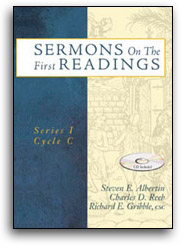
Sermons On The First Readings
Series I, Cycle C
Once upon a time there was a great teacher, a guru, who had many followers. People came from far and wide to listen, learn, and be enlightened by this man. There were one-on-one classes and apprenticeships for those who came to learn. When the students had finished with their lessons, the guru sent them into the world to share their knowledge with others as masters in their own right. Just before each student left, the guru would give each a special gift -- the teacher taught each student the mantra of life and death. Phrase by phrase the guru taught them until they had memorized it by heart. Then he gave them a warning that as long as they said this mantra faithfully, they would be blessed. Its power would give them insight and clarity of thought and allow them to discern the truth when surrounded by lies. Its power as well would keep them from despair and give them hope in the midst of misery and hopelessness. Their faith would be strengthened and one day their souls would find everlasting life. The disciples were grateful and humbled by this great gift. They were warned, however, that they were never to teach the mantra to anyone; it was for them alone, the enlightened of the world.
For many years students finished their studies with the guru, were taught the mantra, and then went into the world to share their wisdom and to pray the mantra in secret. One day a young man, who had been taught the mantra and was humbled by the gift, came to the master guru ready to enter the world. However, when the teacher warned him not to share the mantra with anyone, he asked why. The master responded, "If you share this mantra with others, then what it was to do for you will be handed over to them, and you will live in darkness, even when the light is all around you. You will know only despair and misery of body and soul for the rest of your life. You will stumble over the truth and be endlessly confused. But worst of all, you will lose your faith and your soul. You will be damned forever."
The disciple turned white and was visibly shaken by the master's words. Nevertheless, he decided that he must do what he must do. He went to the nearest city and gathered multitudes around him. He taught them all many things and the people were enthralled with his stories and wisdom. Then he taught them the mantra line by line, just as the master had taught him. The people left muttering the mantra to themselves.
A number of the master's disciples were in the crowd and they were horrified at the man's actions. He had disobeyed the master and betrayed his community by giving away the wisdom of the mantra to unenlightened people. These disciples immediately went back to the master and told him what had happened. They asked the guru, "Are you going to punish the student for what he has done?" The master looked at them sadly and said, "I do not have to, for he will be punished terribly. He knew what his fate would be if he shared the mantra of life with those who were unenlightened. For him it has become the mantra of death. He will live in darkness and despair, without hope or knowledge of the truth. He will live isolated and alone, without the comfort of faith, and he will even lose his soul. How could I punish him further?" And with these words the old master gathered his few belongings, looked at his students sadly, and said, "I am going to that man who gave away my gift of the mantra of life and death." "Why?" they asked in unison. "Because," he said, "out of all my students he alone learned wisdom and compassion. Now that man is my master." And he left them to follow the man who walked now in darkness and despair, the one who had chosen compassion over wisdom and knowledge.
The story of the master and his disciple provides us with the opportunity to reflect upon how we approach the activities of our life. Do we do things for ourselves principally, or are we more concerned about the needs of others. The guru knew the power of the mantra, but only realized later that in limiting its use he was being selfish and failing to show compassion. When he observed the compassionate act of his disciple, the one who had shared the mantra so all would be enlightened at the cost of his own darkness and despair, he knew that this man was the true teacher, and the one he must follow. God calls us, whatever our status in life, to be compassionate, even when hard words may be necessary. We are to be compassionate as God is compassionate.
Jeremiah had a very difficult mission in proclaiming the judgment of God against the nation of Judah. As we have heard for the past few weeks, the prophet proclaims the words which the Hebrews must have found very hard to hear. Some may have written off his message as the ravings of a madman; others may have believed that he was a voice crying in the desert and ignored what he proclaimed. There must have been others who believed that the warning was not directed toward them. Jeremiah, however, was crystal clear that God had made a judgment against the land and people of Judah. God would not forget their transgressions.
The harsh message which Jeremiah proclaimed could not possibly have been the words he wished to proclaim, but as a prophet he spoke God's message as it was revealed to him, with the hope that the people would reform. As a Hebrew himself, Jeremiah assuredly did not wish the fate that God planned. Thus, as we hear in today's reading, he proclaims a message of compassion as he mourns the loss of the nation. The prophet laments the fact that his people will suffer, but the message is clear -- God has abandoned Judah. As the prophet proclaims, the harvest is past, the summer is past, and the people are lost. He mourns for the people and feels their pain. He weeps day and night over the people.
Jeremiah's message against Israel was indeed harsh and difficult to proclaim, but it was God's word and thus necessary. In a similar way, we at times experience the need to speak the difficult word, but we do so in a message that is proclaimed to bring health, wholeness, reconciliation, and possibly conversion and/or transformation to individuals and groups. Parents may find the need to warn their children against the multiple and varied vices which enslave many. The message is difficult to proclaim, but if done in a spirit of compassion, it becomes a message of peace and salvation.
Words of tough love may be necessary to those who are in the grip of an addiction. We would rather not challenge the person, but often it is only by such means that the message of transformation and conversion can be heard. Employers certainly do not like to tell their employees that one's work is unsatisfactory or that the company has made some personnel decisions and, therefore, their jobs will be lost, but this may be the only way for a person to see their inabilities, inadequacies, and possibly the need to move on in life to new ventures and challenges.
It is a much easier road to avoid conflict, to say nothing, or speak only those words that others want to hear. However, in many ways this may be the least compassionate way to assist people. We do nobody a favor by lying; the world is not enriched if we hold all the information we possess for ourselves. The compassionate and progressive thing to do is to follow what is often the difficult, obstacle-laden, and more restricted road. Jesus presents the challenge in this way in the Sermon on the Mount: "Enter through the narrow gate; for the gate is wide and the road is easy that leads to destruction and there are many who take it. For the gate is narrow and the road is hard that leads to life, and there are few who find it" (Matthew 7:13-14).Only by the more difficult path, the narrow gate of compassion, can we place ourselves and others on the correct path that leads to life.
Compassion is a virtue that many experience and exercise through giving. We give of our time, talent, and treasure to meet the needs of others. Certainly Jeremiah gave his life as a prophet to proclaim a hard and difficult message so that his people, the Hebrews, could once again find favor with God. In a similar way Jesus demonstrated compassion by curing the sick, teaching the people, searching for the lost, and ultimately dying to set us free from condemnation. All of us in our varied vocations in life are called to be compassionate through the common vocation of holiness. We may give many things to a variety of peoples and groups, but the most precious gift and the one that shows the greatest compassion and total union with others is our presence. The prophets and Jesus ultimately gave their presence as a compassionate action in the service of others. We must do likewise. A little story illustrates my point.
There once was a wise and much beloved king who cared greatly for his people and only wanted the best for them. The king took a personal interest in people's lives, often disguising himself and wandering about the streets in order see life from the perspective of his people. One day he disguised himself as a poor villager and went to visit the public bath. Many were enjoying fellowship and recreation. The water in the baths was heated, especially in the winter months, by a furnace in a dingy basement underneath the facility. One man was responsible for maintaining the water at the correct temperature. One day the king made his way to the basement to visit with the man who tirelessly tended the fire. The two men shared a meal together and got to know each other. Day after day and week after week the king came to the basement and visited with the man. No one else ever showed any concern for the man. One day the king revealed his true identity to the man. This was a risky move, for the monarch feared that the man might ask for some special royal favor. Instead, the king's new friend looked into his eyes and said, "You left your comfortable palace to sit with me in this hot and dingy cellar. You ate my meager food and showed that you cared about me. You could have bestowed upon me great gifts, but you have given me the greatest gift of all. You gave me the gift of yourself."
Let us demonstrate our compassion. Let us not hold things for ourselves only, but rather, let us, in imitation of the master's disciple, the prophet Jeremiah, and Jesus of Nazareth give away our life. Let us be compassionate as God is compassionate. The reward is eternal life.
For many years students finished their studies with the guru, were taught the mantra, and then went into the world to share their wisdom and to pray the mantra in secret. One day a young man, who had been taught the mantra and was humbled by the gift, came to the master guru ready to enter the world. However, when the teacher warned him not to share the mantra with anyone, he asked why. The master responded, "If you share this mantra with others, then what it was to do for you will be handed over to them, and you will live in darkness, even when the light is all around you. You will know only despair and misery of body and soul for the rest of your life. You will stumble over the truth and be endlessly confused. But worst of all, you will lose your faith and your soul. You will be damned forever."
The disciple turned white and was visibly shaken by the master's words. Nevertheless, he decided that he must do what he must do. He went to the nearest city and gathered multitudes around him. He taught them all many things and the people were enthralled with his stories and wisdom. Then he taught them the mantra line by line, just as the master had taught him. The people left muttering the mantra to themselves.
A number of the master's disciples were in the crowd and they were horrified at the man's actions. He had disobeyed the master and betrayed his community by giving away the wisdom of the mantra to unenlightened people. These disciples immediately went back to the master and told him what had happened. They asked the guru, "Are you going to punish the student for what he has done?" The master looked at them sadly and said, "I do not have to, for he will be punished terribly. He knew what his fate would be if he shared the mantra of life with those who were unenlightened. For him it has become the mantra of death. He will live in darkness and despair, without hope or knowledge of the truth. He will live isolated and alone, without the comfort of faith, and he will even lose his soul. How could I punish him further?" And with these words the old master gathered his few belongings, looked at his students sadly, and said, "I am going to that man who gave away my gift of the mantra of life and death." "Why?" they asked in unison. "Because," he said, "out of all my students he alone learned wisdom and compassion. Now that man is my master." And he left them to follow the man who walked now in darkness and despair, the one who had chosen compassion over wisdom and knowledge.
The story of the master and his disciple provides us with the opportunity to reflect upon how we approach the activities of our life. Do we do things for ourselves principally, or are we more concerned about the needs of others. The guru knew the power of the mantra, but only realized later that in limiting its use he was being selfish and failing to show compassion. When he observed the compassionate act of his disciple, the one who had shared the mantra so all would be enlightened at the cost of his own darkness and despair, he knew that this man was the true teacher, and the one he must follow. God calls us, whatever our status in life, to be compassionate, even when hard words may be necessary. We are to be compassionate as God is compassionate.
Jeremiah had a very difficult mission in proclaiming the judgment of God against the nation of Judah. As we have heard for the past few weeks, the prophet proclaims the words which the Hebrews must have found very hard to hear. Some may have written off his message as the ravings of a madman; others may have believed that he was a voice crying in the desert and ignored what he proclaimed. There must have been others who believed that the warning was not directed toward them. Jeremiah, however, was crystal clear that God had made a judgment against the land and people of Judah. God would not forget their transgressions.
The harsh message which Jeremiah proclaimed could not possibly have been the words he wished to proclaim, but as a prophet he spoke God's message as it was revealed to him, with the hope that the people would reform. As a Hebrew himself, Jeremiah assuredly did not wish the fate that God planned. Thus, as we hear in today's reading, he proclaims a message of compassion as he mourns the loss of the nation. The prophet laments the fact that his people will suffer, but the message is clear -- God has abandoned Judah. As the prophet proclaims, the harvest is past, the summer is past, and the people are lost. He mourns for the people and feels their pain. He weeps day and night over the people.
Jeremiah's message against Israel was indeed harsh and difficult to proclaim, but it was God's word and thus necessary. In a similar way, we at times experience the need to speak the difficult word, but we do so in a message that is proclaimed to bring health, wholeness, reconciliation, and possibly conversion and/or transformation to individuals and groups. Parents may find the need to warn their children against the multiple and varied vices which enslave many. The message is difficult to proclaim, but if done in a spirit of compassion, it becomes a message of peace and salvation.
Words of tough love may be necessary to those who are in the grip of an addiction. We would rather not challenge the person, but often it is only by such means that the message of transformation and conversion can be heard. Employers certainly do not like to tell their employees that one's work is unsatisfactory or that the company has made some personnel decisions and, therefore, their jobs will be lost, but this may be the only way for a person to see their inabilities, inadequacies, and possibly the need to move on in life to new ventures and challenges.
It is a much easier road to avoid conflict, to say nothing, or speak only those words that others want to hear. However, in many ways this may be the least compassionate way to assist people. We do nobody a favor by lying; the world is not enriched if we hold all the information we possess for ourselves. The compassionate and progressive thing to do is to follow what is often the difficult, obstacle-laden, and more restricted road. Jesus presents the challenge in this way in the Sermon on the Mount: "Enter through the narrow gate; for the gate is wide and the road is easy that leads to destruction and there are many who take it. For the gate is narrow and the road is hard that leads to life, and there are few who find it" (Matthew 7:13-14).Only by the more difficult path, the narrow gate of compassion, can we place ourselves and others on the correct path that leads to life.
Compassion is a virtue that many experience and exercise through giving. We give of our time, talent, and treasure to meet the needs of others. Certainly Jeremiah gave his life as a prophet to proclaim a hard and difficult message so that his people, the Hebrews, could once again find favor with God. In a similar way Jesus demonstrated compassion by curing the sick, teaching the people, searching for the lost, and ultimately dying to set us free from condemnation. All of us in our varied vocations in life are called to be compassionate through the common vocation of holiness. We may give many things to a variety of peoples and groups, but the most precious gift and the one that shows the greatest compassion and total union with others is our presence. The prophets and Jesus ultimately gave their presence as a compassionate action in the service of others. We must do likewise. A little story illustrates my point.
There once was a wise and much beloved king who cared greatly for his people and only wanted the best for them. The king took a personal interest in people's lives, often disguising himself and wandering about the streets in order see life from the perspective of his people. One day he disguised himself as a poor villager and went to visit the public bath. Many were enjoying fellowship and recreation. The water in the baths was heated, especially in the winter months, by a furnace in a dingy basement underneath the facility. One man was responsible for maintaining the water at the correct temperature. One day the king made his way to the basement to visit with the man who tirelessly tended the fire. The two men shared a meal together and got to know each other. Day after day and week after week the king came to the basement and visited with the man. No one else ever showed any concern for the man. One day the king revealed his true identity to the man. This was a risky move, for the monarch feared that the man might ask for some special royal favor. Instead, the king's new friend looked into his eyes and said, "You left your comfortable palace to sit with me in this hot and dingy cellar. You ate my meager food and showed that you cared about me. You could have bestowed upon me great gifts, but you have given me the greatest gift of all. You gave me the gift of yourself."
Let us demonstrate our compassion. Let us not hold things for ourselves only, but rather, let us, in imitation of the master's disciple, the prophet Jeremiah, and Jesus of Nazareth give away our life. Let us be compassionate as God is compassionate. The reward is eternal life.
