
Boldly Faithful
Sermon
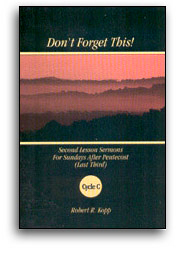
Don't Forget This!
Second Lesson Sermons For Sundays After Pentecost (Last Third) Cycle C
The Dead Poets Society is one of my favorite movies.
It's about an English teacher named John Keating who returns to his stodgy old alma mater named Welton Academy -- the students call it "Hellton" -- and challenges students to live extraordinary lives.
Mr. Keating tells a few students about a secret organization called The Dead Poets Society.
"The Dead Poets Society," he reveals with eyes aglow, "was a society dedicated to sucking the marrow out of life. That phrase is by Thoreau and was invoked at every meeting."
He continues, "A small group of us would meet at the old cave, and we would take turns reading Shelley, Thoreau, Whitman, our own verses -- and in the enchantment of the moment let it work its magic on us."
"You mean," a student asks, "it was a bunch of guys sitting around and reading poetry?"
"Believe me," Keating answers, "we didn't simply read... We let it drip from our tongues like honey. Women swooned, spirits soared ... gods were created, gentlemen."
He begins the first class with these words:
Gather ye rosebuds while ye may,
Old time is still a flying:
And this same flower that smiles today,
Tomorrow will be dying.
"The Latin term for that sentiment," Keating explains, "is Carpe diem... Seize the day!"
Then he says, "One day, hard as it is to believe, each and every one of us is going to stop breathing, turn cold, and die."
Pointing to pictures of their predecessors at Welton, he urges,
Look at the faces of the boys who attended this school sixty or seventy years ago. Don't be timid; go look at them ... They're not that different from any of you, are they? Hope in their eyes, just like yours. They believe themselves destined for wonderful things, just like many of you ... Did not most of them not wait until it was too late before making their lives into one iota of what they were capable? In chasing the almighty deity of success, did they not squander their boyhood dreams? Most of those gentlemen are fertilizing daffodils now! However, if you get very close, boys, you can hear them whisper ... "Carpe diem ... Seize the day ... Make your lives extraordinary."
One day in class, Mr. Keating inspires Todd Anderson to be free for living -- to reach out and seize his extraordinary potential. A powerful poet emerges from the shy and silent and cowering boy. As the scene closes, Mr. Keating walks to Todd's side and whispers into his ear, "Don't you forget this."
Seize the day!
Live extraordinary lives!
Don't forget this!
But it's so hard to keep climbing mountains when we're pulled back down into the valleys. Or as we sing with the old Shaker tune, "It's hard to dance with the devil on your back."
Life has a way of bringing us down -- telling us who we aren't and what we can't do.
And as we age a little and can't quite generate the energy or enthusiasm to pursue dreams anymore and exchange visions of changing the world for the immediate need of knowing if our deodorants will keep us dry all day long, Bob Seger's lament becomes a theme song: "So you're a little bit older and a lot less bolder than you used to be."
Or as John Cougar moans, "O yeah, life goes on long after the thrill of livin' is gone."
That's the way it is in the world.
But that's not the way it is in the Kingdom!
God's people internalize and then exercise the winning wisdom of the Psalmist: "I lift up my eyes to the hills -- where does my help come from? My help comes from the Lord, the Maker of heaven and earth" (Psalm 121:1-2 NIV).
God's people know their Almighty Father enables them for the heroic: "I can do everything through him who gives me strength" (Philippians 4:13 NIV).
And so Noah builds an ark, Abraham starts a nation, Moses leads people out of bondage, David goes from sheep pastures to king's palace, prophets prophesy to politicians without fear, disciples leave home and vocation to follow Christ, martyrs choose Jesus over everyone else because they know God's people live with him longer than anybody else, and Christians still find the way, truth, and life in Jesus.
God's people have mountain-climbing-even-mountain-moving attitudes. God's people would rather risk than rust. God's people know ships are safe in harbors but are compelled by the knowledge that God never meant for ships to remain in harbors.
That's why God's people seize the day as they pray and work to live extraordinary lives.
God's people are boldly faithful.
Don't forget this!
Paul put it this way (see 2 Timothy 1:1-14):
" ... God did not give us a spirit of cowardice, but rather a spirit of power and of love and of self-discipline. Do not be ashamed, then, of the testimony about our Lord ... I am not ashamed, for I know the one in whom I have put my trust, and I am sure that he is able to guard until that day what I have entrusted to him."
Certainly, the Hebrew midwives of Exodus 1 epitomize the boldly faithful resolve of God's people.
When the new king of Egypt who "did not know Joseph" ascended to the throne, he decided to keep God's people in check by controlling their population. So he said to the midwives, "When you act as midwives to the Hebrew women, and see them on the birth stool, if it is a boy, kill him." "But," we read in one of the great testimonies to bold faith, "the midwives feared God; they did not do as the king of Egypt commanded them, but they let the boys live." And then we read of God's retribution, "So God dealt well with the midwives; and the people multiplied and became very strong" (Exodus 1:16, 17, 20).
It's like Jesus promised, "For those who want to save their life will lose it, and those who lose their life for my sake will find it" (see Matthew 16:24-26).
In other words, the boldly faithful are blessed by God.
A story out of the University of Southern California comes to mind. A deeply committed atheist was a professor of philosophy at the university. His agenda for one course was to convince students that God doesn't exist. The professor's students were afraid to argue with him because he was brilliant and passed out the grades that would remain on their transcripts forever. No student had ever challenged the professor for over twenty years.
At the end of every semester, he would say, "If there is anyone who believes in Jesus, stand up!" And after a brief and dramatic pause, he would continue, "Because anyone who does believe in God is a fool!" He always ended, "If God existed, he could stop this piece of chalk from hitting the ground and breaking. Such a simple task to prove that God exists. But he can't do it because he doesn't exist." Then he would drop the chalk to the floor and it would shatter into pieces.
So no one ever took the challenge. Besides, most of the students agreed with the professor, and the Christians who did take the course didn't speak up for a variety of ignoble reasons.
Finally, a freshman and rather bold Christian enrolled in the course because it was required for his major. He prayed every day for strength and courage to be faithful regardless of what the professor said or the class thought.
Predictably, the professor made the notorious challenge as the semester drew to a close: "If there is anyone who believes in Jesus, stand up!"
The young fellow stood up.
The professor and class were shocked because no one had ever risen to the challenge.
Quickly collecting himself, the professor shouted, "You fool! If God existed, he could stop this piece of chalk from hitting the ground and breaking."
But as he was about to drop the chalk, it slipped out of his hand, off the cuff of his shirt, hit the pleat of his pants, slid down his leg, and then rolled off his shoe and onto the floor without breaking.
The professor's jaw dropped.
He looked at the young man, the class, and then ran out of the room.
Then the freshman who had been boldly faithful walked to the front of the class and talked about the saving Lordship of Jesus.
Episcopalian Canon Bryan Green once spoke at a large meeting of college students at St. John the Divine Cathedral in New York City. Meeting with the young people who had welcomed Jesus into their hearts as saving Lord that night, Canon Green said:
My young friends, you have just accepted Jesus Christ as your Savior and Lord. I want you to go home to the dormitory where you live. I want you to call your mother and father long distance and tell them all about it. I want you to tell your roommate all about it. I want you to tell everybody who lives in your dorm about it. I want you to tell everyone you meet on the campus in the days that lie ahead about your new experience in the Christian faith. You know what they're gong to say about you? They're going to say you are a religious fanatic, and you are. And if you aren't, my young friends, you won't be doing anything for Jesus Christ in ten years.
For a long time now, I've been convinced people who really know who he is -- Lord and Savior -- aren't bashful about talking about him regardless of the time, circumstance, or audience. For as I've also come to realize over the years, we're going to live a lot longer with Jesus than anybody else. So we'd better get our loyalties in order!
Admittedly, today's church is populated -- polluted? -- by people and even pastors who have no idea of who he is and what is means to follow him. Indeed, the church is just coming to grips with a terrible reality. Jesus isn't who he used to be in the church anymore. The church in most quarters is in a Christological crisis. The question for today's church is the same question that confronted the church of the first and sixteenth centuries: "Who is Jesus?"
Recently on The Tonight Show, Jay Leno did some man-on-the-street interviews. He asked one young female undergraduate, "Can you name one of the Ten Commandments?" She replied, "Freedom of speech?" So Leno asked her friend to complete this sentence: "Let he who is without sin ... " She said, " ... have a good time." Turning to a young male undergraduate, Leno asked, "Who, according to the Bible, was eaten by a whale?" The boy answered in a serious tone, "Pinocchio."
Fortunately, God's boldly faithful people know who he is and aren't bashful about announcing him.
God's people hear the voices of the patriarchs, prophets, disciples, martyrs, moms, dads, Sunday school teachers, and boldly faithful of all generations whispering into their souls, "Seize the day! Live extraordinary lives!"
God's people don't forget who he is -- Lord and Savior.
God's people don't forget who they are -- his.
God's people don't forget what distinguishes them from everybody else -- joy in him and love for him and his.
God's people don't forget Jesus.
It's about an English teacher named John Keating who returns to his stodgy old alma mater named Welton Academy -- the students call it "Hellton" -- and challenges students to live extraordinary lives.
Mr. Keating tells a few students about a secret organization called The Dead Poets Society.
"The Dead Poets Society," he reveals with eyes aglow, "was a society dedicated to sucking the marrow out of life. That phrase is by Thoreau and was invoked at every meeting."
He continues, "A small group of us would meet at the old cave, and we would take turns reading Shelley, Thoreau, Whitman, our own verses -- and in the enchantment of the moment let it work its magic on us."
"You mean," a student asks, "it was a bunch of guys sitting around and reading poetry?"
"Believe me," Keating answers, "we didn't simply read... We let it drip from our tongues like honey. Women swooned, spirits soared ... gods were created, gentlemen."
He begins the first class with these words:
Gather ye rosebuds while ye may,
Old time is still a flying:
And this same flower that smiles today,
Tomorrow will be dying.
"The Latin term for that sentiment," Keating explains, "is Carpe diem... Seize the day!"
Then he says, "One day, hard as it is to believe, each and every one of us is going to stop breathing, turn cold, and die."
Pointing to pictures of their predecessors at Welton, he urges,
Look at the faces of the boys who attended this school sixty or seventy years ago. Don't be timid; go look at them ... They're not that different from any of you, are they? Hope in their eyes, just like yours. They believe themselves destined for wonderful things, just like many of you ... Did not most of them not wait until it was too late before making their lives into one iota of what they were capable? In chasing the almighty deity of success, did they not squander their boyhood dreams? Most of those gentlemen are fertilizing daffodils now! However, if you get very close, boys, you can hear them whisper ... "Carpe diem ... Seize the day ... Make your lives extraordinary."
One day in class, Mr. Keating inspires Todd Anderson to be free for living -- to reach out and seize his extraordinary potential. A powerful poet emerges from the shy and silent and cowering boy. As the scene closes, Mr. Keating walks to Todd's side and whispers into his ear, "Don't you forget this."
Seize the day!
Live extraordinary lives!
Don't forget this!
But it's so hard to keep climbing mountains when we're pulled back down into the valleys. Or as we sing with the old Shaker tune, "It's hard to dance with the devil on your back."
Life has a way of bringing us down -- telling us who we aren't and what we can't do.
And as we age a little and can't quite generate the energy or enthusiasm to pursue dreams anymore and exchange visions of changing the world for the immediate need of knowing if our deodorants will keep us dry all day long, Bob Seger's lament becomes a theme song: "So you're a little bit older and a lot less bolder than you used to be."
Or as John Cougar moans, "O yeah, life goes on long after the thrill of livin' is gone."
That's the way it is in the world.
But that's not the way it is in the Kingdom!
God's people internalize and then exercise the winning wisdom of the Psalmist: "I lift up my eyes to the hills -- where does my help come from? My help comes from the Lord, the Maker of heaven and earth" (Psalm 121:1-2 NIV).
God's people know their Almighty Father enables them for the heroic: "I can do everything through him who gives me strength" (Philippians 4:13 NIV).
And so Noah builds an ark, Abraham starts a nation, Moses leads people out of bondage, David goes from sheep pastures to king's palace, prophets prophesy to politicians without fear, disciples leave home and vocation to follow Christ, martyrs choose Jesus over everyone else because they know God's people live with him longer than anybody else, and Christians still find the way, truth, and life in Jesus.
God's people have mountain-climbing-even-mountain-moving attitudes. God's people would rather risk than rust. God's people know ships are safe in harbors but are compelled by the knowledge that God never meant for ships to remain in harbors.
That's why God's people seize the day as they pray and work to live extraordinary lives.
God's people are boldly faithful.
Don't forget this!
Paul put it this way (see 2 Timothy 1:1-14):
" ... God did not give us a spirit of cowardice, but rather a spirit of power and of love and of self-discipline. Do not be ashamed, then, of the testimony about our Lord ... I am not ashamed, for I know the one in whom I have put my trust, and I am sure that he is able to guard until that day what I have entrusted to him."
Certainly, the Hebrew midwives of Exodus 1 epitomize the boldly faithful resolve of God's people.
When the new king of Egypt who "did not know Joseph" ascended to the throne, he decided to keep God's people in check by controlling their population. So he said to the midwives, "When you act as midwives to the Hebrew women, and see them on the birth stool, if it is a boy, kill him." "But," we read in one of the great testimonies to bold faith, "the midwives feared God; they did not do as the king of Egypt commanded them, but they let the boys live." And then we read of God's retribution, "So God dealt well with the midwives; and the people multiplied and became very strong" (Exodus 1:16, 17, 20).
It's like Jesus promised, "For those who want to save their life will lose it, and those who lose their life for my sake will find it" (see Matthew 16:24-26).
In other words, the boldly faithful are blessed by God.
A story out of the University of Southern California comes to mind. A deeply committed atheist was a professor of philosophy at the university. His agenda for one course was to convince students that God doesn't exist. The professor's students were afraid to argue with him because he was brilliant and passed out the grades that would remain on their transcripts forever. No student had ever challenged the professor for over twenty years.
At the end of every semester, he would say, "If there is anyone who believes in Jesus, stand up!" And after a brief and dramatic pause, he would continue, "Because anyone who does believe in God is a fool!" He always ended, "If God existed, he could stop this piece of chalk from hitting the ground and breaking. Such a simple task to prove that God exists. But he can't do it because he doesn't exist." Then he would drop the chalk to the floor and it would shatter into pieces.
So no one ever took the challenge. Besides, most of the students agreed with the professor, and the Christians who did take the course didn't speak up for a variety of ignoble reasons.
Finally, a freshman and rather bold Christian enrolled in the course because it was required for his major. He prayed every day for strength and courage to be faithful regardless of what the professor said or the class thought.
Predictably, the professor made the notorious challenge as the semester drew to a close: "If there is anyone who believes in Jesus, stand up!"
The young fellow stood up.
The professor and class were shocked because no one had ever risen to the challenge.
Quickly collecting himself, the professor shouted, "You fool! If God existed, he could stop this piece of chalk from hitting the ground and breaking."
But as he was about to drop the chalk, it slipped out of his hand, off the cuff of his shirt, hit the pleat of his pants, slid down his leg, and then rolled off his shoe and onto the floor without breaking.
The professor's jaw dropped.
He looked at the young man, the class, and then ran out of the room.
Then the freshman who had been boldly faithful walked to the front of the class and talked about the saving Lordship of Jesus.
Episcopalian Canon Bryan Green once spoke at a large meeting of college students at St. John the Divine Cathedral in New York City. Meeting with the young people who had welcomed Jesus into their hearts as saving Lord that night, Canon Green said:
My young friends, you have just accepted Jesus Christ as your Savior and Lord. I want you to go home to the dormitory where you live. I want you to call your mother and father long distance and tell them all about it. I want you to tell your roommate all about it. I want you to tell everybody who lives in your dorm about it. I want you to tell everyone you meet on the campus in the days that lie ahead about your new experience in the Christian faith. You know what they're gong to say about you? They're going to say you are a religious fanatic, and you are. And if you aren't, my young friends, you won't be doing anything for Jesus Christ in ten years.
For a long time now, I've been convinced people who really know who he is -- Lord and Savior -- aren't bashful about talking about him regardless of the time, circumstance, or audience. For as I've also come to realize over the years, we're going to live a lot longer with Jesus than anybody else. So we'd better get our loyalties in order!
Admittedly, today's church is populated -- polluted? -- by people and even pastors who have no idea of who he is and what is means to follow him. Indeed, the church is just coming to grips with a terrible reality. Jesus isn't who he used to be in the church anymore. The church in most quarters is in a Christological crisis. The question for today's church is the same question that confronted the church of the first and sixteenth centuries: "Who is Jesus?"
Recently on The Tonight Show, Jay Leno did some man-on-the-street interviews. He asked one young female undergraduate, "Can you name one of the Ten Commandments?" She replied, "Freedom of speech?" So Leno asked her friend to complete this sentence: "Let he who is without sin ... " She said, " ... have a good time." Turning to a young male undergraduate, Leno asked, "Who, according to the Bible, was eaten by a whale?" The boy answered in a serious tone, "Pinocchio."
Fortunately, God's boldly faithful people know who he is and aren't bashful about announcing him.
God's people hear the voices of the patriarchs, prophets, disciples, martyrs, moms, dads, Sunday school teachers, and boldly faithful of all generations whispering into their souls, "Seize the day! Live extraordinary lives!"
God's people don't forget who he is -- Lord and Savior.
God's people don't forget who they are -- his.
God's people don't forget what distinguishes them from everybody else -- joy in him and love for him and his.
God's people don't forget Jesus.
