
Changing Seasons, Constant Love
Sermon
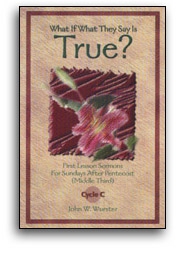
What If What They Say Is True?
First Lesson Sermons For Sundays After Pentecost (Middle Third) Cycle C
Another season has come and gone. Promises that were made have not been fulfilled. Good intentions haven't yielded any tangible results. Dreams have not come true. High hopes have proven to be only wishful thinking. Nothing has really changed; nothing has really improved. The time keeps moving along, but we seem stuck in the same ruts. Old routines remain, prejudices persist, dullness and anxiety continue to be constant companions. Lingering in the air is that nagging sense that things aren't quite right, not as they could be, not as they should be. As Jeremiah says, "The harvest is past, the summer is ended, and we are not saved" (8:20). Time has moved along, the seasons are changing, but nothing has really changed for us. Same old people in the same old lives. Sin still has us in its grip, running our lives, ruining our lives, confusing our sense of what matters, leading us away from God.
Why aren't things better? What about those promises God has made? Why haven't we been restored? Why haven't we been made whole? Is there not a balm in Gilead? Is there no one to heal us? Nothing to make us well? No way to soothe the pain and mend the heart?
As Jeremiah surveys the scene, he longs for a head full of water and eyes that work like fountains, so that he could cry all the tears that need to be cried. Tears for those who suffer. Tears for those who hurt. Tears for those who mourn. So many people, so much pain. Endless tears. Fountains of tears.
Know the feeling? These are days full of tears. Parents not well. Children not well. Spouses not well. A nation not well. There are hardly enough tears to go around. Career decisions to be made. College decisions to be made. Tears of apprehension. Tears of stress. Relationships blown apart. Marriages stretched to the breaking point. Tears of separation. Tears of regret. Is there not a balm in Gilead? Is there no one to heal us? Nothing to make us well? No way to soothe the pain and mend the heart?
I heard recently about a book called A Broken Heart Still Beats. This book is a collection of readings offered to help parents deal with the deaths of their children. The editors, each of whom has tragically lost a child, have pulled together a variety of materials from many authors in an attempt to provide some resources for those struggling with this catastrophe. The death of a child, the editors contend, is not something one "gets over" or "works through." At best, you can learn to live with the sorrow, though the sorrow itself never goes away. Listening to these women speak about this book and this experience was very moving for me, even tearful -- and I'm not even a parent. One comment in particular from the interview that has stayed with me occurred when one of the editors read from a selection in the book, a selection which begins with these words, "Time heals nothing."1 Time heals nothing.
If not time, then what? Is there nothing that can heal us, nothing that can make us well, nothing that can soothe the pain and mend the heart? Is there not a balm in Gilead?
Words, words, words. It seems that's about all we preachers really have. Someone I know once summarized the task of ministry as knowing what to say and when to say it. Words, words, words. I spend lots of time with words -- reading them, writing them, speaking them. I have invested much of my life, much of myself in learning words -- fancy theological words, Greek words, Hebrew words, words for prayers, words for sermons, words for weddings, words for funerals, words for classes, words for children, words for youth, words for adults. Yet in spite of all those words and all the time learning those words, some of the most important words I've learned to speak over the years are very simple ones. They are words I knew before I went to seminary, before I went to college. I've known these words for a long time. You've known them, too. It's only recently that I've learned how useful they are for ministry, how important they are for my understanding of who I am and who God is. Three little words: I don't know.
I don't know why children die. I don't know why hurricanes make last minute turns, sparing some while bringing devastation to others. I don't why troubles seem only to multiply for some folks. I don't know why marriages fall apart. I don't know why diseases like AIDS develop. I don't know why healthy folks get cancer. I don't know why sometimes, even most times, God seems absent. There are so many things I don't know.
The language of not knowing is what I hear in this passage from Jeremiah. "Why then has the health of my poor people not been restored?" he asks (8:22). The prophet has no answers. Why hasn't it gotten better? I don't know.
I am aware that there are people who claim to know why these things happen. People who are convinced that God is behind it all, teaching lessons, granting rewards, exacting retribution, meting out punishment according to some inscrutable plan. I don't know about all that. I think presuming to know what God is up to is risky business. I don't know how hurricanes and diseases and children's deaths and broken relationships fit within the providence of God. I don't how a god who wills bad things can in any way resemble the God who has come among us in Jesus Christ.
Yet, as important as I believe it is to admit what I do not know, it is equally important, no, it is more important, to cling to what I do know. I was reminded of that by a woman named Angelina Julio. She lives in Sudan, a country in Africa that has been beset by war and famine for many years. Thousands have died, millions are at risk. It is grave situation. Here is what Angelina Julio, a seminary student, wrote about what is going on there:
In Sudan, we have never had or experienced full peace. We were born in war and have borne our children also in war. Our lives are ever unstable. We do not know what it means to have a leftover or excess of anything. We live in want of security, stability, wealth, love, health, home, etc. We are deprived of all our rights. The right of defense, the right of ownership of our land, the right to enjoy life as it was given to us by God. We have no freedoms of any kind anywhere. The world seems to weigh very heavy on our shoulders with no one to help but Christ.2
I don't know why the suffering in Sudan is so widespread, so intense. Who could explain it? I don't know. But I do know that Angelina is right. I do know that Christ is present there. I do know that Christ will help, even when no one else will, when no one else can.
There is so much I do not know. But I do know that our lives are in God's hands. I do know that God's love for us has no boundary. I do know that there is someone to heal us. There is someone to make us well. There is someone to soothe the pain and mend the heart. I know it is so.
The weeping prophet Jeremiah, who wishes his eyes might be like fountains because his need to cry for his people is so great, asks with sorrow in his voice, "Is there no balm in Gilead?" Is there nothing to make it better? Is there no one to save us?
Know the answer? I do. This answer is yes: Yes, there is a balm to make the wounded whole. Yes, there is something, someone to make it better. Yes, there is someone to save us. Yes, there is a balm to heal the sin-sick soul. The answer is yes. I know it is so. That's why I'm here. And I suppose that's why you're here, because you know it is so, too. Or you suspect it is so. Or you hope it is so.
Friends, the tear-stained face of Jesus is a reminder that our suffering is God's suffering. Our pain is God's pain. God became flesh in Jesus because God has promised not to leave us alone. The cross is the sign of God's commitment to this world, God's commitment to us, God's commitment to you. In the cross, God's love intersects our sorrow. In the cross, our lives are inextricably linked with God's life. You can see that for yourselves. You can see that in every cross. You can see that in your own life.
The summer is past. The seasons are changing. Time is moving. The one whose love heals and soothes and makes us whole gives us a new chance to keep those promises and follow through on those good intentions and make those dreams come true and see those hopes come to pass. Friends, we have been saved. The news is good. I know it is so. There is a balm in Gilead. Hallelujah!
____________
1. Interview with Anne McCracken and Mary Semel, eds., A Broken Heart Still Beats: After a Child Dies on National Public Radio, October 7, 1998.
2. "Shake and Move the House of the Lord," Presbyterian Outlook, vol. 180, no. 31 (September 28, 1998, 4).
Why aren't things better? What about those promises God has made? Why haven't we been restored? Why haven't we been made whole? Is there not a balm in Gilead? Is there no one to heal us? Nothing to make us well? No way to soothe the pain and mend the heart?
As Jeremiah surveys the scene, he longs for a head full of water and eyes that work like fountains, so that he could cry all the tears that need to be cried. Tears for those who suffer. Tears for those who hurt. Tears for those who mourn. So many people, so much pain. Endless tears. Fountains of tears.
Know the feeling? These are days full of tears. Parents not well. Children not well. Spouses not well. A nation not well. There are hardly enough tears to go around. Career decisions to be made. College decisions to be made. Tears of apprehension. Tears of stress. Relationships blown apart. Marriages stretched to the breaking point. Tears of separation. Tears of regret. Is there not a balm in Gilead? Is there no one to heal us? Nothing to make us well? No way to soothe the pain and mend the heart?
I heard recently about a book called A Broken Heart Still Beats. This book is a collection of readings offered to help parents deal with the deaths of their children. The editors, each of whom has tragically lost a child, have pulled together a variety of materials from many authors in an attempt to provide some resources for those struggling with this catastrophe. The death of a child, the editors contend, is not something one "gets over" or "works through." At best, you can learn to live with the sorrow, though the sorrow itself never goes away. Listening to these women speak about this book and this experience was very moving for me, even tearful -- and I'm not even a parent. One comment in particular from the interview that has stayed with me occurred when one of the editors read from a selection in the book, a selection which begins with these words, "Time heals nothing."1 Time heals nothing.
If not time, then what? Is there nothing that can heal us, nothing that can make us well, nothing that can soothe the pain and mend the heart? Is there not a balm in Gilead?
Words, words, words. It seems that's about all we preachers really have. Someone I know once summarized the task of ministry as knowing what to say and when to say it. Words, words, words. I spend lots of time with words -- reading them, writing them, speaking them. I have invested much of my life, much of myself in learning words -- fancy theological words, Greek words, Hebrew words, words for prayers, words for sermons, words for weddings, words for funerals, words for classes, words for children, words for youth, words for adults. Yet in spite of all those words and all the time learning those words, some of the most important words I've learned to speak over the years are very simple ones. They are words I knew before I went to seminary, before I went to college. I've known these words for a long time. You've known them, too. It's only recently that I've learned how useful they are for ministry, how important they are for my understanding of who I am and who God is. Three little words: I don't know.
I don't know why children die. I don't know why hurricanes make last minute turns, sparing some while bringing devastation to others. I don't why troubles seem only to multiply for some folks. I don't know why marriages fall apart. I don't know why diseases like AIDS develop. I don't know why healthy folks get cancer. I don't know why sometimes, even most times, God seems absent. There are so many things I don't know.
The language of not knowing is what I hear in this passage from Jeremiah. "Why then has the health of my poor people not been restored?" he asks (8:22). The prophet has no answers. Why hasn't it gotten better? I don't know.
I am aware that there are people who claim to know why these things happen. People who are convinced that God is behind it all, teaching lessons, granting rewards, exacting retribution, meting out punishment according to some inscrutable plan. I don't know about all that. I think presuming to know what God is up to is risky business. I don't know how hurricanes and diseases and children's deaths and broken relationships fit within the providence of God. I don't how a god who wills bad things can in any way resemble the God who has come among us in Jesus Christ.
Yet, as important as I believe it is to admit what I do not know, it is equally important, no, it is more important, to cling to what I do know. I was reminded of that by a woman named Angelina Julio. She lives in Sudan, a country in Africa that has been beset by war and famine for many years. Thousands have died, millions are at risk. It is grave situation. Here is what Angelina Julio, a seminary student, wrote about what is going on there:
In Sudan, we have never had or experienced full peace. We were born in war and have borne our children also in war. Our lives are ever unstable. We do not know what it means to have a leftover or excess of anything. We live in want of security, stability, wealth, love, health, home, etc. We are deprived of all our rights. The right of defense, the right of ownership of our land, the right to enjoy life as it was given to us by God. We have no freedoms of any kind anywhere. The world seems to weigh very heavy on our shoulders with no one to help but Christ.2
I don't know why the suffering in Sudan is so widespread, so intense. Who could explain it? I don't know. But I do know that Angelina is right. I do know that Christ is present there. I do know that Christ will help, even when no one else will, when no one else can.
There is so much I do not know. But I do know that our lives are in God's hands. I do know that God's love for us has no boundary. I do know that there is someone to heal us. There is someone to make us well. There is someone to soothe the pain and mend the heart. I know it is so.
The weeping prophet Jeremiah, who wishes his eyes might be like fountains because his need to cry for his people is so great, asks with sorrow in his voice, "Is there no balm in Gilead?" Is there nothing to make it better? Is there no one to save us?
Know the answer? I do. This answer is yes: Yes, there is a balm to make the wounded whole. Yes, there is something, someone to make it better. Yes, there is someone to save us. Yes, there is a balm to heal the sin-sick soul. The answer is yes. I know it is so. That's why I'm here. And I suppose that's why you're here, because you know it is so, too. Or you suspect it is so. Or you hope it is so.
Friends, the tear-stained face of Jesus is a reminder that our suffering is God's suffering. Our pain is God's pain. God became flesh in Jesus because God has promised not to leave us alone. The cross is the sign of God's commitment to this world, God's commitment to us, God's commitment to you. In the cross, God's love intersects our sorrow. In the cross, our lives are inextricably linked with God's life. You can see that for yourselves. You can see that in every cross. You can see that in your own life.
The summer is past. The seasons are changing. Time is moving. The one whose love heals and soothes and makes us whole gives us a new chance to keep those promises and follow through on those good intentions and make those dreams come true and see those hopes come to pass. Friends, we have been saved. The news is good. I know it is so. There is a balm in Gilead. Hallelujah!
____________
1. Interview with Anne McCracken and Mary Semel, eds., A Broken Heart Still Beats: After a Child Dies on National Public Radio, October 7, 1998.
2. "Shake and Move the House of the Lord," Presbyterian Outlook, vol. 180, no. 31 (September 28, 1998, 4).
