
Christ The King
Preaching
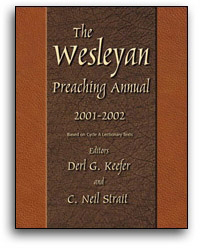
THE WESLEYAN PREACHING ANNUAL 2001--2002
CALL TO WORSHIP
Leader: God! We come to thank and enjoy You.
People: All of us present today in this sanctuary thank You.
Leader: People all over this land bring You thanks.
People: Let thanksgiving flow like a rushing river of water.
Leader: Amen! Let it be so.
OFFERING THOUGHT
God, we have so much to thank You for today - our health, country, family, and friends. But most of all, we thank You for being God of our lives. Amen.
BENEDICTION
Trusting in You
Hoping for eternity
Anwers to life's questions
Nation that is free
Keeping us in troubled times
Salvation for eternity
For all of this and more - THANKS!
SERMON BRIEFS
Praying For The Church
Ephesians 1:15--23
A great prayer movement is sweeping the world. It is estimated that 30 million people sense the call of God to a specific prayer ministry. The call is to engage in prayer walks, prayer circles, prayer concerts, and prayer chains. Prayer lines are available through various resources for the most urgent requests.
The prayer in Ephesians 1:15--23 is a gift from the Apostle Paul to those he loved. I thank God for those friends who have prayed daily for me across the years. Every time they tell me that, I am encouraged and thankful.
Paul's prayer consisted of three elements: thanksgiving, petition, and praise.
I. Thanksgiving
"I have not stopped giving thanks for you, remembering you in my prayers" (Ephesians 1:16). Even though it had been nearly five years since Paul had last seen these Ephesian believers, his love for them had not weakened. Paul was thankful for their faith in the Lord Jesus and for their love for all the saints.
True faith leads to true love. "For this reason, ever since I heard about your faith in the Lord Jesus and your love for all the saints" (v. 15).
Two essential characteristics of a true church are loyalty to Christ and love to others. Loyalty to Christ without love to others results in legalism and self--righteousness. The true Christian loves Christ and loves others. There is no other way to show love to Christ than by showing love to others. In reality, the love of Christ and love of others cannot exist without each other. Our tragedy is that it is too true, as Jonathan Swift once said: "We have just enough religion to make us hate, but not enough to make us love one another."
Begin your prayer with thanksgiving. Thank God for the gift of salvation, for forgiveness, for the body of Christ, for family and friends, for the ministry He has given you to do, for the love of God "for all the saints."
II. Petition
"I keep asking that the God of our Lord Jesus Christ, the glorious Father, may give you the Spirit of wisdom and revelation, so that you may know him better" (v. 17).
Note that before Paul petitions God, he pauses to reflect on to whom he is praying. When we pray, we have an audience with royalty. Therefore, we first honor him as God.
Paul offers four major petitions for a people he loves and for a church which is doing well.
A. Paul prays for the Spirit of wisdom and revelation (v. 17).
The word for wisdom used here is sophia which means the deep things of God. Paul prays that the believers will be led deeper and deeper in the knowledge and revelation of God.
Any person who follows any profession knows he or she must always pursue deeper discoveries. So it is with the Christian. We must continue to experience God in deep and rich ways. A friendship which does not grow closer with the years tends to grow weaker. And so it is with us and God.
B. Paul prays "that the eyes of your heart may be enlightened" (v. 18).
The heart is the center of a person's life. The heart here is pictured as a face with eyes.
When our hearts are enlightened, God's floodlight quickens our mind and understanding so we might know Him better.
C. Paul prays for a new realization of the Christian hope
" ... that you may know the hope to which he has called you" (v. 18).
Hopelessness is preached on every corner. But for the Christian, there is a future. "Hope is the soul's firm anchor in the infallible promises of God, moored to the very throne of God" (Hendriksen).
Hope is the basis of all Christian living.
D. Paul prays for "the riches of his glorious inheritance in the saints" (v. 18).
Christ paid a great price to redeem us and he will give us an inheritance that is incorruptible and undefiled.
E. Paul prays for a new realization of the incomparable great power of God (v. 19).
For Paul, the supreme proof of God's power was the resurrection (v. 20).
When sin and evil men had done everything they could to destroy Christ, the resurrection of Jesus was the proof that God's power is stronger than man's sin.
This power is available for every believer. This same power is at work in and through believers today.
III. Praise
"... which he exerted in Christ when he raised him from the dead and seated him at his right hand in the heavenly realms, far above all rule and authority, power and dominion, and every title that can be given, not only in the present age but also in the one to come. And God placed all things under his feet and appointed him to be head over everything for the church, which is his body, the fullness of him who fills everything in every way" (vv. 20--23).
Paul praises and honors Jesus Christ. Jesus is seated at the right hand of God - the place of authority and power.
In verse 21, Paul exalts Jesus as far above any classification of angelic or spiritual being.
In verse 22, Jesus has conquered all.
Paul wraps up the thanksgiving, petition, and praise in verses 22 and 23. He calls the church by its greatest title - the body of Christ. Christ is the head of the Church, and the Church is the body of Christ. The Church is the complement of Christ. God's plan for the world is in the hands of the Church. Jesus is counting on us.
Nina G. Gunter
A Case For Gladness
Psalm 100
Introduction
Psalm 100 is often memorized and quoted. It has been a source of strength and blessing to countless numbers of people for generations. We recognize many of the phrases from songs and choruses we sing.
In spite of its familiarity, we still learn from it each time we read or quote it. There are fresh lessons for us even today. As we approach another Thanksgiving Day, we are particularly challenged by the admonition to give thanks. As we will see, the psalmist makes a good case for gladness in our lives.
I. In the psalm we get a glimpse of the Lord Himself.
He is presented to us in a variety of ways.
A. We are reminded of the fact that in worship we come into the presence of God Himself.
1. When we come into the presence of God, we come before the creator.
"You alone are the LORD. You made the heavens, even the highest heavens, and all their starry host, the earth and all that is on it, the seas and all that is in them. You give life to everything, and the multitudes of heaven worship you" (Nehemiah 9:6 NIV).
2. He is the Lord of our lives. He is our sustainer and our protector. We are the sheep of His pasture and we are invited into a personal relationship with Him. He assumes responsibility for our care.
"The protection of his child and treasure, is a charge that on himself he laid."
"Of David. The LORD is my light and my salvation - whom shall I fear? The LORD is the stronghold of my life - of whom shall I be afraid?" (Psalms 27:1 NIV).
B. God is love. When we come to worship Him, we find ourselves in the presence of love itself. All of God's relationship with us is an outgrowth of love.
1. God is redemptive. He is always about the business of bringing us back to Himself. Both His wrath and His patience have as a goal our redemption.
"For God so loved the world that he gave his one and only Son, that whoever believes in him shall not perish but have eternal life" (John 3:16 NIV).
"... God does not take away life; instead, he devises ways so that a banished person may not remain estranged from him" (2 Samuel 14:14 NIV).
2. God is kind and faithful. We can lean strongly upon Him and depend on His goodness toward us. When we sing, "Great is thy faithfulness ..." we are singing the truth.
"Be strong and courageous. Do not be afraid or terrified because of them, for the LORD your God goes with you; he will never leave you nor forsake you" (Deuteronomy 31:6 NIV).
II. In this psalm we also get a glimpse of what the Lord expects of us.
A. God expects us to worship Him openly and freely. We are to worship even as we enter the gates. There is to be nothing hidden in our worship of the Lord as we sing and shout His glory.
B. God expects us to serve Him freely. Our worship cannot be separated from our service. A story is told of a man who arrived at church just at dismissal and asked, "Am I late for the worship service?" Another worshipper said, "You are late for worship and right on time for service."
"Jesus replied, 'If anyone loves me, he will obey my teaching' " (John 14:23 NIV).
C. God expects us to trust Him implicitly.
"For the LORD is good and his love endures forever; his faithfulness continues through all generations" (Psalms 100:5 NIV).
Don't you like the word "implicitly"? It means "contained in the nature of something ... having no doubts or reservations ... unquestioning ..." It is part of the nature of our faith that we trust God without doubt or question. We simply trust and obey.
Conclusion
We are challenged to sing and shout the praises of the Lord. We can sing some of these words in choruses which are well--known to us.
A. "I will enter his gates."
B. "I will sing of the mercies."
C. "God is so good."
Harold DeMott
Leader: God! We come to thank and enjoy You.
People: All of us present today in this sanctuary thank You.
Leader: People all over this land bring You thanks.
People: Let thanksgiving flow like a rushing river of water.
Leader: Amen! Let it be so.
OFFERING THOUGHT
God, we have so much to thank You for today - our health, country, family, and friends. But most of all, we thank You for being God of our lives. Amen.
BENEDICTION
Trusting in You
Hoping for eternity
Anwers to life's questions
Nation that is free
Keeping us in troubled times
Salvation for eternity
For all of this and more - THANKS!
SERMON BRIEFS
Praying For The Church
Ephesians 1:15--23
A great prayer movement is sweeping the world. It is estimated that 30 million people sense the call of God to a specific prayer ministry. The call is to engage in prayer walks, prayer circles, prayer concerts, and prayer chains. Prayer lines are available through various resources for the most urgent requests.
The prayer in Ephesians 1:15--23 is a gift from the Apostle Paul to those he loved. I thank God for those friends who have prayed daily for me across the years. Every time they tell me that, I am encouraged and thankful.
Paul's prayer consisted of three elements: thanksgiving, petition, and praise.
I. Thanksgiving
"I have not stopped giving thanks for you, remembering you in my prayers" (Ephesians 1:16). Even though it had been nearly five years since Paul had last seen these Ephesian believers, his love for them had not weakened. Paul was thankful for their faith in the Lord Jesus and for their love for all the saints.
True faith leads to true love. "For this reason, ever since I heard about your faith in the Lord Jesus and your love for all the saints" (v. 15).
Two essential characteristics of a true church are loyalty to Christ and love to others. Loyalty to Christ without love to others results in legalism and self--righteousness. The true Christian loves Christ and loves others. There is no other way to show love to Christ than by showing love to others. In reality, the love of Christ and love of others cannot exist without each other. Our tragedy is that it is too true, as Jonathan Swift once said: "We have just enough religion to make us hate, but not enough to make us love one another."
Begin your prayer with thanksgiving. Thank God for the gift of salvation, for forgiveness, for the body of Christ, for family and friends, for the ministry He has given you to do, for the love of God "for all the saints."
II. Petition
"I keep asking that the God of our Lord Jesus Christ, the glorious Father, may give you the Spirit of wisdom and revelation, so that you may know him better" (v. 17).
Note that before Paul petitions God, he pauses to reflect on to whom he is praying. When we pray, we have an audience with royalty. Therefore, we first honor him as God.
Paul offers four major petitions for a people he loves and for a church which is doing well.
A. Paul prays for the Spirit of wisdom and revelation (v. 17).
The word for wisdom used here is sophia which means the deep things of God. Paul prays that the believers will be led deeper and deeper in the knowledge and revelation of God.
Any person who follows any profession knows he or she must always pursue deeper discoveries. So it is with the Christian. We must continue to experience God in deep and rich ways. A friendship which does not grow closer with the years tends to grow weaker. And so it is with us and God.
B. Paul prays "that the eyes of your heart may be enlightened" (v. 18).
The heart is the center of a person's life. The heart here is pictured as a face with eyes.
When our hearts are enlightened, God's floodlight quickens our mind and understanding so we might know Him better.
C. Paul prays for a new realization of the Christian hope
" ... that you may know the hope to which he has called you" (v. 18).
Hopelessness is preached on every corner. But for the Christian, there is a future. "Hope is the soul's firm anchor in the infallible promises of God, moored to the very throne of God" (Hendriksen).
Hope is the basis of all Christian living.
D. Paul prays for "the riches of his glorious inheritance in the saints" (v. 18).
Christ paid a great price to redeem us and he will give us an inheritance that is incorruptible and undefiled.
E. Paul prays for a new realization of the incomparable great power of God (v. 19).
For Paul, the supreme proof of God's power was the resurrection (v. 20).
When sin and evil men had done everything they could to destroy Christ, the resurrection of Jesus was the proof that God's power is stronger than man's sin.
This power is available for every believer. This same power is at work in and through believers today.
III. Praise
"... which he exerted in Christ when he raised him from the dead and seated him at his right hand in the heavenly realms, far above all rule and authority, power and dominion, and every title that can be given, not only in the present age but also in the one to come. And God placed all things under his feet and appointed him to be head over everything for the church, which is his body, the fullness of him who fills everything in every way" (vv. 20--23).
Paul praises and honors Jesus Christ. Jesus is seated at the right hand of God - the place of authority and power.
In verse 21, Paul exalts Jesus as far above any classification of angelic or spiritual being.
In verse 22, Jesus has conquered all.
Paul wraps up the thanksgiving, petition, and praise in verses 22 and 23. He calls the church by its greatest title - the body of Christ. Christ is the head of the Church, and the Church is the body of Christ. The Church is the complement of Christ. God's plan for the world is in the hands of the Church. Jesus is counting on us.
Nina G. Gunter
A Case For Gladness
Psalm 100
Introduction
Psalm 100 is often memorized and quoted. It has been a source of strength and blessing to countless numbers of people for generations. We recognize many of the phrases from songs and choruses we sing.
In spite of its familiarity, we still learn from it each time we read or quote it. There are fresh lessons for us even today. As we approach another Thanksgiving Day, we are particularly challenged by the admonition to give thanks. As we will see, the psalmist makes a good case for gladness in our lives.
I. In the psalm we get a glimpse of the Lord Himself.
He is presented to us in a variety of ways.
A. We are reminded of the fact that in worship we come into the presence of God Himself.
1. When we come into the presence of God, we come before the creator.
"You alone are the LORD. You made the heavens, even the highest heavens, and all their starry host, the earth and all that is on it, the seas and all that is in them. You give life to everything, and the multitudes of heaven worship you" (Nehemiah 9:6 NIV).
2. He is the Lord of our lives. He is our sustainer and our protector. We are the sheep of His pasture and we are invited into a personal relationship with Him. He assumes responsibility for our care.
"The protection of his child and treasure, is a charge that on himself he laid."
"Of David. The LORD is my light and my salvation - whom shall I fear? The LORD is the stronghold of my life - of whom shall I be afraid?" (Psalms 27:1 NIV).
B. God is love. When we come to worship Him, we find ourselves in the presence of love itself. All of God's relationship with us is an outgrowth of love.
1. God is redemptive. He is always about the business of bringing us back to Himself. Both His wrath and His patience have as a goal our redemption.
"For God so loved the world that he gave his one and only Son, that whoever believes in him shall not perish but have eternal life" (John 3:16 NIV).
"... God does not take away life; instead, he devises ways so that a banished person may not remain estranged from him" (2 Samuel 14:14 NIV).
2. God is kind and faithful. We can lean strongly upon Him and depend on His goodness toward us. When we sing, "Great is thy faithfulness ..." we are singing the truth.
"Be strong and courageous. Do not be afraid or terrified because of them, for the LORD your God goes with you; he will never leave you nor forsake you" (Deuteronomy 31:6 NIV).
II. In this psalm we also get a glimpse of what the Lord expects of us.
A. God expects us to worship Him openly and freely. We are to worship even as we enter the gates. There is to be nothing hidden in our worship of the Lord as we sing and shout His glory.
B. God expects us to serve Him freely. Our worship cannot be separated from our service. A story is told of a man who arrived at church just at dismissal and asked, "Am I late for the worship service?" Another worshipper said, "You are late for worship and right on time for service."
"Jesus replied, 'If anyone loves me, he will obey my teaching' " (John 14:23 NIV).
C. God expects us to trust Him implicitly.
"For the LORD is good and his love endures forever; his faithfulness continues through all generations" (Psalms 100:5 NIV).
Don't you like the word "implicitly"? It means "contained in the nature of something ... having no doubts or reservations ... unquestioning ..." It is part of the nature of our faith that we trust God without doubt or question. We simply trust and obey.
Conclusion
We are challenged to sing and shout the praises of the Lord. We can sing some of these words in choruses which are well--known to us.
A. "I will enter his gates."
B. "I will sing of the mercies."
C. "God is so good."
Harold DeMott
