
The Divine Mission
Sermon
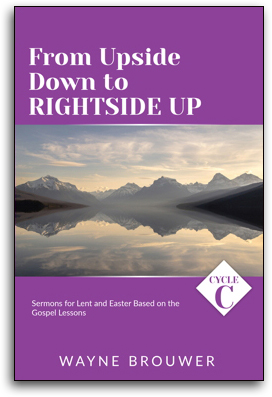
From Upside Down To Rightside Up
Cycle C Sermons for Lent and Easter Based on the Gospel Lessons
A friend of mine taught ethics at a Christian college. Several years ago, there was a scare on campus because a student had been raped. Since my friend wanted his students to deal with actual ethical situations, he began the next class session with a question: “If a friend came to your room in tears, telling how her date had just raped her, what is the first thing you would do to help her?”
After a moment’s reflective silence one student raised her hand and asked, tentatively, “Pray?”
The whole class tittered in nervous laughter, relieved to have a spot of comic relief to ease the tension. Even my friend found himself smiling and shaking his head slightly. “Of course,” he said, “but then what would you do?” For the next hour he led the gathering in an ethical discussion of social care for someone who had been deeply hurt.
When my friend got home that evening, he reflected on the class session and then began to grow restless. Why, at a Christian college, he thought, should the suggestion of helping someone by beginning with prayer be greeted with laughter? And why should even he, an ordained minister of the gospel and a Christian ethics professor, initially wave off the suggestion of prayer as simply a polite formality to be dispensed with before the real business of helping began? Why should prayer seem so insignificant and powerless?
Does Prayer Work?
Jesus’ prayer is powerful, of course, isn’t it? I have always loved John 17, and this great prayer Jesus voiced. Over the years it has come to be known as Jesus’ “high priestly prayer,” because Jesus stands with us and for us before the Father, begging and pleading for our lives to resonate with divine love. Yet did Jesus’ own prayer work? Do we, who know these things, actually find them changing our behaviors? Does prayer, even Jesus’ prayer, work?
These are important questions, for despite our pious talk we often treat prayer with apologetic skepticism. When I was a seminary student, one of the elders at the church where I was working decided to make a career move. He invited the pastor and me to a demonstration of a product promotion speech he was developing as he began a sales and distribution job with a nationally famous pyramid-like company. During our evening together, he played a tape of a motivational speech he had heard at a recent company rally. The most gripping speaker was a former pastor who now was a top sales distributor for this famous firm.
“I used to be a pastor,” the man said, “and all I had to give people was prayer. When I was a pastor, I had a man come to me weeping for the tragedy of his life. ‘I’m a poor fellow, pastor,’ the man cried, ‘and it is ruining my marriage. I can’t make enough to buy my wife the things she wants, and our children feel out of place at school with their shabby clothes. Sometimes I think I should divorce my wife, because then she would get more money from the government than she gets from me. What should I do, pastor?’
“I felt so bad,” said the former pastor, now turned top salesman. “At that time all I could offer the man was prayer. If only I knew then what I know now. If he came to me today, I could help him so much more!”
The crowd roared with approval and applauded that former pastor as if he were God. I think of that man’s motivational speech every time I sit at the bedside of a terminally ill cancer patient. I think of that speech when I wrestle in prayer with a couple nearing divorce. I think of his words when I pray with a friend of mine whose life has been mostly depression and drugs. Does prayer help? Is it more an exercise in placating my uneasy conscience than it is a true “first aid?” I wonder.
The Breath Of Heaven
Yet when I look back over my years of praying and being prayed over, I realize that there is also a larger picture to paint about prayer. For one thing, as Bishop William Temple said, “I don’t know if prayer works, but I do know that when I stop praying, coincidences stop.” I too have found that truth in my life. Although I cannot document every exact answer to prayer, I do know that unseen forces have often assisted me and those I have prayed with in ways beyond rational explanation. Even the medical community has recognized the healing power of prayer, as Dr. Lawrence Dossey has reported in several of his books.
Second, I think of the way that help comes best when we are children. I watched a young girl and boy collide while running through a hallway the other day, banging heads, and falling backward onto the floor. Each was stunned, momentarily, and then each looked around for a nearby parent. It was not until they spied caring mothers that each began a mighty and mournful wail. Not only that, but the crying from pain changed its tone when they each rested in the comfort of hugging arms—wails that earlier seemed edged with torment became whimperings seeking sympathy. A big part of prayer, it seems from scripture, has to do with finding our way into the care of a Father, even when the hurts and pains of life still trouble us.
Third, I think that Jesus is reminding his disciples, and us through them, that we are not alone in the universe, and that times of trouble are times of returning to our truest human condition of spiritual need. Jesus does not promise that all our fortunes will change because a magical prayer has been offered. Rather, he indicates that precisely when we are so troubled, the natural place for us to turn is outside of ourselves and to God. As M. Scott Peck put it in his powerful book, A World Waiting to Be Born, either we know the truth of our spiritual need or we spend our lives playing games with ourselves and others that steal the best of who we are away from us.
Transforming Grace
I think of Fred. Fred was a big man with a big heart. His life had been ringed with tragedy, but he had grown through it and chose to spend his last career years as a missionary in Africa. A few years later he was returned to our town near death. A brain tumor had suddenly appeared and quickly robbed him of speech and motor control. He was hospitalized for several weeks and then released to die at home.
We prayed much for Fred. We shared the personal and family needs through a wide web of Christian contacts. We held specific healing services and added Fred’s condition to our weekly prayer bulletin.
Despite our best desires, we gradually became aware that only death would bring divine healing. Fred’s life this side of eternity was too far destroyed for recovery.
I made regular visits to the small house that Fred’s wife purchased. Mostly Fred lay in bed moaning and restless. While his muscles contorted horribly, his skin began to turn unhuman shades of gray. Several times the family members, scattered at some distance, were called together for what appeared to be “the end.”
On one of these occasions, I stood with them in a circle around Fred’s bed. Fred was greatly agitated and moaned incomprehensibly. I read a Psalm and a promise from Paul, and then we prayed together, holding hands, asking God to take Fred home soon. It only seemed, however, that Fred’s inner restlessness got worse. I stepped closer to the bed and placed my hand on his forehead. I spoke directly to him the blessing he himself had pronounced over God’s people so many times: “The Lord bless you and keep you, Fred. The Lord make his face shine upon you. The Lord smile upon you and give you his peace” (Numbers 6:24-26).
Immediately Fred settled peacefully, his muscles relaxing and his labored breath easing. “You can go home now, Fred,” I said. Each family member held Fred’s hands briefly, speaking words of care release. I walked out of the house. Before I could drive away, Fred slipped into eternity.
Keep Fred’s story in mind as I take you on another pastoral visit, happening at the same time. LaVern struggled with open sores on her legs, among several different ailments. She was in great pain most always and alternated between weeks of sitting in a lounge chair with her legs elevated and periods of aggressive treatment in the hospital. We prayed together regularly over the telephone, and now and then I would sit with her for an hour, sharing the whimsy of life. Few people I knew have endured as much pain and heartbreak as has LaVern. Yet fewer still have developed as joyful an outlook on the many small graces of existence.
One day LaVern called me with a new request. She wanted me to come over with an elder of the church to anoint her with oil. I called one of the elders, a trusted prayer partner, and we gathered around LaVern’s chair. First, we spent time confessing to one another, then we spent time in prayer. We shared the bread and cup of the sacrament, seeking intimacy with Jesus and one another in the body. We touched the sores on LaVern’s legs and begged for healing. Then I took the oil and rubbed it gently over LaVern’s wounds, commanding them, in the name of Jesus, to be healed. We gave God thanks for the healing he was bringing and would accomplish, and I spoke the same blessing I had pronounced over Fred.
There was no “electric shock” moving through my fingers or LaVern’s legs, nor any immediate end to the weeping from the skin openings. Yet in the next week, a remarkable change took place, both in the peace that infused LaVern’s heart and the clear closures of the wounds. Her doctors put off scheduled surgery and several months later LaVern came to Sunday worship for the first time in a year, standing on her own legs.
LaVern’s struggles with those sores continued over the years, and she called for intercession many times. Now and again we looked back to the day we met together with the elders of the church and anointed her wounds as a watershed moment. LaVern believed she experienced a special healing in that moment. I think so too.
I also think Fred was healed in the moment of our touch at his bedside, though in a different way. There is power for life in the gospel of Jesus that sometimes works through the medical industries of our culture and sometimes works despite them. There is nothing in the Bible to call into question a Christian’s use of doctors and prescription medications. But neither does the Bible tell us that doctors are the true great physician. Whenever healing happens, God has smiled. And that is why intercession matters.
Spreading Love
Sometimes in small moments of care, sometimes in consequential movements of socially transforming “great awakenings,” the prayer of Jesus in John 17 unfolds in our lives. When Geoffrey Wainwright wrote a summary of his theology, he called the resulting work Doxology, a song of praise to God. But he found all his words inadequate to convey what his theology meant for living. So he pulled his doctrinal treatises together with this concluding story:
Many years ago, Turkish soldiers raided an Armenian home. The officer in charge ordered the parents killed and gave the daughters to his soldiers to be raped and brought home as slaves. He kept the oldest daughter for himself, using her again and again in despicable ways.
One day, the oldest daughter escaped. After she found her life again, she trained to be a nurse. But when she was finally assigned to a hospital, she discovered that her ward was filled with Turkish officers.
Late one night, her old enemy was brought in. By the light of the lantern, she could see he was near death. She would not have to try to kill him ― with a little neglect, he would be gone.
But the man did not die. As the days passed, he recovered strength. One morning the doctor told him how fortunate he was. The doctor pointed to the young nurse and said, “But for her devotion to you, you would be dead.”
Recognizing her, the officer asked, “Why didn’t you kill me?” She simply replied, “I am a follower of him who said, `Love your enemies.’”
Yes indeed. .
After a moment’s reflective silence one student raised her hand and asked, tentatively, “Pray?”
The whole class tittered in nervous laughter, relieved to have a spot of comic relief to ease the tension. Even my friend found himself smiling and shaking his head slightly. “Of course,” he said, “but then what would you do?” For the next hour he led the gathering in an ethical discussion of social care for someone who had been deeply hurt.
When my friend got home that evening, he reflected on the class session and then began to grow restless. Why, at a Christian college, he thought, should the suggestion of helping someone by beginning with prayer be greeted with laughter? And why should even he, an ordained minister of the gospel and a Christian ethics professor, initially wave off the suggestion of prayer as simply a polite formality to be dispensed with before the real business of helping began? Why should prayer seem so insignificant and powerless?
Does Prayer Work?
Jesus’ prayer is powerful, of course, isn’t it? I have always loved John 17, and this great prayer Jesus voiced. Over the years it has come to be known as Jesus’ “high priestly prayer,” because Jesus stands with us and for us before the Father, begging and pleading for our lives to resonate with divine love. Yet did Jesus’ own prayer work? Do we, who know these things, actually find them changing our behaviors? Does prayer, even Jesus’ prayer, work?
These are important questions, for despite our pious talk we often treat prayer with apologetic skepticism. When I was a seminary student, one of the elders at the church where I was working decided to make a career move. He invited the pastor and me to a demonstration of a product promotion speech he was developing as he began a sales and distribution job with a nationally famous pyramid-like company. During our evening together, he played a tape of a motivational speech he had heard at a recent company rally. The most gripping speaker was a former pastor who now was a top sales distributor for this famous firm.
“I used to be a pastor,” the man said, “and all I had to give people was prayer. When I was a pastor, I had a man come to me weeping for the tragedy of his life. ‘I’m a poor fellow, pastor,’ the man cried, ‘and it is ruining my marriage. I can’t make enough to buy my wife the things she wants, and our children feel out of place at school with their shabby clothes. Sometimes I think I should divorce my wife, because then she would get more money from the government than she gets from me. What should I do, pastor?’
“I felt so bad,” said the former pastor, now turned top salesman. “At that time all I could offer the man was prayer. If only I knew then what I know now. If he came to me today, I could help him so much more!”
The crowd roared with approval and applauded that former pastor as if he were God. I think of that man’s motivational speech every time I sit at the bedside of a terminally ill cancer patient. I think of that speech when I wrestle in prayer with a couple nearing divorce. I think of his words when I pray with a friend of mine whose life has been mostly depression and drugs. Does prayer help? Is it more an exercise in placating my uneasy conscience than it is a true “first aid?” I wonder.
The Breath Of Heaven
Yet when I look back over my years of praying and being prayed over, I realize that there is also a larger picture to paint about prayer. For one thing, as Bishop William Temple said, “I don’t know if prayer works, but I do know that when I stop praying, coincidences stop.” I too have found that truth in my life. Although I cannot document every exact answer to prayer, I do know that unseen forces have often assisted me and those I have prayed with in ways beyond rational explanation. Even the medical community has recognized the healing power of prayer, as Dr. Lawrence Dossey has reported in several of his books.
Second, I think of the way that help comes best when we are children. I watched a young girl and boy collide while running through a hallway the other day, banging heads, and falling backward onto the floor. Each was stunned, momentarily, and then each looked around for a nearby parent. It was not until they spied caring mothers that each began a mighty and mournful wail. Not only that, but the crying from pain changed its tone when they each rested in the comfort of hugging arms—wails that earlier seemed edged with torment became whimperings seeking sympathy. A big part of prayer, it seems from scripture, has to do with finding our way into the care of a Father, even when the hurts and pains of life still trouble us.
Third, I think that Jesus is reminding his disciples, and us through them, that we are not alone in the universe, and that times of trouble are times of returning to our truest human condition of spiritual need. Jesus does not promise that all our fortunes will change because a magical prayer has been offered. Rather, he indicates that precisely when we are so troubled, the natural place for us to turn is outside of ourselves and to God. As M. Scott Peck put it in his powerful book, A World Waiting to Be Born, either we know the truth of our spiritual need or we spend our lives playing games with ourselves and others that steal the best of who we are away from us.
Transforming Grace
I think of Fred. Fred was a big man with a big heart. His life had been ringed with tragedy, but he had grown through it and chose to spend his last career years as a missionary in Africa. A few years later he was returned to our town near death. A brain tumor had suddenly appeared and quickly robbed him of speech and motor control. He was hospitalized for several weeks and then released to die at home.
We prayed much for Fred. We shared the personal and family needs through a wide web of Christian contacts. We held specific healing services and added Fred’s condition to our weekly prayer bulletin.
Despite our best desires, we gradually became aware that only death would bring divine healing. Fred’s life this side of eternity was too far destroyed for recovery.
I made regular visits to the small house that Fred’s wife purchased. Mostly Fred lay in bed moaning and restless. While his muscles contorted horribly, his skin began to turn unhuman shades of gray. Several times the family members, scattered at some distance, were called together for what appeared to be “the end.”
On one of these occasions, I stood with them in a circle around Fred’s bed. Fred was greatly agitated and moaned incomprehensibly. I read a Psalm and a promise from Paul, and then we prayed together, holding hands, asking God to take Fred home soon. It only seemed, however, that Fred’s inner restlessness got worse. I stepped closer to the bed and placed my hand on his forehead. I spoke directly to him the blessing he himself had pronounced over God’s people so many times: “The Lord bless you and keep you, Fred. The Lord make his face shine upon you. The Lord smile upon you and give you his peace” (Numbers 6:24-26).
Immediately Fred settled peacefully, his muscles relaxing and his labored breath easing. “You can go home now, Fred,” I said. Each family member held Fred’s hands briefly, speaking words of care release. I walked out of the house. Before I could drive away, Fred slipped into eternity.
Keep Fred’s story in mind as I take you on another pastoral visit, happening at the same time. LaVern struggled with open sores on her legs, among several different ailments. She was in great pain most always and alternated between weeks of sitting in a lounge chair with her legs elevated and periods of aggressive treatment in the hospital. We prayed together regularly over the telephone, and now and then I would sit with her for an hour, sharing the whimsy of life. Few people I knew have endured as much pain and heartbreak as has LaVern. Yet fewer still have developed as joyful an outlook on the many small graces of existence.
One day LaVern called me with a new request. She wanted me to come over with an elder of the church to anoint her with oil. I called one of the elders, a trusted prayer partner, and we gathered around LaVern’s chair. First, we spent time confessing to one another, then we spent time in prayer. We shared the bread and cup of the sacrament, seeking intimacy with Jesus and one another in the body. We touched the sores on LaVern’s legs and begged for healing. Then I took the oil and rubbed it gently over LaVern’s wounds, commanding them, in the name of Jesus, to be healed. We gave God thanks for the healing he was bringing and would accomplish, and I spoke the same blessing I had pronounced over Fred.
There was no “electric shock” moving through my fingers or LaVern’s legs, nor any immediate end to the weeping from the skin openings. Yet in the next week, a remarkable change took place, both in the peace that infused LaVern’s heart and the clear closures of the wounds. Her doctors put off scheduled surgery and several months later LaVern came to Sunday worship for the first time in a year, standing on her own legs.
LaVern’s struggles with those sores continued over the years, and she called for intercession many times. Now and again we looked back to the day we met together with the elders of the church and anointed her wounds as a watershed moment. LaVern believed she experienced a special healing in that moment. I think so too.
I also think Fred was healed in the moment of our touch at his bedside, though in a different way. There is power for life in the gospel of Jesus that sometimes works through the medical industries of our culture and sometimes works despite them. There is nothing in the Bible to call into question a Christian’s use of doctors and prescription medications. But neither does the Bible tell us that doctors are the true great physician. Whenever healing happens, God has smiled. And that is why intercession matters.
Spreading Love
Sometimes in small moments of care, sometimes in consequential movements of socially transforming “great awakenings,” the prayer of Jesus in John 17 unfolds in our lives. When Geoffrey Wainwright wrote a summary of his theology, he called the resulting work Doxology, a song of praise to God. But he found all his words inadequate to convey what his theology meant for living. So he pulled his doctrinal treatises together with this concluding story:
Many years ago, Turkish soldiers raided an Armenian home. The officer in charge ordered the parents killed and gave the daughters to his soldiers to be raped and brought home as slaves. He kept the oldest daughter for himself, using her again and again in despicable ways.
One day, the oldest daughter escaped. After she found her life again, she trained to be a nurse. But when she was finally assigned to a hospital, she discovered that her ward was filled with Turkish officers.
Late one night, her old enemy was brought in. By the light of the lantern, she could see he was near death. She would not have to try to kill him ― with a little neglect, he would be gone.
But the man did not die. As the days passed, he recovered strength. One morning the doctor told him how fortunate he was. The doctor pointed to the young nurse and said, “But for her devotion to you, you would be dead.”
Recognizing her, the officer asked, “Why didn’t you kill me?” She simply replied, “I am a follower of him who said, `Love your enemies.’”
Yes indeed. .
