
Good Friday
Worship
Lectionary Worship Workbook, Series IV, Cycle C
Soul Motion
Object:
Consider opening the sanctuary from noon until 7:00 p.m. so people can stop by on their way home from work, with fifteen- to thirty-minute "services" at noon, 3:00, and 6:00. Another option is to read one scripture and sing one hymn at the top of each hour. Deacons, Stephen Ministers, Elders, and other leaders may wish to schedule themselves to "cover" a block of time so attendees are not alone with the Good Friday experience.
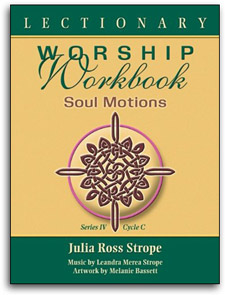
Have available copies of the Celtic knot from the book cover and the hands found on the divider pages.
Record instrumental versions of nineteenth-century cross hymns to play during the hours the sanctuary is open. These hours are for persons who wish to "feel" the pain of injustice, guilt, shame, and betrayal surrounding Jesus' death.
People enter space/sanctuary, dimly lighted, with instrumental music playing quietly, live or recorded -- the classical passions, sections from Jesus Christ Superstar, jazz masses, Tavener's Ikos, and the nineteenth-century cross hymns.
The cross may be draped in black; a single red or white rose might be placed on the communion table along with the chalice, paten (with a loaf of bread), and a single large white burning candle.
In a corner of the sanctuary, between "services," people could fill Easter baskets for a Hospice/AIDS center or for the staff of an emergency room. Individually wrapped candies could be donated several weeks prior to Good Friday. Baskets must be small, wrapped in clear cellophane, and labeled with the church's name. Deacons, Stephen Ministers, or other church leaders can deliver the baskets later in the evening or the next morning.
At prescribed times the leader gathers people for "group" meditation.
Leader: It's Good Friday. Welcome to this time and space. Here you can be saturated with Divine Actions of the past; Palm Sunday slid through Maundy Thursday into "God's Friday." Here you can steep yourself in the present with all your senses and your mind alert for Holy Conversation. Here you can consider the future and how you will honor the time and experience of today.
Hear the story of Jesus of Nazareth, how his culture -- the Roman Occupation and religious people -- murdered him. In Jesus dying, we see the violent mindset of humanity. His death calls us to be aware of our own sins -- prejudice, miserliness, cynicism, arrogance....
Leader gives a brief synopsis of Holy Week
Jesus entered Jerusalem last Sunday with fanfare and a cheerful crowd. However, the high hopes for freedom from oppression vanished by Thursday evening when Judas left Jesus and the other disciples to celebrate the Passover meal without him while he negotiated Jesus' arrest. After a trial and a mob's accusations, Jesus was sentenced to death. Here's the next part of the story.
Leader reads Luke 23:26-56
(Include the burial scene since many people will not read it before Sunday's Resurrection Story.)
Leader/musician plays (live or recorded)
"When I Survey The Wondrous Cross"
(Invite people to hum the melody while reading the words in the hymnal silently.)
Leader invites people to look at the Celtic knot
(Read aloud the interpretation found at the front of this book. Lead the people in a brief meditation):
Leader: Look at the undulations in the knot; notice the cross-overs and turns. Each person meanders this cross/star pathway. We each carry within us the characters who walked with Jesus.
Look at the knot. What of you is Peter? How are you like Judas? When are you Mother Mary? When are you Mary Magdalene? What of you participates unwittingly in maligning the Holy? Where are you when God is speaking?
Look at the hands. How do your hands betray God? How do your hands receive God's gift? How do your hands treasure and share God's gift?
Look at the knot and the hands. How does your experience today take you into the world as a vital twenty-first-century disciple of Jesus the Christ?
Leader Prays
Living God -- we know that Jesus, your Child, died long ago. Somehow, his death continues to touch us. We regret that his life ended too soon. Somehow, your love impels us to find ways to make you visible in this world. Thank you for Jesus, for his teachings, and for the vitality of his living, then and now. Amen.
Leader concludes the meditation time with a live or recorded solo
(If the people are to stay with the pain -- "Were You There When They Crucified My Lord?" or if present time is to be emphasized, a benediction like "May You Run And Not Be Weary," by Hanson and Murakami, found in Sing the Faith #2281)
(After concluding the last service, the leader blows out the one candle and turns out the lights except for hallways and stairs and says, "Good night.")
Music
Go To Dark Gethsemane
Words: James Montgomery, 1820, 1825, alt.
Music: Richard Redhead, 1853
REDHEAD 76
Were You There?
Words: African-American spiritual
Music: African-American spiritual; arr. Melva Wilson Costen, 1987
WERE YOU THERE
Have available copies of the Celtic knot from the book cover and the hands found on the divider pages.
Record instrumental versions of nineteenth-century cross hymns to play during the hours the sanctuary is open. These hours are for persons who wish to "feel" the pain of injustice, guilt, shame, and betrayal surrounding Jesus' death.
People enter space/sanctuary, dimly lighted, with instrumental music playing quietly, live or recorded -- the classical passions, sections from Jesus Christ Superstar, jazz masses, Tavener's Ikos, and the nineteenth-century cross hymns.
The cross may be draped in black; a single red or white rose might be placed on the communion table along with the chalice, paten (with a loaf of bread), and a single large white burning candle.
In a corner of the sanctuary, between "services," people could fill Easter baskets for a Hospice/AIDS center or for the staff of an emergency room. Individually wrapped candies could be donated several weeks prior to Good Friday. Baskets must be small, wrapped in clear cellophane, and labeled with the church's name. Deacons, Stephen Ministers, or other church leaders can deliver the baskets later in the evening or the next morning.
At prescribed times the leader gathers people for "group" meditation.
Leader: It's Good Friday. Welcome to this time and space. Here you can be saturated with Divine Actions of the past; Palm Sunday slid through Maundy Thursday into "God's Friday." Here you can steep yourself in the present with all your senses and your mind alert for Holy Conversation. Here you can consider the future and how you will honor the time and experience of today.
Hear the story of Jesus of Nazareth, how his culture -- the Roman Occupation and religious people -- murdered him. In Jesus dying, we see the violent mindset of humanity. His death calls us to be aware of our own sins -- prejudice, miserliness, cynicism, arrogance....
Leader gives a brief synopsis of Holy Week
Jesus entered Jerusalem last Sunday with fanfare and a cheerful crowd. However, the high hopes for freedom from oppression vanished by Thursday evening when Judas left Jesus and the other disciples to celebrate the Passover meal without him while he negotiated Jesus' arrest. After a trial and a mob's accusations, Jesus was sentenced to death. Here's the next part of the story.
Leader reads Luke 23:26-56
(Include the burial scene since many people will not read it before Sunday's Resurrection Story.)
Leader/musician plays (live or recorded)
"When I Survey The Wondrous Cross"
(Invite people to hum the melody while reading the words in the hymnal silently.)
Leader invites people to look at the Celtic knot
(Read aloud the interpretation found at the front of this book. Lead the people in a brief meditation):
Leader: Look at the undulations in the knot; notice the cross-overs and turns. Each person meanders this cross/star pathway. We each carry within us the characters who walked with Jesus.
Look at the knot. What of you is Peter? How are you like Judas? When are you Mother Mary? When are you Mary Magdalene? What of you participates unwittingly in maligning the Holy? Where are you when God is speaking?
Look at the hands. How do your hands betray God? How do your hands receive God's gift? How do your hands treasure and share God's gift?
Look at the knot and the hands. How does your experience today take you into the world as a vital twenty-first-century disciple of Jesus the Christ?
Leader Prays
Living God -- we know that Jesus, your Child, died long ago. Somehow, his death continues to touch us. We regret that his life ended too soon. Somehow, your love impels us to find ways to make you visible in this world. Thank you for Jesus, for his teachings, and for the vitality of his living, then and now. Amen.
Leader concludes the meditation time with a live or recorded solo
(If the people are to stay with the pain -- "Were You There When They Crucified My Lord?" or if present time is to be emphasized, a benediction like "May You Run And Not Be Weary," by Hanson and Murakami, found in Sing the Faith #2281)
(After concluding the last service, the leader blows out the one candle and turns out the lights except for hallways and stairs and says, "Good night.")
Music
Go To Dark Gethsemane
Words: James Montgomery, 1820, 1825, alt.
Music: Richard Redhead, 1853
REDHEAD 76
Were You There?
Words: African-American spiritual
Music: African-American spiritual; arr. Melva Wilson Costen, 1987
WERE YOU THERE
