
"Hallowed Be Thy Name"
Sermon
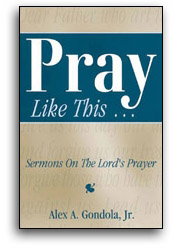
PRAY LIKE THIS ...
Sermons On The Lord's Prayer
My previous church in West Springfield - like this one - was located next to a graveyard. Only in West Springfield the graves came right up to the side of the church itself. It was a grave sight! If you were bored with the sermon, and glanced out the window, you likely faced an eighteenth century carving of the Grim Reaper!
Church volunteers maintained that cemetery for years. They lovingly cared for the ancient stones, some of which were 250 years old. They cut the grass. They pulled the weeds. They pruned the bushes and repaired the wrought--iron fences.
That ancient burial ground was treated with respect. It was, in fact, an oasis of green in a somewhat run--down part of town. Still, every Halloween, it was also a potential target. The Trustees knew this. They kept the gates locked. The cemetery was well lit. The police did their best to patrol it. Actually, police coverage around the church was always excellent. One sergeant in my congregation attributed it to our strategic location: one block from the Station House and two doors from Dunkin' Donuts!
Unfortunately, one Halloween, vandals did get into the cemetery. They turned over or broke some of the ancient stones. They spray--painted some of the modern monuments, too.
I remember going out to the cemetery the morning after Halloween. Ed was with me. Ed was a seventy--year member. Most of Ed's family was buried in that graveyard. Ed and his wife would be buried in that cemetery, too. The old gentleman was clearly pained when he saw the damaged stones. I remember his eyes misting with anger and frustration as he asked, "Alex, isn't anything sacred anymore?"
"Isn't anything sacred anymore?" That's a good question! I'm not a social conservative. But I sometimes wonder myself. For it seems to me many things we used to hold in reverence just aren't respected. Take, for example, the Oval Office at the White House. Some presidents wouldn't even take off their suit coats or loosen their ties while in that room. Yet we all know how the Oval Office and its surrounding rooms have been misused. One result, I think, could be an erosion of respect for the Presidency of the United States.
Take the men who used to be the role models of my childhood: Christopher Columbus, George Washington, and Thomas Jefferson among them. Every schoolchild was taught to honor them. Good--bye, Columbus! In twenty years his reputation has changed from courageous explorer to exploiter of indigenous peoples. Washington and Jefferson don't shine with quite the same luster anymore either. For most of us now know more about these "Fathers of our Country" and their sex lives than we really care to know.
Take the American flag. When I was in elementary school, flag raising and flag lowering was a big daily ceremony. It took four people either to raise or to lower the flag: one child to hold it, one child to fold it, one child to salute it, and a teacher to oversee. It was an honor to be chosen to raise or lower the flag. Often the teacher granted it as a reward for good behavior. I myself got to raise the flag about twice.
Heaven help you if you accidentally let the flag touch the ground or didn't fold it correctly! We thought lightning would strike us dead! But (until the recent patriotic revival after the events of September 11, 2001) I would guess flag raising and lowering was not a ceremony at most of our schools until recently. It just was not considered important.
I could go on: a loss of reverence for life (children killing children), the erosion of marriage, the breakup of the family, our abuse of the planet (which Native Americans considered sacred). But you know the problems all too well. Ed's question raised the day after Halloween in that desecrated graveyard is still valid: Isn't there anything sacred anymore?
But then we come to our Lord's Prayer and its very first petition. Jesus said to his disciples and us, "Pray like this; Our Father who art in heaven, hallowed be thy name" (Matthew 6:9 RSV). To "hallow" means "to respect greatly," "to make holy or set apart," "to venerate," or "to hold sacred."
The first thing we should ask for in prayer is that God be respected. Our duty is to honor God, even before we pray for our daily bread. Is anything sacred? The name of God is!
Now there's more to this petition than just not cursing. Although the Third Commandment says God is not pleased when we take God's name in vain, we ask God to damn a hammer. How foolish! We want the Creator of the Universe to curse an inanimate object? That's disrespectful and an abuse of God's name. And if it hurts us when our good names are misused, can't we also assume using God's name as a curse is hurtful to God?
President Woodrow Wilson's father was a distinguished Presbyterian minister. Dr. Wilson once was with a group of men who were having a heated debate. In the midst of the argument one of the men took the Lord's name in vain. Then he realized Dr. Wilson, the Presbyterian pastor, the President's father, was there. The man apologized profusely to the pastor. To which Dr. Wilson responded, "It is not to me that you owe your apology, but to God" (reported in The Lord's Prayer by Clarence Macartney, Fleming H. Revell Company, p. 26).
Hallowing the name of God means not cursing. But it's more than just not cursing. It is treating God with the measure of respect God truly deserves. God deserves to be respected because God is our Creator. The Psalmist says the moon and the stars are the work of God's hands. Psalm 8: "O Lord, our Lord, how majestic is thy name in all the earth" (v. 1 RSV). God raised up the mountains and poured out the oceans. The skies above us, with their white clouds and deep blues and pinks and grays at sunset, are the canvas of God. "The sky is ... daily bread of (our) eyes," writes Emerson.
Every blade of grass is infused with the goodness of God. Spring is God's way of saying, "Do it again! Do it again!" "Earth's crammed with heaven, and every common bush afire with God," writes Elizabeth Barrett Browning.
Another poet, Joyce Kilmer, writes in a poem we all learned as children:
I think that I shall never see
A poem as lovely as a tree.
A tree whose hungry mouth is pressed
Against the earth's sweet flowing breast.
Poems are made by fools like me.
But only God can make a tree.
The other day, I sat on the steps of the bandstand on the Town Common. It was dark. The October wind was rustling in the trees. I noticed the trees. It occurred to me that human beings can land a man on the moon, launch a space shuttle, create complicated computer networks. But nothing we have made yet compares to the wonder of a single tree.
God deserves to be respected because God is our Creator: a wonderful, astonishing Creator. "O Lord, our Lord, how majestic is thy name in all the earth!" You have surrounded us with beauty. Hallowed be thy name.
And God is not only our Creator but also our Sustainer. You and I couldn't exist for even an instant, except that God holds us in life. Take a breath. Take a nice deep breath. Take another one. Feels good, doesn't it? Every breath we draw is a gift from God. "O Lord, our Lord, how majestic is thy name in all the earth!" You are the God who keeps us alive! Hallowed be thy name.
And God not only made us and sustains us, but God also claims us. The Bible, all 1,000--plus pages of it, is a record of God's love. A love that enfolds us like a mother enfolds her baby in her arms after birth. "Can a woman forget her own baby and not love the child that she bore? Even if a mother should forget her child, I will never forget you," promises God (Isaiah 49:15 TEV).
God's love is a love for us that will not let us go. It's a love that will even suffer and die for us on a Cross. God made us and sustains us and claims us and loves us. "O Lord, our Lord, how majestic is thy name in all the earth." God is far kinder to us than we deserve. Hallowed be thy name.
Hallowing God is respecting God as Creator and Sustainer. It's accepting the love that God has for each of us. But hallowing God is also, in a strange way, keeping our distance. It's recognizing the appropriate separation between our Creator and us. That's one thing I get from the story of Moses and God assigned for today.
In this wonderful, ancient passage, 3,000 or so years old, Moses meets God in the Tent of Meeting. They talk face to face, like two old friends. God's relationship with Moses is open and easy. Moses dares to question God. And God doesn't get angry. Moses even talks God into changing God's mind. Moses is very close to God. But even in this intimate relationship there remains a distance. Moses is creature and God remains God. Moses begs to see God's face. He loves God. He's close to God. He longs to know God completely.
But God can't show Moses the fullness of God's glory. You and I can't see God and live, at least not in this life. God's holiness and power would be overwhelming to weak, sinful creatures like us. The most Moses is allowed to see is a glimpse of God's back. Even then Moses must be hidden in the cleft of a rock.
There's truth in that old story. God is our Creator and Sustainer and Lover: closer than breathing, nearer than our hands and feet. But God is also Other. God's distance and God's mystery are also a sign of God's love. We need to respect that distance and treat God and God's name with honor.
Is nothing sacred anymore? At least one thing should be. John Killinger writes that reverence for God is like a tent pole that holds up everything else. When we don't honor God, the tent pole collapses, and everything else starts falling down around us.
But when we respect God as Creator, Sustainer, Lover, and Other, when we put God first in all things, when we seek to hallow God by doing God's will for us, our lives find a supportive center and everything else begins to fall into its proper place (The God Named Hallowed, Abingdon Press, pp. 27, 29).
Praying "Our Father, who art in heaven, hallowed be your name" every day - praying "(God) Your reputation is at stake in me today. May I live in such a way as to do Your person great credit" (W. Phillip Keller, A Layman Looks at the Lord's Prayer, Worldwide Publications, p. 56) is important.
Hallowing the name of God with our words and deeds is raising the tent pole. It is the first step in recovering a sense of the sacredness of all of life.
Church volunteers maintained that cemetery for years. They lovingly cared for the ancient stones, some of which were 250 years old. They cut the grass. They pulled the weeds. They pruned the bushes and repaired the wrought--iron fences.
That ancient burial ground was treated with respect. It was, in fact, an oasis of green in a somewhat run--down part of town. Still, every Halloween, it was also a potential target. The Trustees knew this. They kept the gates locked. The cemetery was well lit. The police did their best to patrol it. Actually, police coverage around the church was always excellent. One sergeant in my congregation attributed it to our strategic location: one block from the Station House and two doors from Dunkin' Donuts!
Unfortunately, one Halloween, vandals did get into the cemetery. They turned over or broke some of the ancient stones. They spray--painted some of the modern monuments, too.
I remember going out to the cemetery the morning after Halloween. Ed was with me. Ed was a seventy--year member. Most of Ed's family was buried in that graveyard. Ed and his wife would be buried in that cemetery, too. The old gentleman was clearly pained when he saw the damaged stones. I remember his eyes misting with anger and frustration as he asked, "Alex, isn't anything sacred anymore?"
"Isn't anything sacred anymore?" That's a good question! I'm not a social conservative. But I sometimes wonder myself. For it seems to me many things we used to hold in reverence just aren't respected. Take, for example, the Oval Office at the White House. Some presidents wouldn't even take off their suit coats or loosen their ties while in that room. Yet we all know how the Oval Office and its surrounding rooms have been misused. One result, I think, could be an erosion of respect for the Presidency of the United States.
Take the men who used to be the role models of my childhood: Christopher Columbus, George Washington, and Thomas Jefferson among them. Every schoolchild was taught to honor them. Good--bye, Columbus! In twenty years his reputation has changed from courageous explorer to exploiter of indigenous peoples. Washington and Jefferson don't shine with quite the same luster anymore either. For most of us now know more about these "Fathers of our Country" and their sex lives than we really care to know.
Take the American flag. When I was in elementary school, flag raising and flag lowering was a big daily ceremony. It took four people either to raise or to lower the flag: one child to hold it, one child to fold it, one child to salute it, and a teacher to oversee. It was an honor to be chosen to raise or lower the flag. Often the teacher granted it as a reward for good behavior. I myself got to raise the flag about twice.
Heaven help you if you accidentally let the flag touch the ground or didn't fold it correctly! We thought lightning would strike us dead! But (until the recent patriotic revival after the events of September 11, 2001) I would guess flag raising and lowering was not a ceremony at most of our schools until recently. It just was not considered important.
I could go on: a loss of reverence for life (children killing children), the erosion of marriage, the breakup of the family, our abuse of the planet (which Native Americans considered sacred). But you know the problems all too well. Ed's question raised the day after Halloween in that desecrated graveyard is still valid: Isn't there anything sacred anymore?
But then we come to our Lord's Prayer and its very first petition. Jesus said to his disciples and us, "Pray like this; Our Father who art in heaven, hallowed be thy name" (Matthew 6:9 RSV). To "hallow" means "to respect greatly," "to make holy or set apart," "to venerate," or "to hold sacred."
The first thing we should ask for in prayer is that God be respected. Our duty is to honor God, even before we pray for our daily bread. Is anything sacred? The name of God is!
Now there's more to this petition than just not cursing. Although the Third Commandment says God is not pleased when we take God's name in vain, we ask God to damn a hammer. How foolish! We want the Creator of the Universe to curse an inanimate object? That's disrespectful and an abuse of God's name. And if it hurts us when our good names are misused, can't we also assume using God's name as a curse is hurtful to God?
President Woodrow Wilson's father was a distinguished Presbyterian minister. Dr. Wilson once was with a group of men who were having a heated debate. In the midst of the argument one of the men took the Lord's name in vain. Then he realized Dr. Wilson, the Presbyterian pastor, the President's father, was there. The man apologized profusely to the pastor. To which Dr. Wilson responded, "It is not to me that you owe your apology, but to God" (reported in The Lord's Prayer by Clarence Macartney, Fleming H. Revell Company, p. 26).
Hallowing the name of God means not cursing. But it's more than just not cursing. It is treating God with the measure of respect God truly deserves. God deserves to be respected because God is our Creator. The Psalmist says the moon and the stars are the work of God's hands. Psalm 8: "O Lord, our Lord, how majestic is thy name in all the earth" (v. 1 RSV). God raised up the mountains and poured out the oceans. The skies above us, with their white clouds and deep blues and pinks and grays at sunset, are the canvas of God. "The sky is ... daily bread of (our) eyes," writes Emerson.
Every blade of grass is infused with the goodness of God. Spring is God's way of saying, "Do it again! Do it again!" "Earth's crammed with heaven, and every common bush afire with God," writes Elizabeth Barrett Browning.
Another poet, Joyce Kilmer, writes in a poem we all learned as children:
I think that I shall never see
A poem as lovely as a tree.
A tree whose hungry mouth is pressed
Against the earth's sweet flowing breast.
Poems are made by fools like me.
But only God can make a tree.
The other day, I sat on the steps of the bandstand on the Town Common. It was dark. The October wind was rustling in the trees. I noticed the trees. It occurred to me that human beings can land a man on the moon, launch a space shuttle, create complicated computer networks. But nothing we have made yet compares to the wonder of a single tree.
God deserves to be respected because God is our Creator: a wonderful, astonishing Creator. "O Lord, our Lord, how majestic is thy name in all the earth!" You have surrounded us with beauty. Hallowed be thy name.
And God is not only our Creator but also our Sustainer. You and I couldn't exist for even an instant, except that God holds us in life. Take a breath. Take a nice deep breath. Take another one. Feels good, doesn't it? Every breath we draw is a gift from God. "O Lord, our Lord, how majestic is thy name in all the earth!" You are the God who keeps us alive! Hallowed be thy name.
And God not only made us and sustains us, but God also claims us. The Bible, all 1,000--plus pages of it, is a record of God's love. A love that enfolds us like a mother enfolds her baby in her arms after birth. "Can a woman forget her own baby and not love the child that she bore? Even if a mother should forget her child, I will never forget you," promises God (Isaiah 49:15 TEV).
God's love is a love for us that will not let us go. It's a love that will even suffer and die for us on a Cross. God made us and sustains us and claims us and loves us. "O Lord, our Lord, how majestic is thy name in all the earth." God is far kinder to us than we deserve. Hallowed be thy name.
Hallowing God is respecting God as Creator and Sustainer. It's accepting the love that God has for each of us. But hallowing God is also, in a strange way, keeping our distance. It's recognizing the appropriate separation between our Creator and us. That's one thing I get from the story of Moses and God assigned for today.
In this wonderful, ancient passage, 3,000 or so years old, Moses meets God in the Tent of Meeting. They talk face to face, like two old friends. God's relationship with Moses is open and easy. Moses dares to question God. And God doesn't get angry. Moses even talks God into changing God's mind. Moses is very close to God. But even in this intimate relationship there remains a distance. Moses is creature and God remains God. Moses begs to see God's face. He loves God. He's close to God. He longs to know God completely.
But God can't show Moses the fullness of God's glory. You and I can't see God and live, at least not in this life. God's holiness and power would be overwhelming to weak, sinful creatures like us. The most Moses is allowed to see is a glimpse of God's back. Even then Moses must be hidden in the cleft of a rock.
There's truth in that old story. God is our Creator and Sustainer and Lover: closer than breathing, nearer than our hands and feet. But God is also Other. God's distance and God's mystery are also a sign of God's love. We need to respect that distance and treat God and God's name with honor.
Is nothing sacred anymore? At least one thing should be. John Killinger writes that reverence for God is like a tent pole that holds up everything else. When we don't honor God, the tent pole collapses, and everything else starts falling down around us.
But when we respect God as Creator, Sustainer, Lover, and Other, when we put God first in all things, when we seek to hallow God by doing God's will for us, our lives find a supportive center and everything else begins to fall into its proper place (The God Named Hallowed, Abingdon Press, pp. 27, 29).
Praying "Our Father, who art in heaven, hallowed be your name" every day - praying "(God) Your reputation is at stake in me today. May I live in such a way as to do Your person great credit" (W. Phillip Keller, A Layman Looks at the Lord's Prayer, Worldwide Publications, p. 56) is important.
Hallowing the name of God with our words and deeds is raising the tent pole. It is the first step in recovering a sense of the sacredness of all of life.
