
Presents And The Gift Of Presence
Sermon
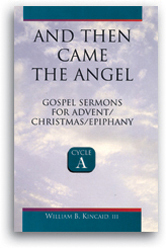
And Then Came the Angel
Gospel Sermons For Advent/Christmas/Epiphany
Some of you may have opened gifts before you came here tonight, others may do so later tonight or tomorrow morning. Most of us are to the point that, when you consider gifts from people at school and work and church and clubs, most of December is spent giving to one another. We all agree it is still more blessed to give than to receive, and that would never be in question if the selection of presents was not such a difficult task.
Many men will remember, all too painfully, all the effort given to the selection of gifts for our fathers while they were younger and still living at home. You see, when people live in the same house, one of the greatest temptations to overcome is this tendency to give things to each other that we hope will become community property. "I bet Dad will love this bright yellow tie and I am sure he will wear it often. If not, it does happen to go well with my favorite blue blazer." "I am sure Dad will enjoy this video of pro basketball highlights. He'll probably watch it several nights a week, especially when I am home to watch it with him." Women, who are consistently credited with more sensitivity, probably are guilty of the same kinds of things.
Oh, how patient we are with each other at gift-giving time, and how delightful it is when the tables are turned. The joy comes when the father, who has a closet full of yellow ties and a bookcase loaded with basketball videos, is found perusing the collections of trains in the local toy store. He decides to buy a very expensive train, one with real smoke, a real whistle, and enough track to drive anybody crazy putting it together, but we shouldn't worry. The train is not for him. He says it's for his grandchildren!
John Vannorsdall confessed that for a long time he had taken the short cut with Christmas. He writes, "It became clear, for example, that while I enjoyed receiving well-chosen gifts, I myself was a shopper who invested no time at all in the process. One year I gave everyone staplers. Another year I bought flashlights for everyone, a dozen big, fancy flashlights. It didn't matter whether people needed or wanted one of them, or could afford to replace the six batteries required to operate them.
"I didn't get away with this. People were very nice about the flashlights, pushed all the buttons and said they'd never seen anything like it, but I knew I'd failed. There was a cost to Christmas which wasn't money. It was the cost of thoughtfulness and time, and I knew I had not paid the cost. There are those who prefer Christmas simple. Buy a dozen flashlights. I'm sure Grandma always wanted a flashlight which blinks yellow or red, shines forward and backward, and is too heavy to carry. But thoughtful women and men know that Christmas is much more -- considerably more profound and much more satisfying."1
The gifts we give, whether they be flashlights and yellow ties or candleholders and coffee mugs, are important symbols which express our love. But they are small tokens compared to the real generosity of this season. Christmas is ultimately about a God whose giving included reaching out through an innocent baby to embrace a hurting world.
In this season one gift transcends all other gifts. A gift which shifts the focus from presents (p-r-e-s-e-n-t-s) to presence (p-r-e-s-e-n-c-e). God's gift of the Christ-child is more significant, of more ultimate value than anything we are able to give. Through the Christ-child, we have life, we know life, and we share life. Because of the Christ-child, we give with a new spirit and a new love and a new freedom. God has shown us the perfect example of giving. Now, we are able to give simply for the love and joy of giving, and our gifts are more than sweaters and ear rings. Now, we can offer a bit of ourselves as a sign that the Christmas spirit has taken root in our lives. Just as God has chosen to be with us, now we can be with others, and for no other reason than to be together.
Henri Nouwen told the story of a student who, many years after graduation, returned to sit in his old professor's office where so many questions had been answered and so many problems had been solved. When the student entered he told his professor that he didn't need anything, he came just to visit, to be together. They sat for a while in silence and looked at each other. One broke the silence by telling the other how nice it was to see each other. The other agreed, and then there was silence. Then the student said, "When I look at you it is as if I am in the presence of Christ." The professor remembers that did not startle or surprise him and that he could only respond with, "It is the Christ in you who recognizes the Christ in me." The student replied with the most healing words Nouwen had heard in many years. "Yes, Christ indeed is in our midst. From now on, wherever you go, or wherever I go, all the ground between us will be holy ground."2
Our culture puts such an emphasis on productivity--on doing things, solving problems, making plans, producing products--that two things have happened. In many cases, those who do not solve or plan or produce are looked upon as second class citizens. And secondly, the idea of getting together just for the sake of being together is so foreign that when we do come together we often fail to see the Christ in one another because of this uneasy feeling that we ought to be doing something.
The wonder of this night is that the presence of Christ is with us so that we can genuinely be with each other. No longer must we sit with family members whose divided attention leads to comments like, "She never listens to me." No longer must we sit across from co-workers who half-heartedly hear what we say. No longer must we be at church meetings and plan what we are going to say before the person speaking is ever finished. No longer must we come to worship so unfocused and distracted that we leave unfulfilled.
This is the holiest night of the year. It requires of us reflection and self-examination, and it brings to us the promise that we can be with each other in more meaningful ways. Through the presence of Christ in us, we can recognize the presence of Christ in each other. We can listen and really hear what we are saying to each other. We can share one another's pain and make it our own. We can know of one another's joys and celebrate as if they were our own.
On this night God chooses to be with us so that we might be with one another. May God's love shape our relationships. May God's wisdom guide our decisions. May God's glory touch our ordinary lives. And may God's gift this night live in us and through us, that what we experience in each other is the very presence of Christ.
____________
1. John Vannorsdall, "A Touch of Foreboding," Lectionary Homiletics (December 1991), pp. 6-7.
2. Henri J. M. Nouwen, Reaching Out (New York: Doubleday, 1975), p. 45.
Many men will remember, all too painfully, all the effort given to the selection of gifts for our fathers while they were younger and still living at home. You see, when people live in the same house, one of the greatest temptations to overcome is this tendency to give things to each other that we hope will become community property. "I bet Dad will love this bright yellow tie and I am sure he will wear it often. If not, it does happen to go well with my favorite blue blazer." "I am sure Dad will enjoy this video of pro basketball highlights. He'll probably watch it several nights a week, especially when I am home to watch it with him." Women, who are consistently credited with more sensitivity, probably are guilty of the same kinds of things.
Oh, how patient we are with each other at gift-giving time, and how delightful it is when the tables are turned. The joy comes when the father, who has a closet full of yellow ties and a bookcase loaded with basketball videos, is found perusing the collections of trains in the local toy store. He decides to buy a very expensive train, one with real smoke, a real whistle, and enough track to drive anybody crazy putting it together, but we shouldn't worry. The train is not for him. He says it's for his grandchildren!
John Vannorsdall confessed that for a long time he had taken the short cut with Christmas. He writes, "It became clear, for example, that while I enjoyed receiving well-chosen gifts, I myself was a shopper who invested no time at all in the process. One year I gave everyone staplers. Another year I bought flashlights for everyone, a dozen big, fancy flashlights. It didn't matter whether people needed or wanted one of them, or could afford to replace the six batteries required to operate them.
"I didn't get away with this. People were very nice about the flashlights, pushed all the buttons and said they'd never seen anything like it, but I knew I'd failed. There was a cost to Christmas which wasn't money. It was the cost of thoughtfulness and time, and I knew I had not paid the cost. There are those who prefer Christmas simple. Buy a dozen flashlights. I'm sure Grandma always wanted a flashlight which blinks yellow or red, shines forward and backward, and is too heavy to carry. But thoughtful women and men know that Christmas is much more -- considerably more profound and much more satisfying."1
The gifts we give, whether they be flashlights and yellow ties or candleholders and coffee mugs, are important symbols which express our love. But they are small tokens compared to the real generosity of this season. Christmas is ultimately about a God whose giving included reaching out through an innocent baby to embrace a hurting world.
In this season one gift transcends all other gifts. A gift which shifts the focus from presents (p-r-e-s-e-n-t-s) to presence (p-r-e-s-e-n-c-e). God's gift of the Christ-child is more significant, of more ultimate value than anything we are able to give. Through the Christ-child, we have life, we know life, and we share life. Because of the Christ-child, we give with a new spirit and a new love and a new freedom. God has shown us the perfect example of giving. Now, we are able to give simply for the love and joy of giving, and our gifts are more than sweaters and ear rings. Now, we can offer a bit of ourselves as a sign that the Christmas spirit has taken root in our lives. Just as God has chosen to be with us, now we can be with others, and for no other reason than to be together.
Henri Nouwen told the story of a student who, many years after graduation, returned to sit in his old professor's office where so many questions had been answered and so many problems had been solved. When the student entered he told his professor that he didn't need anything, he came just to visit, to be together. They sat for a while in silence and looked at each other. One broke the silence by telling the other how nice it was to see each other. The other agreed, and then there was silence. Then the student said, "When I look at you it is as if I am in the presence of Christ." The professor remembers that did not startle or surprise him and that he could only respond with, "It is the Christ in you who recognizes the Christ in me." The student replied with the most healing words Nouwen had heard in many years. "Yes, Christ indeed is in our midst. From now on, wherever you go, or wherever I go, all the ground between us will be holy ground."2
Our culture puts such an emphasis on productivity--on doing things, solving problems, making plans, producing products--that two things have happened. In many cases, those who do not solve or plan or produce are looked upon as second class citizens. And secondly, the idea of getting together just for the sake of being together is so foreign that when we do come together we often fail to see the Christ in one another because of this uneasy feeling that we ought to be doing something.
The wonder of this night is that the presence of Christ is with us so that we can genuinely be with each other. No longer must we sit with family members whose divided attention leads to comments like, "She never listens to me." No longer must we sit across from co-workers who half-heartedly hear what we say. No longer must we be at church meetings and plan what we are going to say before the person speaking is ever finished. No longer must we come to worship so unfocused and distracted that we leave unfulfilled.
This is the holiest night of the year. It requires of us reflection and self-examination, and it brings to us the promise that we can be with each other in more meaningful ways. Through the presence of Christ in us, we can recognize the presence of Christ in each other. We can listen and really hear what we are saying to each other. We can share one another's pain and make it our own. We can know of one another's joys and celebrate as if they were our own.
On this night God chooses to be with us so that we might be with one another. May God's love shape our relationships. May God's wisdom guide our decisions. May God's glory touch our ordinary lives. And may God's gift this night live in us and through us, that what we experience in each other is the very presence of Christ.
____________
1. John Vannorsdall, "A Touch of Foreboding," Lectionary Homiletics (December 1991), pp. 6-7.
2. Henri J. M. Nouwen, Reaching Out (New York: Doubleday, 1975), p. 45.
