
Proper 22/Pentecost 20/Ordinary Time 27
Preaching
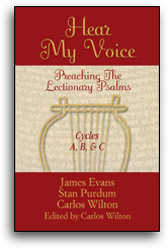
Hear My Voice
Preaching The Lectionary Psalms for Cycles A, B, C
Object:
This psalm's opening verses are among the most recognizable for understanding the experience of a worship community in exile. The evocative, "How can we sing the songs of Zion in a foreign land?" (v. 4) has become biblical shorthand for this experience. In a single poetic stroke the psalmist is able to convey not only the tragedy of social displacement, but also the agony of spiritual despair.
The psalmist's insight into this dilemma goes beyond mere context. Separation from the temple was certainly an issue. The songs don't ring as true, the prayers as meaningful, and the benedictions as helpful outside the proper setting for worship. But there is much more at risk.
The psalmist understands that the words themselves are important, that they carry meaning and are essential to maintaining identity. If members of the community of faith ever give up the particularity of their language, they will have no meaningful way to talk about their faith. Even more critical, if the community of faith adopts the language of the culture that holds it captive, the people will not only lose their own faith, but will become participants by default in a new faith.
Christianity in America certainly faces similar challenges. As we become more and more like our culture, we lose a distinctively biblical and Christian identity. These changes happen subtly and often without much fanfare. While in graduate school, I attended a multi-disciplinary seminar that included professors and students from several different schools of study. There were lawyers, doctors, scientists, classicists, historians, psychologists, and graduate religion students.
In the course of the seminar, a local church contacted me about becoming their pastor. Using the language of my tradition (Baptist) I mentioned to my peers that I was being considered for a "call." Many of them found this a strange way to talk about employment and began to have fun with it at my expense. It became a running joke for several days, as different students in the seminar mimicked my language that seemed provincial to them. I have caught myself later, and on some occasions since, using the language of the secular marketplace to talk about being "hired" by a church.
The particularity of our language is essential to communicating to each other the theological meaning of what we do and who we are. To use the language of "call," instead of the more commonplace "hired," reminds us that in the clergy/church relationship, there is a presumption that God is involved in the process. While the church may use standard business practices to evaluate candidates, we still cling to the idea that somehow God works in the mix to bring together clergy and congregation.
There are other issues and challenges from culture that are even more insidious than the language of hiring. It makes a difference whether we meet in an "auditorium" or a "sanctuary." Which word best captures the biblical meaning of "pastor": CEO or educator or counselor or activist? Is it possible anymore to meaningfully invoke images such as prophet or shepherd?
It's difficult to sing the songs of Zion in a foreign land -- but necessary. "If I forget you, O Jerusalem, let my right hand wither" (v. 5). Jesus understood this very well when he reminded his followers that they were to be "in the world but not of the world." In the world we work and contribute to the peace of the city, but by not being of the world we speak and live a language of faith that creates our character and carries our hope.
-- J. E.
The psalmist's insight into this dilemma goes beyond mere context. Separation from the temple was certainly an issue. The songs don't ring as true, the prayers as meaningful, and the benedictions as helpful outside the proper setting for worship. But there is much more at risk.
The psalmist understands that the words themselves are important, that they carry meaning and are essential to maintaining identity. If members of the community of faith ever give up the particularity of their language, they will have no meaningful way to talk about their faith. Even more critical, if the community of faith adopts the language of the culture that holds it captive, the people will not only lose their own faith, but will become participants by default in a new faith.
Christianity in America certainly faces similar challenges. As we become more and more like our culture, we lose a distinctively biblical and Christian identity. These changes happen subtly and often without much fanfare. While in graduate school, I attended a multi-disciplinary seminar that included professors and students from several different schools of study. There were lawyers, doctors, scientists, classicists, historians, psychologists, and graduate religion students.
In the course of the seminar, a local church contacted me about becoming their pastor. Using the language of my tradition (Baptist) I mentioned to my peers that I was being considered for a "call." Many of them found this a strange way to talk about employment and began to have fun with it at my expense. It became a running joke for several days, as different students in the seminar mimicked my language that seemed provincial to them. I have caught myself later, and on some occasions since, using the language of the secular marketplace to talk about being "hired" by a church.
The particularity of our language is essential to communicating to each other the theological meaning of what we do and who we are. To use the language of "call," instead of the more commonplace "hired," reminds us that in the clergy/church relationship, there is a presumption that God is involved in the process. While the church may use standard business practices to evaluate candidates, we still cling to the idea that somehow God works in the mix to bring together clergy and congregation.
There are other issues and challenges from culture that are even more insidious than the language of hiring. It makes a difference whether we meet in an "auditorium" or a "sanctuary." Which word best captures the biblical meaning of "pastor": CEO or educator or counselor or activist? Is it possible anymore to meaningfully invoke images such as prophet or shepherd?
It's difficult to sing the songs of Zion in a foreign land -- but necessary. "If I forget you, O Jerusalem, let my right hand wither" (v. 5). Jesus understood this very well when he reminded his followers that they were to be "in the world but not of the world." In the world we work and contribute to the peace of the city, but by not being of the world we speak and live a language of faith that creates our character and carries our hope.
-- J. E.
