
Proper 24/Pentecost 22/Ordinary Time 29
Preaching
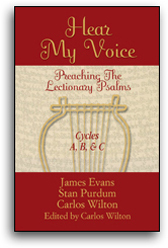
Hear My Voice
Preaching The Lectionary Psalms for Cycles A, B, C
Object:
Psalm 119 is well-known as the longest chapter in the Bible. The poem is actually an extended, and extensive, meditation on the meaning of the law. Given the sterile connotations often associated with "law" and "legalism," it's hard sometimes to appreciate the lyrical beauty of these reflections. One thing is for certain, the writer of this psalm does not view the law as either sterile or void of vitality.

We help ourselves somewhat if we remember that "law" in this psalm, and its corresponding "your word," have reference to Torah -- the Law of Moses. Torah is more than just legislative matters, case law, injunctions, and statutes, though it includes all of that. Torah is best understood as "instruction." This is what the psalmist celebrates throughout his long poem. Torah is life-giving. Torah, when internalized, creates a meaningful life. Torah frees us from foolishness by instilling wisdom. Torah does not do its work through legislative coercion. Torah does its work by changing the essential character of those who reflect on its meaning.
This principle is amply illustrated in the section of the psalm we consider here. The psalmist does not hold back his emotions: "O how I love your law" (v. 97). This is a passionate relationship with truth -- and with the hope of personal, as well as community, maturity.
The psalmist employs relational and sensory images to communicate the power of the law to transform us. The law makes us wiser than both our enemies and our teachers. The law has the power to advance our learning in spite of our age. The law is like a safety harness that keeps us from being pulled into evil. Yet the law is sweet, like honey on the tongue.
There is an important point to understand in all this -- though not so much in what the psalmist says about the law, though his words are important and instructive. Equally important is his model of commitment to the law. The example the psalmist offers us, of how to love the law and pursue truth, is an excellent model for spiritual formation and Christian education.
We will not make much headway in any endeavor without commitment. The artist who masters the piano or some other musical instrument cannot do so without regular attention to the instrument. The athlete who seeks to compete at some high level cannot afford to miss a day of training and conditioning. The writer who would compose a masterpiece must sit with the words every day if the work is ever to be finished.
Similar comparisons could be made to other endeavors. If a married couple expects their relationship to survive and thrive over a number of years, they must be intentional about communication, conflict management, and nurturing affection. Parents who want to see their children grow and mature into fully functioning adults must commit the time needed to train and guide them.
The psalmist shows us the wisdom of the passionate pursuit. Whether it is God's truth or a chance to perform at Carnegie Hall, it is disciplined and intentional attention to the task that brings about the desired result. In the case of the law, the result is wisdom and the doorway to a meaningful relationship with God.
-- J. E.
We help ourselves somewhat if we remember that "law" in this psalm, and its corresponding "your word," have reference to Torah -- the Law of Moses. Torah is more than just legislative matters, case law, injunctions, and statutes, though it includes all of that. Torah is best understood as "instruction." This is what the psalmist celebrates throughout his long poem. Torah is life-giving. Torah, when internalized, creates a meaningful life. Torah frees us from foolishness by instilling wisdom. Torah does not do its work through legislative coercion. Torah does its work by changing the essential character of those who reflect on its meaning.
This principle is amply illustrated in the section of the psalm we consider here. The psalmist does not hold back his emotions: "O how I love your law" (v. 97). This is a passionate relationship with truth -- and with the hope of personal, as well as community, maturity.
The psalmist employs relational and sensory images to communicate the power of the law to transform us. The law makes us wiser than both our enemies and our teachers. The law has the power to advance our learning in spite of our age. The law is like a safety harness that keeps us from being pulled into evil. Yet the law is sweet, like honey on the tongue.
There is an important point to understand in all this -- though not so much in what the psalmist says about the law, though his words are important and instructive. Equally important is his model of commitment to the law. The example the psalmist offers us, of how to love the law and pursue truth, is an excellent model for spiritual formation and Christian education.
We will not make much headway in any endeavor without commitment. The artist who masters the piano or some other musical instrument cannot do so without regular attention to the instrument. The athlete who seeks to compete at some high level cannot afford to miss a day of training and conditioning. The writer who would compose a masterpiece must sit with the words every day if the work is ever to be finished.
Similar comparisons could be made to other endeavors. If a married couple expects their relationship to survive and thrive over a number of years, they must be intentional about communication, conflict management, and nurturing affection. Parents who want to see their children grow and mature into fully functioning adults must commit the time needed to train and guide them.
The psalmist shows us the wisdom of the passionate pursuit. Whether it is God's truth or a chance to perform at Carnegie Hall, it is disciplined and intentional attention to the task that brings about the desired result. In the case of the law, the result is wisdom and the doorway to a meaningful relationship with God.
-- J. E.

