
The Road To Nazareth
Sermon
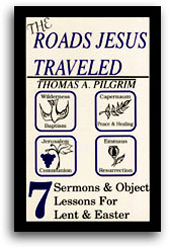
The Roads Jesus Traveled
Sermons And Object LessonsFor Lent And Easter
Not long ago I was driving down the interstate. I saw standing by the road a young man, not very impressive in appearance, who seemed to have all he owned in two bags. As I went by he held up a sign with one word on it: "Home." I wanted to stop and help him get home and yet because of the way things are today I did not even slow down. But I have often wondered where home was - and if he got there and what happened when he arrived.
Immediately after his baptism and his time in the wilderness the first thing Jesus did was to head for home, the town of Nazareth.
Oh, you remember Nazareth. It was a two-bit kind of town. It was a town no one really thought much of. It was a town where you would not really want to live. And people often said, "Can anything good come out of Nazareth?" Jesus did. He came out of Nazareth and now he is on his way back
on the road to Nazareth - headed back there at the beginning of his ministry.
I wonder if those people in Nazareth will know him when he gets there? I wonder if they ever really knew him? Who is this Jesus? We have been asking that question, of course, for 2,000 years. We have come up with many good answers, though I suspect that all the answers are less than he is. The sum of the parts is less than Jesus. Who is he?
Is he the Christ of dogma - the Christ of our creeds? Surely those statements tell us who he is. And yet, he is more than the telling of them.
Is he the Christ of the theologically minded, who down through 2,000 years have sought to explain him and have used all their best thinking? Is he the Christ of Saint Augustine, Thomas Aquinas, Karl Barth, Paul Tillich?
Is he the Jesus of history, sought after by those 19th century theologians who knew they could take all the information in the New Testament, put it all together, search out the evidence and come up with a complete biography of Jesus? Is he the one they searched for, only to be challenged by Albert Schweitzer's book, The Quest of the Historical Jesus, which said we cannot find out all the details of his life?
Is he the Christ of literature, art and music whose life more than any other person in history has captured the minds of writers, artists and musicians?
Is he the Jesus of revolutionaries, who in every part of the world have found in him their inspiration to create a new order of things?
Is he the Christ of heresies, as old as the church itself, which we still have with us today and which say he is either only a man and nothing more, or completely God and nothing less?
Is he the Jesus of the hippies, Lord of the yuppies, Master of the elite or Savior of the poor?
Is he the Christ of the liberals, the conservatives, the fundamentalists, the charismatics, the right wing or the left or us modern folk in between, or some new version of all of that which has not even been thought up yet?
Who is this Jesus? One thing for sure and for certain, he still remains. Even though he has been scandalized, theologized, apologized, scrutinized and theorized, he still remains. Even though there has been cultural upheaval, political revolution, social evolution and moral pollution, he still remains.
Who is this Jesus? "Is not this Joseph's son?" That was the question they asked that day when he went back home to Nazareth and stood up in church with all the people in his home synagogue and read from the book of Isaiah: "The spirit of the Lord is upon me, because he has anointed me to preach good news to the poor. He has sent me to proclaim release to the captives and recovery of sight to the blind, to set at liberty those who are oppressed, to proclaim the acceptable year of the Lord."
Then he looked at all the home-folks, those with whom he had been raised and he said to them, "Today this Scripture has been fulfilled in your hearing."
How proud they were of him at first. They spoke well of him and wondered at those gracious words, "Is not this Joseph's son? We know him. What a fine young man." But Jesus knew the people at home. And he said, "Doubtless, you will quote to me this proverb, 'Physician, heal yourself.' ... Truly, I say to you no prophet is acceptable in his own country."
After Jesus had spoken, the home-folks took Jesus out to the edge of town and were going to throw him off the side of a hill because they really did not know who he was.
Who is this Jesus? That is life's ultimate question. Upon the answer rests the answers to all of our questions about the meaning of life. Let me give you some answers which are so simple, yet they contain the most profound truths.
I
He comes to us as one of us. That is who he is. He is the one who comes to us as one of us. When Jesus went back to Nazareth he was one of them, a Nazareth boy. They knew him as one of them.
God sent him to be that. He is God's son, and in a way we can never adequately explain he is God's son in human flesh - the God-Man "... who though he was in the form of God, did not count equality with God a thing to be held onto, but emptied himself, taking the form of a servant, being born in the likeness of men."
That is the way Paul put it. He emptied himself of that which was divine and became one of us.
In doing this, he identified himself with all of us. He took upon himself all the pain, sorrow, sin and heartache of those he walked among. He even chose a road that led to death by crucifixion - the ultimate identification with us. In doing this, he comes to us as one of us and takes upon himself all our pain, sorrow, sin and heartache.
The phone rang in the office one morning and a little voice said, "Sorry, this is the wrong number." He hung up before I could say anything, but I wanted to say, "No wait! I'm the wrong number, not you." Jesus came to be one of us, to become the wrong number so that we would have the right number.
I read somewhere about a young man in college who had a placement one quarter for a few hours a week in a nursing home. His first day he confessed to his supervisor he did not know what to say. The supervisor said, "Good, you see that lady over there. Go over and say hello." He walked over and said, "Hello." She asked, "Are you a relative?" He answered, "No." She said, "Good! I hate my relatives! Sit down!"
Jesus is a relative of ours who has come to us - Son of God and our brother - who makes us become the children of God also. He comes to us as one of us.
II
He comes to us where we are. That is also who he is. He is the one who comes to us where we are. He went home to his own people first and met them where they were. He knew where they were. And he knew also that "No prophet is acceptable in his own country." But even so he went to them.
You see this throughout the New Testament accounts of his life. Wherever people were, that is where he went. He went to a wedding feast - and out around the lake - and up on the side of a hill - and along a dusty road - and in the middie of town - and into all those homes - wherever there were people who had troubles, problems, pains, sins and sorrows, he went to them.
Because he met them where they were he had a way of putting them at ease. Sometime people are really uncomfortable around preachers and they have this overwhelming compulsion to demonstrate their ignorance of the Bible. Once on "The Jeffersons" the preacher came to see George. In response to some statement made by the preacher George said, "Well, it's like the Bible says, it is easier for a needle to get into heaven than it is for a rich man to get in a camel's eye." But no one was very uptight around Jesus. He put them at ease where they were and because of that he was able to call out the best from them.
Where are you right now? A teacher asked her fifth grade students how many points there are on a compass. One boy said, "Five!" She said, "No, there are four." He replied, "But I can prove it. There is north, south, east, west and the place where I am right now."
Wherever you are right now Jesus is the one who comes to you and he can put your life at ease. He will make himself a part of your struggle. He will say the right thing - the healing word, the hopeful word, the forgiving word, the helpful word, the lifting word - and he will call out the best from within you. He comes to us where we are.
III
He comes to us and calls us to go with him. That is also who he is. He is the one who calls us to go with him. Jesus left Nazareth and went on the road. No one from Nazareth went with him. He called no disciples from Nazareth and no one volunteered. But he does call us to go with him - and out on other roads. For whoever we are and whatever we are, he does not leave us as we are. He calls us to become more than we are and to move on further than we are. He says to us as he said to those fishermen by the lake in the long ago, "Follow me and I will make you become fishers of men."
A preacher was working on two sermons for the coming Sunday. Being the month of June one had to do with a graduation theme and for Sunday night something else. Late Friday evening he received a call saying the graduation speaker at a nearby girls college was ill and could he fill in at the last minute? He said he would and asked his wife to put his sermon in his Bible and give it to him as he went out the door. He arrived a few minutes late, just in time to speak. He walked over to the podium, opened his Bible and read out the first line - not knowing his wife had picked up the wrong sermon - "Follow me and I will make you fishers of men." That was good news for those girls.
The good news is that Jesus calls us to come and go with him, to follow him, to become servants, fishers and followers, witnesses, to become more than we are.
Dr. Maxie Dunnam, a United Methodist minister in Memphis, Tennessee, wrote a book called Jesus' Claims - Our Promises. He told the story of Washington Gladden, a minister who lived back at the turn of the century. As a young man he had sought to know Christ, but was not able to find the peace he was told he should have. He attended services, read, prayed and followed all kinds of suggestions. But he could never find the experience others had. Then one day he met a minister who understood what he was going through. He told the young man to walk in the ways of Christ and serve him, and to trust God whether he felt right or not. That was the thing he needed to hear. He began to follow Christ in all he did. He gave his life in service and became a minister. And he sought to relate the Christian gospel to the problems of his time. He was one of the leaders of the church in this country. His commitment to Christ was expressed in these words: "0 Master, let me walk with thee in lowly paths of service free; Tell me thy secret; help me bear the strain of toil, the fret of care. Help me the slow of heart to move by some clear winning word of love; Teach me the wayward feet to stay, and guide them in the homeward way."
Who is this Jesus? He is the one who comes to us and calls us to go with him - to walk with him. Unless you come to grips with who this Jesus is you will never know who you are, and what your life is all about.
1. Dunnam, Maxie, Jesus' Claims - Our Promises, The Upper Room, Nashville, Tennessee, 1985, p. 55.
Pastoral Prayer
O God, our Father, we bow before thee today because we have come to know that all our hopes and dreams are bound up in thy will, thou who art the source of all good things. So, be near us in this time of worship and may our songs of praise bring glory to thy name.
We are mindful today, 0 God, of the journey of our Lord on the roads he traveled. Keep us ever mindful of him during these days of Lent.
We thank thee, gracious Father, for all the ways our lives are blessed of thee. We have seen thy hand at work in our lives, and we know that out of thy goodness all good gifts have been showered upon us. Accept our thanksgiving and help us to have thankful lifestyles - lives which are the expression of thy goodness toward us and our willingness to be a blessing so that other lives may be blessed of thee.
Forgive our sins, merciful Father, and restore to us the joy of thy salvation. Turn on the light of love in our hearts that they would be strangely warmed and may the light of that love shine in us and through us that we would be a light which shines in the darkness even as our Lord Jesus was the light of the world and calls us to be the light in a world threatened by darkness.
Be near our sick. Comfort those who mourn. Guide those who lose their way. Touch those who despair. And we will give thee honor and glory, through Jesus Christ, our Lord. Amen.
Discussion Questions
Read Aloud: Luke 4:16-30
1. Who do you think Jesus is?
2. What is there about Jesus that touches your life the most?
3. In what ways have you found in Jesus, his message, his ministry and his mission, liberation, help and hope?
4. In what ways do you feel Jesus has identified himself with you? How do you identify yourself with him?
5. How do you think Jesus and the Christian gospel speak to you where you are?
6. In what ways do you feel the call of God in your life?
7. How does following Jesus help you know who you are?
Closing: Have a time of sentence prayers to be ended by the group leader.
Children's Object Lesson
Lent 2
God's Calling Card
Object: A calling card
Good morning boys and girls. I want you to know I am so glad that you are here today. This Sunday morning we are thinking about a Scripture lesson that tells us about Jesus going back to his home town of Nazareth. Jesus grew up there in that town. And at the beginning of his ministry he decided that he would go back there and preach to the people in his own home church or synagogue. One of the things we will be thinking about today is the fact that Jesus still comes to be with us whoever we are and wherever we are.
Who can tell us what this is? Okay, it is a card and this is a special kind. It is a "calling card." This has the name of our church on it and my name. I can go see some person and if they are not at home I can leave this in their door and they will know that I have been there.
If I go to visit someone who is in the hospital and that person is not in his or her room, I can leave this and they will know I have been there to see them. I can also write them a message on this card like, "Sorry I missed you," or "Hope you feel better" or "I am praying for you."
In a way we could say God has a calling card he has left with us. His Son Jesus brought it into the world. And it has a message for us. The message is, "God so loved the world that he gave his only son that whoever believes in him should not perish but have everlasting life."
There are a lot of ways we get that message. We find it in the Bible as we study and learn in Sunday school. We learn from other people that God loves us as we share his love with each other. We get the message in all the ways God has blessed us and all the good things God does for us.
Now I am going to give each one of you one of these calling cards. It has our church's name on this side and mine. And on the back it has a message from me to you that I have written. And the message says, "I love you!"
Thank you for being here with us today.
May we pray: Father, thank you for loving each one of us and making us to be your children. And thank you for sending us the message. Amen.
Order Of Worship
Organ Prelude
The Lighting Of The Candles
The Choral Call To Worship
Welcome And Attendance Registration
*The Hymn Of Praise: "All Hail The Power Of Jesus' Name"
*The Affirmation Of Faith: The Apostles' Creed
*The Gloria Patri
The Children's Message: "God's Calling Card"
The Pastoral Prayer
*The Hymn Of Preparation: "Jesus, I My Cross Have Taken"
*The Dedication Of Tithes And Offerings
The Offertory
*The Doxology
The Anthem
The Message: "The Road To Nazareth" (Luke 4:16-30)
The Invitation To Christian Discipleship
*The Hymn Of Consecration: "More Love To Thee, 0 Christ"
*The Benediction
*The Choral Response
Organ Postlude
*Congregation Standing
Immediately after his baptism and his time in the wilderness the first thing Jesus did was to head for home, the town of Nazareth.
Oh, you remember Nazareth. It was a two-bit kind of town. It was a town no one really thought much of. It was a town where you would not really want to live. And people often said, "Can anything good come out of Nazareth?" Jesus did. He came out of Nazareth and now he is on his way back
on the road to Nazareth - headed back there at the beginning of his ministry.
I wonder if those people in Nazareth will know him when he gets there? I wonder if they ever really knew him? Who is this Jesus? We have been asking that question, of course, for 2,000 years. We have come up with many good answers, though I suspect that all the answers are less than he is. The sum of the parts is less than Jesus. Who is he?
Is he the Christ of dogma - the Christ of our creeds? Surely those statements tell us who he is. And yet, he is more than the telling of them.
Is he the Christ of the theologically minded, who down through 2,000 years have sought to explain him and have used all their best thinking? Is he the Christ of Saint Augustine, Thomas Aquinas, Karl Barth, Paul Tillich?
Is he the Jesus of history, sought after by those 19th century theologians who knew they could take all the information in the New Testament, put it all together, search out the evidence and come up with a complete biography of Jesus? Is he the one they searched for, only to be challenged by Albert Schweitzer's book, The Quest of the Historical Jesus, which said we cannot find out all the details of his life?
Is he the Christ of literature, art and music whose life more than any other person in history has captured the minds of writers, artists and musicians?
Is he the Jesus of revolutionaries, who in every part of the world have found in him their inspiration to create a new order of things?
Is he the Christ of heresies, as old as the church itself, which we still have with us today and which say he is either only a man and nothing more, or completely God and nothing less?
Is he the Jesus of the hippies, Lord of the yuppies, Master of the elite or Savior of the poor?
Is he the Christ of the liberals, the conservatives, the fundamentalists, the charismatics, the right wing or the left or us modern folk in between, or some new version of all of that which has not even been thought up yet?
Who is this Jesus? One thing for sure and for certain, he still remains. Even though he has been scandalized, theologized, apologized, scrutinized and theorized, he still remains. Even though there has been cultural upheaval, political revolution, social evolution and moral pollution, he still remains.
Who is this Jesus? "Is not this Joseph's son?" That was the question they asked that day when he went back home to Nazareth and stood up in church with all the people in his home synagogue and read from the book of Isaiah: "The spirit of the Lord is upon me, because he has anointed me to preach good news to the poor. He has sent me to proclaim release to the captives and recovery of sight to the blind, to set at liberty those who are oppressed, to proclaim the acceptable year of the Lord."
Then he looked at all the home-folks, those with whom he had been raised and he said to them, "Today this Scripture has been fulfilled in your hearing."
How proud they were of him at first. They spoke well of him and wondered at those gracious words, "Is not this Joseph's son? We know him. What a fine young man." But Jesus knew the people at home. And he said, "Doubtless, you will quote to me this proverb, 'Physician, heal yourself.' ... Truly, I say to you no prophet is acceptable in his own country."
After Jesus had spoken, the home-folks took Jesus out to the edge of town and were going to throw him off the side of a hill because they really did not know who he was.
Who is this Jesus? That is life's ultimate question. Upon the answer rests the answers to all of our questions about the meaning of life. Let me give you some answers which are so simple, yet they contain the most profound truths.
I
He comes to us as one of us. That is who he is. He is the one who comes to us as one of us. When Jesus went back to Nazareth he was one of them, a Nazareth boy. They knew him as one of them.
God sent him to be that. He is God's son, and in a way we can never adequately explain he is God's son in human flesh - the God-Man "... who though he was in the form of God, did not count equality with God a thing to be held onto, but emptied himself, taking the form of a servant, being born in the likeness of men."
That is the way Paul put it. He emptied himself of that which was divine and became one of us.
In doing this, he identified himself with all of us. He took upon himself all the pain, sorrow, sin and heartache of those he walked among. He even chose a road that led to death by crucifixion - the ultimate identification with us. In doing this, he comes to us as one of us and takes upon himself all our pain, sorrow, sin and heartache.
The phone rang in the office one morning and a little voice said, "Sorry, this is the wrong number." He hung up before I could say anything, but I wanted to say, "No wait! I'm the wrong number, not you." Jesus came to be one of us, to become the wrong number so that we would have the right number.
I read somewhere about a young man in college who had a placement one quarter for a few hours a week in a nursing home. His first day he confessed to his supervisor he did not know what to say. The supervisor said, "Good, you see that lady over there. Go over and say hello." He walked over and said, "Hello." She asked, "Are you a relative?" He answered, "No." She said, "Good! I hate my relatives! Sit down!"
Jesus is a relative of ours who has come to us - Son of God and our brother - who makes us become the children of God also. He comes to us as one of us.
II
He comes to us where we are. That is also who he is. He is the one who comes to us where we are. He went home to his own people first and met them where they were. He knew where they were. And he knew also that "No prophet is acceptable in his own country." But even so he went to them.
You see this throughout the New Testament accounts of his life. Wherever people were, that is where he went. He went to a wedding feast - and out around the lake - and up on the side of a hill - and along a dusty road - and in the middie of town - and into all those homes - wherever there were people who had troubles, problems, pains, sins and sorrows, he went to them.
Because he met them where they were he had a way of putting them at ease. Sometime people are really uncomfortable around preachers and they have this overwhelming compulsion to demonstrate their ignorance of the Bible. Once on "The Jeffersons" the preacher came to see George. In response to some statement made by the preacher George said, "Well, it's like the Bible says, it is easier for a needle to get into heaven than it is for a rich man to get in a camel's eye." But no one was very uptight around Jesus. He put them at ease where they were and because of that he was able to call out the best from them.
Where are you right now? A teacher asked her fifth grade students how many points there are on a compass. One boy said, "Five!" She said, "No, there are four." He replied, "But I can prove it. There is north, south, east, west and the place where I am right now."
Wherever you are right now Jesus is the one who comes to you and he can put your life at ease. He will make himself a part of your struggle. He will say the right thing - the healing word, the hopeful word, the forgiving word, the helpful word, the lifting word - and he will call out the best from within you. He comes to us where we are.
III
He comes to us and calls us to go with him. That is also who he is. He is the one who calls us to go with him. Jesus left Nazareth and went on the road. No one from Nazareth went with him. He called no disciples from Nazareth and no one volunteered. But he does call us to go with him - and out on other roads. For whoever we are and whatever we are, he does not leave us as we are. He calls us to become more than we are and to move on further than we are. He says to us as he said to those fishermen by the lake in the long ago, "Follow me and I will make you become fishers of men."
A preacher was working on two sermons for the coming Sunday. Being the month of June one had to do with a graduation theme and for Sunday night something else. Late Friday evening he received a call saying the graduation speaker at a nearby girls college was ill and could he fill in at the last minute? He said he would and asked his wife to put his sermon in his Bible and give it to him as he went out the door. He arrived a few minutes late, just in time to speak. He walked over to the podium, opened his Bible and read out the first line - not knowing his wife had picked up the wrong sermon - "Follow me and I will make you fishers of men." That was good news for those girls.
The good news is that Jesus calls us to come and go with him, to follow him, to become servants, fishers and followers, witnesses, to become more than we are.
Dr. Maxie Dunnam, a United Methodist minister in Memphis, Tennessee, wrote a book called Jesus' Claims - Our Promises. He told the story of Washington Gladden, a minister who lived back at the turn of the century. As a young man he had sought to know Christ, but was not able to find the peace he was told he should have. He attended services, read, prayed and followed all kinds of suggestions. But he could never find the experience others had. Then one day he met a minister who understood what he was going through. He told the young man to walk in the ways of Christ and serve him, and to trust God whether he felt right or not. That was the thing he needed to hear. He began to follow Christ in all he did. He gave his life in service and became a minister. And he sought to relate the Christian gospel to the problems of his time. He was one of the leaders of the church in this country. His commitment to Christ was expressed in these words: "0 Master, let me walk with thee in lowly paths of service free; Tell me thy secret; help me bear the strain of toil, the fret of care. Help me the slow of heart to move by some clear winning word of love; Teach me the wayward feet to stay, and guide them in the homeward way."
Who is this Jesus? He is the one who comes to us and calls us to go with him - to walk with him. Unless you come to grips with who this Jesus is you will never know who you are, and what your life is all about.
1. Dunnam, Maxie, Jesus' Claims - Our Promises, The Upper Room, Nashville, Tennessee, 1985, p. 55.
Pastoral Prayer
O God, our Father, we bow before thee today because we have come to know that all our hopes and dreams are bound up in thy will, thou who art the source of all good things. So, be near us in this time of worship and may our songs of praise bring glory to thy name.
We are mindful today, 0 God, of the journey of our Lord on the roads he traveled. Keep us ever mindful of him during these days of Lent.
We thank thee, gracious Father, for all the ways our lives are blessed of thee. We have seen thy hand at work in our lives, and we know that out of thy goodness all good gifts have been showered upon us. Accept our thanksgiving and help us to have thankful lifestyles - lives which are the expression of thy goodness toward us and our willingness to be a blessing so that other lives may be blessed of thee.
Forgive our sins, merciful Father, and restore to us the joy of thy salvation. Turn on the light of love in our hearts that they would be strangely warmed and may the light of that love shine in us and through us that we would be a light which shines in the darkness even as our Lord Jesus was the light of the world and calls us to be the light in a world threatened by darkness.
Be near our sick. Comfort those who mourn. Guide those who lose their way. Touch those who despair. And we will give thee honor and glory, through Jesus Christ, our Lord. Amen.
Discussion Questions
Read Aloud: Luke 4:16-30
1. Who do you think Jesus is?
2. What is there about Jesus that touches your life the most?
3. In what ways have you found in Jesus, his message, his ministry and his mission, liberation, help and hope?
4. In what ways do you feel Jesus has identified himself with you? How do you identify yourself with him?
5. How do you think Jesus and the Christian gospel speak to you where you are?
6. In what ways do you feel the call of God in your life?
7. How does following Jesus help you know who you are?
Closing: Have a time of sentence prayers to be ended by the group leader.
Children's Object Lesson
Lent 2
God's Calling Card
Object: A calling card
Good morning boys and girls. I want you to know I am so glad that you are here today. This Sunday morning we are thinking about a Scripture lesson that tells us about Jesus going back to his home town of Nazareth. Jesus grew up there in that town. And at the beginning of his ministry he decided that he would go back there and preach to the people in his own home church or synagogue. One of the things we will be thinking about today is the fact that Jesus still comes to be with us whoever we are and wherever we are.
Who can tell us what this is? Okay, it is a card and this is a special kind. It is a "calling card." This has the name of our church on it and my name. I can go see some person and if they are not at home I can leave this in their door and they will know that I have been there.
If I go to visit someone who is in the hospital and that person is not in his or her room, I can leave this and they will know I have been there to see them. I can also write them a message on this card like, "Sorry I missed you," or "Hope you feel better" or "I am praying for you."
In a way we could say God has a calling card he has left with us. His Son Jesus brought it into the world. And it has a message for us. The message is, "God so loved the world that he gave his only son that whoever believes in him should not perish but have everlasting life."
There are a lot of ways we get that message. We find it in the Bible as we study and learn in Sunday school. We learn from other people that God loves us as we share his love with each other. We get the message in all the ways God has blessed us and all the good things God does for us.
Now I am going to give each one of you one of these calling cards. It has our church's name on this side and mine. And on the back it has a message from me to you that I have written. And the message says, "I love you!"
Thank you for being here with us today.
May we pray: Father, thank you for loving each one of us and making us to be your children. And thank you for sending us the message. Amen.
Order Of Worship
Organ Prelude
The Lighting Of The Candles
The Choral Call To Worship
Welcome And Attendance Registration
*The Hymn Of Praise: "All Hail The Power Of Jesus' Name"
*The Affirmation Of Faith: The Apostles' Creed
*The Gloria Patri
The Children's Message: "God's Calling Card"
The Pastoral Prayer
*The Hymn Of Preparation: "Jesus, I My Cross Have Taken"
*The Dedication Of Tithes And Offerings
The Offertory
*The Doxology
The Anthem
The Message: "The Road To Nazareth" (Luke 4:16-30)
The Invitation To Christian Discipleship
*The Hymn Of Consecration: "More Love To Thee, 0 Christ"
*The Benediction
*The Choral Response
Organ Postlude
*Congregation Standing
