
In Search Of The Perfect Father
Self Help
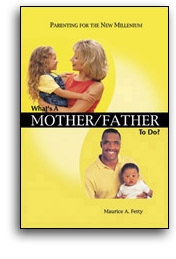
What's A Mother/Father To Do?
Parenting For The New Millennium
Honor your father and mother ... that it may be well with you and that you may live long on the earth. Fathers, do not provoke your children to anger, but bring them up in the discipline and instruction of the Lord.
-- Ephesians 6:2-4
Paul the Apostle did not write a great deal about love, marriage, and family, and what he did write is today considerably disputed by women. Recently at a wedding I read his advice to the Colossian Christians that wives should be subject to their husbands, as is fitting in the Lord (3:18). Some of the bridesmaids visibly smirked even though the passage was the bride's choice.
Earlier in his Ephesian letter, Paul gives essentially the same advice, but drives it home even further. "Wives be subject to your husbands, as to the Lord. For the husband is the head of the wife as Christ is head of the church ... As the church is subject to Christ, so let wives be subject in everything to their husbands" (5:22-24). Feminist blood boils upon hearing those words and protest marches gain momentum against Paul as a defender of the centuries-old oppressive patriarchy. "What does Paul, celibate and single, know about women?" they ask. Just as Thomas Jefferson tore out pages of the Bible with which he disagreed so as to end up with a very thin Bible, so feminists, mild and strident, rip out these undesirable pages from the sacred text for their own condensed "Reader's Digest" Bible.
If what Paul said about women and marriage offends many feminists, what he said about children and fathers may offend many children. "Children, obey your parents, for this is right." "Well, just how old do you have to be before you no longer have to obey your parents?" ask today's sometimes strident children. "And just how long do you have to be subservient, and even obsequious, to ensure your rightful share of the estate?" ask the older children.
More than that, Paul goes on to quote the ancient law of Deuteronomy that children are to "honor your father and your mother ... that it may be well with you and that you may live long on the earth" (6:2-3). Our children might have second thoughts if they heard more of the ancient Deuteronomic law which suggests that "whoever curses his father or mother shall be put to death" (Exodus 20:17), or "whoever strikes his father or his mother shall be put to death." The ancient law said further that if a son was stubborn and rebellious his parents could bring him to the leaders of the community and he would be stoned to death (Deuteronomy 21:18).
Ancient Jewish law was not alone in endorsing ultimate authority and power of the father over the children. Roman Law in the time of Paul also gave to the father the power of life and death over his children. Certain kinds of disobedience could be punishable by death, and the Roman child's inheritance could be dangled in front of him all his life to keep him in line. Would it be possible sincerely to honor that kind of father? Fear might be there, and respect, but possibly not honor!
If some of the biblical and Roman images of marriage, parenting, and fatherhood leave something to be desired, we could well argue that many contemporary images are equally dissatisfying. At the opposite end of the spectrum of the all-powerful Roman father is the bumbling, nitwit father of Bringing Up Father of television fame and Dagwood Bumstead -- note the name, "Bumstead" -- of comic strip fame.
Robert Bly observes that the father in contemporary television ads is forever the dumb, dependent "child," who has to be told by his all-knowing wife even what cold medicine to take. In many current situation comedies the men are easily outwitted by the women, who teach them a lesson and who hold the world together all by themselves. Bly doubts this is really "what people want," as the saying goes. Instead, says Bly in his book, Iron John, "Many young Hollywood writers, rather than confront their father in Kansas, take revenge on the remote father by making all adult men look like fools" (p. 23).
Could that be a microcosm of what is happening in today's society -- taking revenge on fathers in "Kansas," or wherever they may be, instead of confronting them? If not in our situation comedies, then perhaps on our therapists' couches, we may be either confronting or taking revenge on our fathers.
Are we having troubles? Then the customary Freudian answer is to search the childhood. And if the mothers frequently come up for review by the therapists, so do the fathers. And in our search for the perfect childhood, and thus our health and wholeness for our own life, we therefore search for the perfect father. But to our chagrin, upon closer examination, we find he was never there -- never perfect as we had hoped or imagined. So how can we honor a man who thwarted our perfect childhood and who thereby impaired our happy adulthood?
Some answers may be found in our text in the two phrases "that it may be well with you" and "that you may live long upon the earth."
I.
Consider first the phrase, "That it may be well with you."
It may "be well with you and me" if we seek to understand the complexities of maleness and fatherhood in today's world. There are a wide variety of conflicting images and expectations foisted upon the modern male, says Rosalind Miles in her provocative book, Love, Sex, Death, and The Making of The Male. The male "has to carve out a career and through it make his mark on the world; he has to form, and, ideally, to sustain a marriage; he has to win bread and with it provide, year in, year out, for those he calls his own" (p. 134).
Ms. Miles admits the increased role of women in providing the livelihood for families (obviously in single families), but the main expectation of providing for wife and family still remains with the husband. He must carry out these responsibilities with clarity, conviction, and power, says Miles. "He who hesitates is lost; who shows weakness is despised; who fails will be thrown to the jackals" (p. 134). "Work, marriage, fatherhood, all these are built on a complex and interlocking set of expectations and tensions in which the hope of personal fulfillment, happiness, and success are at war with other equally integral themes of dominance, power, and possession," says Miles (p. 135).
Probably some of the maladies of modern day fatherhood have their origins in the Industrial Revolution. At that time, fathers were separated from their families to work in places removed from the wife and unfamiliar to the children. If in ancient Israel the father was priest for the family, and if in Colonial New England the father took responsibility for child education, nurture, and discipline, today that role has largely been assumed by the mother. If the father is the remote breadwinner, the mother is the nurturer close at hand.
As the man's role with women, children, and society decreased, his identification with work, power, and success increased. A man was not thought of primarily as a husband and father, but as an economic functionary. We still ask not "who are you?" but "what do you do?" It is difficult for us men ever to think of ourselves with an identity other than work and career. When Dr. Zhivago was asked what he was going to do in the remote retreat he answered simply, "I'm going to live." Our answer would be to achieve, to accumulate power and wealth, and to get to the top.
We men are accustomed to repressing our feelings and masking our emotions. "Big boys don't cry" is the ancient adage. However, most women, wishing for a more tender man, do in fact hope he will not, as a second lieutenant, break into tears just before leading his platoon over the hill against the enemy. And if the male pilot of our jetliner has one of his engines fail, we hope he will not collapse in emotional devastation. And in the championship football game, one yard from the goal, with ten seconds to go, we do hope the fullback, seeing the menacing guards and tackles, will not burst into tears. Yes, there is a time when "big boys should not cry!"
Nevertheless, we "big boys" do get obsessed with compulsion, competition, and preoccupation with dominance and possession. If a man is successful he can have whatever he wants. The fabulously wealthy man is infinitely more respected than the holy man, and easily collects around him fawning admirers and obsequious devotees -- even of high rank.
Many will remember that Aristotle Onassis rose from poverty to become one of the world's wealthiest men. Like Imelda Marcos, he had an obsession with shoes, perhaps in an effort to compensate for the barefoot days of his penniless childhood.
But Onassis' craving for possession went well beyond shoes. His personal secretary said that Onassis married Jackie Kennedy "to show the world that he could buy anything or anybody." He wanted to demonstrate that nothing was beyond his price, even when Jackie's financial advisors were demanding many millions of dollars for the famous widow, who was only too willing to marry for money more than love. Onassis' staff later referred to Jackie as the "supertanker" because he paid about as much for her as he did one of his big ships. "Jackie was an acquisition, nothing more or less" (quoted in Miles, p. 169).
Onassis demonstrated on a grand scale what many men are still striving for on a small scale -- identity, worth, selfhood, and sexual prowess as demonstrated in power and success. Feelings are repressed as feminine and dangerous and irrelevant. Power and dominance are the name of the game.
But very often these characteristics of seeking success, fame or power to compensate for failings and weaknesses of the past can serve "to replicate and even deepen these wounds." Strangely and surprisingly, success can lead to loneliness and an estrangement from the self and others. And a successful man's search for self-transcendence over boyhood wounds of weakness, fear, and failure may only serve to mimic the original dysfunction, says Miles (p. 176). Lyndon Johnson regularly humiliated those close to him. Saddam Hussein is a study in pathological sadism. Romania's Ceaucescue was a pathetic case of perverted power.
If so-called "fathers of nations" are projected images in large scale of our own fathers, we may be in deep trouble! Fortunately, many of us, despite the stresses of society, have had loving and attentive fathers. But, in our therapy sessions and in our imaginings, it will be well with us if we release our fathers from our wish that they were perfect. Paradise never was, not even with Adam in Eden.
II.
Paul also says we should honor fathers so that "you may live long on the earth."
In his best-selling book, The Care Of The Soul, Thomas Moore says that we lack a deep sense of the father in today's society. "Without that deep spirit of the father, we are left with father substitutes -- people willing to play the part for their own gain, offering superficial tokens of fatherhood, but not the father's soul."
Rap groups provide "worldly" and "fatherly" advice to many boys without real fathers or with absent fathers. Violent movie and television heroes fulfill a masculine substitute, an all-powerful father image for others. For those with more domesticated tastes, psychiatrists and therapists of all sizes and descriptions will listen to us for $100 to $500 per hour! (We pay handsomely to get someone to listen to us today!)
Sociologists Brigitte and Peter Berger, in their controversial book, War Over The Family, say that the state and quasi-public agencies have taken over many of the historic fatherly roles. If the Roman father once had control over his child's destiny, today the state and its agencies increasingly exercise that control. Fathers, in fact, are not held in honor when they are held responsible for their children's behavior but whose authority is often undermined by the state and whose role is ridiculed by society. We need to affirm again the divinely instituted structure of family, say the Bergers. "We know too much about children to be sanguine about the degradation of fatherhood," say the Bergers (p. 193).
Or as Thomas Moore put it so well, "Without soulful fathers, our society is left with mere reason and ideology as guides. Then we suffer collective fatherlessness: not having a clear national direction; giving the spoils of a wealthy economy to a few finding only rare examples of deep morality, law, and community ..." (pp. 38-39). The "father" can represent the odyssey, the risk, the adventure, the soul-journey, the separation from the past, and the quest for the new. Rather than the eternal return to the womb, the search for the "father" may call the soul to growth, to maturity, to self-acceptance, and to forgiveness.
Rather than perpetually reaching into the past for blame, the "father" calls us into the future by forgiveness and challenge, as did the father of the prodigal son. Instead of affixing responsibility upon genes and birth parents for one's failures and hang-ups, the "father" in Jesus urges us to be born again of the Heavenly Father and to accept responsibility for our life-adventures under his discreet parenting.
Rosalind Miles, in her book, Love, Sex, Death, and The Making of The Male, writes a great deal about the competitive violence within men. Spousal abuse and child abuse are increasing. The twentieth century has in many ways been a century of violence. Our movies and television shows are filled with outrageous violence. Miles lays a lot of the cause at the feet of men, at their need for sexual conquest, their need for self-transcendence, their need to bond with men in a female-dominated world, and in their fear of women.
Yet, psychoanalyst Rollo May says in his excellent book, Power and Innocence, that violence often arises out of the feeling of powerlessness. Says May, "I cannot recall a time during the last four decades when there was so much talk about the individual's capacities and potentialities and so little actual confidence on the part of the individual about his power to make a difference psychologically or politically" (p. 21).
Violence has its breeding ground in impotence, says May. Through violence men try to establish self-esteem and defend a self-image. Violence comes out of a rage of powerlessness and insignificance. And the origin of this sense of powerlessness is generally the young person's lack of a relationship with a strong father, says Dr. May (p. 34).
Thus, we fathers will do well to reassert ourselves as feeling, emotional, human beings within a context of family. We will do well to think of ourselves as belonging to God rather than to the state or corporation or firm or business. We will do well to step up to our responsibilities for nurturing and guidance and soul sharing.
And as children, we will be wise to change our focus from the past to the future. Alas, our earthly fathers have failed us; all the way back to Adam who blamed Eve for his sin who in turn blamed the serpent. Freud was right, when we sense the imperfections; we seek a perfect Heavenly Father. But, he was wrong to suggest the Heavenly Father is only a projection of our needs and wishes.
He is the true Father of us all, even of Adam and Eve, says the Bible. Our earthly fathers are not perfect -- never were, never will be. But then again, we are not perfect children -- never were, never will be.
The perfect fatherhood will be found only in heaven. In the meantime, let us honor our earthly fathers with appreciation and forgiveness.
Prayer
Almighty God, our Heavenly Father, who through the centuries has made yourself known not only as the powerful Creator, but also as our loving parent, we give you praise and thanks for shaping us in your image and for designing us to be your family. On this Father's Day when the eyes of the children are turned toward the fathers, so would we, your children, turn our loving and adoring eyes to you, Father of us all. We thank you for your providential care, your overflowing gifts of grace, your enduring patience, and your willingness to forgive, and to have us begin again. Help us always to be grateful and never to take for granted all you have given us.
We give you thanks also for our earthly fathers and grandfathers, for kindly stepfathers and for those who befriended us as a father and helped us along life's way. Even now in your presence we call to mind their kindly deeds, their wise counsel and guidance, their steady support and encouragement, their hard work and sacrifice to give us a better life and a nobler way of living. Deliver us from any hardness of heart and insolence of spirit, which would prevent proper honor and gratitude. Bless this day, O Lord, our fathers, whether they be near at hand or far away, or even with you in your heavenly household where mansions were prepared for them.
However, in our time and close at hand, we have many troubled men and fathers. Some have been lured into affairs and infidelities forsaking their beloved and betraying their vows. Cause them to repent and restore them to wholeness. Some have neglected wife and children in the obsession with career and the drive to get ahead. Restore them to a sense of balance and priorities.
Some men and fathers feel cheated and shunned in the present society and sense they have little real influence over the development of their children. Help them, O Lord, and encourage them toward positive influence. Some men and fathers have been verbally and physically abusive, often repeating a pattern practiced on them. Give them wisdom and strength to break the cycle and to deal with frustration and anger in a more responsible way.
O God, Divine Father of us all, bring our families closer together. Turn the hearts of the children to their parents and the hearts of the parents to their children. Cause us to see anew the miracle of human living and to develop anew the rich experience of human loving within our families. Through Jesus Christ our Lord. Amen.
-- Ephesians 6:2-4
Paul the Apostle did not write a great deal about love, marriage, and family, and what he did write is today considerably disputed by women. Recently at a wedding I read his advice to the Colossian Christians that wives should be subject to their husbands, as is fitting in the Lord (3:18). Some of the bridesmaids visibly smirked even though the passage was the bride's choice.
Earlier in his Ephesian letter, Paul gives essentially the same advice, but drives it home even further. "Wives be subject to your husbands, as to the Lord. For the husband is the head of the wife as Christ is head of the church ... As the church is subject to Christ, so let wives be subject in everything to their husbands" (5:22-24). Feminist blood boils upon hearing those words and protest marches gain momentum against Paul as a defender of the centuries-old oppressive patriarchy. "What does Paul, celibate and single, know about women?" they ask. Just as Thomas Jefferson tore out pages of the Bible with which he disagreed so as to end up with a very thin Bible, so feminists, mild and strident, rip out these undesirable pages from the sacred text for their own condensed "Reader's Digest" Bible.
If what Paul said about women and marriage offends many feminists, what he said about children and fathers may offend many children. "Children, obey your parents, for this is right." "Well, just how old do you have to be before you no longer have to obey your parents?" ask today's sometimes strident children. "And just how long do you have to be subservient, and even obsequious, to ensure your rightful share of the estate?" ask the older children.
More than that, Paul goes on to quote the ancient law of Deuteronomy that children are to "honor your father and your mother ... that it may be well with you and that you may live long on the earth" (6:2-3). Our children might have second thoughts if they heard more of the ancient Deuteronomic law which suggests that "whoever curses his father or mother shall be put to death" (Exodus 20:17), or "whoever strikes his father or his mother shall be put to death." The ancient law said further that if a son was stubborn and rebellious his parents could bring him to the leaders of the community and he would be stoned to death (Deuteronomy 21:18).
Ancient Jewish law was not alone in endorsing ultimate authority and power of the father over the children. Roman Law in the time of Paul also gave to the father the power of life and death over his children. Certain kinds of disobedience could be punishable by death, and the Roman child's inheritance could be dangled in front of him all his life to keep him in line. Would it be possible sincerely to honor that kind of father? Fear might be there, and respect, but possibly not honor!
If some of the biblical and Roman images of marriage, parenting, and fatherhood leave something to be desired, we could well argue that many contemporary images are equally dissatisfying. At the opposite end of the spectrum of the all-powerful Roman father is the bumbling, nitwit father of Bringing Up Father of television fame and Dagwood Bumstead -- note the name, "Bumstead" -- of comic strip fame.
Robert Bly observes that the father in contemporary television ads is forever the dumb, dependent "child," who has to be told by his all-knowing wife even what cold medicine to take. In many current situation comedies the men are easily outwitted by the women, who teach them a lesson and who hold the world together all by themselves. Bly doubts this is really "what people want," as the saying goes. Instead, says Bly in his book, Iron John, "Many young Hollywood writers, rather than confront their father in Kansas, take revenge on the remote father by making all adult men look like fools" (p. 23).
Could that be a microcosm of what is happening in today's society -- taking revenge on fathers in "Kansas," or wherever they may be, instead of confronting them? If not in our situation comedies, then perhaps on our therapists' couches, we may be either confronting or taking revenge on our fathers.
Are we having troubles? Then the customary Freudian answer is to search the childhood. And if the mothers frequently come up for review by the therapists, so do the fathers. And in our search for the perfect childhood, and thus our health and wholeness for our own life, we therefore search for the perfect father. But to our chagrin, upon closer examination, we find he was never there -- never perfect as we had hoped or imagined. So how can we honor a man who thwarted our perfect childhood and who thereby impaired our happy adulthood?
Some answers may be found in our text in the two phrases "that it may be well with you" and "that you may live long upon the earth."
I.
Consider first the phrase, "That it may be well with you."
It may "be well with you and me" if we seek to understand the complexities of maleness and fatherhood in today's world. There are a wide variety of conflicting images and expectations foisted upon the modern male, says Rosalind Miles in her provocative book, Love, Sex, Death, and The Making of The Male. The male "has to carve out a career and through it make his mark on the world; he has to form, and, ideally, to sustain a marriage; he has to win bread and with it provide, year in, year out, for those he calls his own" (p. 134).
Ms. Miles admits the increased role of women in providing the livelihood for families (obviously in single families), but the main expectation of providing for wife and family still remains with the husband. He must carry out these responsibilities with clarity, conviction, and power, says Miles. "He who hesitates is lost; who shows weakness is despised; who fails will be thrown to the jackals" (p. 134). "Work, marriage, fatherhood, all these are built on a complex and interlocking set of expectations and tensions in which the hope of personal fulfillment, happiness, and success are at war with other equally integral themes of dominance, power, and possession," says Miles (p. 135).
Probably some of the maladies of modern day fatherhood have their origins in the Industrial Revolution. At that time, fathers were separated from their families to work in places removed from the wife and unfamiliar to the children. If in ancient Israel the father was priest for the family, and if in Colonial New England the father took responsibility for child education, nurture, and discipline, today that role has largely been assumed by the mother. If the father is the remote breadwinner, the mother is the nurturer close at hand.
As the man's role with women, children, and society decreased, his identification with work, power, and success increased. A man was not thought of primarily as a husband and father, but as an economic functionary. We still ask not "who are you?" but "what do you do?" It is difficult for us men ever to think of ourselves with an identity other than work and career. When Dr. Zhivago was asked what he was going to do in the remote retreat he answered simply, "I'm going to live." Our answer would be to achieve, to accumulate power and wealth, and to get to the top.
We men are accustomed to repressing our feelings and masking our emotions. "Big boys don't cry" is the ancient adage. However, most women, wishing for a more tender man, do in fact hope he will not, as a second lieutenant, break into tears just before leading his platoon over the hill against the enemy. And if the male pilot of our jetliner has one of his engines fail, we hope he will not collapse in emotional devastation. And in the championship football game, one yard from the goal, with ten seconds to go, we do hope the fullback, seeing the menacing guards and tackles, will not burst into tears. Yes, there is a time when "big boys should not cry!"
Nevertheless, we "big boys" do get obsessed with compulsion, competition, and preoccupation with dominance and possession. If a man is successful he can have whatever he wants. The fabulously wealthy man is infinitely more respected than the holy man, and easily collects around him fawning admirers and obsequious devotees -- even of high rank.
Many will remember that Aristotle Onassis rose from poverty to become one of the world's wealthiest men. Like Imelda Marcos, he had an obsession with shoes, perhaps in an effort to compensate for the barefoot days of his penniless childhood.
But Onassis' craving for possession went well beyond shoes. His personal secretary said that Onassis married Jackie Kennedy "to show the world that he could buy anything or anybody." He wanted to demonstrate that nothing was beyond his price, even when Jackie's financial advisors were demanding many millions of dollars for the famous widow, who was only too willing to marry for money more than love. Onassis' staff later referred to Jackie as the "supertanker" because he paid about as much for her as he did one of his big ships. "Jackie was an acquisition, nothing more or less" (quoted in Miles, p. 169).
Onassis demonstrated on a grand scale what many men are still striving for on a small scale -- identity, worth, selfhood, and sexual prowess as demonstrated in power and success. Feelings are repressed as feminine and dangerous and irrelevant. Power and dominance are the name of the game.
But very often these characteristics of seeking success, fame or power to compensate for failings and weaknesses of the past can serve "to replicate and even deepen these wounds." Strangely and surprisingly, success can lead to loneliness and an estrangement from the self and others. And a successful man's search for self-transcendence over boyhood wounds of weakness, fear, and failure may only serve to mimic the original dysfunction, says Miles (p. 176). Lyndon Johnson regularly humiliated those close to him. Saddam Hussein is a study in pathological sadism. Romania's Ceaucescue was a pathetic case of perverted power.
If so-called "fathers of nations" are projected images in large scale of our own fathers, we may be in deep trouble! Fortunately, many of us, despite the stresses of society, have had loving and attentive fathers. But, in our therapy sessions and in our imaginings, it will be well with us if we release our fathers from our wish that they were perfect. Paradise never was, not even with Adam in Eden.
II.
Paul also says we should honor fathers so that "you may live long on the earth."
In his best-selling book, The Care Of The Soul, Thomas Moore says that we lack a deep sense of the father in today's society. "Without that deep spirit of the father, we are left with father substitutes -- people willing to play the part for their own gain, offering superficial tokens of fatherhood, but not the father's soul."
Rap groups provide "worldly" and "fatherly" advice to many boys without real fathers or with absent fathers. Violent movie and television heroes fulfill a masculine substitute, an all-powerful father image for others. For those with more domesticated tastes, psychiatrists and therapists of all sizes and descriptions will listen to us for $100 to $500 per hour! (We pay handsomely to get someone to listen to us today!)
Sociologists Brigitte and Peter Berger, in their controversial book, War Over The Family, say that the state and quasi-public agencies have taken over many of the historic fatherly roles. If the Roman father once had control over his child's destiny, today the state and its agencies increasingly exercise that control. Fathers, in fact, are not held in honor when they are held responsible for their children's behavior but whose authority is often undermined by the state and whose role is ridiculed by society. We need to affirm again the divinely instituted structure of family, say the Bergers. "We know too much about children to be sanguine about the degradation of fatherhood," say the Bergers (p. 193).
Or as Thomas Moore put it so well, "Without soulful fathers, our society is left with mere reason and ideology as guides. Then we suffer collective fatherlessness: not having a clear national direction; giving the spoils of a wealthy economy to a few finding only rare examples of deep morality, law, and community ..." (pp. 38-39). The "father" can represent the odyssey, the risk, the adventure, the soul-journey, the separation from the past, and the quest for the new. Rather than the eternal return to the womb, the search for the "father" may call the soul to growth, to maturity, to self-acceptance, and to forgiveness.
Rather than perpetually reaching into the past for blame, the "father" calls us into the future by forgiveness and challenge, as did the father of the prodigal son. Instead of affixing responsibility upon genes and birth parents for one's failures and hang-ups, the "father" in Jesus urges us to be born again of the Heavenly Father and to accept responsibility for our life-adventures under his discreet parenting.
Rosalind Miles, in her book, Love, Sex, Death, and The Making of The Male, writes a great deal about the competitive violence within men. Spousal abuse and child abuse are increasing. The twentieth century has in many ways been a century of violence. Our movies and television shows are filled with outrageous violence. Miles lays a lot of the cause at the feet of men, at their need for sexual conquest, their need for self-transcendence, their need to bond with men in a female-dominated world, and in their fear of women.
Yet, psychoanalyst Rollo May says in his excellent book, Power and Innocence, that violence often arises out of the feeling of powerlessness. Says May, "I cannot recall a time during the last four decades when there was so much talk about the individual's capacities and potentialities and so little actual confidence on the part of the individual about his power to make a difference psychologically or politically" (p. 21).
Violence has its breeding ground in impotence, says May. Through violence men try to establish self-esteem and defend a self-image. Violence comes out of a rage of powerlessness and insignificance. And the origin of this sense of powerlessness is generally the young person's lack of a relationship with a strong father, says Dr. May (p. 34).
Thus, we fathers will do well to reassert ourselves as feeling, emotional, human beings within a context of family. We will do well to think of ourselves as belonging to God rather than to the state or corporation or firm or business. We will do well to step up to our responsibilities for nurturing and guidance and soul sharing.
And as children, we will be wise to change our focus from the past to the future. Alas, our earthly fathers have failed us; all the way back to Adam who blamed Eve for his sin who in turn blamed the serpent. Freud was right, when we sense the imperfections; we seek a perfect Heavenly Father. But, he was wrong to suggest the Heavenly Father is only a projection of our needs and wishes.
He is the true Father of us all, even of Adam and Eve, says the Bible. Our earthly fathers are not perfect -- never were, never will be. But then again, we are not perfect children -- never were, never will be.
The perfect fatherhood will be found only in heaven. In the meantime, let us honor our earthly fathers with appreciation and forgiveness.
Prayer
Almighty God, our Heavenly Father, who through the centuries has made yourself known not only as the powerful Creator, but also as our loving parent, we give you praise and thanks for shaping us in your image and for designing us to be your family. On this Father's Day when the eyes of the children are turned toward the fathers, so would we, your children, turn our loving and adoring eyes to you, Father of us all. We thank you for your providential care, your overflowing gifts of grace, your enduring patience, and your willingness to forgive, and to have us begin again. Help us always to be grateful and never to take for granted all you have given us.
We give you thanks also for our earthly fathers and grandfathers, for kindly stepfathers and for those who befriended us as a father and helped us along life's way. Even now in your presence we call to mind their kindly deeds, their wise counsel and guidance, their steady support and encouragement, their hard work and sacrifice to give us a better life and a nobler way of living. Deliver us from any hardness of heart and insolence of spirit, which would prevent proper honor and gratitude. Bless this day, O Lord, our fathers, whether they be near at hand or far away, or even with you in your heavenly household where mansions were prepared for them.
However, in our time and close at hand, we have many troubled men and fathers. Some have been lured into affairs and infidelities forsaking their beloved and betraying their vows. Cause them to repent and restore them to wholeness. Some have neglected wife and children in the obsession with career and the drive to get ahead. Restore them to a sense of balance and priorities.
Some men and fathers feel cheated and shunned in the present society and sense they have little real influence over the development of their children. Help them, O Lord, and encourage them toward positive influence. Some men and fathers have been verbally and physically abusive, often repeating a pattern practiced on them. Give them wisdom and strength to break the cycle and to deal with frustration and anger in a more responsible way.
O God, Divine Father of us all, bring our families closer together. Turn the hearts of the children to their parents and the hearts of the parents to their children. Cause us to see anew the miracle of human living and to develop anew the rich experience of human loving within our families. Through Jesus Christ our Lord. Amen.
