
Second Thoughts
Sermon
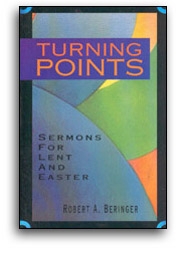
Turning Points
Sermons For Lent And Easter
Sooner or later the spiritual journey we make as followers of Jesus Christ leads us to a Jericho Road. The Jerusalem-Jericho Road of Jesus' day was the scene of one of the most compelling stories our Lord ever told. To this day, the actual road is little more than a strip of rocky terrain which leads us from Jerusalem south to the village of Jericho.
What is remarkable is that in just 15 miles, the elevation drops from 2,400 feet above sea level to 1,400 feet below sea level at the Dead Sea. (I will always remember those figures because when I once preached on this parable, I announced that the Dead Sea was 1,400 miles below sea level! Afterward, a parishioner said, ''Pastor, I know you preachers go pretty deep for your sermons, but your message this morning takes the cake!'')
But spiritually speaking, those who are serious about following Jesus Christ are going to find themselves on a Jericho Road, confronted by the same choices that faced the people in our Lord's story long ago. Four travelers made their way down
that shortcut from Jerusalem to Jericho. I must admit that I have never had much sympathy for the first traveler. He well knew the reputation of that gloomy road -- the danger from outlaws that confronted anyone foolish enough to travel alone. Yet, he deliberately took all the risks! He was not the first person in the world, nor certainly the last, to plunge recklessly along a path he knew to be dangerous and even foolhardy.
Nor am I excusing the priest, the second traveler on the road that day. Someday he will have to answer to God for why a person who spent his whole life proclaiming a message of love, simply walked by the wounded person in the ditch. Apparently, he was one of those religious persons who are so heavenly minded, they are no earthly good!
But as I have lived longer and experienced more of life, I have come to have a real sympathy for the Levite, the third of the travelers on the road to Jericho that day. Now he too passed by the person in need, but somehow I feel certain he did so only after a terrible struggle with what I am going to call his 'second thoughts.'' In those days Levites were assistants to the priests. They were not clergy, but they helped with the Temple sacrifices, and perhaps even sang in the choir.
I see this Levite in my mind, journeying along the road. Suddenly, he is startled by a moan from the lips of the man who had been mugged. Instinctively, he stops! He starts across the road to help! And then, I see him pause, and in that introspective interval, an army of 'second thoughts'' pounces on him! When he heard the cry of pain, a worthy thought was born in his heart; but alas, it died there because of his second thoughts. He began to wonder about the whole thing being a clever trap. With a hasty glance at his watch, he began to ponder whether he was really willing to get that involved in another person's problem. Those second thoughts finally won out, as they so often do, and after hesitating in the middle of the road, he too passed by on the other side.
Now, lest anyone think that these people in Jesus' story are buried in the long ago and far away, let me tell you how I recently met both the Levite and the Samaritan in my own
spiritual journey. It was late afternoon and, as a busy pastor, I was hurrying to get home in my car for a quick supper. Suddenly as I rounded a bend, I came upon two elderly women struggling to change a flat tire. Instinctively I took my foot off the gas and slowed down. I knew I should stop and help them. After all, that's the Christian thing to do. But right at that moment, I met the Levite in my own soul, and those second thoughts pounced on me! To myself I said, ''You're already late for dinner. Your wife has bell choir at 7 p.m. You've got an appointment and a meeting yourself. Surely someone with more time will come along.''
And sure enough, as I looked back into the rearview mirror, a young woman in a pickup truck was slowing down to offer her assistance to the women with the flat tire! The Good Samaritan lives even today! Now I realize that I am approaching this story in a very personal way, but our second thoughts happen to be a very personal matter.
After years of preaching about the Good Samaritan, I suddenly have gained a whole new appreciation for this one who stopped, and was moved by compassion for the wounded traveler. Perhaps he had seen those popular roadsigns that say, ''Commit A Random Act Of Kindness.'' But he too must have paused, just as the Levite did, wondering if this whole scene was nothing but a clever trap. The Samaritan may have been a person in a hurry. Who knows, maybe he was even on his way to a committee meeting of citizens to clean up the old Jericho Road! I sometimes think more Christian discipleship has died in committee meetings than anywhere else. There's a sign I have seen in churches that reads, ''God So Loved The World, He Didn't Send A Committee.'' But that is the great thing about this Samaritan. He simply did not let those second thoughts destroy the loving and gracious impulse that God put in his heart.
To be fair about this, I should quickly tell you that there are times in my life when I have been very grateful for second thoughts. Our second thoughts were given to us by a Wise Creator as a sort of watchdog over human activities. They are
a sort of protective mechanism that sends out a warning signal against acting too quickly, speaking without thinking. There were a number of people at a party, listening to a singer. One man turned to the man next to him and said, ''That woman who is singing has a terrible voice. Any idea who she is?'' ''Why yes,'' said the second man, 'she happens to be my wife.'' That should have ended the matter, but sometimes not even our second thoughts can save us from disaster! The first man stammered, ''I beg your pardon; it's not really her voice. It's that awful music she is singing. Who would ever have written a piece of music like that?'' And the second man said quietly, ''I did!''
No, I can think of so many times when my second thoughts have helped me bite my tongue, curb my anger, and saved me from reckless danger. But as a pastor for many years, I have also seen that testing bureau of second thoughts robbing people of those impulses to Christlike love and action. Like the Levite in Jesus' story, many of us want to do the Christlike thing in the face of hunger, poverty, injustice, and desperate human need. Yet, when the moment comes, we let our all too-abundant self concern for safety and security rob us of the ability to act in love.
In Hemingway's book, A Farewell To Arms, the author describes two soldiers talking. One is a much-decorated hero, a shell-shocked remnant of some valiant action where he displayed great courage. The other man has never seen action, and wonders if he will be a coward under fire. The younger man says, ''You would do it again, wouldn't you? You'd get another medal for bravery.'' But the old veteran shakes his head and says, ''No, not now that I've had a chance to think about it!''
I just wonder what would have happened to the Christian enterprise in this world if second thoughts had been allowed to destroy every valiant, sacrificial, courageous act of love done in the name of the Lord Jesus Christ? Would Christ have gone to the Cross to die for the sins of the world? Would the missionary movement have brought the Gospel to the far off
places of the world? Would Christians today be involved in feeding the hungry, sheltering the homeless, overcoming prejudice, and standing with the outcasts of society who spend their lives struggling with AIDS or living in our prisons?
I seriously doubt that God would be able to continue the transforming work of Jesus Christ, if all those sensible reasons we give ourselves about our own security and self-interest were allowed to take control! Thank God the Holy Spirit sometimes allows us to win that battle with our second thoughts!
In the February 1994 issue of Reader's Digest1 there is a story of how God's Spirit helped one man win his battle with second thoughts. On September 26, 1944, Ray Hamley, an RAF flying officer, and his crew flying an American-built B-25, dropped bombs on the town of Kleve just outside Germany's border with Holland. Ray was 21 years old, and his bombs that day hit the railroad station, a number of Nazi factories, and the town church. He had an inkling that day that one of his bombs hit the church, but war was war. That day in 1944 a young woman in Kleve mourned not only the loss of her church, but the loss of her parents who happened to live in a house next to the church. For the town of Kleve, 647 civilians and 879 military personnel would die before the Second World War was over.
Meanwhile, Ray Hamley went home to England after the war, married his childhood sweetheart, and became the head of a primary school. But then in 1983, someone handed Ray a newspaper clipping that showed how the people of a little town in Holland named Kleve were rebuilding the Church of St. Mary that had been bombed during the war. Something triggered in Ray's memory. He found his old logbook in the attic, and suddenly realized that it had been his bomb that had destroyed the church back in 1944.
An impulse was born in his heart as he thought about that tiny town, and how the loss of their church must have touched those people. But then came the second thoughts: ''Come on, Ray, after all, the Nazis bombed innocent children in London and Warsaw; it was wartime; it was years ago; forget it, Ray, and get on with your life; it's not your concern.''
But thank God, Ray Hamley did not let those second thoughts win out. He wrote to the Mayor of Kleve, asking for the forgiveness of the townspeople, and requesting that his letter be read by the priest at the dedication of the new church building. In 1984, Ray got a reply from the people of Kleve, requesting that he and his family come and see the new church building. But again, those second thoughts attacked Ray, and he could not even answer the letter.
Once more the parish priest in Kleve wrote to Ray, this time with a letter signed by 500 parishioners offering their forgiveness in the name of Jesus Christ! Ray Hamley went to Kleve. His visit not only healed old wounds in his life, but has brought about an incredible reconciliation between Ray's hometown in England and the people of Kleve in Holland. And it all happened because by the power of God, Ray Hamley was able to conquer his second thoughts! For Ray Hamley, this was a turning point in his life.
On your spiritual journey, there is someone calling out for your help. Let the Spirit of Christ help you to respond as did a certain Samaritan long ago.
1. Reader's Digest, February 1994 Edition, Reader's Digest Association, Inc., Pleasantville, New York, page 98.
Discussion Questions
Luke 10:25-37
1. If you were in Jericho at the time and heard about the incident on the road, would you:
a. go to visit the wounded man in the inn
b. send a card to the wounded man
c. write a letter to the editor praising the Samaritan
d. talk to someone about how terrible the crime rate is on the Jericho Road
e. sympathize with the Levite and the priest who played it safe
f. do nothing
2. What are your honest feelings when you confront someone in desperate need?
a. I feel sorry for you.
b. Here, let me give you a hand.
c. I feel so inadequate to be of real help.
d. If only I had more time, I would be glad to help.
e. There must be someone around with first aid training.
f. My appointment can wait! I'll help!
g. Sorry, there's just too much risk involved for me to stop.
3. Why do you think the Samaritan stopped when the others ''passed by on the other side''?
a. He was more sensitive.
b. He did not care about the religious problem of touching a person who was dead.
c. He knew in his heart what it means to be a hurting person.
d. He did not have as much to lose as the others.
4. When do you feel someone should reach out and help you?
a. When the pressures of work or school are getting me down
b. When I don't feel well
c. When I've just failed in something I tried to do
d. When I am afraid
e. When I feel alone
f. Other
5. In making choices as a Christian, which of the following is most important to you?
a. What will others think of me
b. What Jesus Christ would do in a similar situation
c. What will help me get ahead
d. What I feel in my heart is right
e. What should be helpful to others
6. Are your 'second thoughts'' helpful in keeping you from danger, or do they keep you from really expressing Christ's love in risky situations?
What is remarkable is that in just 15 miles, the elevation drops from 2,400 feet above sea level to 1,400 feet below sea level at the Dead Sea. (I will always remember those figures because when I once preached on this parable, I announced that the Dead Sea was 1,400 miles below sea level! Afterward, a parishioner said, ''Pastor, I know you preachers go pretty deep for your sermons, but your message this morning takes the cake!'')
But spiritually speaking, those who are serious about following Jesus Christ are going to find themselves on a Jericho Road, confronted by the same choices that faced the people in our Lord's story long ago. Four travelers made their way down
that shortcut from Jerusalem to Jericho. I must admit that I have never had much sympathy for the first traveler. He well knew the reputation of that gloomy road -- the danger from outlaws that confronted anyone foolish enough to travel alone. Yet, he deliberately took all the risks! He was not the first person in the world, nor certainly the last, to plunge recklessly along a path he knew to be dangerous and even foolhardy.
Nor am I excusing the priest, the second traveler on the road that day. Someday he will have to answer to God for why a person who spent his whole life proclaiming a message of love, simply walked by the wounded person in the ditch. Apparently, he was one of those religious persons who are so heavenly minded, they are no earthly good!
But as I have lived longer and experienced more of life, I have come to have a real sympathy for the Levite, the third of the travelers on the road to Jericho that day. Now he too passed by the person in need, but somehow I feel certain he did so only after a terrible struggle with what I am going to call his 'second thoughts.'' In those days Levites were assistants to the priests. They were not clergy, but they helped with the Temple sacrifices, and perhaps even sang in the choir.
I see this Levite in my mind, journeying along the road. Suddenly, he is startled by a moan from the lips of the man who had been mugged. Instinctively, he stops! He starts across the road to help! And then, I see him pause, and in that introspective interval, an army of 'second thoughts'' pounces on him! When he heard the cry of pain, a worthy thought was born in his heart; but alas, it died there because of his second thoughts. He began to wonder about the whole thing being a clever trap. With a hasty glance at his watch, he began to ponder whether he was really willing to get that involved in another person's problem. Those second thoughts finally won out, as they so often do, and after hesitating in the middle of the road, he too passed by on the other side.
Now, lest anyone think that these people in Jesus' story are buried in the long ago and far away, let me tell you how I recently met both the Levite and the Samaritan in my own
spiritual journey. It was late afternoon and, as a busy pastor, I was hurrying to get home in my car for a quick supper. Suddenly as I rounded a bend, I came upon two elderly women struggling to change a flat tire. Instinctively I took my foot off the gas and slowed down. I knew I should stop and help them. After all, that's the Christian thing to do. But right at that moment, I met the Levite in my own soul, and those second thoughts pounced on me! To myself I said, ''You're already late for dinner. Your wife has bell choir at 7 p.m. You've got an appointment and a meeting yourself. Surely someone with more time will come along.''
And sure enough, as I looked back into the rearview mirror, a young woman in a pickup truck was slowing down to offer her assistance to the women with the flat tire! The Good Samaritan lives even today! Now I realize that I am approaching this story in a very personal way, but our second thoughts happen to be a very personal matter.
After years of preaching about the Good Samaritan, I suddenly have gained a whole new appreciation for this one who stopped, and was moved by compassion for the wounded traveler. Perhaps he had seen those popular roadsigns that say, ''Commit A Random Act Of Kindness.'' But he too must have paused, just as the Levite did, wondering if this whole scene was nothing but a clever trap. The Samaritan may have been a person in a hurry. Who knows, maybe he was even on his way to a committee meeting of citizens to clean up the old Jericho Road! I sometimes think more Christian discipleship has died in committee meetings than anywhere else. There's a sign I have seen in churches that reads, ''God So Loved The World, He Didn't Send A Committee.'' But that is the great thing about this Samaritan. He simply did not let those second thoughts destroy the loving and gracious impulse that God put in his heart.
To be fair about this, I should quickly tell you that there are times in my life when I have been very grateful for second thoughts. Our second thoughts were given to us by a Wise Creator as a sort of watchdog over human activities. They are
a sort of protective mechanism that sends out a warning signal against acting too quickly, speaking without thinking. There were a number of people at a party, listening to a singer. One man turned to the man next to him and said, ''That woman who is singing has a terrible voice. Any idea who she is?'' ''Why yes,'' said the second man, 'she happens to be my wife.'' That should have ended the matter, but sometimes not even our second thoughts can save us from disaster! The first man stammered, ''I beg your pardon; it's not really her voice. It's that awful music she is singing. Who would ever have written a piece of music like that?'' And the second man said quietly, ''I did!''
No, I can think of so many times when my second thoughts have helped me bite my tongue, curb my anger, and saved me from reckless danger. But as a pastor for many years, I have also seen that testing bureau of second thoughts robbing people of those impulses to Christlike love and action. Like the Levite in Jesus' story, many of us want to do the Christlike thing in the face of hunger, poverty, injustice, and desperate human need. Yet, when the moment comes, we let our all too-abundant self concern for safety and security rob us of the ability to act in love.
In Hemingway's book, A Farewell To Arms, the author describes two soldiers talking. One is a much-decorated hero, a shell-shocked remnant of some valiant action where he displayed great courage. The other man has never seen action, and wonders if he will be a coward under fire. The younger man says, ''You would do it again, wouldn't you? You'd get another medal for bravery.'' But the old veteran shakes his head and says, ''No, not now that I've had a chance to think about it!''
I just wonder what would have happened to the Christian enterprise in this world if second thoughts had been allowed to destroy every valiant, sacrificial, courageous act of love done in the name of the Lord Jesus Christ? Would Christ have gone to the Cross to die for the sins of the world? Would the missionary movement have brought the Gospel to the far off
places of the world? Would Christians today be involved in feeding the hungry, sheltering the homeless, overcoming prejudice, and standing with the outcasts of society who spend their lives struggling with AIDS or living in our prisons?
I seriously doubt that God would be able to continue the transforming work of Jesus Christ, if all those sensible reasons we give ourselves about our own security and self-interest were allowed to take control! Thank God the Holy Spirit sometimes allows us to win that battle with our second thoughts!
In the February 1994 issue of Reader's Digest1 there is a story of how God's Spirit helped one man win his battle with second thoughts. On September 26, 1944, Ray Hamley, an RAF flying officer, and his crew flying an American-built B-25, dropped bombs on the town of Kleve just outside Germany's border with Holland. Ray was 21 years old, and his bombs that day hit the railroad station, a number of Nazi factories, and the town church. He had an inkling that day that one of his bombs hit the church, but war was war. That day in 1944 a young woman in Kleve mourned not only the loss of her church, but the loss of her parents who happened to live in a house next to the church. For the town of Kleve, 647 civilians and 879 military personnel would die before the Second World War was over.
Meanwhile, Ray Hamley went home to England after the war, married his childhood sweetheart, and became the head of a primary school. But then in 1983, someone handed Ray a newspaper clipping that showed how the people of a little town in Holland named Kleve were rebuilding the Church of St. Mary that had been bombed during the war. Something triggered in Ray's memory. He found his old logbook in the attic, and suddenly realized that it had been his bomb that had destroyed the church back in 1944.
An impulse was born in his heart as he thought about that tiny town, and how the loss of their church must have touched those people. But then came the second thoughts: ''Come on, Ray, after all, the Nazis bombed innocent children in London and Warsaw; it was wartime; it was years ago; forget it, Ray, and get on with your life; it's not your concern.''
But thank God, Ray Hamley did not let those second thoughts win out. He wrote to the Mayor of Kleve, asking for the forgiveness of the townspeople, and requesting that his letter be read by the priest at the dedication of the new church building. In 1984, Ray got a reply from the people of Kleve, requesting that he and his family come and see the new church building. But again, those second thoughts attacked Ray, and he could not even answer the letter.
Once more the parish priest in Kleve wrote to Ray, this time with a letter signed by 500 parishioners offering their forgiveness in the name of Jesus Christ! Ray Hamley went to Kleve. His visit not only healed old wounds in his life, but has brought about an incredible reconciliation between Ray's hometown in England and the people of Kleve in Holland. And it all happened because by the power of God, Ray Hamley was able to conquer his second thoughts! For Ray Hamley, this was a turning point in his life.
On your spiritual journey, there is someone calling out for your help. Let the Spirit of Christ help you to respond as did a certain Samaritan long ago.
1. Reader's Digest, February 1994 Edition, Reader's Digest Association, Inc., Pleasantville, New York, page 98.
Discussion Questions
Luke 10:25-37
1. If you were in Jericho at the time and heard about the incident on the road, would you:
a. go to visit the wounded man in the inn
b. send a card to the wounded man
c. write a letter to the editor praising the Samaritan
d. talk to someone about how terrible the crime rate is on the Jericho Road
e. sympathize with the Levite and the priest who played it safe
f. do nothing
2. What are your honest feelings when you confront someone in desperate need?
a. I feel sorry for you.
b. Here, let me give you a hand.
c. I feel so inadequate to be of real help.
d. If only I had more time, I would be glad to help.
e. There must be someone around with first aid training.
f. My appointment can wait! I'll help!
g. Sorry, there's just too much risk involved for me to stop.
3. Why do you think the Samaritan stopped when the others ''passed by on the other side''?
a. He was more sensitive.
b. He did not care about the religious problem of touching a person who was dead.
c. He knew in his heart what it means to be a hurting person.
d. He did not have as much to lose as the others.
4. When do you feel someone should reach out and help you?
a. When the pressures of work or school are getting me down
b. When I don't feel well
c. When I've just failed in something I tried to do
d. When I am afraid
e. When I feel alone
f. Other
5. In making choices as a Christian, which of the following is most important to you?
a. What will others think of me
b. What Jesus Christ would do in a similar situation
c. What will help me get ahead
d. What I feel in my heart is right
e. What should be helpful to others
6. Are your 'second thoughts'' helpful in keeping you from danger, or do they keep you from really expressing Christ's love in risky situations?
