
Stuff They Never Teach You
Preaching
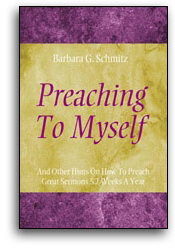
Preaching To Myself
And Other Hints On How To Preach Great Sermons 52 Weeks A Year
1. First Sermon
The first sermon I ever preached was as a layperson in a small rural church in New York State. I think I preached on one of the Psalms. I don't remember anything else about it, except that it was an old church and it did not even have a toilet. I'll be honest with you -- not having toilet facilities impacts a person's sermons in more ways than one.
Your first sermon is going to ramble all over the place, toilet or not. But eventually, you'll start to get better.
2. The Most Important Advice About Preaching That You Will Ever Receive
I am about to share with you the most important advice about preaching that you will ever receive. It alone will justify the purchasing of this book. At first it may not appear to you to be the most important advice, but I assure you that it is. Some day, you will thank me. My advice is this: Before you leave the vesting room to go preach, look in the mirror, smile, and make sure that you don't have pieces of food in your teeth. You will look pretty ridiculous if you have poppy seeds from your morning bagel sticking to your front tooth, or a big piece of green lettuce dangling from your incisor. Or, frankly, something worse: I am visualizing a male preacher with a beard who has a cold -- enough said.
3. Pulling Pork From The Barrel
Once I asked a colleague what he would be preaching on the next Sunday. "Oh," said he, "I think I'm going to pull some pork out of the barrel." Recognizing this as a vague political term, I asked him exactly what that meant. He replied, "That means I'm preaching an old sermon I've already got in the file."
I have to say I have mixed feelings about preaching old sermons. I remember my disgust as a young pastor when one day the preacher for the day arrived in the sacristy to vest, and put his sermon notes down on the table. They were, no kidding, yellow. I thought to myself, "Can't you even copy the sermon on fresh paper? This is awful." However, I have to be honest and say, it was a very good sermon. A classic. Worthy of being repeated. So why should the preacher have bothered to write another sermon when the one he had was perfectly appropriate?
You can also imagine my surprise when some parishioners informed me that one of my predecessors had exactly 52 sermons. Yup, 52 sermons, one for each Sunday of the year, and he repeated them over and over during his tenure. They knew his sermons pretty well, and, I understand, used the sermon time after a while to catch up on sleep.
My conviction is this: We preachers need to be getting fresh sermons from the Holy Spirit each week -- that's our vocation and our privilege, our ministry and our job. We should be working hard to discern God's word for today for the people to whom we are preaching. That said, however, there are some times to pull the pork out of the barrel. One, as I've mentioned, is when you have a terrific sermon. Like a good recipe, why bother to try to improve on it? Just keep serving it up as often as you can. Serve it to different groups, if you can, but serve it up. Second, there are those weeks when either you are out of town all week, or completely absorbed in gut-wrenching pastoral work, or have some major sickness or family problem that draws all your energy and leaves you feeling pretty dry, without much energy to write a sermon. If those circumstances happen, then pulling some pork out of the barrel makes sense. (Make sure you update any examples or stories you have so it's not totally obvious to everyone that you are reusing an old sermon). However, if this is happening more than three or four times a year, you are pulling too much pork.
4. Bad Hair Day Sermons
Occasionally you want to crawl out of the pulpit on your hands and knees and head for the nearest hole. Sometimes sermons turn out bad. They fall flat. It doesn't make any sense to you, and you wrote the thing! You need to know this happens.
Think about a bad sermon in terms of baking a recipe. Most of the time it comes out swell. But sometimes you undercook it or overcook (a.k.a. burn) it. If you forget one key ingredient, like yeast or baking powder, the whole thing will fall flat. Or you forget to grease the bottom of the pans and everything sticks. See all this as a learning process. It happens to the best preachers, just like striking out happens to the best hitters. Go back to the dugout and get ready for the next time at the plate.
5. Hazards Of The Remote Microphone
Here is maybe the second little piece of advice that frankly may save you your job some day. So many churches these days use lapel microphones, and what a blessing they are as they force all those who sit in the back pew to actually have to hear your sermon rather than escape it. (Before the invention of lapel mikes, it was a known fact that older women who were hard of hearing would sit in the back three pews and then proceed to complain -- very loudly -- that they could not hear the sermon.)
You will want to find the "off" position on your friendly mike and commit it to memory. I have heard terrible tales of preachers who, following the sermon, ducked into the bathroom to take care of some emergency personal business, such as vomiting or urinating. However, they forgot to turn off their lapel mike, and these unpleasant and rather personal sounds were then broadcast throughout the church.
6. When You Get The Giggles
As any youngster knows, the worst place to get the giggles is in church, because once you get them, there is no stopping them. Things in church are hilariously funny once you start on a giggly roll.
Sometimes it happens during the reading of the lessons. A typo, a mispronunciation, and there is a titter throughout the congregation. One time, the scripture reading was from Timothy, and the reader said, "Now unto God immoral, the only-wise God...." The all-time winner for bad pronunciation has to be the poor lay reader who was stuck with an Old Testament reading that included the Hittites, the Philistines, and the Jebusites. The challenged reader made it through the list only to pronounce the last group as the "Jebu-zitties."
Sometimes it's the bulletin announcements. Since entire books have been published on unintentionally humorous bulletin announcements, I won't go into details here. My advice is simply not to read the bulletin announcements until after the sermon!
Sometimes it's pure human drama. In one moment of total silence between readings, a person passed air in a very loud way. Everyone in the entire church heard it, and the place was on the brink of an uproar, so as I stood up to read the Gospel, I simply said, "Okay, let's all laugh and just get it out real good." When they finally stopped laughing, they and I could go on.
Sometimes only the preacher gets the giggles. This has happened to me only one time. I was seated in a pew next to a tall, lanky fellow named John, and I simply buried my head in his stomach and laughed until I stopped. What anybody else thought, I don't know, but it was the beginning of a good friendship with the gentleman who lent me his tummy.
7. What To Do If You Forget To Bring Your Sermon
This pretty much happens to everybody sooner or later. You will be in your car on the way to church, or worse, processing into church at the start of the service, and you will realize that you and your sermon notes are not in the same place. The first time this happens, it could cause an anxiety attack. However, there is no need to panic. Simply do this: write down your three main points. If your sermon has any organization and flow to it, you should be able to remember at least one major illustration or story for each main point. Jot down these main points, and the key words to remind you of the illustrations, on a piece of paper. These are now your sermon notes. Wing it the best you can. Don't apologize for losing your notes or even tell them you did. And here it a little secret: I am willing to bet you will get more positive feedback than you usually do. That's just the way it works.
I recommend "pretending" you have lost your sermon notes each week in preparation for the big day. It can be a little game to play with yourself, especially if you have a long commute to church. On the serious side, it is also one of the single most helpful exercises I can think of doing when your sermon is written but you really aren't happy with it, because that may be a clue it really doesn't flow well. If you pretend that you have forgotten your notes, it will help you to reduce your convoluted and wordy sermon down to three or so main points which do have some clarity and connection.
8. Pages Out Of Order?
Even if you number your pages, things can go wrong. I have heard about an ordination service where the preacher's notes were subterfuged by his colleagues -- when he got to the pulpit, the pages were all out of order. Or, every so often, a page turns up missing -- you are in the middle of the sermon when you realize you are missing a whole page. There's not a whole lot to do at this point except grin and bear it, try to fix it, and if you can't, wing it as best you can.
9. What Time Is It? -- And Other Questions To Ask
Stirred up and chest puffed out one fine first Sunday of Advent, I began my sermon about the end times and knowing the times and seasons by bellowing out a stirring, rhetorical question appropriate for Advent: "Do you know what time it is?" In the stupendous silence that followed, a small male voice in the front pew said, "It's ten after eight."
Beware: If you ask a question, somebody just might answer it.
Since I often preach from the center aisle, and sometimes ask questions, I do get answers. If they are biblical knowledge sorts of questions, I usually have a long wait before some tentative guesses are offered. If they are more everyday kinds of questions, people generally speak up with their best guesses to my questions.
Occasionally, someone raises a hand or asks me a question straight out. In that case, I just answer it the best I can and if it looks like trouble, I don't give any more eye contact in that direction!
The first sermon I ever preached was as a layperson in a small rural church in New York State. I think I preached on one of the Psalms. I don't remember anything else about it, except that it was an old church and it did not even have a toilet. I'll be honest with you -- not having toilet facilities impacts a person's sermons in more ways than one.
Your first sermon is going to ramble all over the place, toilet or not. But eventually, you'll start to get better.
2. The Most Important Advice About Preaching That You Will Ever Receive
I am about to share with you the most important advice about preaching that you will ever receive. It alone will justify the purchasing of this book. At first it may not appear to you to be the most important advice, but I assure you that it is. Some day, you will thank me. My advice is this: Before you leave the vesting room to go preach, look in the mirror, smile, and make sure that you don't have pieces of food in your teeth. You will look pretty ridiculous if you have poppy seeds from your morning bagel sticking to your front tooth, or a big piece of green lettuce dangling from your incisor. Or, frankly, something worse: I am visualizing a male preacher with a beard who has a cold -- enough said.
3. Pulling Pork From The Barrel
Once I asked a colleague what he would be preaching on the next Sunday. "Oh," said he, "I think I'm going to pull some pork out of the barrel." Recognizing this as a vague political term, I asked him exactly what that meant. He replied, "That means I'm preaching an old sermon I've already got in the file."
I have to say I have mixed feelings about preaching old sermons. I remember my disgust as a young pastor when one day the preacher for the day arrived in the sacristy to vest, and put his sermon notes down on the table. They were, no kidding, yellow. I thought to myself, "Can't you even copy the sermon on fresh paper? This is awful." However, I have to be honest and say, it was a very good sermon. A classic. Worthy of being repeated. So why should the preacher have bothered to write another sermon when the one he had was perfectly appropriate?
You can also imagine my surprise when some parishioners informed me that one of my predecessors had exactly 52 sermons. Yup, 52 sermons, one for each Sunday of the year, and he repeated them over and over during his tenure. They knew his sermons pretty well, and, I understand, used the sermon time after a while to catch up on sleep.
My conviction is this: We preachers need to be getting fresh sermons from the Holy Spirit each week -- that's our vocation and our privilege, our ministry and our job. We should be working hard to discern God's word for today for the people to whom we are preaching. That said, however, there are some times to pull the pork out of the barrel. One, as I've mentioned, is when you have a terrific sermon. Like a good recipe, why bother to try to improve on it? Just keep serving it up as often as you can. Serve it to different groups, if you can, but serve it up. Second, there are those weeks when either you are out of town all week, or completely absorbed in gut-wrenching pastoral work, or have some major sickness or family problem that draws all your energy and leaves you feeling pretty dry, without much energy to write a sermon. If those circumstances happen, then pulling some pork out of the barrel makes sense. (Make sure you update any examples or stories you have so it's not totally obvious to everyone that you are reusing an old sermon). However, if this is happening more than three or four times a year, you are pulling too much pork.
4. Bad Hair Day Sermons
Occasionally you want to crawl out of the pulpit on your hands and knees and head for the nearest hole. Sometimes sermons turn out bad. They fall flat. It doesn't make any sense to you, and you wrote the thing! You need to know this happens.
Think about a bad sermon in terms of baking a recipe. Most of the time it comes out swell. But sometimes you undercook it or overcook (a.k.a. burn) it. If you forget one key ingredient, like yeast or baking powder, the whole thing will fall flat. Or you forget to grease the bottom of the pans and everything sticks. See all this as a learning process. It happens to the best preachers, just like striking out happens to the best hitters. Go back to the dugout and get ready for the next time at the plate.
5. Hazards Of The Remote Microphone
Here is maybe the second little piece of advice that frankly may save you your job some day. So many churches these days use lapel microphones, and what a blessing they are as they force all those who sit in the back pew to actually have to hear your sermon rather than escape it. (Before the invention of lapel mikes, it was a known fact that older women who were hard of hearing would sit in the back three pews and then proceed to complain -- very loudly -- that they could not hear the sermon.)
You will want to find the "off" position on your friendly mike and commit it to memory. I have heard terrible tales of preachers who, following the sermon, ducked into the bathroom to take care of some emergency personal business, such as vomiting or urinating. However, they forgot to turn off their lapel mike, and these unpleasant and rather personal sounds were then broadcast throughout the church.
6. When You Get The Giggles
As any youngster knows, the worst place to get the giggles is in church, because once you get them, there is no stopping them. Things in church are hilariously funny once you start on a giggly roll.
Sometimes it happens during the reading of the lessons. A typo, a mispronunciation, and there is a titter throughout the congregation. One time, the scripture reading was from Timothy, and the reader said, "Now unto God immoral, the only-wise God...." The all-time winner for bad pronunciation has to be the poor lay reader who was stuck with an Old Testament reading that included the Hittites, the Philistines, and the Jebusites. The challenged reader made it through the list only to pronounce the last group as the "Jebu-zitties."
Sometimes it's the bulletin announcements. Since entire books have been published on unintentionally humorous bulletin announcements, I won't go into details here. My advice is simply not to read the bulletin announcements until after the sermon!
Sometimes it's pure human drama. In one moment of total silence between readings, a person passed air in a very loud way. Everyone in the entire church heard it, and the place was on the brink of an uproar, so as I stood up to read the Gospel, I simply said, "Okay, let's all laugh and just get it out real good." When they finally stopped laughing, they and I could go on.
Sometimes only the preacher gets the giggles. This has happened to me only one time. I was seated in a pew next to a tall, lanky fellow named John, and I simply buried my head in his stomach and laughed until I stopped. What anybody else thought, I don't know, but it was the beginning of a good friendship with the gentleman who lent me his tummy.
7. What To Do If You Forget To Bring Your Sermon
This pretty much happens to everybody sooner or later. You will be in your car on the way to church, or worse, processing into church at the start of the service, and you will realize that you and your sermon notes are not in the same place. The first time this happens, it could cause an anxiety attack. However, there is no need to panic. Simply do this: write down your three main points. If your sermon has any organization and flow to it, you should be able to remember at least one major illustration or story for each main point. Jot down these main points, and the key words to remind you of the illustrations, on a piece of paper. These are now your sermon notes. Wing it the best you can. Don't apologize for losing your notes or even tell them you did. And here it a little secret: I am willing to bet you will get more positive feedback than you usually do. That's just the way it works.
I recommend "pretending" you have lost your sermon notes each week in preparation for the big day. It can be a little game to play with yourself, especially if you have a long commute to church. On the serious side, it is also one of the single most helpful exercises I can think of doing when your sermon is written but you really aren't happy with it, because that may be a clue it really doesn't flow well. If you pretend that you have forgotten your notes, it will help you to reduce your convoluted and wordy sermon down to three or so main points which do have some clarity and connection.
8. Pages Out Of Order?
Even if you number your pages, things can go wrong. I have heard about an ordination service where the preacher's notes were subterfuged by his colleagues -- when he got to the pulpit, the pages were all out of order. Or, every so often, a page turns up missing -- you are in the middle of the sermon when you realize you are missing a whole page. There's not a whole lot to do at this point except grin and bear it, try to fix it, and if you can't, wing it as best you can.
9. What Time Is It? -- And Other Questions To Ask
Stirred up and chest puffed out one fine first Sunday of Advent, I began my sermon about the end times and knowing the times and seasons by bellowing out a stirring, rhetorical question appropriate for Advent: "Do you know what time it is?" In the stupendous silence that followed, a small male voice in the front pew said, "It's ten after eight."
Beware: If you ask a question, somebody just might answer it.
Since I often preach from the center aisle, and sometimes ask questions, I do get answers. If they are biblical knowledge sorts of questions, I usually have a long wait before some tentative guesses are offered. If they are more everyday kinds of questions, people generally speak up with their best guesses to my questions.
Occasionally, someone raises a hand or asks me a question straight out. In that case, I just answer it the best I can and if it looks like trouble, I don't give any more eye contact in that direction!
