
Washed By Water: The Jordan
Sermon
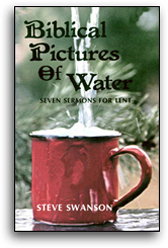
BIBLICAL PICTURES OF WATER
SEVEN SERMONS FOR LENT
When a priest in the medieval Christian church stood before the altar of God and raised the bread of holy communion above his head, he said in Latin, hoc est corpus, "This is the body." That was the supreme moment of mystery; that was the moment of miracle; that was the moment of change. At that moment the medieval Christian believed that ordinary bread became the body of Christ.
Hoc est corpus, "This is the body." What the ordinary person way back in the corner of the cathedral thought he heard was not hoc est corpus, but "hocus-pocus." That word soon came to mean magic, mystery, seeing the unbelievable happen before your very eyes. The medieval priest felt that mystery very deeply when he spoke those words. It was a solemn and scary moment. Martin Luther was so frightened the first time he spoke those words as a novice priest that he nearly fainted right there at the altar.
Today, five hundred years later, the consecration of the elements is still a moment of high excitement and mystery - and even fear as we hold God's bread in our hands and say, "This is the body ..."
The Lord's Supper uses bread and wine. The Sacrament of Baptism uses water. Somehow water doesn't hold the same kind of mystery because no one expects water to become anything different. Water doesn't represent anything. The bread of communion both represents and is the body of Christ. The water of baptism, however, is simply water. It is merely the agent of washing. In fact, that's what the word baptism means: baptizo (Greek), "I wash."
Water is great for washing. Water can dissolve almost anything. Nearly half of the world's known chemicals can be found dissolved in the world's natural waters. Some substances form solutions with water; other merely go into suspension in water - such as the silt in the Mississippi River or the soapy murk in a tubful of water, residue that swirls down the drain after Suzie's bath.
The amazing thing about a river full of water is that no matter how many chemicals are dissolved in it, or how much mud is suspended in it, or how many Suzies uncork their bathtubs into it, when the sun hits that water and evaporates some of it to form a cloud, the water in that cloud is pure. The river may be absolutely filthy, but you can always distill pure water from it.
There has always been the same amount of water on this earth. There may be wet years and dry years, but all the water is somewhere. We use it over and over again. Some of the same molecules in the water we wash in today may have been in the waters Moses parted with his staff, or the water in which David washed his feet, or the water the woman of Samaria drew for Jesus, or that John Calvin used in a baptism.
There is something very satisfying about washing. That must be what we appreciate about baptism. Because baptism is a washing, it makes us feel clean - even if we just watch - and we like feeling clean. Nothing feels better when we are extremely dirty than does soothing, cleansing water.
Everybody has his own "dirty story," I suppose, but the dirtiest I can remember being was when Martin Olson and I tore down an old house one August. I knew it would be dirty work, but I never dreamed it would be so bad as the day we pulled down the attic ceiling. Down came plaster dust and street dust - and shingle dust - sixty-five years worth of dust that stuck to our sweaty arms and faces on that ninety-five degree afternoon. We would have made a perfect before-and-after picture of the washing of baptism on that day: two absolutely dirty people washed clean.
Sometimes, though, we wash and we still don't feel clean. Maybe that's the difference between dirty and filthy. Even on that ninety-five degree day, caked with grime, Martin and I sat and ate our lunch without even washing our hands. We thought nothing of it. It's not so bad to eat with dirty hands. It's different, though, when you're filthy.
I remember my dad telling me a filthy story. It goes back to outhouse days in south Minneapolis, I'd guess around 1915. One of the common Halloween pranks in those days was to take a stout ten foot pole, wedge it under the ridge in the back of an outhouse, and then, by pushing forward and upward, you could topple that little building frontward on its door.
That's what Dad and his friends were doing. Dad and a kid they called Eddie Upstairs were watching the street, while Pinhead, Worms, Peckie, and Eddie Downstairs tipped over a whole block of outhouses.
Everything went fine until they tried one with a rotten foundation. Then, perhaps to prove that sin often has its own rewards, Pinhead and Worms pushed too hard and Peakie fell in.
That's the difference between dirty and filthy. You don't climb out of a hole like that and go directly to Aunt Polly's Halloween taffy pull. An experience like that gives you a filthy feeling, a defiled feeling. Only a lot of scrubbing can wash off that feeling. You can eat lunch with dirty hands, but not with filthy hands.
Problems arise, however, when the dirt or the filth or the stain is somehow connected with wrong or evil or sin, because that produces guilt. Dirt and even filth wash off; guilt is something else. Guilt isn't on the outside; you can't really scrub it off. Plain water, ordinary water, can't touch guilt.
If Shakespeare's play, Macbeth is about anything, it is about guilt. Macbeth has two memorable scenes that involve washing and guilt. In the beginning of the play, Macbeth and Lady Macbeth conspire to kill the good king, Duncan. When murderer Macbeth comes back from the king's bedchamber with bloody hands, Lady M. says to her husband:
"Go and get some water,
And wash this filthy witness from your hand."
At that Macbeth notices his hands. It's not just a filthy witness; it's not just a bit of blood. That stain is innocent blood. That filthy business is the guilt of a cold-blooded murder. Macbeth stares at his hands and says:
"What hands are here? Ha! they pluck out mine eyes.
Will all great Neptune's ocean wash this blood
Clean from my hand?" (II, I, 58-61)
Lady Macbeth pooh-poohs all his worries. "A little water clears us of this deed," she says. But much later, as the play ends, we see her under a nurse's care, gone mad. The doctor whispers:
"What is it she does now? Look, how she rubs her hands."
Her nurse answers:
"It is an accustomed action with her, to seem thus washing her hands: I have known her to continue in this a quarter of an hour."
It is apparent that, in her trance, Lady Macbeth sees spots of blood. She lifts her fingers to her face and says:
"Here's the smell of blood still: all the perfumes of Arabia will not sweeten this little hand." (V, iii, 56, 67)
Guilt. The incredibly indelible stain of guilt. Guilt drove Macbeth and his lady to madness and to death; it will drive any of us to death.
There is nothing so real, so haunting, and so crippling as a feeling of guilt. Ordinary water can wash away dirt; ordinary water can even wash away filth. But the stains and spots of guilt require extraordinary water.
Those who have a real hold on the Good News know that there is such an extraordinary water. Jesus took ordinary water and made it extraordinary by connecting it to the Word - to his words really. Words of promise. "By water and the Word," we sing in the hymn. Baptism: the water and the Word. A washing with a promise.
When I was little, my mom used to give me colossal baths, real scrubbings. I'm sure I just shone afterwards. Mothers seem to appreciate that shiny, scrubbed look. Sometimes, though, there wasn't time for one of those momentous baths. What I got then was called a katavask - a cat wash - a lick and a promise.
Maybe that's how we should see baptism, as a katavask - a lick and a promise. A little water or a lot, a ritual washing; it happens only once. The promise in that simple washing, however, is gigantic. God promises it will last forever, that as long as we keep the faith and ask for forgiveness, our sins are washed away daily, hourly, every minute of every day of every year of our lives. Through baptism we become Mr. Clean, Mrs. Clean, Miss Clean. God's forgiveness makes us shine like scrubbed kids. We glow. We radiate.
We need that washing because we were born with sin. We continue to need the promise that went with that washing because of the sins we commit day by day - and because of the guilt of that sin.
Guilt and sin are the very stuff our lives are made of. Since Adam and Eve, since the beginning, since the fall of humankind, we have all needed to be picked up out of the dirt and filth, and washed off, scrubbed up. Baptism is that washing.
But, we ask: if baptism washes away the stains and the guilt of sin, why in the world did Jesus want to be baptized?
John the Baptist had the same question. John was one of the first to recognize Jesus as the Christ of God and he thought it was very strange, in fact absolutely crazy, that he, an ordinary, sinful man, was asked to baptize the chosen one of God, the sinless and perfect Christ Jesus. "I need to be baptized by you," John said. Why "... do you come to me?"
Jesus had an answer. Jesus always had an answer. "To fulfill all righteousness," he said. I don't know what that means exactly, but I think it was a part of his becoming one of us. From the beginning, Jesus struggled to be one of us, to be a human being, a person. He was born as we were born; he was dedicated and circumcized like any other Jewish boy; he ate, slept, worked, and played as one of us; he grew up like the rest of us.
But when Jesus began his public ministry, his real work, he must have found it harder and harder to remain one with us. He was baptized for forgiveness even though he needed no forgiveness. He practiced his family religion even though he himself would later start an entirely new religion. And, in the end, he died just like the rest of us - but not really. If the wage of sin is death, Jesus didn't earn that wage. He didn't deserve to die on that cross - yet he did die.
On that rugged cross the blood of Jesus was shed and, in that blood, we see still another kind of washing. Some of the old hymns portrayed that washing very vividly: "Washed in the blood of the Lamb," we used to sing. Or how about this verse from the old hymn, "I Lay My Sins on Jesus":
I bring my guilt to Jesus
To wash my crimson stains
White in his blood most precious
Till not a spot remains.
(Horatius Bonar, ca. 1845)
Or this one:
There is a fountain filled with blood
Drawn from our Savior's veins;
And sinners plunged beneath that flood
Lose all their guilty stains.
(William Cowper, 1771)
That's pretty heavy imagery, but that's about the size of it. It's Lady Macbeth in reverse. Somehow or other, when Jesus died, his holy and precious blood spattered over the entire world. There's a spot of his blood on every one of us and that spot won't wash off. We can cover it up; we can pretend it isn't there, but we are marked. We are marked with the blood of the Lamb.
That blood can cleanse us; that blood can save us. Christ's blood washes us clean and baptism reminds us of that. When the little bitty babies and the children and the young people and the adults are brought forward in every kind of church and chapel around the world week after week and year after year, they are indeed washed with water, they are indeed cleansed - but they are also marked with the blood of the Lamb, the Lamb without blemish and without spot.
That blood, that water, that washing takes care of all the dirt and filth and stain. That washing also takes care of the guilt. Baptism is a complete washing, once and for all time. In him and through him and with him we are washed clean - forever and ever and ever.
O Jesus, let your precious blood
Be to my soul a cleansing flood.
Turn not, O Lord, your guest away,
But grant that justified I may
Go to my house, at peace to be:
O God, be merciful to me!
(Magnus B. Landstad, 1802-1880)
Hoc est corpus, "This is the body." What the ordinary person way back in the corner of the cathedral thought he heard was not hoc est corpus, but "hocus-pocus." That word soon came to mean magic, mystery, seeing the unbelievable happen before your very eyes. The medieval priest felt that mystery very deeply when he spoke those words. It was a solemn and scary moment. Martin Luther was so frightened the first time he spoke those words as a novice priest that he nearly fainted right there at the altar.
Today, five hundred years later, the consecration of the elements is still a moment of high excitement and mystery - and even fear as we hold God's bread in our hands and say, "This is the body ..."
The Lord's Supper uses bread and wine. The Sacrament of Baptism uses water. Somehow water doesn't hold the same kind of mystery because no one expects water to become anything different. Water doesn't represent anything. The bread of communion both represents and is the body of Christ. The water of baptism, however, is simply water. It is merely the agent of washing. In fact, that's what the word baptism means: baptizo (Greek), "I wash."
Water is great for washing. Water can dissolve almost anything. Nearly half of the world's known chemicals can be found dissolved in the world's natural waters. Some substances form solutions with water; other merely go into suspension in water - such as the silt in the Mississippi River or the soapy murk in a tubful of water, residue that swirls down the drain after Suzie's bath.
The amazing thing about a river full of water is that no matter how many chemicals are dissolved in it, or how much mud is suspended in it, or how many Suzies uncork their bathtubs into it, when the sun hits that water and evaporates some of it to form a cloud, the water in that cloud is pure. The river may be absolutely filthy, but you can always distill pure water from it.
There has always been the same amount of water on this earth. There may be wet years and dry years, but all the water is somewhere. We use it over and over again. Some of the same molecules in the water we wash in today may have been in the waters Moses parted with his staff, or the water in which David washed his feet, or the water the woman of Samaria drew for Jesus, or that John Calvin used in a baptism.
There is something very satisfying about washing. That must be what we appreciate about baptism. Because baptism is a washing, it makes us feel clean - even if we just watch - and we like feeling clean. Nothing feels better when we are extremely dirty than does soothing, cleansing water.
Everybody has his own "dirty story," I suppose, but the dirtiest I can remember being was when Martin Olson and I tore down an old house one August. I knew it would be dirty work, but I never dreamed it would be so bad as the day we pulled down the attic ceiling. Down came plaster dust and street dust - and shingle dust - sixty-five years worth of dust that stuck to our sweaty arms and faces on that ninety-five degree afternoon. We would have made a perfect before-and-after picture of the washing of baptism on that day: two absolutely dirty people washed clean.
Sometimes, though, we wash and we still don't feel clean. Maybe that's the difference between dirty and filthy. Even on that ninety-five degree day, caked with grime, Martin and I sat and ate our lunch without even washing our hands. We thought nothing of it. It's not so bad to eat with dirty hands. It's different, though, when you're filthy.
I remember my dad telling me a filthy story. It goes back to outhouse days in south Minneapolis, I'd guess around 1915. One of the common Halloween pranks in those days was to take a stout ten foot pole, wedge it under the ridge in the back of an outhouse, and then, by pushing forward and upward, you could topple that little building frontward on its door.
That's what Dad and his friends were doing. Dad and a kid they called Eddie Upstairs were watching the street, while Pinhead, Worms, Peckie, and Eddie Downstairs tipped over a whole block of outhouses.
Everything went fine until they tried one with a rotten foundation. Then, perhaps to prove that sin often has its own rewards, Pinhead and Worms pushed too hard and Peakie fell in.
That's the difference between dirty and filthy. You don't climb out of a hole like that and go directly to Aunt Polly's Halloween taffy pull. An experience like that gives you a filthy feeling, a defiled feeling. Only a lot of scrubbing can wash off that feeling. You can eat lunch with dirty hands, but not with filthy hands.
Problems arise, however, when the dirt or the filth or the stain is somehow connected with wrong or evil or sin, because that produces guilt. Dirt and even filth wash off; guilt is something else. Guilt isn't on the outside; you can't really scrub it off. Plain water, ordinary water, can't touch guilt.
If Shakespeare's play, Macbeth is about anything, it is about guilt. Macbeth has two memorable scenes that involve washing and guilt. In the beginning of the play, Macbeth and Lady Macbeth conspire to kill the good king, Duncan. When murderer Macbeth comes back from the king's bedchamber with bloody hands, Lady M. says to her husband:
"Go and get some water,
And wash this filthy witness from your hand."
At that Macbeth notices his hands. It's not just a filthy witness; it's not just a bit of blood. That stain is innocent blood. That filthy business is the guilt of a cold-blooded murder. Macbeth stares at his hands and says:
"What hands are here? Ha! they pluck out mine eyes.
Will all great Neptune's ocean wash this blood
Clean from my hand?" (II, I, 58-61)
Lady Macbeth pooh-poohs all his worries. "A little water clears us of this deed," she says. But much later, as the play ends, we see her under a nurse's care, gone mad. The doctor whispers:
"What is it she does now? Look, how she rubs her hands."
Her nurse answers:
"It is an accustomed action with her, to seem thus washing her hands: I have known her to continue in this a quarter of an hour."
It is apparent that, in her trance, Lady Macbeth sees spots of blood. She lifts her fingers to her face and says:
"Here's the smell of blood still: all the perfumes of Arabia will not sweeten this little hand." (V, iii, 56, 67)
Guilt. The incredibly indelible stain of guilt. Guilt drove Macbeth and his lady to madness and to death; it will drive any of us to death.
There is nothing so real, so haunting, and so crippling as a feeling of guilt. Ordinary water can wash away dirt; ordinary water can even wash away filth. But the stains and spots of guilt require extraordinary water.
Those who have a real hold on the Good News know that there is such an extraordinary water. Jesus took ordinary water and made it extraordinary by connecting it to the Word - to his words really. Words of promise. "By water and the Word," we sing in the hymn. Baptism: the water and the Word. A washing with a promise.
When I was little, my mom used to give me colossal baths, real scrubbings. I'm sure I just shone afterwards. Mothers seem to appreciate that shiny, scrubbed look. Sometimes, though, there wasn't time for one of those momentous baths. What I got then was called a katavask - a cat wash - a lick and a promise.
Maybe that's how we should see baptism, as a katavask - a lick and a promise. A little water or a lot, a ritual washing; it happens only once. The promise in that simple washing, however, is gigantic. God promises it will last forever, that as long as we keep the faith and ask for forgiveness, our sins are washed away daily, hourly, every minute of every day of every year of our lives. Through baptism we become Mr. Clean, Mrs. Clean, Miss Clean. God's forgiveness makes us shine like scrubbed kids. We glow. We radiate.
We need that washing because we were born with sin. We continue to need the promise that went with that washing because of the sins we commit day by day - and because of the guilt of that sin.
Guilt and sin are the very stuff our lives are made of. Since Adam and Eve, since the beginning, since the fall of humankind, we have all needed to be picked up out of the dirt and filth, and washed off, scrubbed up. Baptism is that washing.
But, we ask: if baptism washes away the stains and the guilt of sin, why in the world did Jesus want to be baptized?
John the Baptist had the same question. John was one of the first to recognize Jesus as the Christ of God and he thought it was very strange, in fact absolutely crazy, that he, an ordinary, sinful man, was asked to baptize the chosen one of God, the sinless and perfect Christ Jesus. "I need to be baptized by you," John said. Why "... do you come to me?"
Jesus had an answer. Jesus always had an answer. "To fulfill all righteousness," he said. I don't know what that means exactly, but I think it was a part of his becoming one of us. From the beginning, Jesus struggled to be one of us, to be a human being, a person. He was born as we were born; he was dedicated and circumcized like any other Jewish boy; he ate, slept, worked, and played as one of us; he grew up like the rest of us.
But when Jesus began his public ministry, his real work, he must have found it harder and harder to remain one with us. He was baptized for forgiveness even though he needed no forgiveness. He practiced his family religion even though he himself would later start an entirely new religion. And, in the end, he died just like the rest of us - but not really. If the wage of sin is death, Jesus didn't earn that wage. He didn't deserve to die on that cross - yet he did die.
On that rugged cross the blood of Jesus was shed and, in that blood, we see still another kind of washing. Some of the old hymns portrayed that washing very vividly: "Washed in the blood of the Lamb," we used to sing. Or how about this verse from the old hymn, "I Lay My Sins on Jesus":
I bring my guilt to Jesus
To wash my crimson stains
White in his blood most precious
Till not a spot remains.
(Horatius Bonar, ca. 1845)
Or this one:
There is a fountain filled with blood
Drawn from our Savior's veins;
And sinners plunged beneath that flood
Lose all their guilty stains.
(William Cowper, 1771)
That's pretty heavy imagery, but that's about the size of it. It's Lady Macbeth in reverse. Somehow or other, when Jesus died, his holy and precious blood spattered over the entire world. There's a spot of his blood on every one of us and that spot won't wash off. We can cover it up; we can pretend it isn't there, but we are marked. We are marked with the blood of the Lamb.
That blood can cleanse us; that blood can save us. Christ's blood washes us clean and baptism reminds us of that. When the little bitty babies and the children and the young people and the adults are brought forward in every kind of church and chapel around the world week after week and year after year, they are indeed washed with water, they are indeed cleansed - but they are also marked with the blood of the Lamb, the Lamb without blemish and without spot.
That blood, that water, that washing takes care of all the dirt and filth and stain. That washing also takes care of the guilt. Baptism is a complete washing, once and for all time. In him and through him and with him we are washed clean - forever and ever and ever.
O Jesus, let your precious blood
Be to my soul a cleansing flood.
Turn not, O Lord, your guest away,
But grant that justified I may
Go to my house, at peace to be:
O God, be merciful to me!
(Magnus B. Landstad, 1802-1880)
