
When The Song Can Finally Be Sung
Sermon
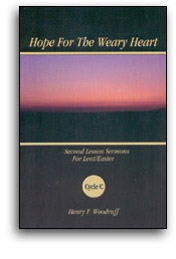
Hope For The Weary Heart
Second Lesson Sermons For Lent/Easter Cycle C
Now you can't even trust the police. When I was a child growing up in Texas, everyone knew how to spot the police cars: they were big old Ford Crown Victorias, painted black with white doors, sporting black wall tires with little moon hubcaps -- or, if they really wanted to be sneaky and fool you, they were big old Ford Crown Victorias painted gray, with whip antennas and license plates that read "City" on them. You could bet the farm on it. Now all that has changed. Police cars are all different makes and models and colors. Even the State Highway Patrol can now be seen driving sport utility vehicles. Not to be outdone, the Youngstown Police Chief has announced a new weapon in the war on crime. A sleek, sporty, white Chevrolet Camero, outfitted for police use, now awaits the officer who over a period of two weeks can write the most tickets for people playing their car stereo or their boom-boxes too loudly. I feel safer already! All of this is just one more tidal wave in the sea of change that surrounds us.
Thank God, there are some things that are verities, like Big Macs that will clog your arteries, and New York models wearing weird clothes, and people demonstrating exercise machines who obviously don't need them, and most especially what happens in every major league ball park in this country between the top and bottom half of the seventh inning. You know what it is: the stadium organ begins to play those familiar notes, everyone stands up, and swaying to the music all join in singing that familiar chorus, "Take me out to the ball game ?" It doesn't matter what's happening on the field; it doesn't matter whether the home team is ten runs ahead or ten runs behind. When the seventh inning comes, it's time to sing! The music plays; the words come on the screen; the mighty chorus is sung.
Yes, but living isn't a baseball game, and it is no more certain than the color, make, and model of police cars. Living is a sea of change, and everyone of us is caught up in it. There was a time when you could count on working for the same company for thirty or forty years, knowing that if you invested in the company, they would invest in you. That time is gone forever, and now people have to be flexible, knowing that their job and all that goes with it -- self-esteem, security, the means of caring for your family -- all of it can vanish in a moment. There was a time when school was the safest place in the world; that, too, is gone forever. Living in a society where there are far more guns than people, no place is entirely safe, neither schools nor the local McDonald's. It is our daily walk: life ... is fragile; it can change in an instant. A phone call from extended family in the middle of the night, the tough words you dread to hear from the physician, the surreal drama unfolding in your marriage when your life partner says, "No more; I'm leaving. I don't love you anymore; I'm not even sure if I ever did" -- all this and more are the heart-ripping brutal reminders that little, if anything, is really certain other than uncertainty. Then, in the seventh inning of our lives, what song do we sing, what chorus do we hear? We know the answer to that: sometimes it's a quiet whimper, sometimes a loud wail. Its origin is the lived experience of our often ambiguous and more often senseless lives. From a confused mind or a broken heart it rises, given voice by our despair. We know the words; we know the haunting melody. Do we, on this day, know something else? Do we know a different song, another melody, this one proclaiming victory, this one sung to the tune of joy and hope?
God's Good News for our lives today is one, that there is such a song and melody; two, God is ready to teach it to us, to plant it in our heart; and three, there is a time to sing it, and it is not in the seventh inning of our lives, when it's almost over. So says the Seer in his fantastic vision of life and death and all that is between and beyond. Look with him with eyes of faith, and we, too, shall see and hear.
With highly symbolic language, John describes what truly transcends description. He sees a multitude, worshiping God, all joining in a song of victory. We know it's a song of victory, for they have shed their tattered rags and are clothed in new, white robes. They wave in their hands the palm branch of victory; and even the opening word of the chorus speaks of victory, for the word translated "salvation" can also be translated "victory." How can this be, given the fact that their puny lives have been crushed by the power of a demonic Emperor -- for this is the "great tribulation" John has in mind: the very real tribulation of a persecuted church at the close of the first century -- how can this be? It can be because they have discovered the truth about living! Victory and liberation belong to God, and it is in the power of God that we know victory! It is the truth Jesus flung in the face of his accusers as we read in the Gospel of John: "My Father," says Jesus, "is greater than all" (John 10:29), and all who are in Christ shall triumph over all that is destructive to living. All in Christ shall know and sing the song of victory! You see, there really is a song of victory; God has given it to us, Easter people, the Body of the Risen Christ. Sometimes neither the words nor the melody come easily; sometimes the words seem empty, the tune discordant. But this does not mean there isn't the song, nor does it mean we cannot sing it! First, of course, we have to learn it. Are you ready? Then let John teach us. Look at what gave the martyrs victory. It wasn't their death; that's too easy: we all die. No, it was their life that gained the victory, their life lived in faithful response to the victory God had already achieved. Allow me to unpack that for a moment.
God has already won the victory over all that is destructive to human living. The victory is not in doubt, but in the life, death, and resurrection of Jesus -- the "Lamb who was slain," to use John's terminology -- the victory is an accomplished fact. God has demonstrated who really is worthy of worship, and what power really is the strongest power. And it was not the Emperor, nor violence, nor brutality. Neither is it all that is around us competing and conflicting for our allegiance and worship. Rather, it is God and God alone who is worthy of worship, and it is self-giving love which is the triumphant power. You see, the "great tribulation" may have been a historical event, but the time of testing of God's people is timeless. Always and in every generation -- including and especially this one -- the people of God are in danger of being seduced by the Lie, by what is illusion and unworthy of our allegiance and worship. The name of the emperor just changes a bit: once it was Domition or Nero -- now it's your bank account, or stock portfolio, or the things you've accumulated, or unrestrained self-centeredness. Given the victory of God, what response, then, shall we make to it? If we, like those who have gone before us are to be conquerors -- and notice that this is another rendering of the word we translate "martyr"; the same word can be translated conqueror, or "victor," as well as "witness" -- if we are to be victors, then the choice is obvious. We become conquerors when we trust and worship God! We stake our very lives on the victory of God in the liberating love of Christ, and in living that love and fidelity, we, too, shall sing the song of victory! This is what John is teaching us; it is how we learn the song. Yes, and we shall sing it now!
"Really?" you say. Can we really sing it now? Let's be honest with each other. Right now, it's hard for some of us to sing the song of victory. Right now, our lives are stressed and stretched. Right now, we don't feel all that victorious, all that joyful. We feel burdened and saddened by failure and heartaches. We feel the silence of not knowing love, or companionship, or hope. We feel the sadness of separation from the God who often seems distant and silent. Songs are hard right now; so we really wonder, "Can I really sing the song of victory now?" Maybe later, in a different time and place -- but right now? Absolutely! We can absolutely sing it now! It doesn't matter if we're ten runs behind, we still can sing the song, for there is no better time than the present. Once again the Seer lets us see it. In his conversation with the Elder about who the chorus is, the Elder tells John, "These are those who are coming through the great tribulation" (Revelation 7:14), and they are still singing! You see, it's an ongoing, ever-present, ever-now reality! We are always in the midst of testing and stress; we are always coming through the great tribulation. It is an every day challenge. This is why not only is there no better time than the present to sing the song of victory; there is no time other than now to sing! We're not going to see a time and moment when we are not in tribulation -- at least not this side of living!
Get to your feet, then, Christians! The victory is won! Of this, we can be certain! It's time to sing! The music is playing; the words are on the screen; the chorus waits only for your voice and my voice to join in.
Thank God, there are some things that are verities, like Big Macs that will clog your arteries, and New York models wearing weird clothes, and people demonstrating exercise machines who obviously don't need them, and most especially what happens in every major league ball park in this country between the top and bottom half of the seventh inning. You know what it is: the stadium organ begins to play those familiar notes, everyone stands up, and swaying to the music all join in singing that familiar chorus, "Take me out to the ball game ?" It doesn't matter what's happening on the field; it doesn't matter whether the home team is ten runs ahead or ten runs behind. When the seventh inning comes, it's time to sing! The music plays; the words come on the screen; the mighty chorus is sung.
Yes, but living isn't a baseball game, and it is no more certain than the color, make, and model of police cars. Living is a sea of change, and everyone of us is caught up in it. There was a time when you could count on working for the same company for thirty or forty years, knowing that if you invested in the company, they would invest in you. That time is gone forever, and now people have to be flexible, knowing that their job and all that goes with it -- self-esteem, security, the means of caring for your family -- all of it can vanish in a moment. There was a time when school was the safest place in the world; that, too, is gone forever. Living in a society where there are far more guns than people, no place is entirely safe, neither schools nor the local McDonald's. It is our daily walk: life ... is fragile; it can change in an instant. A phone call from extended family in the middle of the night, the tough words you dread to hear from the physician, the surreal drama unfolding in your marriage when your life partner says, "No more; I'm leaving. I don't love you anymore; I'm not even sure if I ever did" -- all this and more are the heart-ripping brutal reminders that little, if anything, is really certain other than uncertainty. Then, in the seventh inning of our lives, what song do we sing, what chorus do we hear? We know the answer to that: sometimes it's a quiet whimper, sometimes a loud wail. Its origin is the lived experience of our often ambiguous and more often senseless lives. From a confused mind or a broken heart it rises, given voice by our despair. We know the words; we know the haunting melody. Do we, on this day, know something else? Do we know a different song, another melody, this one proclaiming victory, this one sung to the tune of joy and hope?
God's Good News for our lives today is one, that there is such a song and melody; two, God is ready to teach it to us, to plant it in our heart; and three, there is a time to sing it, and it is not in the seventh inning of our lives, when it's almost over. So says the Seer in his fantastic vision of life and death and all that is between and beyond. Look with him with eyes of faith, and we, too, shall see and hear.
With highly symbolic language, John describes what truly transcends description. He sees a multitude, worshiping God, all joining in a song of victory. We know it's a song of victory, for they have shed their tattered rags and are clothed in new, white robes. They wave in their hands the palm branch of victory; and even the opening word of the chorus speaks of victory, for the word translated "salvation" can also be translated "victory." How can this be, given the fact that their puny lives have been crushed by the power of a demonic Emperor -- for this is the "great tribulation" John has in mind: the very real tribulation of a persecuted church at the close of the first century -- how can this be? It can be because they have discovered the truth about living! Victory and liberation belong to God, and it is in the power of God that we know victory! It is the truth Jesus flung in the face of his accusers as we read in the Gospel of John: "My Father," says Jesus, "is greater than all" (John 10:29), and all who are in Christ shall triumph over all that is destructive to living. All in Christ shall know and sing the song of victory! You see, there really is a song of victory; God has given it to us, Easter people, the Body of the Risen Christ. Sometimes neither the words nor the melody come easily; sometimes the words seem empty, the tune discordant. But this does not mean there isn't the song, nor does it mean we cannot sing it! First, of course, we have to learn it. Are you ready? Then let John teach us. Look at what gave the martyrs victory. It wasn't their death; that's too easy: we all die. No, it was their life that gained the victory, their life lived in faithful response to the victory God had already achieved. Allow me to unpack that for a moment.
God has already won the victory over all that is destructive to human living. The victory is not in doubt, but in the life, death, and resurrection of Jesus -- the "Lamb who was slain," to use John's terminology -- the victory is an accomplished fact. God has demonstrated who really is worthy of worship, and what power really is the strongest power. And it was not the Emperor, nor violence, nor brutality. Neither is it all that is around us competing and conflicting for our allegiance and worship. Rather, it is God and God alone who is worthy of worship, and it is self-giving love which is the triumphant power. You see, the "great tribulation" may have been a historical event, but the time of testing of God's people is timeless. Always and in every generation -- including and especially this one -- the people of God are in danger of being seduced by the Lie, by what is illusion and unworthy of our allegiance and worship. The name of the emperor just changes a bit: once it was Domition or Nero -- now it's your bank account, or stock portfolio, or the things you've accumulated, or unrestrained self-centeredness. Given the victory of God, what response, then, shall we make to it? If we, like those who have gone before us are to be conquerors -- and notice that this is another rendering of the word we translate "martyr"; the same word can be translated conqueror, or "victor," as well as "witness" -- if we are to be victors, then the choice is obvious. We become conquerors when we trust and worship God! We stake our very lives on the victory of God in the liberating love of Christ, and in living that love and fidelity, we, too, shall sing the song of victory! This is what John is teaching us; it is how we learn the song. Yes, and we shall sing it now!
"Really?" you say. Can we really sing it now? Let's be honest with each other. Right now, it's hard for some of us to sing the song of victory. Right now, our lives are stressed and stretched. Right now, we don't feel all that victorious, all that joyful. We feel burdened and saddened by failure and heartaches. We feel the silence of not knowing love, or companionship, or hope. We feel the sadness of separation from the God who often seems distant and silent. Songs are hard right now; so we really wonder, "Can I really sing the song of victory now?" Maybe later, in a different time and place -- but right now? Absolutely! We can absolutely sing it now! It doesn't matter if we're ten runs behind, we still can sing the song, for there is no better time than the present. Once again the Seer lets us see it. In his conversation with the Elder about who the chorus is, the Elder tells John, "These are those who are coming through the great tribulation" (Revelation 7:14), and they are still singing! You see, it's an ongoing, ever-present, ever-now reality! We are always in the midst of testing and stress; we are always coming through the great tribulation. It is an every day challenge. This is why not only is there no better time than the present to sing the song of victory; there is no time other than now to sing! We're not going to see a time and moment when we are not in tribulation -- at least not this side of living!
Get to your feet, then, Christians! The victory is won! Of this, we can be certain! It's time to sing! The music is playing; the words are on the screen; the chorus waits only for your voice and my voice to join in.
